Greystone Mansion and Gardens…

My quick overnight jaunt to Los Angeles allowed me time to visit one more venue on my list of lesser known garden sites: Greystone Mansion and Gardens, also called the Doheny Estate, in Beverly Hills. A heads up if this post inspires you to spend an afternoon at this lovely historic home and gardens which are now a city park, complete wth its own on site ranger: when your GPS tells you to turn off Sunset Blvd. onto Doheny Road–make sure you turn on Doheny ROAD not on Doheny DRIVE. I saw many other beautiful estates and gardens during the 30 minutes I spent going in circles on Doheny Drive but not one homeowner invited me in to take photos. Apparently this is common enough that a very explicit caution about just that is printed on the brochure–which of course you do not have until you get there!
Greystone 24

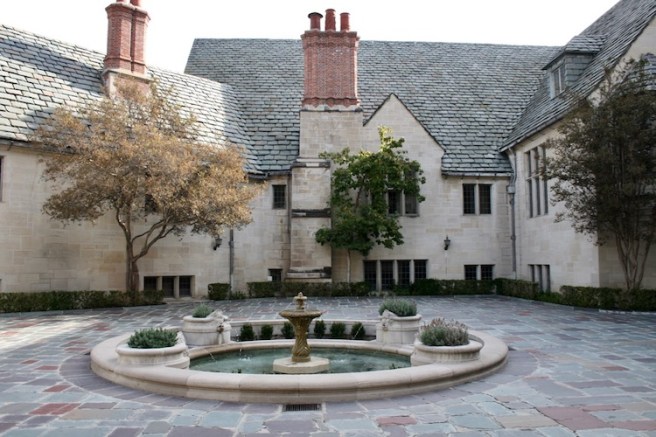
View of the Inner Courtyard

The gardens’ brochure offers a brief Doheny Family history to help you put Greystone in its proper context. In 1892, Edward Doheny Sr. and his business partner discovered the first productive oil well in Los Angeles. With the opening of additional deposits in California and Mexico they became one of the largest producers of oil in the world. In the 1910s Mr. Doheny Sr. purchased a number of land parcels in what is now Beverly Hills, creating the 429 acre Doheny Ranch. The 12 and a half acre parcel which became the site of Greystone was on the western edge of the ranch. In 1926 the senior Mr. Doheny gave the land to his son, Edward “Ned” Doheny Jr. and his wife Lucy.

Southern California architect Gordon B. Kaufmann designed the 46,054 square foot 55 room home in the English Tudor style. It took 18 months to build the mansion, outbuildings and install the landscape at a completion cost in 1928 of $3,166,578. The house is built of steel reinforced concrete faced with Indiana limestone and has a Welsh slate roof. The grounds included a tennis court, kennels, garages and stables, a fire station, swimming pool and greenhouse.

Ned Doheny was tragically shot and killed within a year of the family moving into their new home. Lucy Doheny, her five children, and eventually her second husband remained at Greystone until 1955 when she sold the mansion and 18 acres of land to Chicago industrialist Henry Crown. Mr. Crown never occupied the home instead starting a long tradition of using the property as a movie location–over 69 films have been made there to date. The City of Beverly Hills purchased the property in 1965 and the grounds were dedicated as a city park in 1971. The American Film Institute was based at Greystone from 1969-1972. Greystone was listed on the National Register of Historic Places in 1976.

The grounds of Greystone are open daily with plentiful free parking (I am pretty sure this is the only place in metro LA that has plentiful free parking) and the mansion is the site of many cultural events and activities.
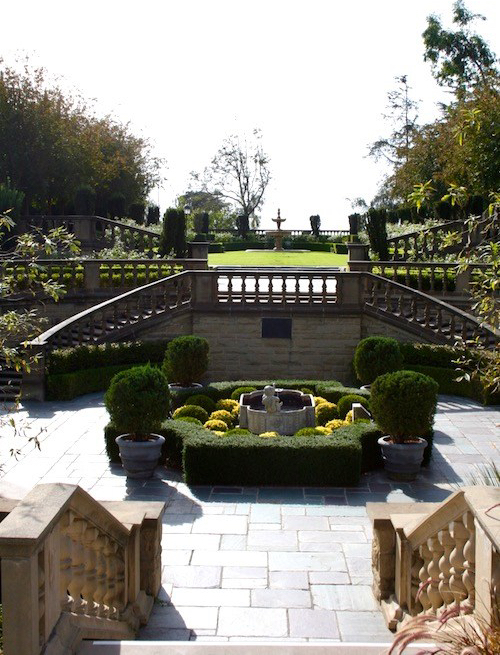
Greystone 1

Looking down into the Forecourt of the Formal Garden.

Landscape architect Paul Thiene and lead designer Emile Kuehl created a series of terraced gardens and lawns that reflected a mixture of styles, most notable are the Italian Renaissance inspired gardens above the house. Parking is at the highest point on the hill and so you wind downhill through these gardens to approach the mansion.
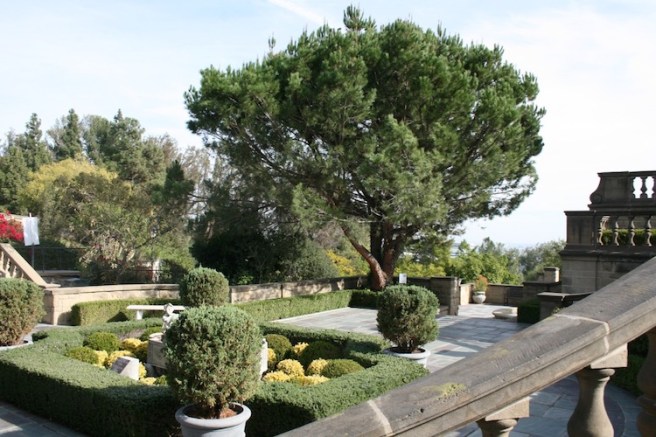
Greystone 2

You go down stone stairs into the Forecourt and then back up another set to the Formal Garden.
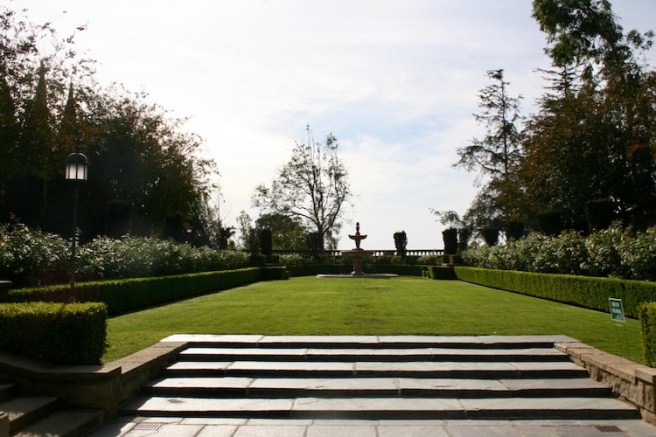
Greystone 3

On a clear day you can probably see the ocean from this classic garden. The plant materials are as you would suppose them to be in a garden of this style: clipped boxwood, ‘Iceberg’ roses, columnar yews and mature single trunked crape myrtles.
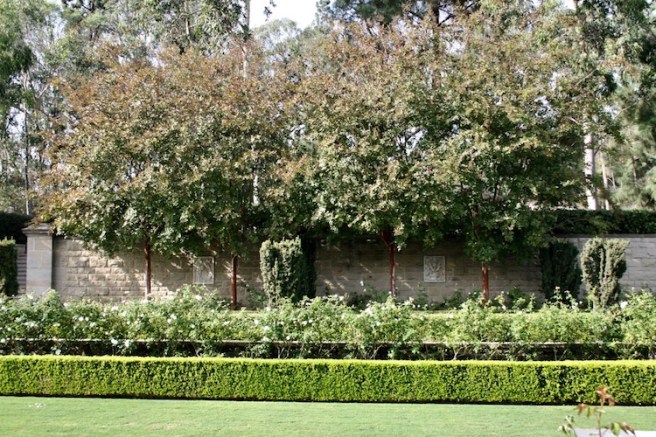
Greystone 4

Greystone 5

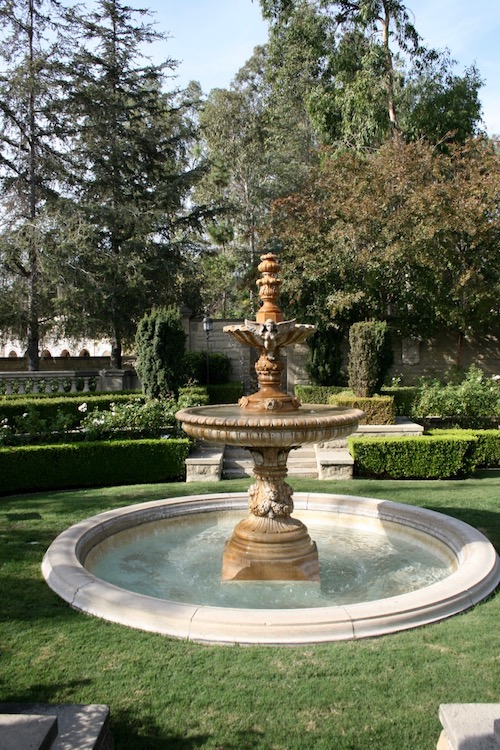
Classic fountain at the furthest sight line

Greystone 6

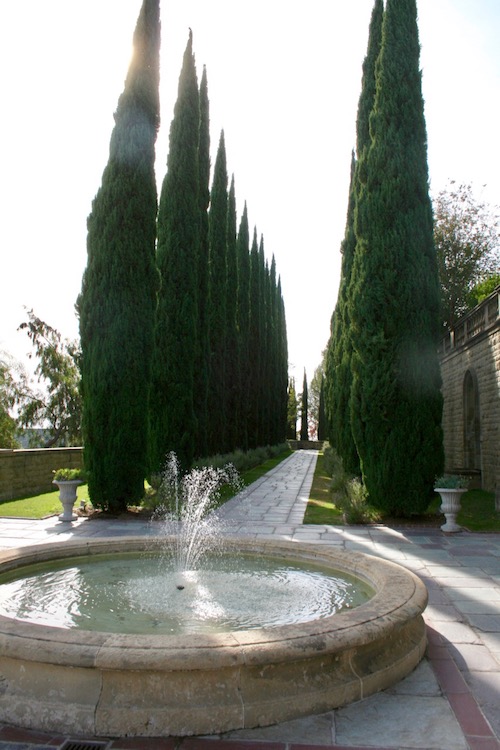
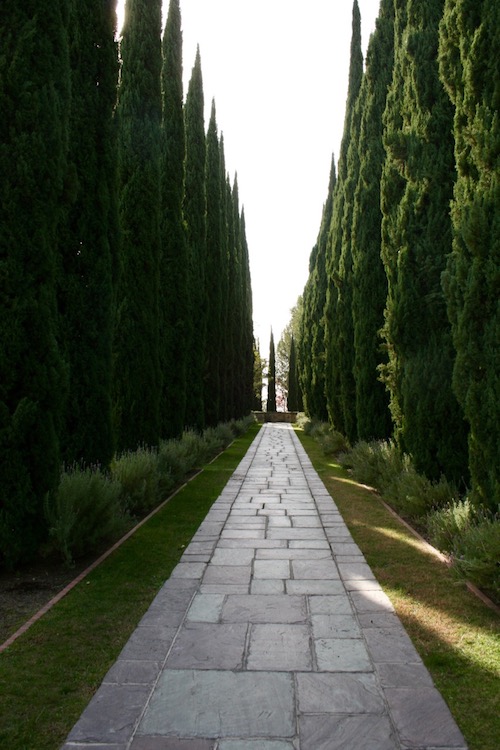
From the Forecourt another stairway leads me to another sparkling fountain and the Cypress Walk.
Greystone 7

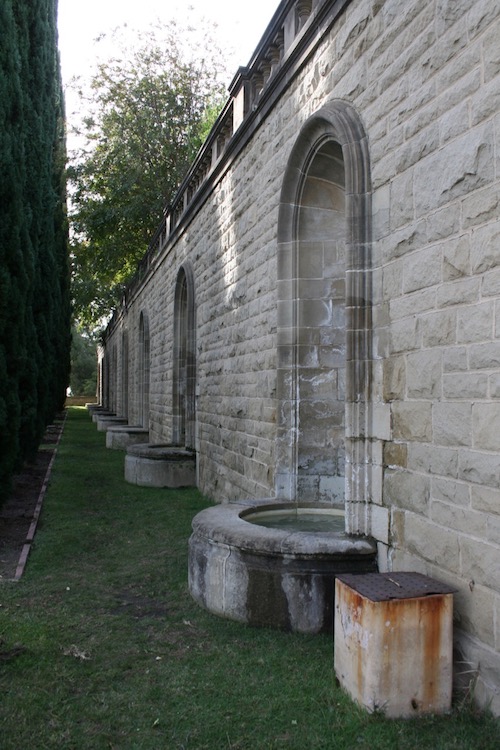
I love the simplicity of the soaring cypress allee complimented only by the stone walk, lawn and French lavender snuggled in their bases. The massive retaining wall which supports the Formal Garden above is not left without ornamentation–each of these framed alcoves houses a small bubbling pool.

Greystone 10

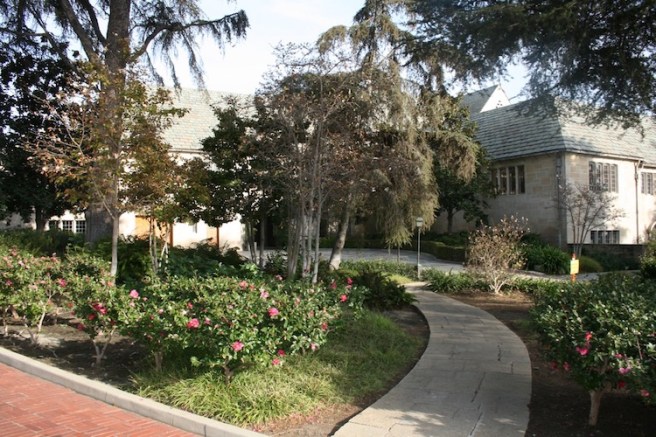
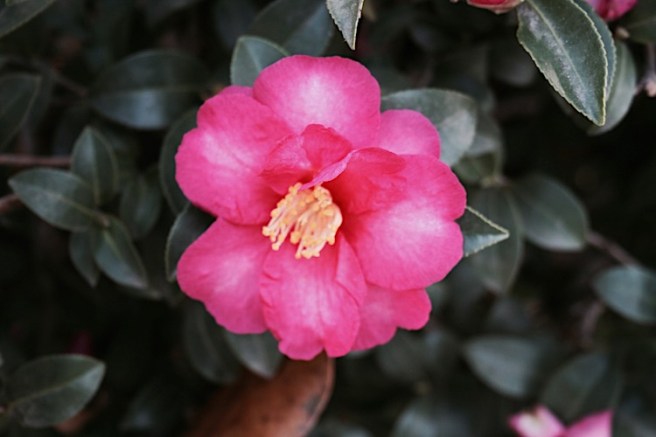
Two more sets of stone steps down and walk along the back of the Inner Courtyard Wall brings me to the West Courtyard . This curved swathe of Camillia sasanqua is at least 100 feet long and reinforces the philosophy of using great quantities of a restrained variety of plants so that the mass has reasonable proportion to the adjacent structure. These blooms are shaded by mature Southern magnolias.
Greystone 11

Greystone 12

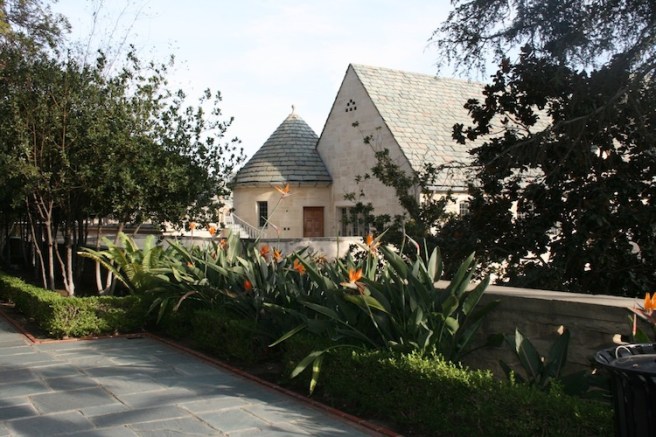
This stone area would have served as the car park for the mansion. Guests could be dropped off right at the archway which shelters the home’s main entry. It was not atypical for home built in this era to have the ‘front door’ in the back–thus preserving the views from the front of the home. The Inner Courtyard (first photo) lies on the other side of the entrance archway.

Greystone 14

This stone path leads me from the West Courtyard entrance to the Reflection Pond. More clipped boxwood and white roses in formally geometric beds.

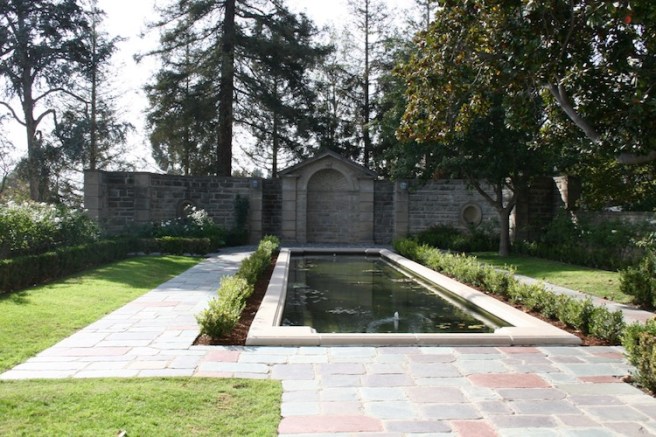
Greystone 18

Greystone 19

This koi filled pond is visible from Greystone’s Mansion Terrace which spans the entire width of the back of the home.
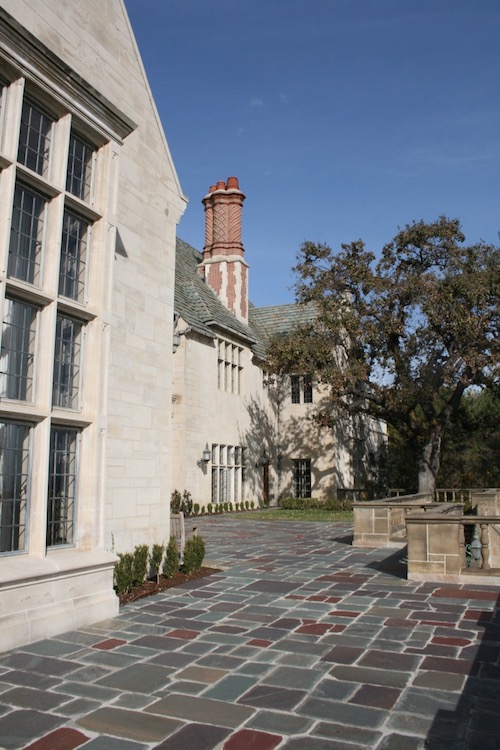
Greystone 20

The walkways and this terrace are paved with colorful stone (slate?) which is complimentary to the home’s facade and the slate roof.
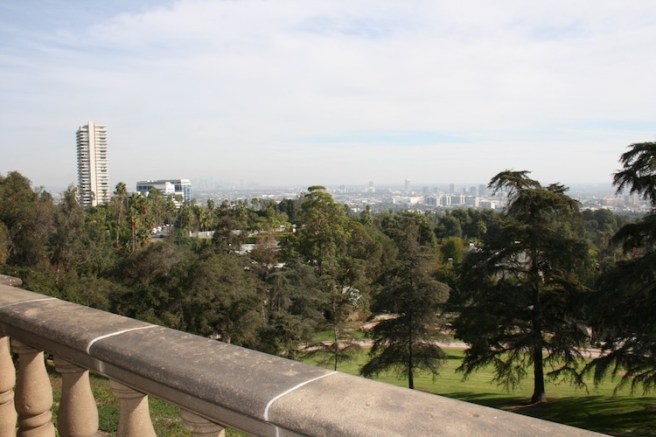
Greystone 21

It is hard to believe that this property is actually in the city until you catch the stunning view from the balustrade of the Mansion Terrace.
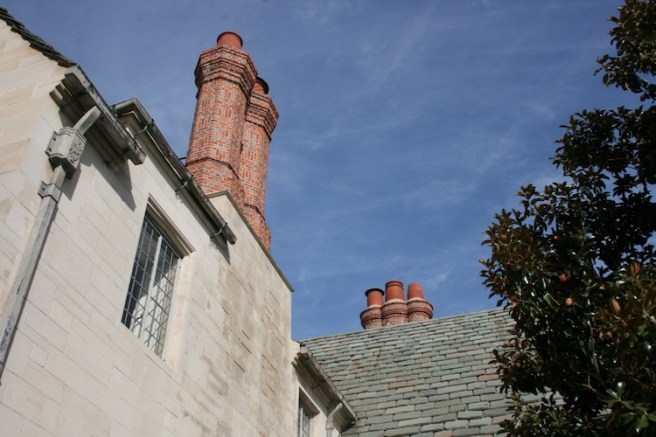
Greystone 22

Copper gutters, brick chimney pots, leaded glass windows and, of course, that great Welsh slate roof.
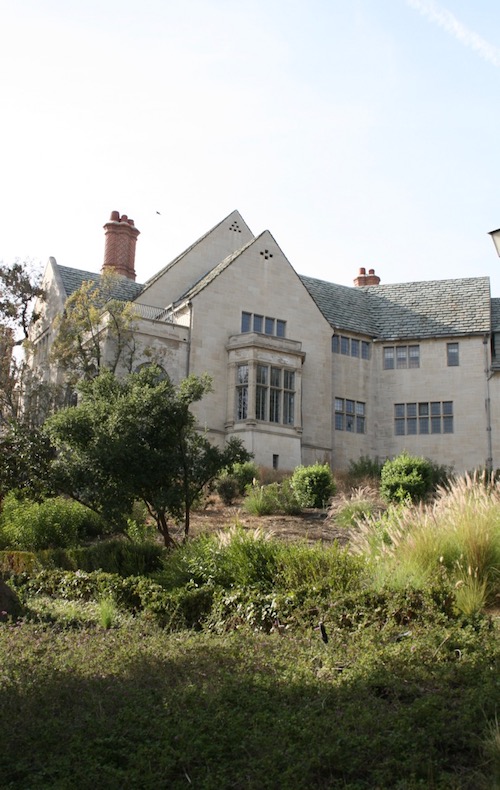
Greystone 27

A long curving path with multiple sets of steps on the east side of Greystone leads me downhill in front of the mansion in an effort to get the ‘curb appeal’ photo. This planted slope appears to have been updated with broad groups of grasses, shrubs and ground covers which have more drought tolerance than the uphill formal areas.
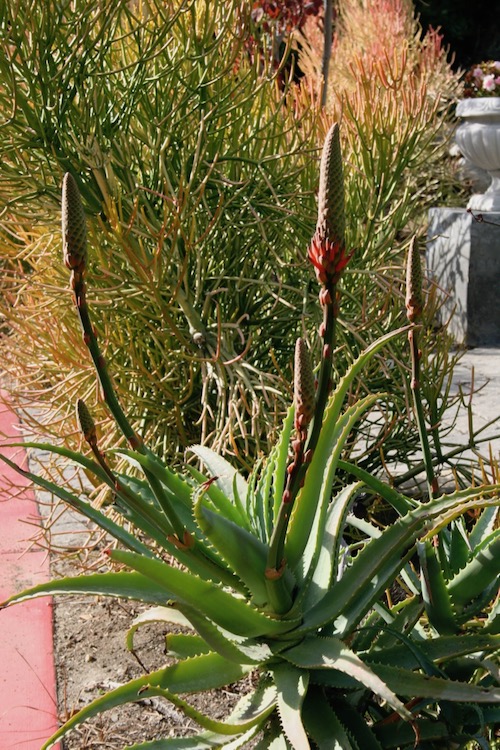
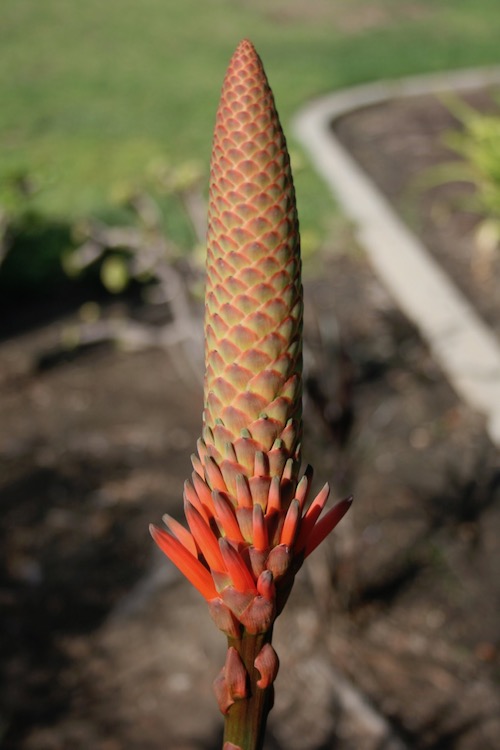
There are some small areas of succulents–this is one of very few plants I saw that probably would not have been part of the original plans–I am sure that just like everywhere else in water starved California attempts at xeric modifications are being made in areas that will not take away from the overall garden atmosphere.
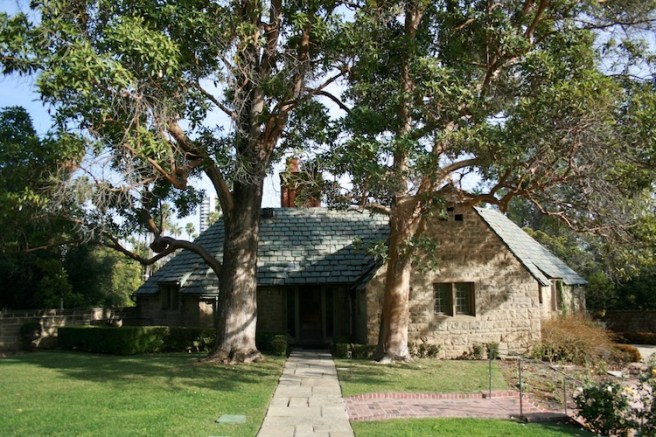
Greystone 28

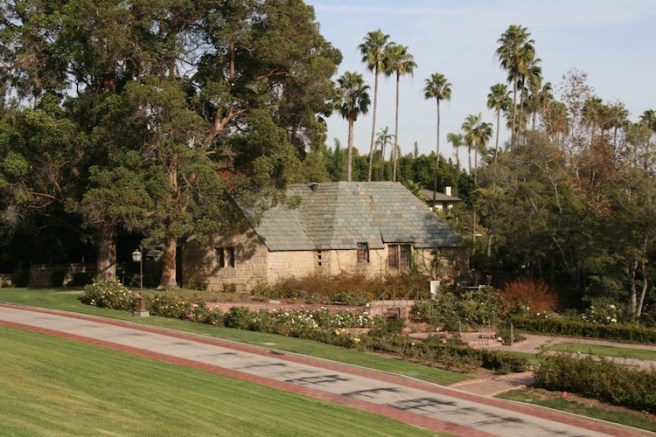
At the bottom of the hillside property the original Gatehouse now serves as Greystone’s main office.
Greystone 29

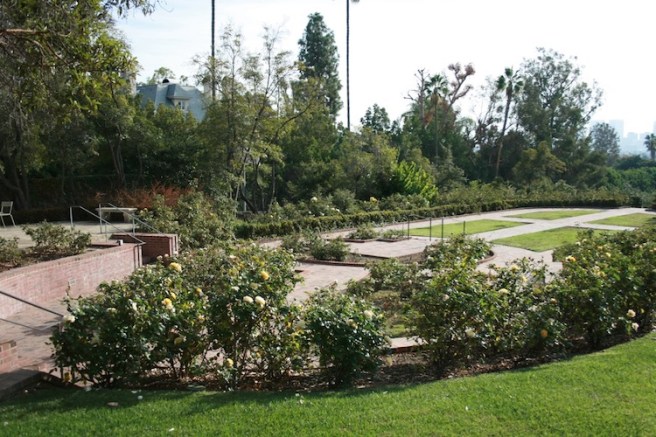
Tucked up against the Gatehouse is the small but formal Rose Garden.

Greystone 31

I am not sure what the cultivar name for this rose is but it is powerfully fragrant even late in the season.
Greystone 32

This modern day brick lined roadway leads to the original Stables, Garages and Greenhouse.
Greystone 30

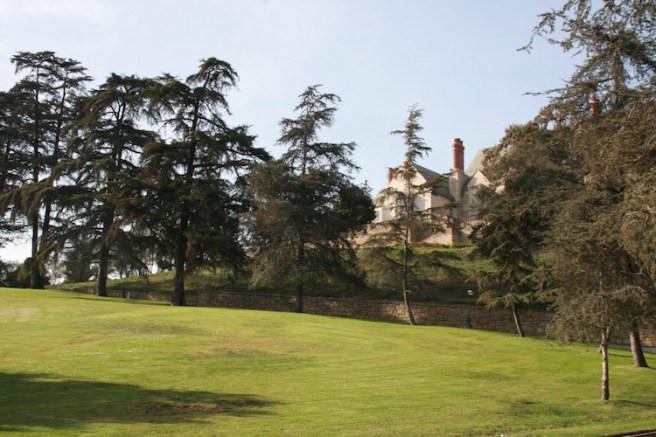
To give you a sense of the scale I am standing on that paved road looking across the lawns and planted slope uphill to the imposing home.
Greystone 33

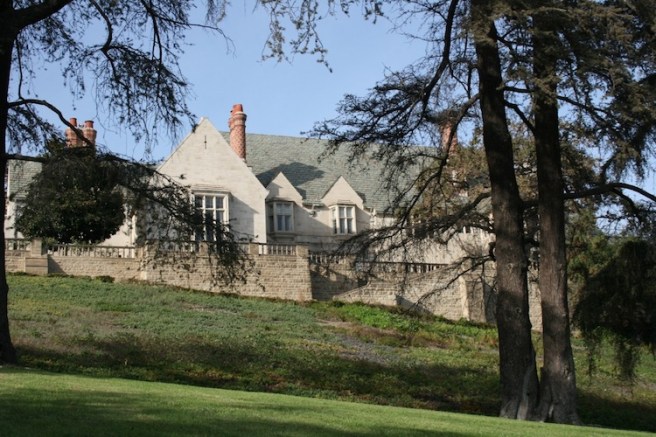
A number of paths through the broad lawn allow you to descend the hillside toward the west side of the house. This would be similar to the view seen by guests as the approach Greystone on the driveway that will take them to the West Courtyard. Can you imagine?
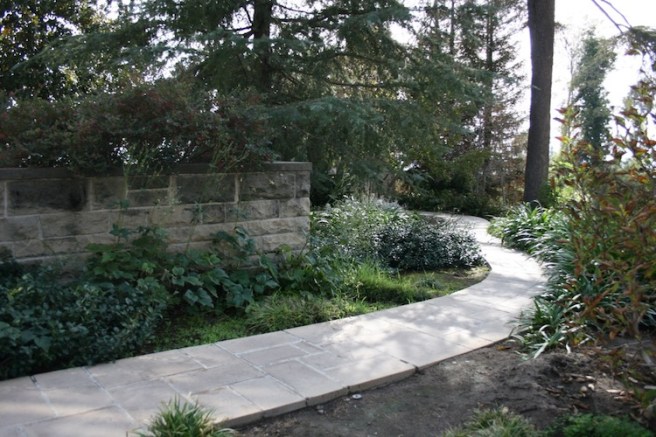
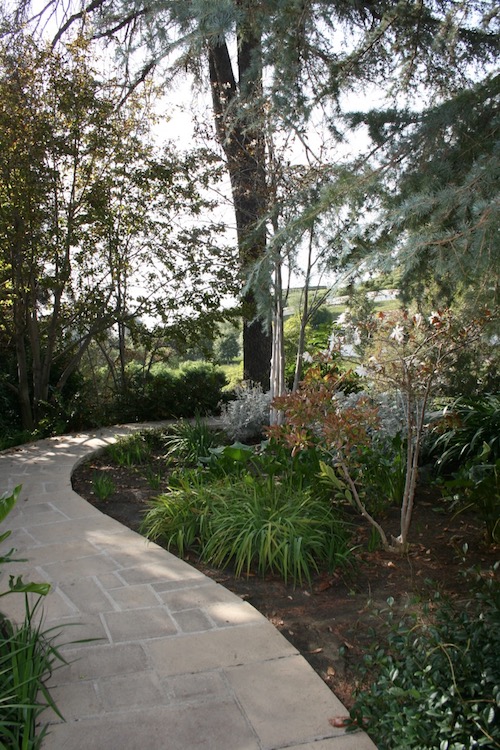
Greystone 13


Greystone 16

More modern day pathways lead visitors back to the home’s elevation. This pretty little Magnolia stellata was unexpectedly in bloom!

Greystone 17

Greystone 35

Sort of like the back stairs in a home, several sets of stone stairs on the west end will lead me back up to the far end of the Formal Garden. Interestingly, I saw none of these openings when I was IN the Formal Garden.

Greystone 36

View from the first landing looking back at the West Courtyard

Greystone 38

Gorgeous hardscape

Greystone 37

Uphill one more terrace level–there is a bridge at this level connecting the garden to the home via a second story walled courtyard.
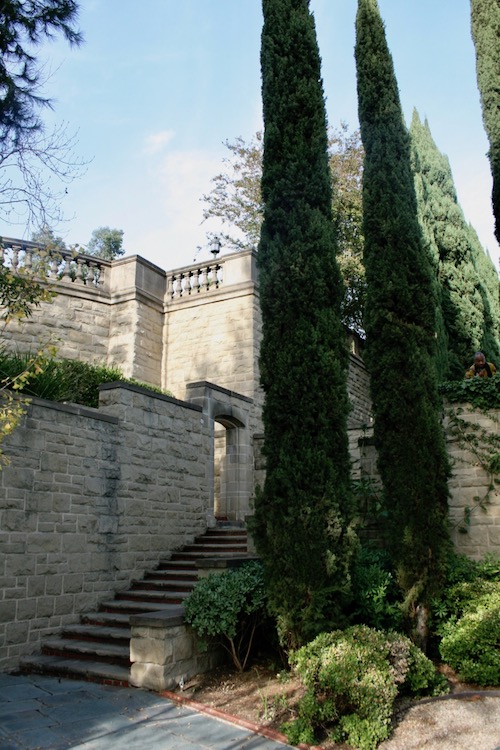
Greystone 39

Back stairway landing hidden at the west end of the Cypress Walk

Greystone 40

Arriving the back way to the elevation of the Formal Garden I find the site of the original Pool House and Pool. The bricked over pool is popular for wedding receptions and community events. Without my Greystone brochure map I would have missed this entirely. It is directly adjacent to the fountain end of the Formal Garden but totally obscured from view by the trees and high courtyard wall.

I have come full circle–from top to bottom to top again–and I am sure I have missed lots of landscape detail along the way. Greystone is a fairytale mansion surrounded by formal and informal gardens styled perfectly to complement its era and architecture–a fun afternoon for gardeners and historic home buffs alike.

Greystone 41

Yes–there really is a Beverly Hills Park Ranger–a polite young man with a spiffy uniform and a very nice ride!


Blue Ribbon Garden…

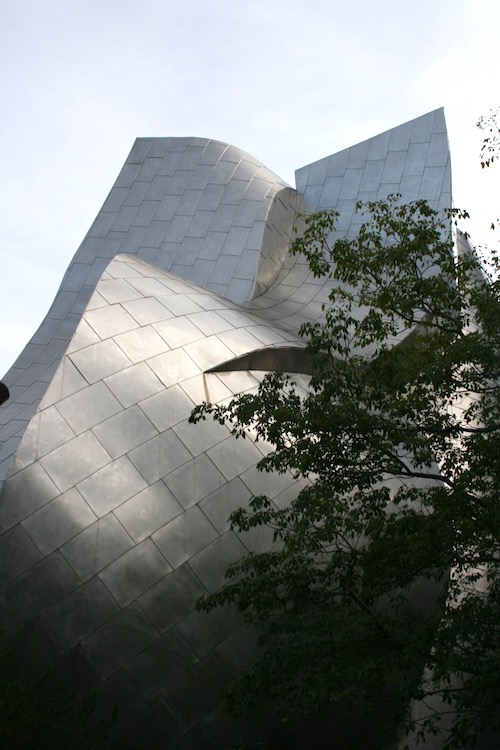
The Walt Disney Concert Hall in Los Angeles is a gleaming silver space age structure which opened in October 2003. Designed by celebrated architect Frank Gehry, it is home to the Los Angeles Philharmonic and the Los Angeles Master Chorale. The photo below is the facade as viewed from Grand Ave and 2nd Street. The building occupies the entire block and each side features a variety of flat and undulating metal panels. At $4.50 per 15 minutes of parking in the structure across the street you are just not getting views of all sides of the building!

Blue Ribbon 18

A short walk up a wide staircase easily visible from the corner of Grand and 2nd will take you to one of downtown Los Angeles’s secret garden gems–The Blue Ribbon Garden. This rooftop garden wraps the modern architecture of the Hall on three sides. In spite of its almost 1 acre size the garden is intimate in nature, an amazing design feat given that at the core of the garden the building’s facade rises several more stories and that there are also many opportunities from garden’s perimeter for expansive views of the surrounding city.

The Blue Ribbon Garden is a gift from individual members of The Blue Ribbon, an organization of women devoted to the support of the music center and its resident companies. The garden provides a gracious outdoor venue for receptions and other events; I imagine it would be beautiful at night when lit for a gathering of music lovers.

Blue Ribbon 2

This sculptural Erythrina coralloides, native to Mexico and commonly called naked coral tree, is one of several in the garden and greets you at the top of the stairs. This species is the first of many tropical trees and shrubs in the landscape. The naked coral bears showy red flowers in the spring and is deciduous, as you can see by its just turning leaves. This species is said to be the most cold hardy of the coral trees. Just beyond, a labyrinth awaits a busy Angeleno in need of a calm respite from the hustle and bustle of downtown. I fully intended to get a closer look at this but when I circled back at the end of my wanderings an actual line had formed with soon-to-be-newlyweds and their engagement photographers waiting for their turn in the labyrinth’s center!

Blue Ribbon 3

This garden’s plant palette is well-defined and restrained; the selected elements are repeated throughout. No willy-nilly plant collectors at work here. That restraint has produced a very calm but not at all boring viewing experience. As with many open urban gardens, this one seems to be a magnet for readers and lunchers in ones and twos–nothing rambunctious going on here.

Blue Ribbon 6

Also repeated throughout the landscape is the Bauhinia x blakeana, or Hong Kong orchid tree. I had to stand on my tip toes to catch a good look at its blooms.

Blue Ribbon 7

Another tropical, the Hong Kong orchid tree grows to about 20 feet tall and broad and is semi-deciduous and frost tender.

Blue Ribbon 1

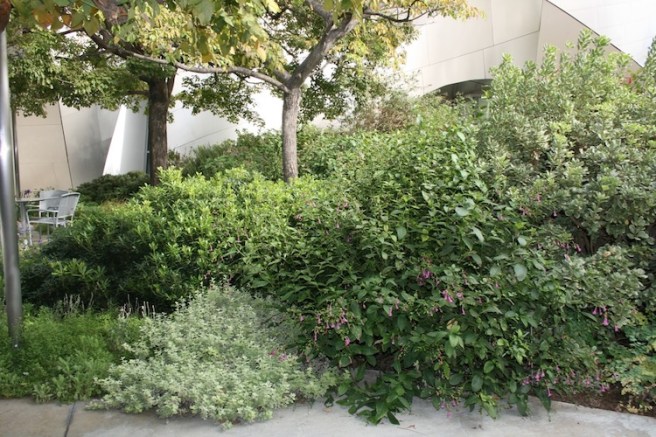
The juxtaposition of the leafy green trees, even those just starting to don their fall colors, with the sleek metallic building facade somehow seems to be both startling and expected and the same time.

Blue Ribbon 10

Lovely foliage color combination

Blue Ribbon 9

The bed plantings soften the winding edges of the wide paths. Pavers set into the paths pay tribute to those donors whose gifts built this city garden.

Blue Ribbon 4

Large mounds of Strobilanthus cusia, Chinese rain ball, offer late fall blooms. Also called Assam indigo, this herbaceous perennial is native to tropical climes and not frost hardy. There are over 350 species in this genus and one of the most commonly known to American gardeners is Strobilanthus dyeranus, Persian shield, grown for its green, silver and purple variegated foliage with pale violet flowers. The Chinese rain ball and all its cousins are surely hummingbird havens!

Blue Ribbon 14

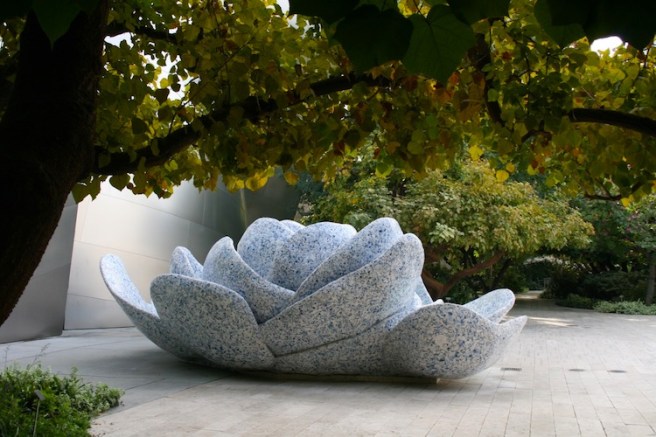
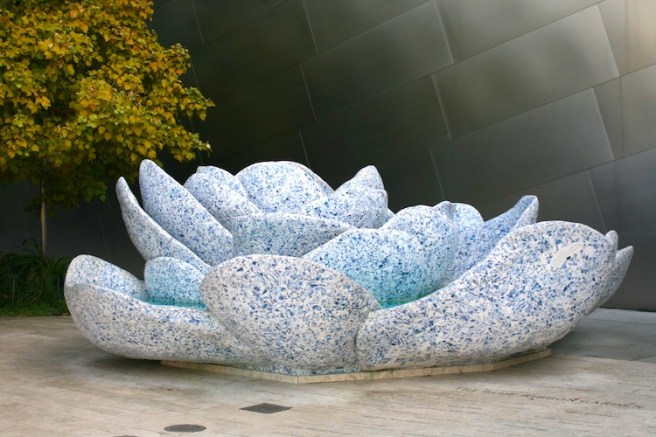
Definitely a focal point in the garden, the architect designed this fountain to pay tribute to the late Lillian Disney and her love of roses and Royal Delft porcelain vases.

Blue Ribbon 12

The large rose is covered in a mosaic of thousands of pieces of broken Delft porcelain and tiles.

Blue Ribbon 11

You can just make out some of the donor tribute pavers surrounding the rose. More silvery wall panels rising to the sky provide a backdrop for the fountain. I am not sure if the water action on this fountain is intentionally subtle or if it was just not working today.

Blue Ribbon 15

Wow–from total shade to total sun in just a few feet!

Blue Ribbon 16

Another interesting pair of semi-tropical trees–these are Dombeya wallichii, the pink ball tree from Madagascar. The velvety heart shaped leaves are dinner plate sized as seen below. In autumn and winter this smallish tree will be adorned with large clusters of fragrant pink flowers. The clusters will fade to pale pink, then brownish, and then dry on the tree. So sorry that these were not in bloom yet.

Blue Ribbon 17

Although much of the plant material grown here is not conducive to my garden’s slightly colder winters, the obvious takeaway for me is how effective using limited but bold and repeated plant selections throughout a space can be. The Blue Ribbon Garden earns a place on my list of off the beaten path small gardens to revisit at a different time of year, even if I have only an hour to spare. I would love to see the pink ball tree in bloom!


Garden goodie gazing in Cambria…

THE GARDEN SHED

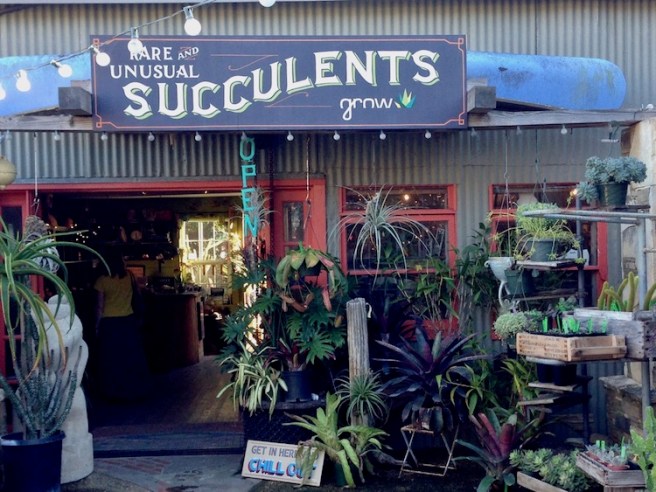
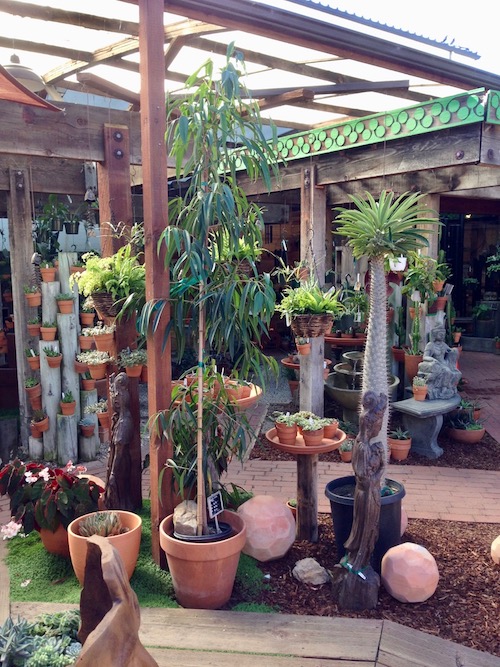
On every road trip to the Central Coast I visit this Cambria East Village gem without fail. The Shops at the Garden Shed offer a whimsical small boutique shopping experience which includes several small shops clustered around the back courtyard of the aforementioned Garden Shed which itself has a lovely selection of garden art, home accessories, pots and plants. Even though I have never really been a rusty metal, upcycled, vintage kind of girl this place just makes me smile. It is perfectly in step with the woodsy, redwood and glass meets Victorian cottage vibe of this seaside village.

G Shed 1

G Shed 2

When you walk through the inside retail space of The Garden Shed you emerge into this courtyard, a riot of colorful plants and pots, displayed in creative and unusual vintage vignettes.

G Shed 3

This charming rusted gate on the shady side of the courtyard is the shipping and delivery entrance–what a loss for gardeners that it remains propped open all day, literally disappearing into the fencing.

G Shed 4

G Shed 7

G Shed 5

There are lots of succulents and some seasonal color to be found. Many plants are sourced locally from wholesale growers.

The Junk Girls make all kinds of interesting and unique items from recycled materials and parts. This vintage truck/planter leaves no doubt as to their skill set and the rusty bicycles pedal across their roof, watched by another Scarecrow Festival entry. I am SO without  succulent knowledge and can’t identify this monster for you but it looked truly alive.

G Shed 11

g-shed-9.jpg

The back of the courtyard is occupied by Grow, a specialty nursery focusing on rare succulents. They also have an inside area with pots and lots of garden themed treasures.

G Shed 8

G Shed 6

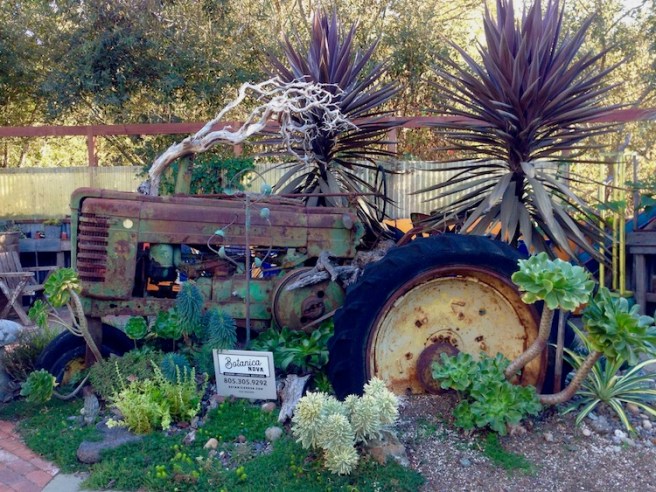
This old tractor, acting as both art and landscape,  is at the very back of the courtyard behind Grow.

G Shed 10

G shed 12

This architectural specimen may be run of the mill amongst gardeners who are knowledgeable about the wide variety of succulents but it was pretty spectacular to me!

CAMBRIA NURSERY & FLORIST

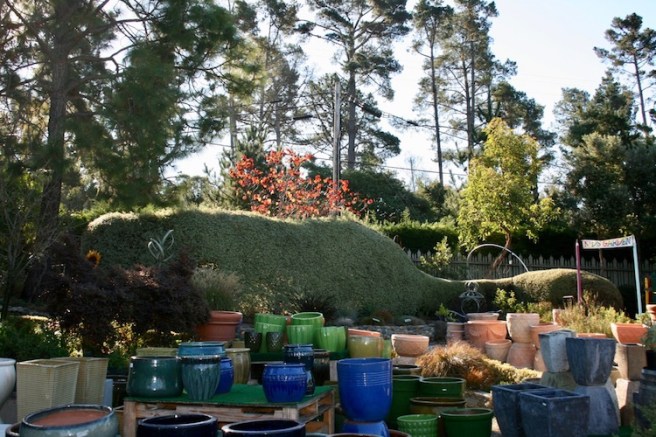
This was my first opportunity to check out this full service nursery and florist perched  high on a hill above the village. Although their emphasis is on coast friendly, drought tolerant plants with proven track records in local climate conditions there is a little bit of everything to be found on the 4 acres nursery grounds–vegetables, perennials, succulents, shrubs and trees. A number of quaint outbuildings feature seasonal home decor. Cambria Nursery also does an extensive Christmas light festival which was in the preliminary set up stages on my visit.

Cambria Nursery 1

Who wouldn’t be charmed by entering through this classic red barn?

Cambria Nursery 2

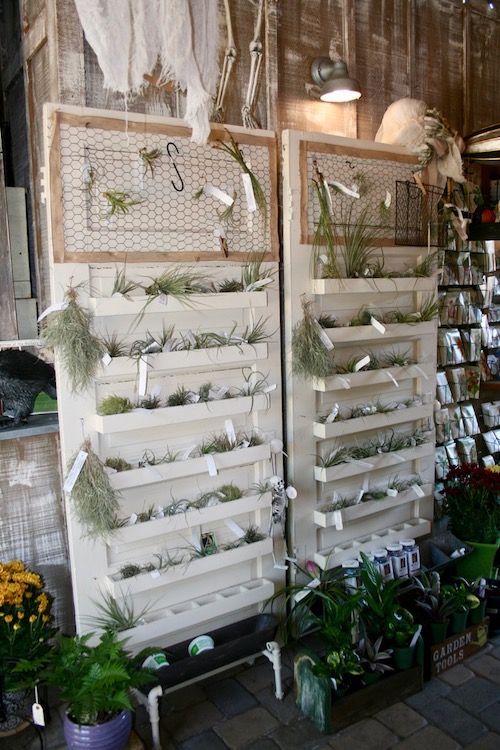
This fun display rack houses a bevy of Tillandsia, the so-called airplants. Most species in this genus are either epiphytes (growing without soil while attached to other plants) or aerophytes (having no roots and typically native to areas with shifting desert soil).

Cambria Nursery 3

Decorated for fall, the grounds are easily wandered on paver patios and decomposed granite paths–the latter being a little challenging on which to maneuver your wagon loaded with garden additions.

Cambria Nursery 9Great succulent displays are ubiquitous in the mild winter parts of California but few are as well organized and labeled as this one.
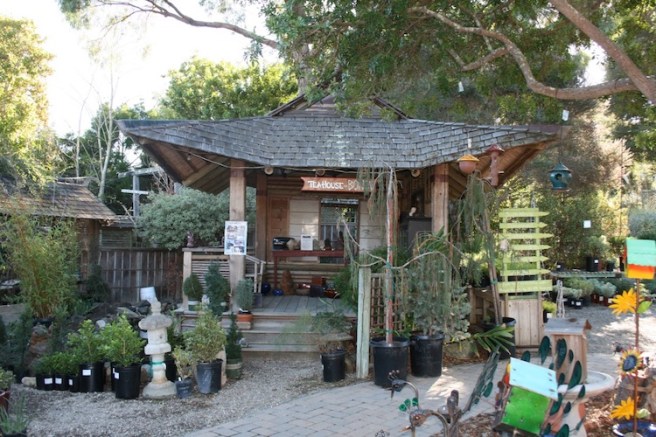
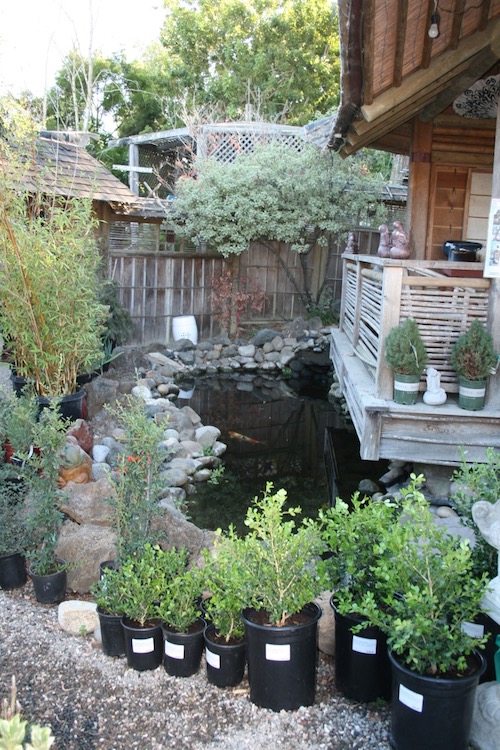
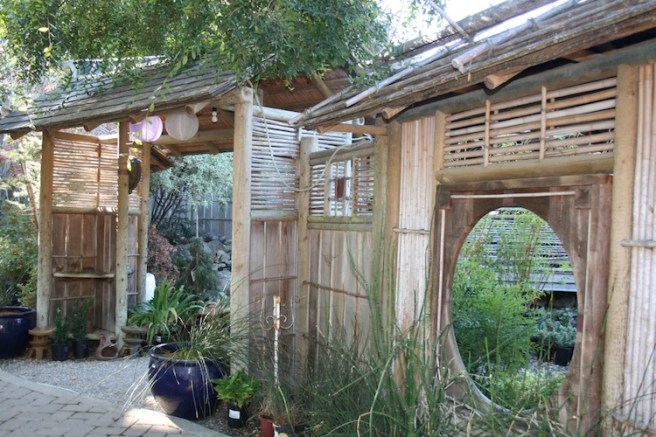
I especially liked the Japanese Tea House and its small koi pond. The Tea House provides a focal point around which are grouped all those plants we typically think of as having an Asian garden aesthetic.

Cambria Nursery 4

Cambria Nursery 5

Cambria Nursery 8

Colorful signage helps shoppers negotiate the meandering paths to the many demonstration beds and the nursery stock represented in them.

Cambria Nursery 7

A wonderful and seemingly life-sized whale topiary is settled into the hillside next to the Kids Garden. The topiary material is Pittosporum tenuifolium ‘Marjorie Channon’.

Cambria Nursery 6

The condition of the plants available varied widely. The six paks and 4″ pots were fresh as was some of the wide selection of woody shrubs. Many of the woodies looked a little long in their cans but frankly did not look much different than drought tolerants and natives in late fall even if they are in the ground. The staff was very attentive and knowledgeable. I did snap up a great looking Sollya heterophylla (Australian bluebell creeper) that is bound for my in progress side yard renovation. I am putting this nursery destination back on my list to visit in early spring–I’ll do some research on selections whose names I jotted down and be ready to fill up my wagon.


The Garden Gallery in Morro Bay…

California’s Central Coast towns are home to a nice mix of kitchy tourist shops and upscale local art and craft galleries. Mixed in you will find a wonderful variety of dining experiences along with all the charm of any town from whose streets water is visible. Morro Bay is no exception–and it is home to a lovely garden shop that has as much appeal for those who do not dig in the dirt as those of us who do.

The Garden Gallery is located on the Embarcadero just across the street from the water in Morro Bay. Even though the wood and glass indoor/outdoor shopping experience is by no means a full service garden center it is a must see destination for me every time I am anywhere close to this stretch of Highway 1. The highly creative staff combines plant materials in interesting ways and containers and I admire the care that is put into the ever changing displays.

Gallery 1

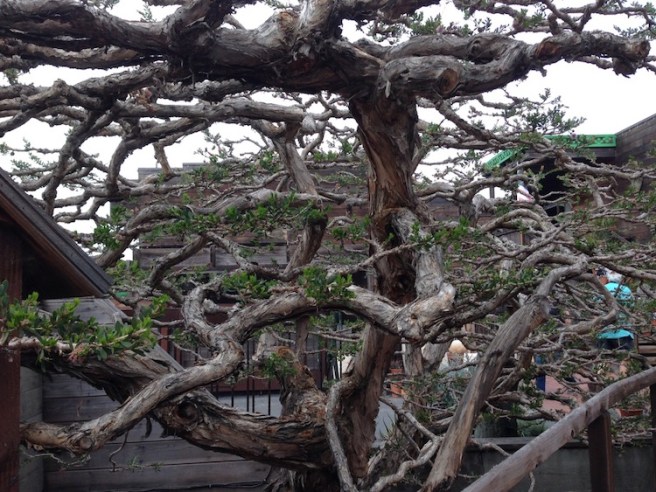
The magic starts immediately at the unique front gate. This stunning living screen is a 44 year old Melaleuca nesophila, commonly called pink melaleuca. This coast friendly tree or large shrub is impervious to beach winds and salt spray and is drought tolerant to boot.  This one is an ongoing bonsai project and, having just been clipped in the last few days, has very little visible green–making the gnarled trunk structure even more prominent.

Gallery 20

It is a very overcast morning and the grays of the buildings’ wood cladding, the sky and the tree all seem to meld together.

Gallery 18

Take a closer look at the patinated detail on the gate…I want this gate hanging man so badly!

Gallery 19

The shop is compact but spread over several buildings and several levels around an open courtyard–lots of steps to take care with–and has a bench or two on the wooden landings for shoppers to take a breather or just plop down and take it all in. More than once I have found the bench next to the sculpture below occupied by someone reading the daily paper or a book. The fog has burned off enough to catch a peek of blue sky!

Gallery 15

This piece of art is called Leap Frog and can be yours for $8,500. I’ll take two.

The majority of plants are succulents and bromeliads. At every turn another vignette offers ideas for potting and displaying these very coast friendly specimens. The tree like green shrubs are mature Hollywood junipers.

Gallery 7

Gallery 3

Gallery 6

The Gallery offers many ideas making use of wall space to move the green up from the ground with wall mounted pots, boxes and metal baskets.

Gallery 4

Gallery 2

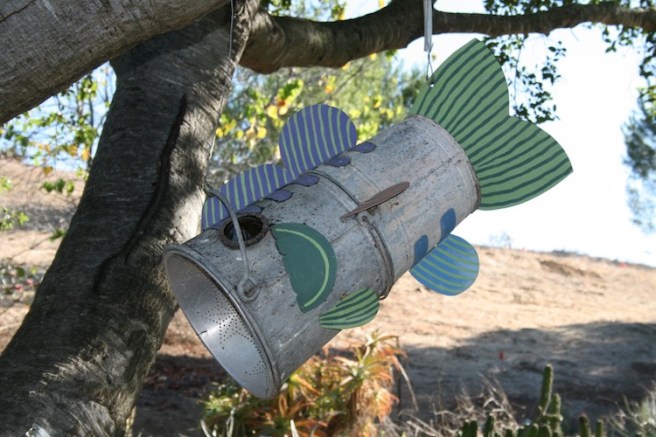
Check out these great hanging metal fish–available in several sizes and finishes.

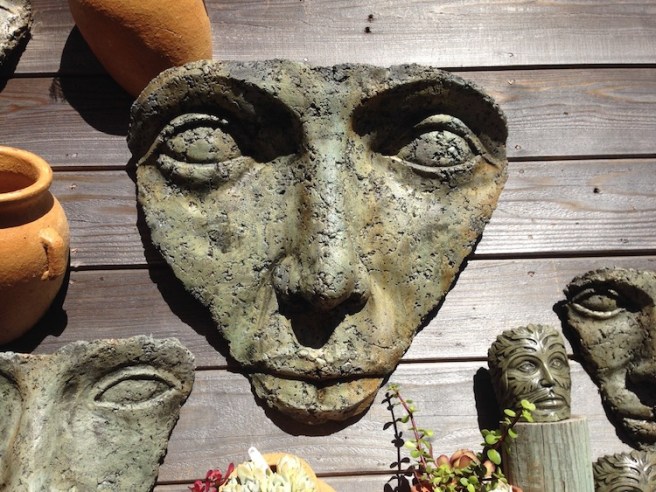
These great Mother Nature faces also caught my eye.

Gallery 8

It was all I could do not to come home with this spectacular birdhouse!

Gallery 25

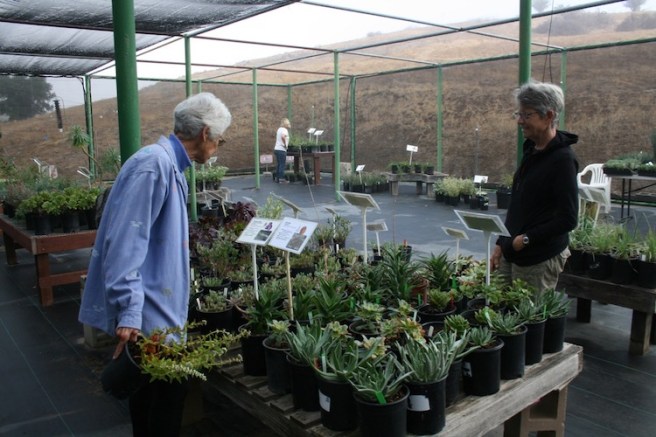
The weather protected surrounding small sales areas have a eclectic mix of high quality decorative home items. The overall vibe of the goods the Garden Gallery features is that of elevated natural materials–definitely a Sunset magazine aesthetic. The seasonal tablescapes and displays are always beautifully done.
Gallery 16

One of several shapes of turned wooden vases and lamp bases

Gallery 17

Shallow woven baskets as wall art

gallery-13.jpg

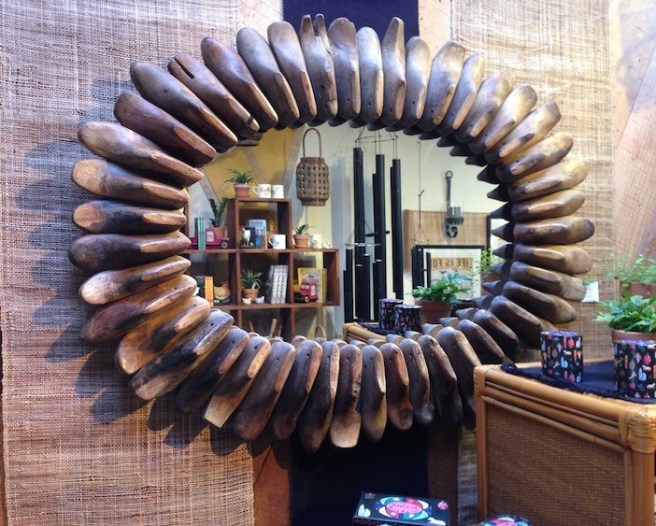
Great large mirror framed with wooden shoe molds

Gallery 26

Fall and Thanksgiving accents

Gallery 27

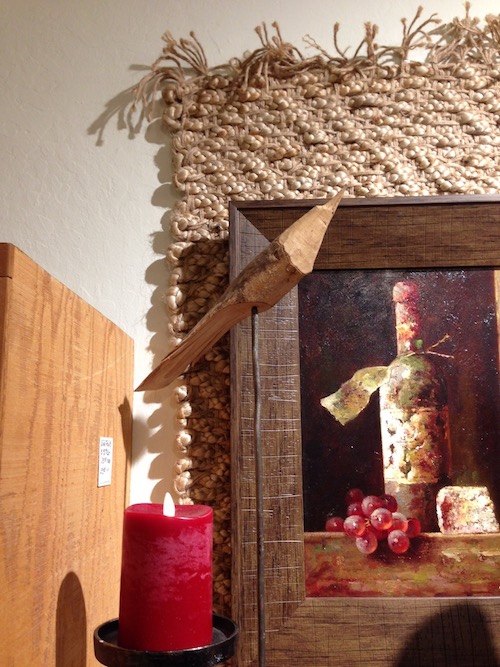
My quilting friendship group has decided we are good enough with our hands to carve these primitive birds. We are going home to find our husbands’ old boy scout knives and you may see us in your yards picking up nice fat sticks!

The Garden Gallery is an inspirational place to browse whether you are looking for a special plant, a unique display idea or nature inspired art. Don’t miss it! Still to come–The Garden Shed and Cambria Nursery & Florist in Cambria.


SLO down for this Central Coast botanical garden…

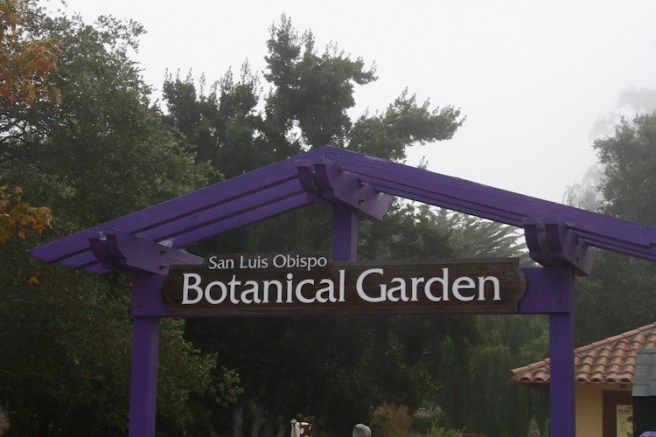
The coastal morning fog (which followed those several screaming hot days) had not yet lifted when I arrived at the San Luis Obispo Botanical Garden just as it opened. San Luis Obispo, lovingly nicknamed SLO, is home to Cal Poly. Although now consolidated with other disciplines of study, the former horticulture department has been responsible for many professionals in the ornamental horticulture and plant science world. Although it makes perfect sense that SLO would have a botanical garden I had heard nary a mention of it from any of my plant road tripping, nursery shopping, garden touring compatriots.

SLOBG 1

San Luis Obispo Botanical Garden is located on Highway 1 tucked into El Chorro Regional Park. It was established in 1989 and focuses on plants adapted to the dry summers of California and the world’s other four Mediterranean climate regions.

SLOBG 12

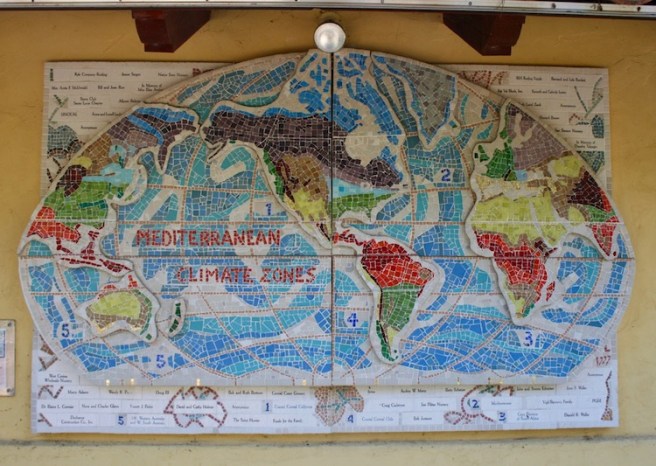
Gold tiles on this beautiful mosaic map near the entrance show the Mediterranean climates which were first studied scientifically around the Mediterranean Sea. These climate regions feature hot summers with no rain which stresses plants. Winters are mild with rain which supports growth and blooming. Adapted plants are able to minimize water loss and store water to survive through the summer. This type of plant material does not make a classically beautiful garden filled year round with showy color but does provide a great resource for gardeners faced with long dry summers and mild wet winters as a place to see successful plants in situ and at mature size. Sort of a bloom where you are planted philosophy–we all can’t have English cottage gardens or Pacific Northwest woodlands.

SLOBG 2

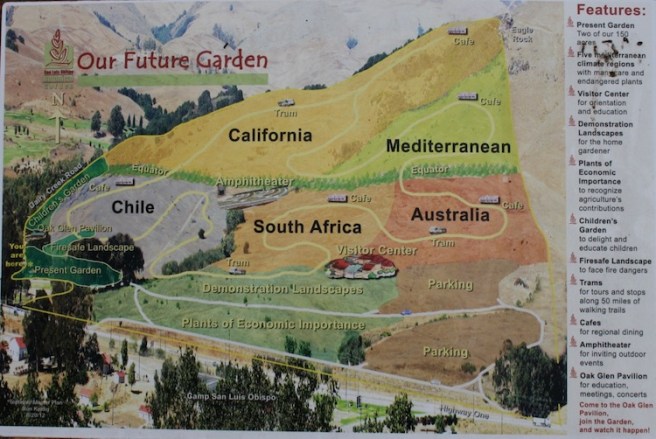
The present garden (far left middle in green) represents only 2 of the 150 acres laid out in the garden’s 1998 master plan. Development of these remaining acres awaits further funding. Check out http://www.slobg.org  for ways you can donate to help this ambitious project!

SLOBG 3

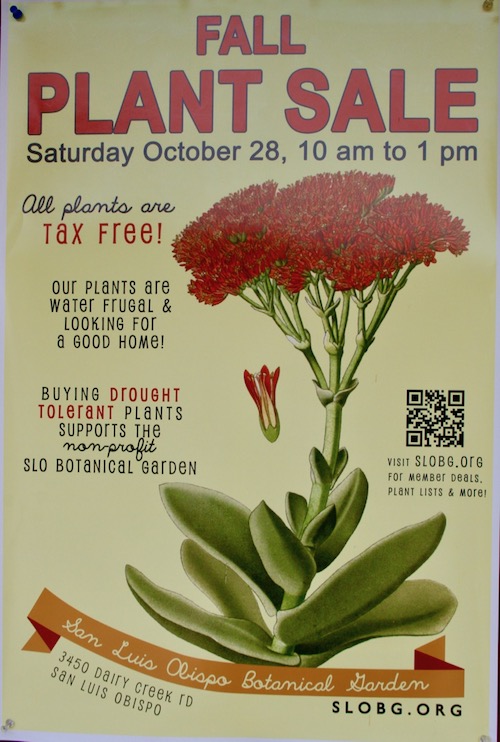
Lucky for me, my visit coincides with the annual Fall Plant Sale. Knowing that the early shopper gets the best selection I am headed there first, hoping to find a few new-to-me goodies to incorporate in my long side yard renovation. As it is a pretty much stand alone area with little view of the front yard proper I think it can take a few ‘one ofs’ without distracting from the visual rhythm of the existing landscape. Up the hill I go!

SLOBG 4

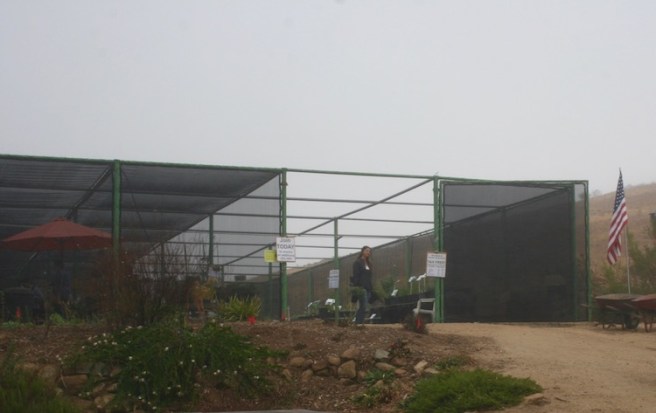
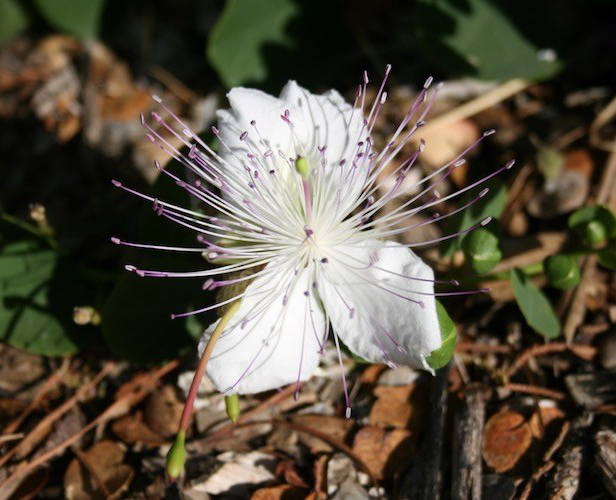
The screened houses are almost ethereal in the low hanging fog. Note the  barely visible shrub with the white blooms cascading down the slope–this is Capparis spinosa, the evergreen shrub whose flower buds are pickled and bottled as capers. I encountered the plant elsewhere in the garden and decided it was a little large and rangy for my needs but I did snap a photo of its gorgeous flower.

SLOBG 6

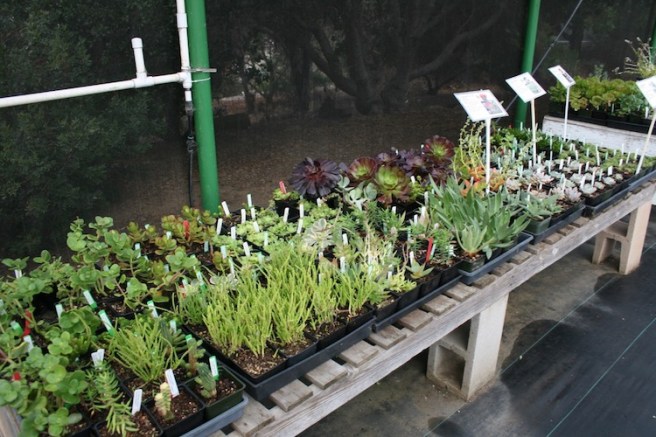
Unlike my valley, the Central Coast is able to many plant succulents directly into the ground without fear of frost–there were many varieties and container sizes available.

SLOBG 7

Happy shoppers!

SLOBG 5

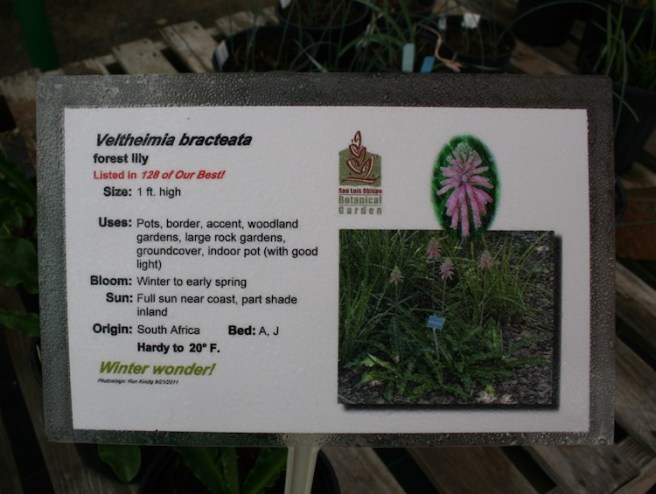
I was really impressed with the sale’s organization and excellent labels. The forest lily was one of my purchases and I doubt I would have looked twice (only foliage, no flower) had the photo of the plant in bloom not caught my eye. I am going to put this one in a pot for its first year and give it some winter protection while I settle on a spot in the ground with enough summer shade.

SLOBG 13

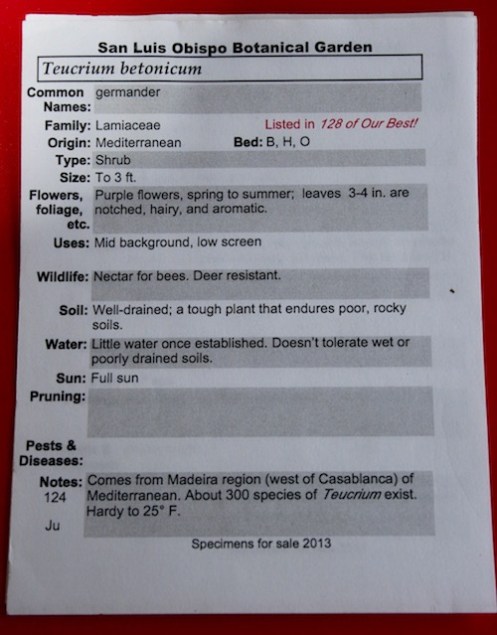
Knowledgeable volunteers to assist shoppers were abundant and I was given an information sheet like this one for each of my selections. For those with garden questions the SLO County Master Gardeners (not affiliated with the botanical garden) were on hand with lots of reference material to tease out the answers. Although this was a modest sale in terms of the number of plants, the individual plants were in excellent condition, the variety of plants was great and I even got a ride back to my car with the garden’s Education Director, Lindsey Morgan, plant booty tucked safely in the back of her golf cart!

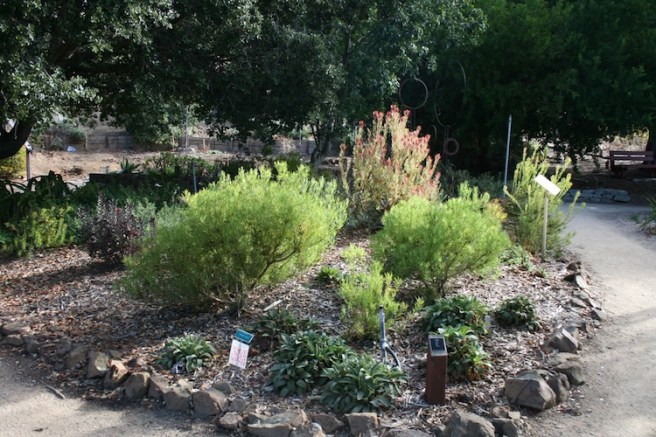
With the precious cargo stowed away in my car I spent some time wandering the meandering hilly paths of the garden. The Self Guided Tour leaflet listed the not-to-miss specimens in each of the site’s numbered climate zones. Most zones had several beds and each bore a reference letter. Note that the above info sheet told me to look in the Mediterranean region (#4) at beds B, H, or O to see Teucrium betonicum–easy to find.

SLOBG 8

Many of the plant labels have attached QR (Quick Response) codes–the little jigsaw looking square scanner codes you see on everything these days–which allow you to access additional information about the plant using your smartphone camera. The red ones like above link you to the garden’s publication, 128 of Our Best!

SLOBG 9

SLOBG 11

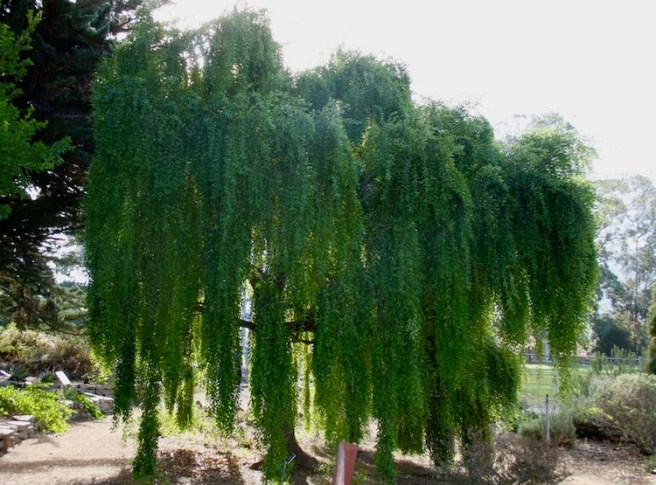
This bright green, weeping mayten tree (Maytenus boaria) is the star of the Chilean Region. Its lush and graceful branches make it hard to believe that is a drought tolerant evergreen from canyons in central Chile’s coastal ranges. If this one is at its mature size it would make a lovely addition to a midsize residential garden.

SLOBG 14

Many of the plants in the California Region have small or needle-like leaves with hard coatings to minimize water loss. Manzanitas (Arctostaphylus spp.) and California lilacs (Ceanothus spp.) are good examples of this water saving foliage strategy. In several of my April 2017 posts about the Theodore Payne Native Plant Tour there are photos of many different cultivars of both of these species. Both species are spring/summer bloomers and as such don’t look like much more than green shrubs here!

SLOBG 15

SLOBG 16

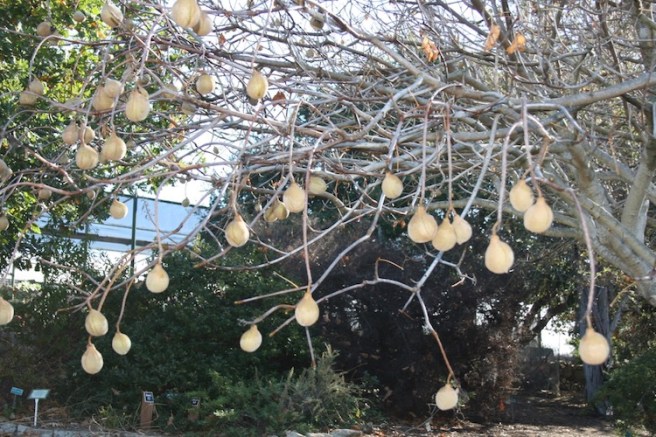
The California buckeye (Aesculus californica) is a summer deciduous tree which blooms in the spring and then drops its large leaves to reduce water loss. It is easily identified from a distance by its large, hard, fig shaped fruits. My tour leaflet taught me that the Chumash and Salinan peoples crushed and tossed these toxic fruits into ponds and streams to temporarily stun fish for easy harvest.

SLOBG 17

Can’t resist a great piece of garden art made from recycled/upcycled materials.

SLOBG 22

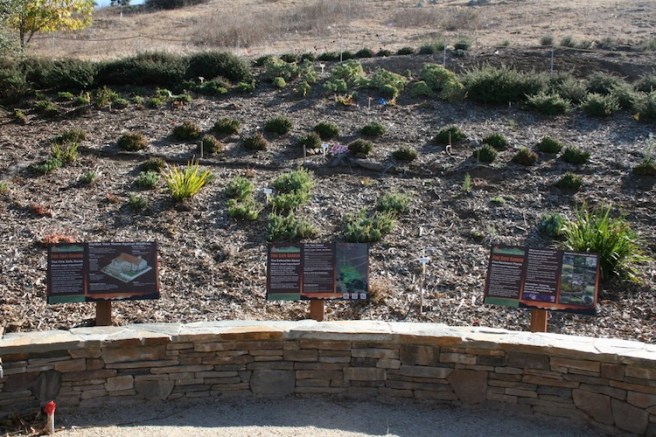
The Firesafe Demonstration Landscape includes plants with fire resistive properties and good educational materials about maintaining a fire defensible space around homes built near natural spaces. Dry summers = fire danger–we have all seen the recent examples of loss of life and property to wild fires.

SLOBG 20

SLOBG 21

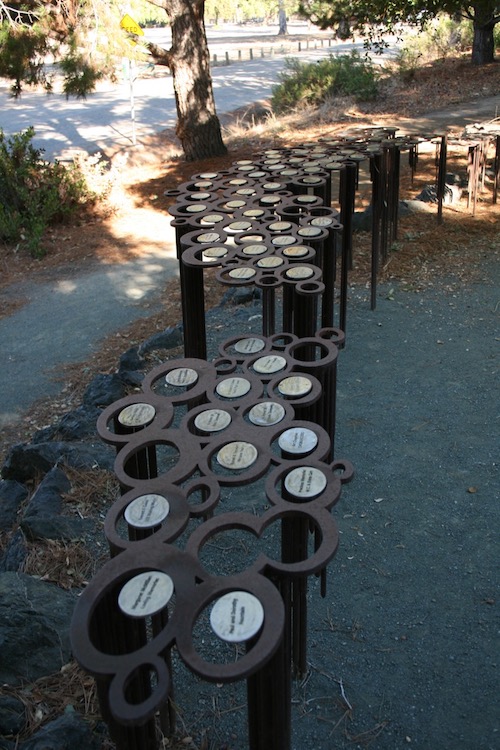
The Life Celebration Garden is a quiet, contemplative space furnished with benches in the shade of oaks. The Allen Root art piece entitled Celebration invites you to imagine as you view it a flowing stream with circles of ripples from pebbles tossed into it.

SLOBG 24

The Children’s Garden features drought tolerant plants, edibles, insect and bird houses and is the site for a variety of family friendly educational activities designed to spark interest in and appreciation of our natural world.

As I wandered the casual garden spaces I observed many of these little house and conjured up a scenario in which the SLO Botanical Garden was providing shelter for some quasi-endangered little creature. Meeting up with garden staffer Lindsey Morgan near the end of my tour I question her about the wildlife the houses were sheltering–turned out to be the native Sprinkerlus manifoldii–proving that I can be be sucked into believing just about anything.

SLOBG 25

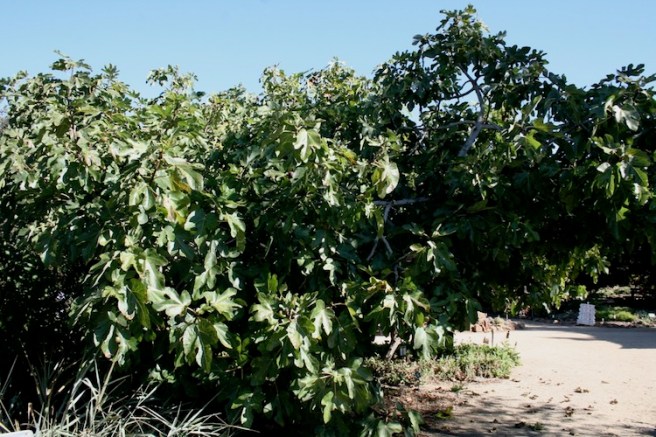
OK, so this Historic Fig Tree doesn’t really look different from any other fig tree but here is its story: A cutting of the ‘Mother Fig’ at the San Gabriel Mission was given to Father Jose Cavalier of the San Luis Obispo Mission in the late 1780s. It grew to be a large tree in the Mission’s orchard until its removal in 1974 during construction work. Many cuttings were made at that time and this one was given to the SLO Botanical Garden in 1997. It is Ficus carica (edible fig) and bears fruit annually.

SLOBG 26

So ends today’s brief tour of this nascent botanical garden. I love the fact that it is part of the larger regional park. There are people playing baseball in the field to one side of it and I can see tent campers on a not too distant rise. I expect that locals use the park for many family friendly activities and events and that makes the garden another place you can spend part of a larger day in the park–learning about plants and wildlife under the open skies rather than a classroom. I plan to return in the spring to see many of the garden’s shrubs in the full flush of a coastal spring. I hope you will come too!

SLOBG 28

This caper bud escaped harvest and the pickling brine to offer this gorgeous bloom!


As the crow flies…

My quilting group is fortunate to be able to cut and stitch for a week twice a year at an oceanfront beach cottage in Cayucos, CA. It is a time to sew, relax, eat out and revisit a number of must drop into Central Coast sites and shops. We are equal opportunity road trippers and include quilt stores, the apple farm, garden centers, the farmer’s market and anything that looks like fun. Late October coastal weather is generally cool and moist with foggy mornings and pleasant afternoons. Wonderful weather to open the windows for a cool breeze and walk leisurely on the sand from the cottage to downtown Cayucos. This year we enjoyed (??) record high temperatures for three days with highs hovering at 100 degrees–even more incentive to wander up and down the coast in search of businesses with air conditioning!

The next village up the coast is Cambria–renown as the site of one of only 3 native Monterey pine forests on the US mainland.  A special pottery store, a wonderful needlepoint/yarn store and a very fun store called Home Arts are always on the go to list. The Garden Shed is also worthy of a visit and I will dedicate another post to introducing you to this cluster of quirky garden and gift storefronts.

This year we found ourselves right in the middle of the Cambria Scarecrow Festival. Here are a few of the MANY scarecrows sponsored and constructed by both business and organizations.

Scarecrows 1

Scarecrows 4

This bevy of stick beauties clothed in knitted and crocheted outfits reminiscent of the 1960s were fabulous!

Scarecrows 5

A painterly offering in front of one of many art galleries

Scarecrows 6

The Queen of Hearts

Scarecrows 7

Guardian of the Garden

Scarecrows 8

Popeye, Olive Oil and Sweet Pea

Old Happy Herb at Ephraim Pottery

Scarecrows 11

The Love Courier

Scarecrows 19

Groot from the movie Guardians of the Galaxy–this one won a ribbon for innovative use of materials. It is made of cardboard and the split foam tube you use to cover pipes in cold areas.

Scarecrows 12

Scarecrows 13

Scarecrows 14

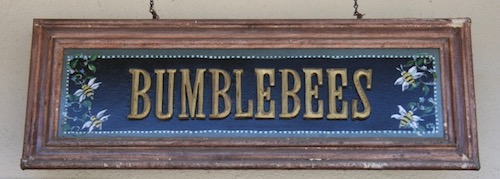
In front of a gift shop called Bumblebees

Scarecrows 15

The Photo Crow-Today Everything Exists to End in a Photograph

Scarecrows 16

Scarecrows 17

How could you not love this fishing frog and his skeletal mermaid lady friend?

Scarecrows 32

Linn’s Restaurant and Pie Shop has their delivery girl working overtime.

Scarecrows 20

A little more traditional

Scarecrows 21

Scarecrows 22

The Cambria New Wave Riders-the bicycle wheels were motorized and they looked as though they were really riding!

Scarecrows 31

Knit 1, Purl 2

Scarecrows 23

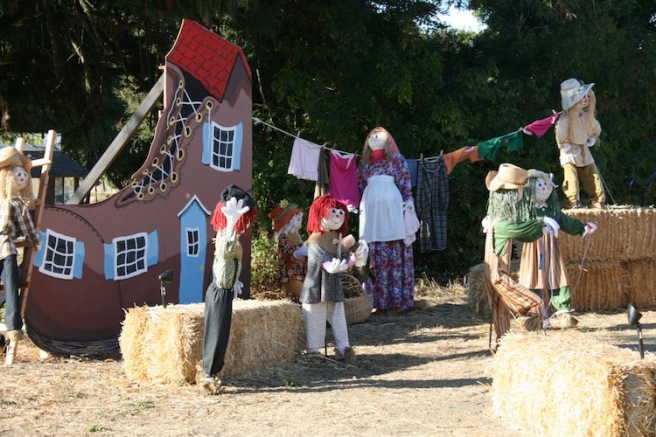
The Old Woman Who lived in a Shoe and some of her many children

Scarecrows 24

Dakota the dog

Scarecrows 26

Scarecrows 25

Tree Bob-the Ent of the East Village handles all the needed tools of the realtor trade on his multiple arms and no, I don’t have a clue what ‘Ent’ means. Any help out there?

Scarecrows 28

Doing Our Part to Conserve Water

Scarecrows 27

Ichabod Crane and the Headless Horseman

Scarecrows 33

This one says it all!

More posts from the Central Coast in the next week.


Tech meets (very little) turf #2…

It is a unique experience to see the inspirational garden of a noted San Jose garden designer and a very personal garden he crafted for a one of his clients in a single afternoon. The Garden Conservancy has a reputation for delivering fabulous garden touring experiences at its Open Days across the nation.

The Holden garden is only a few streets over from designer Cevan Forristt’s outdoor sanctuary. Both gardens lay in the flood zone for nearby Coyote Creek and found themselves under 6 feet of water in February 2017 when the creek ravaged its banks.  It was amazing to see how beautifully they have recovered–I would have not known the depth of the damage to the Holden garden without seeing a photograph taken by the homeowners from their 2nd story.

Hints to the global nature of the garden appear on the front of the neat stucco bungalow in the form of Indonesian style shutters.

Hogan 38

The front garden is no bigger than a minute but features design details in keeping with the global theme.

Hogan 1

Hogan 37

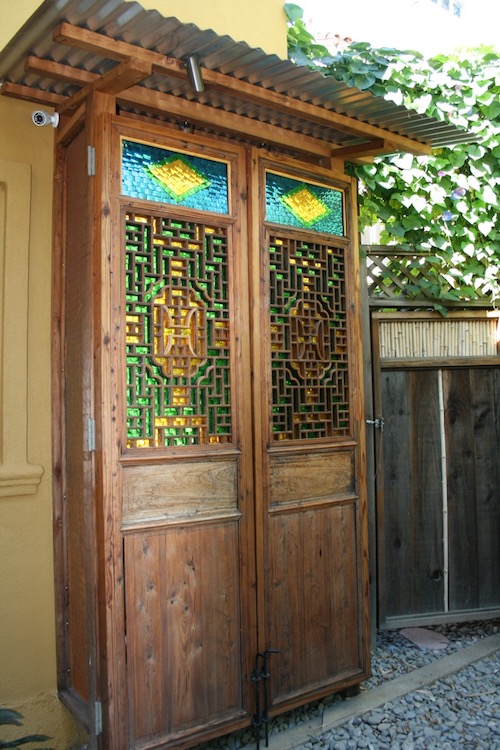
A Moorish tile front walk and massive pots lead to these stylized gates. The potted bamboo provides some leafy relief from the surrounding hard surfaces. It is possible that in a former life the steeply sloped walk into this below street grade garden was a driveway–possible a garage occupied space behind the bungalow?

Hogan 2

Hogan 35

There are so many details to take in I really don’t know where to look first. My initial impression is that this garden is a fabulous entertaining space–many seating and eating areas with enough green to blur the edges.

The property line fences and just about every surface has been dressed with texture advancing the global theme–remember this is the designer who made a century old Victorian into a Far Eastern sanctuary.

Hogan 30

I love this trough plumbed with running water. No surface is without an artistic element.

Hogan 34

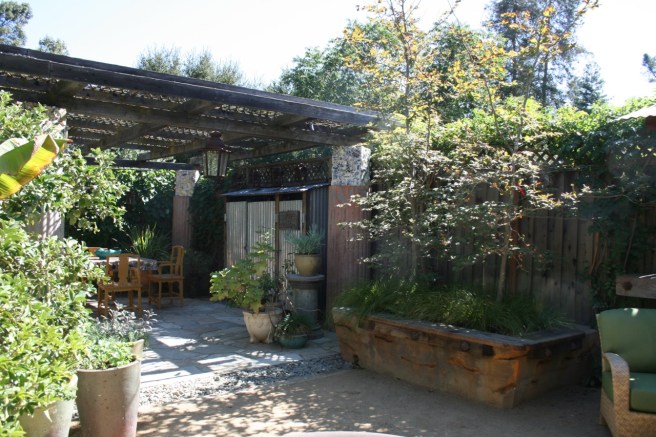
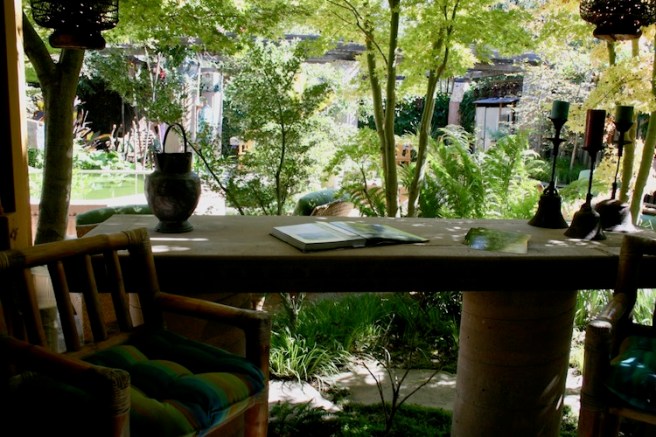
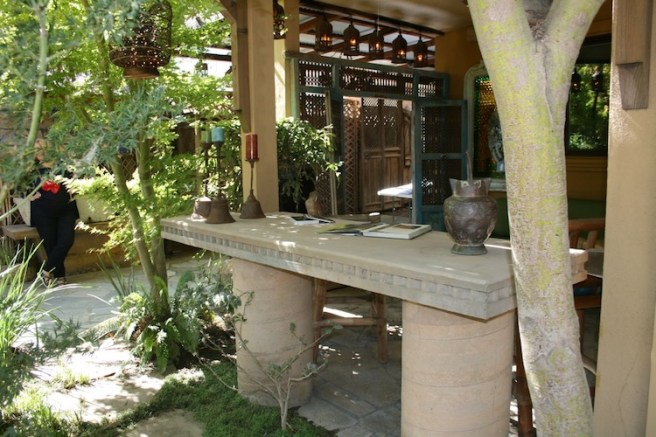
I am immediately drawn to this massive shade structure which provides shelter for a custom poured concrete table which I think seats 12 or 16 on antique throne like chairs.

Hogan 33

From a slightly different angle you can see the corrugated metal storage area and massive poured columns supporting the shade structure. The colored concrete columns were poured into tubes formed from sheets of corrugated metal.

Each column is capped with a unique pottery shard element. Designer Cevan Forristt purchased an entire warehouse of broken pottery from a company whose stock was destroyed in the 1989 Loma Prieta earthquake and has had those shards stored in numerous barrels for years, dipping into the booty to fashion one of a kind decorative elements for himself and his clients. Remember the blue pottery mosaic pots I shared with you in the post on Cevan’s garden? It is all I can do not to start collecting garage sale pottery…here are a few of the column cap designs. The substantial edge of the table also features a wide multicolored shard mosaic band.

Hogan 11

Hogan 9

Hogan 8

This garden is accessible and inviting. Nothing is out of bounds and the space is appealing to both adults and impervious to children.

Hogan 21

Hogan 32

The natural materials of the green cushioned seating areas is a unifying factor. Throughout the garden there are a variety of materials used and repeated–corrugated metal, distressed/rustic wood, poured concrete, rusted iron and bamboo.

Hogan 20

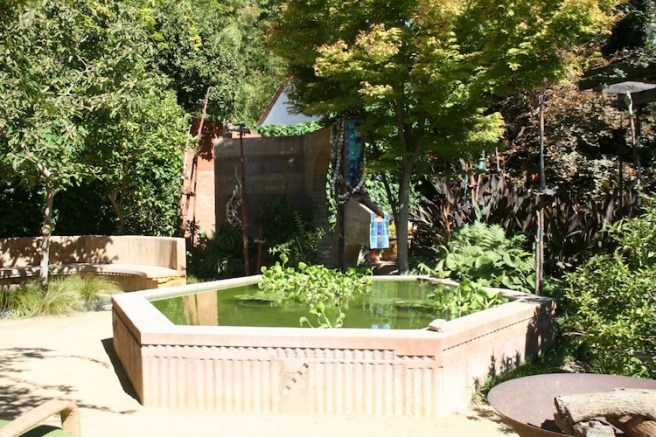
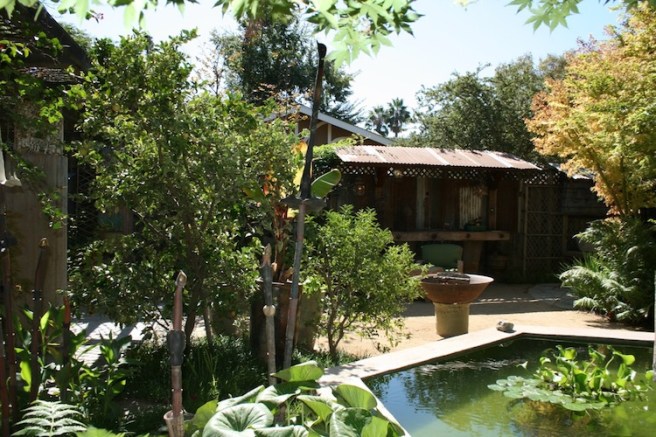
A six sided koi pond is the center point of the garden. As with all the poured concrete elements, the pond was made by the designer. A trough like spout provides a waterfall effect. The homeowners shared that the koi did not swim their way to safety from the flood waters and had to be replaced.

Hogan 5

Hogan 16

Hogan 15

Above and below you see a few of the ceramic flora pieces created by Berkeley sculptor Marcia Donohue.

Hogan 18

Hogan 13

These organic pieces rise from the greens of the plant material as totems to the plant gods. I understand that Marcia Donahue’s Berkeley garden is a fabulous experience–chock full of plants and sculpture!

Hogan 23

The planters and custom surround for the grill were fabricated with forms that are utilized to pour column for freeway overpasses.

Hogan 22

This gorgeous piece serves as an outdoor buffett for storage of dishes and serve ware used for outdoor dining. Notice the corrugated metal ‘hat’ fashioned to allow the rain to run off.

Hogan 27

Details evoking global travel abound.

Hogan 10

Looking back toward the almost invisible home.

Hogan 24

The second story overhang (Eastern US folks-think ‘walk-out basement’) creates a shady sitting and dining spot.

Hogan 28

Looking out into the garden from that shady spot.

Hogan 26

Same spot from the garden side. More poured concrete columns support a concrete table top at bar height.

Hogan 36

Every detail  remains in character.

Hogan 29

I am so happy I got to see this masterful interplay of materials and plants. Evocative of global travel tucked within busy San Jose, this garden transports every visitor to far flung and mysterious places.


Winter’s royalty…

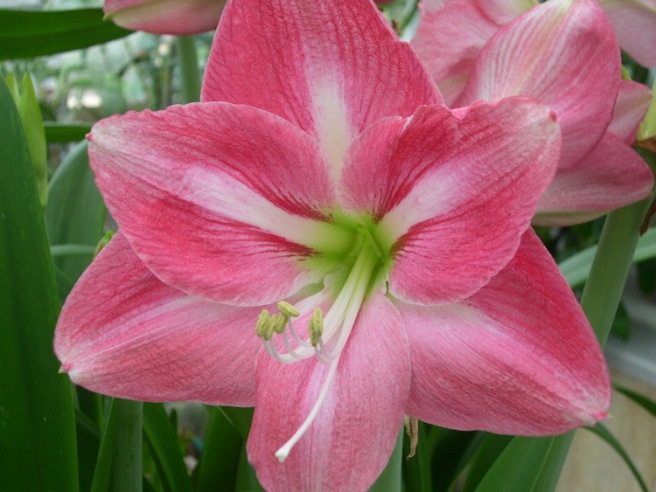
I’m going to take a quick detour from the San Jose gardens posts because…it’s Amaryllis Potting Up Day! Yup, that’s in capital letters because at my home it is an actual holiday worthy event. For at least the last twenty years I have potted up quantities of Hippeastrum hybrids, commonly called amaryllis, in the fall. My amaryllis intentions have ranged from growing a few to use as part of Christmas tablescapes all the way to potting several hundred a season to fuel a small home-based business when I lived in Georgia. My Georgia home had a 400 sq. foot sunroom drenched with light from 8 foot high windows on three sides, offering a perfect indoor greenhouse in which to winter force all sorts of bulbs–a serendipitous set up which I know I will never have again. Given the sheer number of these bulbs I have forced over my adult life I was amazed to find I had only a few photographs in my files. I don’t know the cultivar on this one but I can just see the tables full of plants in the background and the year indicates it is from the days when my sunroom ‘greenhouse’ was alive with color in early December.

Winter Queens 1

The amaryllis we force to bloom at Christmas time are mostly from a broad category called (no hort degree needed here) Christmas Flowering. These varieties are natives to South Africa and their southern hemisphere origin makes them especially eager to pop out of dormancy. Within this category the bulbs are then subcategorized based on their height and flower size as Symphony (largest), Sonata and Sonatini. Singles and doubles, solids and marked varieties exist in all categories. Christmas Flowering amaryllis typically come into bloom 4-6 weeks from planting.

I hold over plants (that I have not given away) for forcing in the subsequent year so in any given year I have a combination of previous years’ bulbs and newly purchased bulbs–after New Year’s I’ll add a post on what to do with your spent bulbs. I like to try a couple of new varieties each year. This year I am growing ‘Wedding Dance’ (single white), ‘Rozetta’ (double mottled pale pink), ‘Blushing Bride’ (another pink), ‘Razzle Dazzle’ (striped red and white), ‘Merry Christmas’ (single deep red) and ‘Gervase’ (yet another single pink). I also have a few held over which have become orphaned from their tags so each will be a new surprise. I purchase my bulbs primarily from Van Engelen Inc. which is the bulk quantity pricing arm of John Scheepers. Both are easily found on your internet search engine. A note about those bulbs in boxes at the big box and grocery stores–your results will look successful to you just until you see an amaryllis grown from a top quality bulb grower. Mail order bulbs from reputable growers are typically shipped out to the purchaser within a couple of weeks of their late September harvest. They are full and firm with new roots popping out, not shrunken and dried out looking. There is no telling when the bulbs in the prepackaged units came out of the ground and whether they have been stored at the proper temperature in the interim. Well, actually you know they haven’t as newly dug bulbs that you are not ready to plant should be refrigerated at 50 degrees with good ventilation–not happening at the mass market outlets!
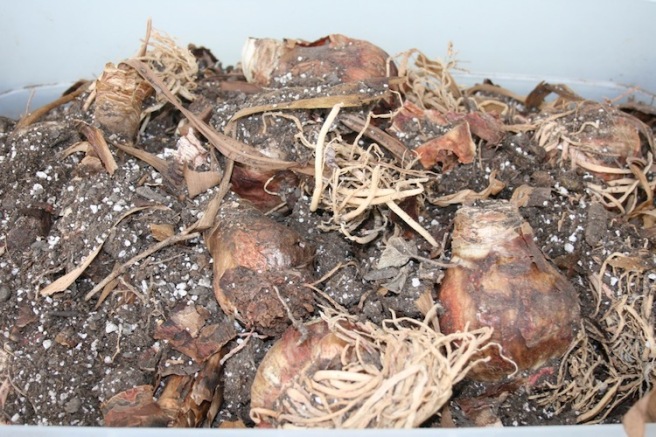
So below you can see that I have retrieved my pots of last year’s bulbs from their dark resting place (artificially induced dormancy) and, keeping each cultivar separate, dumped each pot’s contents into a large plastic bin.

Winter Queens 11

They have been unwatered and in the dark since mid July. Not every bulb will be viable. Below you can see the contrast between the fat one (happy face–good for another year) and its neighbor (compost bin bound).
Winter Queens 4

This group is the variety called ‘Wedding Dance’ and some of these bulbs have been forced for several years. After a while they just don’t have much left and need to be replaced.

Winter Queens 5

Winter Queens 6

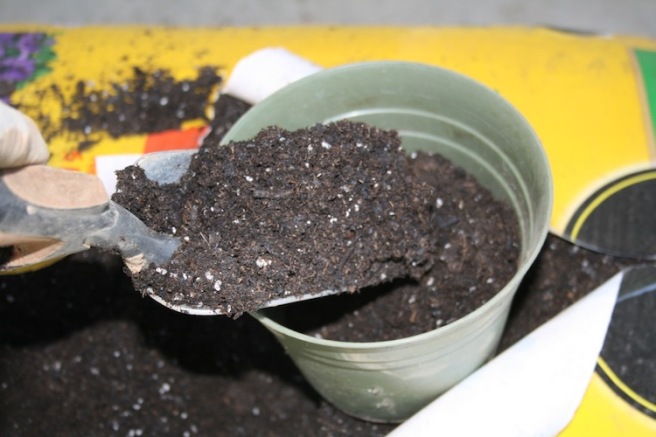
My pots have been cleaned and partially filled with fresh, good quality potting mix.

Winter queens 12

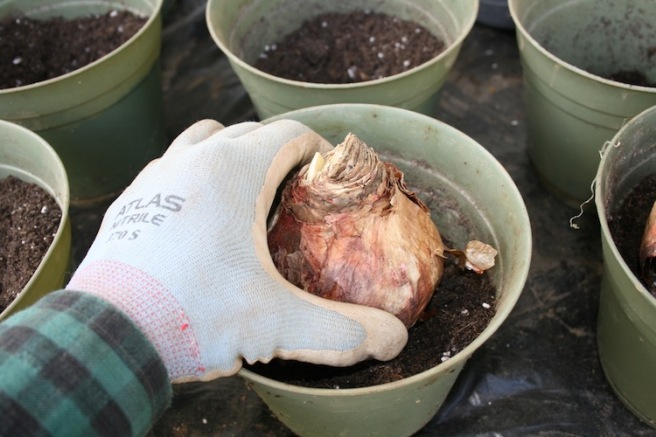
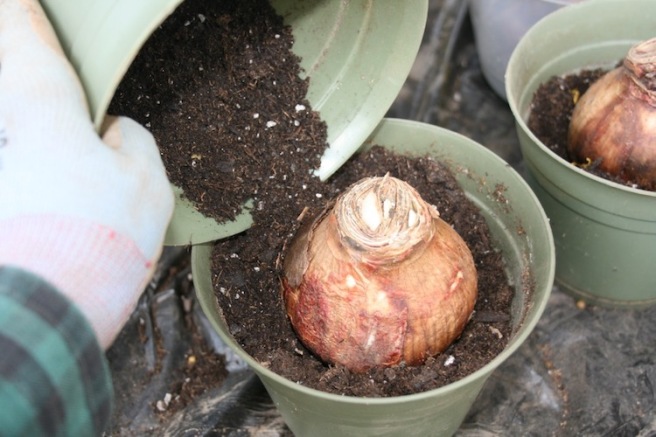
I clean up any dead root material from the base of the bulb and work the bulb a bit into the partially soil filled pot. Amaryllis like to be in a cozy pot with about 1/4 of the bulb above the final soil level. The bulb nose and shoulder above the soil prevent water from collecting in the sprout and rotting your bulb. Although you can force these bulbs sitting directly on pebbles with their roots submerged, bulbs planted in soil must have good drainage.

Winter Queens 7

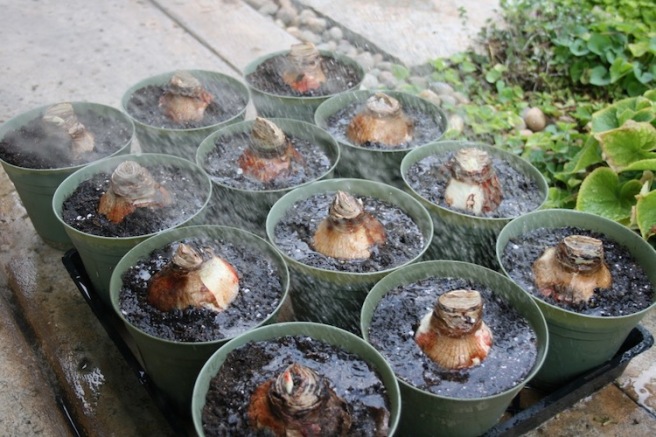
Adding potting mix to the appropriate level.

Winter Queens 13

Giving this group a good drink and time to properly drain.

Winter Queens 14

The potting up date I select is based on how I will be using my plants and keeping the 4-6 weeks to bloom time in mind. Gifts for a ladies’ lunch the first week of December demand an earlier potting up date than having a beautiful bloom show for my Christmas Eve table. This year I will do a second mass planting 2-3 weeks from now to accommodate late December needs. I work each variety as a group and label every pot with the cultivar name and the date. In a perfect gardening world I would plant each variety over the course of several weeks so that I would have all my chosen varieties at varying stages of maturity, extending my bloom season. If anything every gets to be perfect in my gardening world you will be the first to know.

The Royal Dutch amaryllis is a second broad category you will find in catalogs and online. These originate in the Netherlands and bloom 8-12 weeks after planting. I have, with difficulty, forced these to bloom by Christmas by giving them ample bottom heat and a much warmer than average environment. Most bulb growers would prefer to make only a single shipment to each customer and thus send both kinds of bulbs out in mid-October, making holiday bloom a challenge. Probably the most well-known amaryllis in the retail market, a mid to pale pink called ‘Appleblossom’ actually falls in the Royal Dutch group–I have to think that its tendency must be more to the 8 weeks than the 12 weeks to bloom time. Two years ago I planted a container with 10 bulbs called ‘Hercules’ after a late bulb shipment (apparently a European harvest issue) the first week in November and I had this wonderful display for Valentine’s Day!

Winter Queens 2

Each bulb bore multiple 24″ stalks and the blooms measured easily 7-8″ across. It was such a breath of spring to come!

Winter Queens 3

‘Hercules’ is going to become MY Valentine’s Day amaryllis. It was almost May before the many waves of bloom stalks were finally spent. I lifted the bulbs and potted them up for gardening friends to hold over for the next year. A fresh dozen bulbs will refill my ceramic container and have two to spare for individual pots.

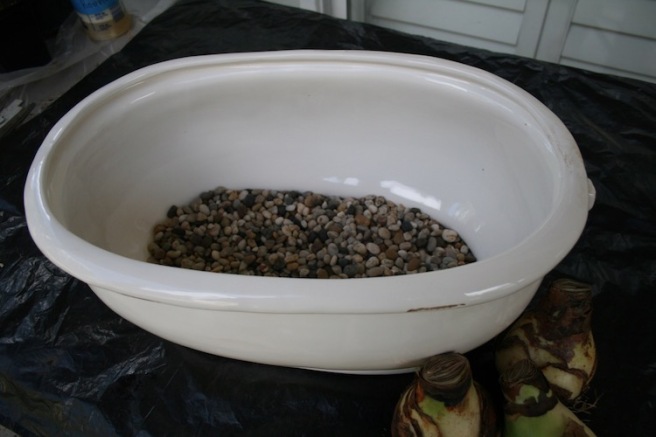
Because this large (20″ X 12″ X 8″ deep) container is actually a bottle cooler it has no drainage. I add a 2 inch layer of pebbles to the bottom and will be very careful with watering.

Winter Queens 8

A few inches of potting mix to make the bulb a cozy nest, a precise arrangement for fit, filling out the spoil to the bulb shoulders, and voila!

Winter Queens 9

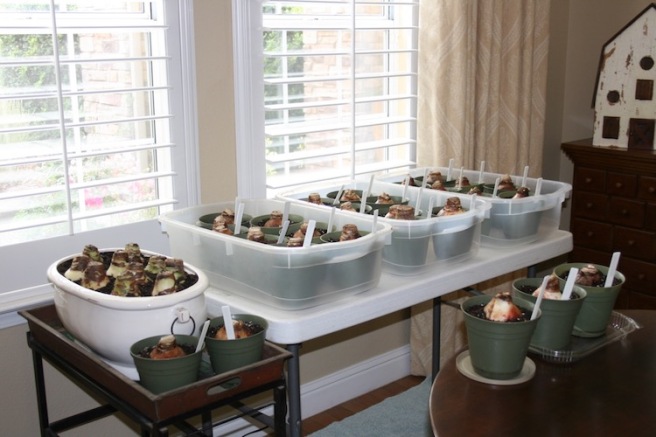
All my newly planted amaryllis get a temporary home by my south facing dining room window. ‘Hercules’ gets a special spot on a heat mat to help him along. As the weather cools I will move them up to the loft to capture the natural movement of the warm air. About that time my second planting can assume their position in the dining room. As everything is nicely dampened now I will wait until the stems peek up to water again. The bins make it easier to rotate the pots’ positions for more even warmth from the sun.

Winter Queens 10

As with every year, I can’t wait to see the first bit of green emerge from these lifeless looking globes. Soon there will be a chill in the air and I will once again pay court to winter’s royalty.

Tech meets (very little) turf…

The Garden Conservancy’s Open Days final California offerings for 2017 were three suburban gardens in San Jose, the heart of the Silicon Valley. The majority of the California Open Days occur in April and May and so I was surprised to see San Jose on the docket for September. Although the previews for these three gardens led me to feel they would not particularly fit my personal garden aesthetic they were intriguing enough to point me toward the freeway and in close enough proximity to each other to make it an easy trip. All three promised a mix of garden materials that would not be as summer weary as my those in my own garden!

THE GARDEN OF CEVAN FORRISTT

From street side it is immediately obvious that this garden is not just another neat suburban garden on a narrow street of bungalows of various ages and sizes. In fact, I am not even sure there is actually a house amongst the formidable walls, stones, urns and troughs. Cevan (pronounced Kevin) lives his garden design, embracing concepts and experiences gained from extensive Near and Far East travels and his background in stage set design. His highly stylized garden is probably not a garden suited for a young family or those of us who may need firmer footing but it clearly reflects his personality, playfulness and ‘more is more’ embrace of life.

GC SJ Cevan 1

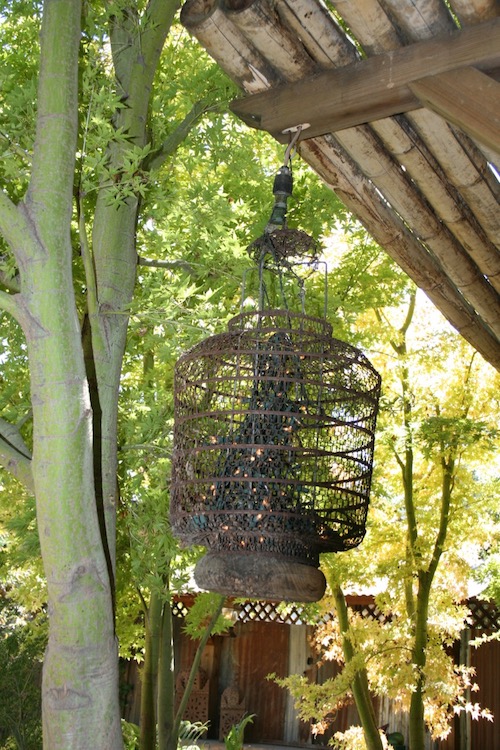
The patinaed iron gates confirm his garden as his private sanctuary.

GC SJ Cevan 2

His mail is delivered in this unique repurposed copper box.

GC SJ Cevan 39

The front garden is a maze of narrow walkways, many with interesting stone accents.

GC SJ Cevan 6

Fortress like stacked stone acts as walls for the paths. There is almost no place in the front garden where it is possible to back up to get a wide shot.

GC SJ Cevan 37

GC SJ Cevan 42

GC SJ Cevan 33

Succulents and perennials top walls and fill gigantic cement troughs. Much of the plant material is closer to eye level than the ground!

GC SJ Cevan 31

GC SJ Cevan 30

GC SJ Cevan 29

GC SJ Cevan 28

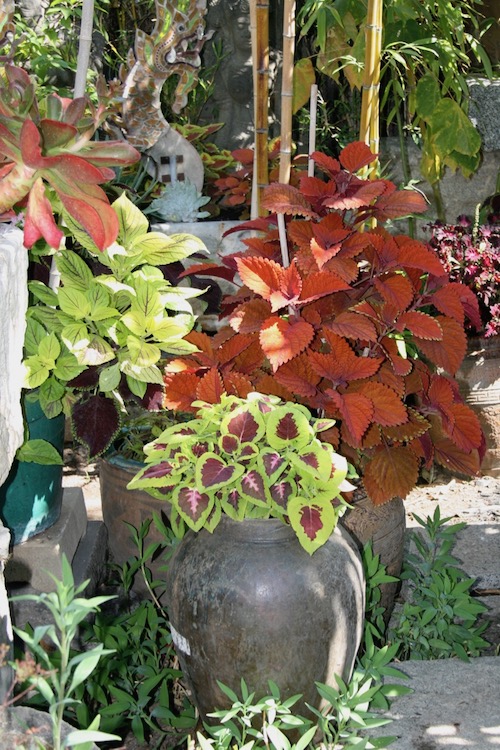
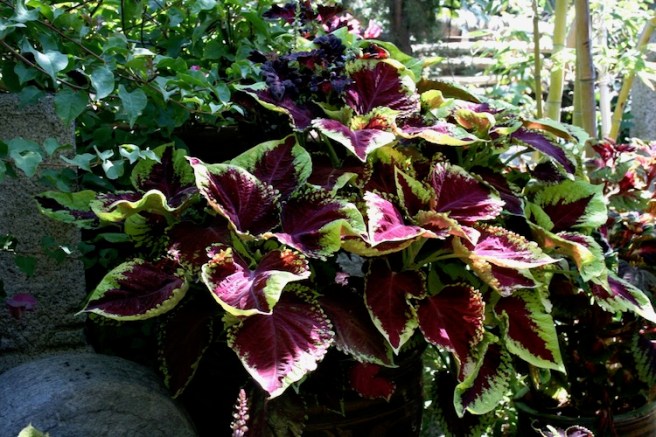
The garden has a wonderful assortment of Coleus, primarily in pots. A  stone wall defines their own narrow garden room. It is hard to remember where I have gone left or right–there are vignettes, urns, statuary and decorative found objects at every turn.

GC SJ Cevan 25

GC SJ Cevan 35

GC SJ Cevan 34

GC SJ Cevan 32

GC SJ Cevan 27

GC SJ Cevan 3

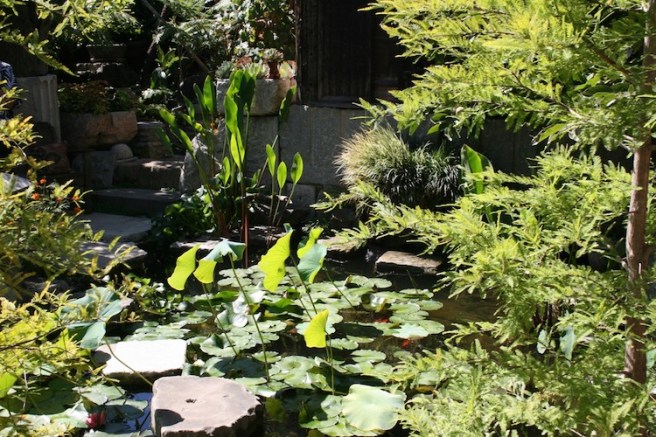
A cushioned stone bench provides a view of the peaceful koi pond. Above you see a young bald cypress planted directly in the pond. From the bench you get a narrow view of the Forristt home. Originally a modest Victorian cottage built from a kit around the turn of the century, it is clad on almost every surface with reclaimed materials and artifacts to disguise its nature and create the aura of an Asian dwelling.

GC SJ Cevan 5

Traversing the pond on raised concrete piers to yet new views of the garden  I feel compelled to explain that I have now walked no more than 15 feet in from the from the entry gate–there is not a square foot unstructured or lying fallow.

GC SJ Cevan 44

GC SJ Cevan 43

In this very small space exist areas of full sun, dappled shade and complete shade. The perimeter of the garden, front and rear, has been planted with very tall screening plants and narrow trees, virtually eliminating any views outside the garden and reinforcing its air of mystery and privacy.

GC SJ Cevan 19

GC SJ Cevan 18

GC SJ Cevan 40

GC SJ Cevan 38

GC SJ Cevan 6

GC SJ Cevan 14

Stone, recycled and salvaged artifacts act as walls, pedestals and planters.

GC SJ Cevan 17

The well shaded rear garden gate offers additional layers of detail.

GC SJ Cevan 16

GC SJ Cevan 13

GC SJ Cevan 21

Very few of us would dare to nurture a towering stand of bamboo in our gardens–Cevan explained that this variety does not run aggressively.

GC SJ Cevan 15

GC SJ Cevan 11

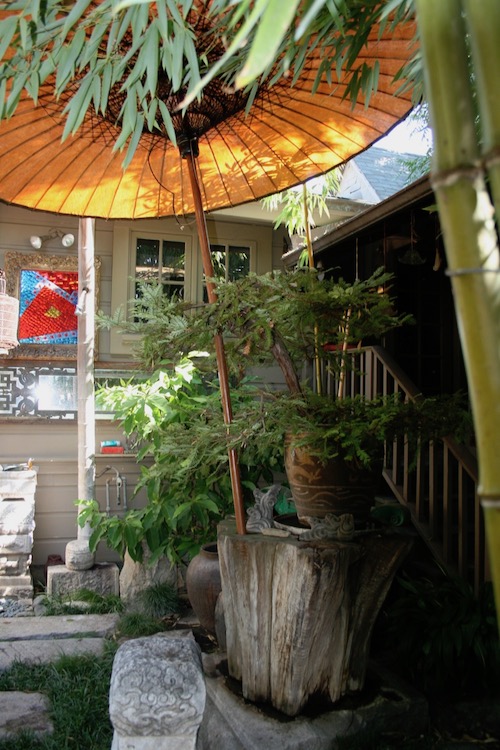
A number of colorful umbrellas offer high shade in the rear garden. Their poles are cleverly anchored in holes in large stones and in one case, a tree stump.

GC SJ Cevan 12

GC SJ Cevan 7

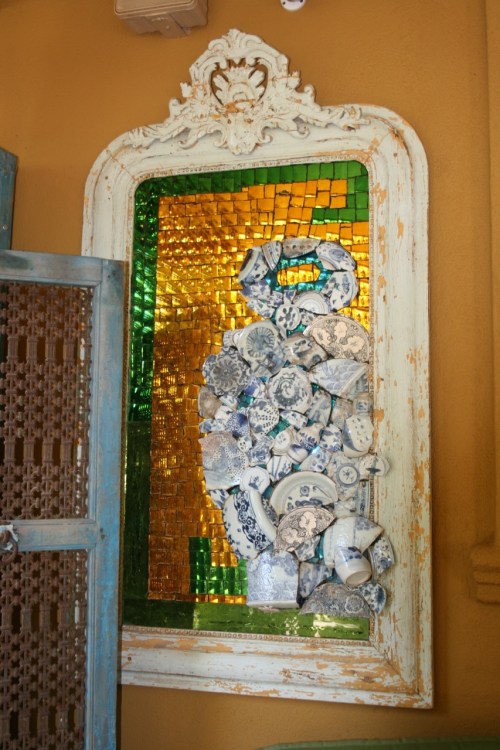
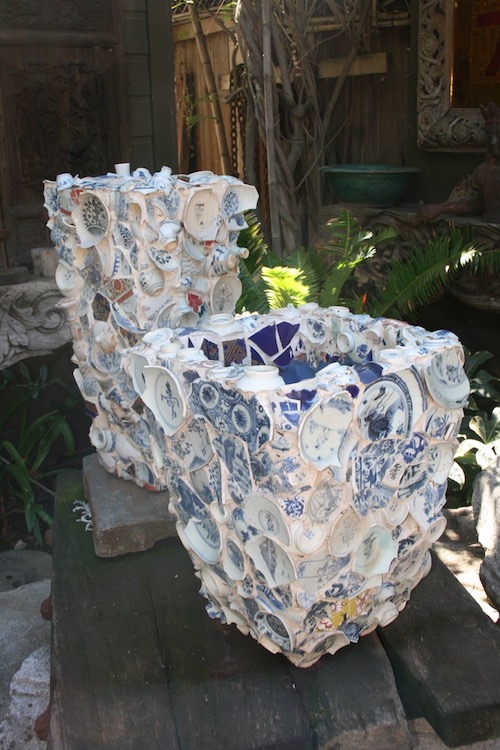
I loved these large urns tiled with broken blue and white china.

GC SJ Cevan 9

GC SJ Cevan 8

Ok–so this has really been a lot to take in! This very personal retreat like garden is not everyone’s cup of chai but there are strategies and elements here that when used on a less over the top scale will make a sanctuary space for anyone who embraces Asian design. If you would like to know more about Cevan Forristt Landscape Design and see  additional photos (far better than mine) check out http://www.forristt.com or the write up in the book Private Gardens, pictured below.

GC SJ Cevan 23

In  my next post I will take you to the Holden Garden which was designed by Cevan Forristt to meet the couple’s specific desires for an entertaining space inspired by global travel.


Autumn musings…

As spring is the most anticipated season to those cold weather gardeners whose labors lay under a blanket of winter ice and snow, autumn is the season that hot and dry climate gardeners eagerly await. And we don’t wait patiently either. We grouse, we commiserate, we complain daily about the soaring temperature, crispy plantings and the lack of rain–you would think we have actually forgotten where we live. Somehow it always seems to be ‘the worst summer ever’.

Autumn is my favorite season. Autumn is the busiest season in my garden. It is the time to reflect on how first season in the ground plantings have fared–declaring both winners and losers; plan for additions to beds and borders; complete essential cutting back and dividing of perennials; refreshing the humus topdressing everywhere and a myriad of routine maintenance tasks. If I have a productive autumn my spring must-dos are reduced exponentially. With various injuries having kept me out of the garden since late spring for all but the least physically demanding jobs, there is a great deal to be done!

Over the last couple of weeks our temps have dropped down into the eighties and nineties, allowing for a human being to actually be out in the garden for more than 30 minutes at a time. Take a peek at what’s going on.

Aut Reflect 3

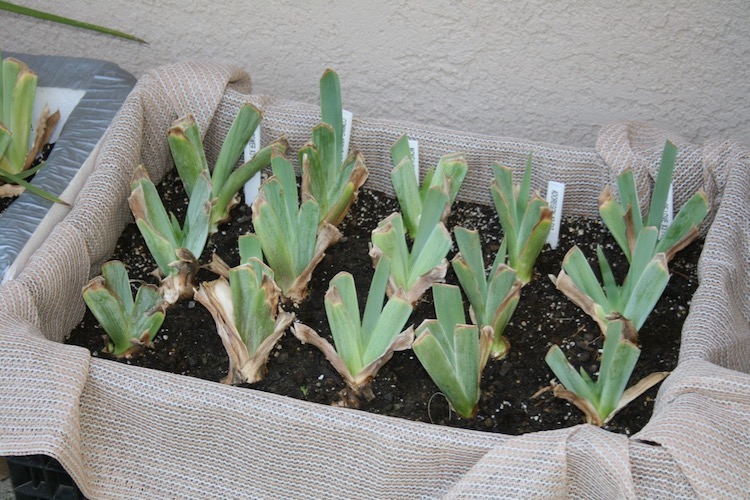
Working this wide front bed entails dividing dozens of bearded iris–over 20 cultivars which were last divided 4 years ago. July and August are more preferred months for iris division but it is simply too hot and thus my iris seem to have acclimated to September division and replanting. Multiple salvia cultivars await their final pinch back and the Santa Barbara daisy–now reduced to wee fist sized clumps–had totally obscured the soil.

Aut Reflect 2

I am declaring Salvia ‘Mystic Spires Blue’ a winner! I found 3 bedraggled 4″ pots last fall and dug each one into a different spot in the garden, hoping for the best. This is one which is sited in full on all day sun.

Aut Reflect 4

Iris divisions are settling in; asters and salvias have been neatened up. Not much to look at right now but most of these perennials will bounce right back for another short bloom before shutting down for winter in late November.

Aut Reflect 10

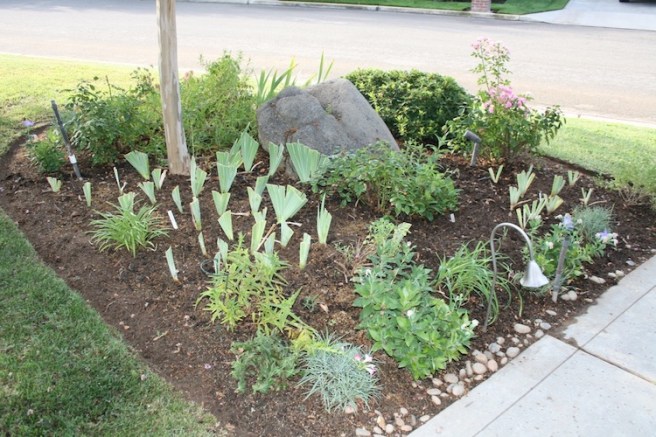
The driveway circle bed completed early spring 2017 is looking great. The most time consuming care this bed has required through the summer is the periodic removal of the crape myrtle suckers whose growth was no doubt stimulated by all the shovel work around their huge roots systems.

Aut Reflect 1

Disappointingly, none of the Correa ‘Carmine Bells’ in this new bed survived. Three were planted last November and grew steadily through the rainy season and spring. Above you can see that one has already been removed, the one in the foreground is flat dead and the one behind and to its right is starting to fail. Below you see a shot of the same plant in March of this year.

img_5553.jpg

I guess DEAD assumes it to be in the loser category for me. I have read a lot about these drought tolerant Australian natives trying to discern what happened. Ruling out overwatering (they grew like gangbusters during out wettest season) I am leaning toward too much reflected heat from the street and driveway. They are in a morning only sun position as they require but just inside the shade canopy and the literature does caution against reflected heat. The three Correa were the only plants lost in the new bed–any thoughts about the cause?

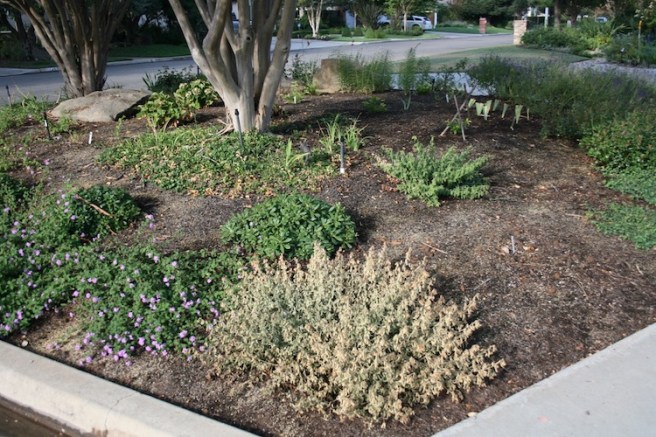
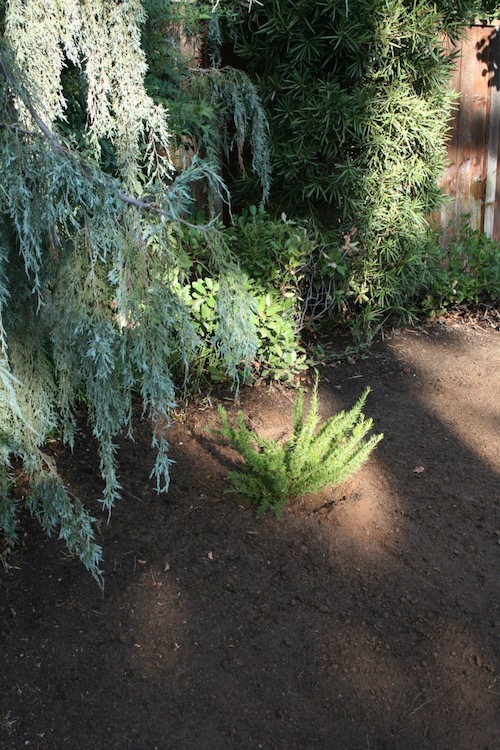
I’ve made my first two additions to the 12′ X 140′ side bed. The burgundy foliage and rigid form of Berberis ‘Helmond Pillar’ is a good contrast to the weeping grey-blue ‘Tolleson’s Blue’ juniper as its backdrop. It’s tucked behind the boulder Dave dragged out from under the juniper’s canopy (see my Labor Day post). Around the corner I dug in a $2 (yes, two dollars!!) Grevillea ‘Pink Pearl’ I picked up on my Sacramento trip. It looks like a drop in a very big bucket now but literature puts it at 6′ X 6′ in average garden conditions. My Virginia and Maryland travels in June have cemented my goal to get out of the small leafed, medium green rut and strive for more variety in foliage shape, size and color. Mature trees and compacted soil are making this new lawn-free bed a challenge to plan and plant–look for a spring post when the project is completed.

Aut Reflect 12

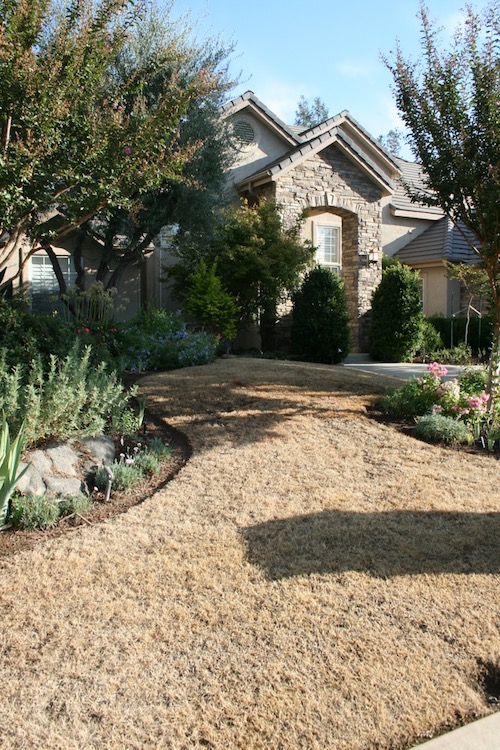
Just to make sure there is no rest this fall and winter, we have targeted another lawn area. The lawn has been chemically killed and awaits a man (or woman, I guess) with a shovel to remove the remnants. The foreground of this photo is the site for my Little Free Library to be added along with a sturdy bench. Stay tuned on this area also!

A couple of other winners from this year–

Aut Reflect 7
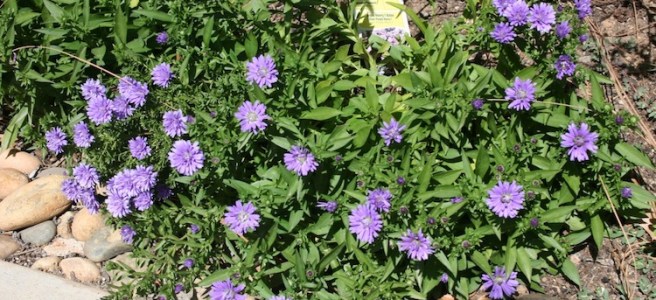
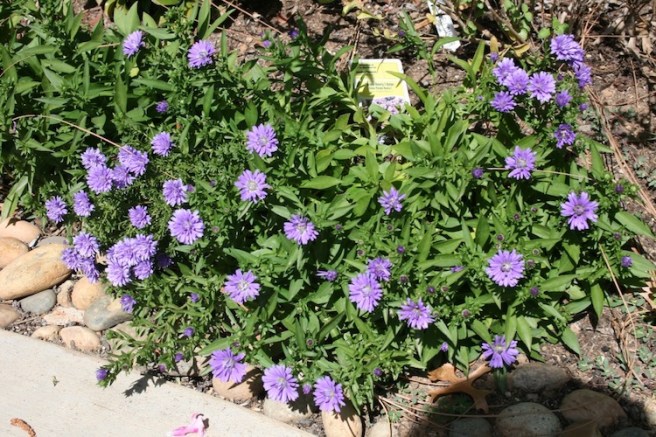
Aster novi-belgii ‘Henry I Purple’ has been blooming non-stop since June
Aut Reflect 9
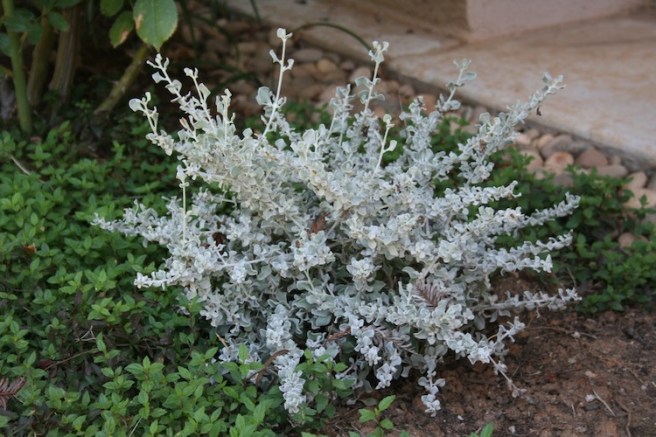
Leucophyllum candidum ‘Thunder Cloud’ has almost white foliage and sporadic small dark purple blooms–one of the smallest cultivars of Texas ranger

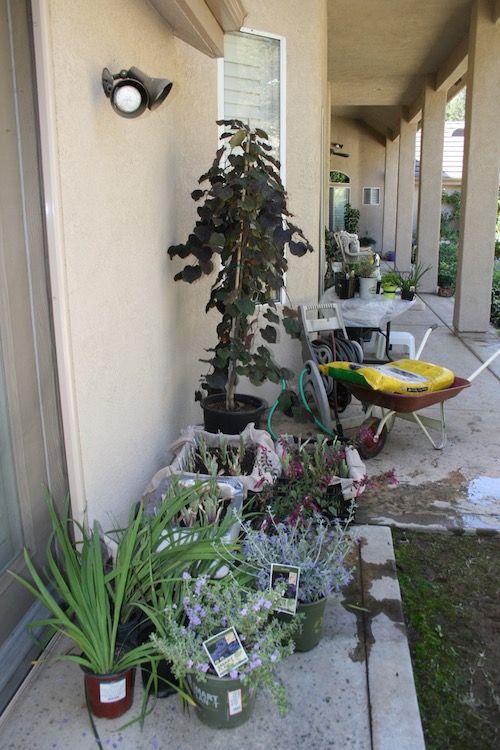
One of a few staging areas for special finds, potted up divisions of perennials and crate after crate of iris in holding mode ready to go into new bed areas. I am really excited about the weeping redbud, Cercis canadensis ‘Ruby Falls’–gorgeous heart shaped burgundy leaves! Autumn is the best time for planting but the worst time to find plant material so I accumulate specimens throughout the summer months in areas I can count on them having some afternoon shade and a nearby hose.

Aut Reflect 17

A mixed bed in the back garden still sports nice blooms–mostly small flowered salvias.

Aut Reflect 19

This Salvia ‘Fancy Dancer’ was cut back about 3 weeks ago and has rewarded me with fresh green foliage and another nice bloom cycle.

Aut Reflect 18

No horticultural degree needed to know I have totally lost control of this climbing rose, ‘Morning Magic’. Yes, that is a cane about 6 feet long laying horizontally. Definitely moving this tidying up task toward the top of my list.

Autumn is my favorite season. Autumn is the busiest season in my garden. That just about covers it.