The pharmacist and the physic…

Less than 24 hours after our plane touched down at Heathrow we are visiting our first true London garden–not quite a record for me in a foreign country, but close.  I just could not see enough of the Buckingham Palace garden to call it a true visit.  Dave and I walked the 1.7 miles from Queen E.’s turf to take in the beauty of London’s oldest botanic garden, the Chelsea Physic Garden. While the green stuff is more my passion than that of my pharmacist husband he could not help but admit he was intrigued with the history and purpose of this 4 acre walled garden which was establish in 1673.

The Worshipful Societies of Apothecaries purchased this plot of land on the River Thames for the purpose of training apprentices in the identification and use of medicinal plants. It would also serve as the base for their extensive livery services which moved goods up and down the Thames. The proximity to the river allowed the Apothecaries to moor their barges, collect plants in the surrounding areas and take advantage of the river’s warm currents which contributed to the location having a very favorable microclimate for growing a wide variety of useful plants. The establishment of the garden also allowed plants from other parts of the world to be introduced to Great Britain through the garden’s Apothecaries. In the 1700s the garden’s establishment of a global seed exchange system called Index Seminum solidified its international reputation. This seed exchange still exists today!

In 1680, a physician trainee named Hans Sloane apprenticed at the Chelsea Physic Garden and would eventually play a pivotal role in the life of the garden. As other transportation forms emerged and the monopoly of the barge livery service declined, business slowed and the Apothecaries were no longer financially solvent. Hans Sloane, now a successful physician, purchased the 4 acres and the surrounding land, called Chelsea Manor. Dr. Sloane then leased back the garden area to the Apothecaries in perpetuity for the sum of 5 pounds per year. This business arrangement remains intact–the non-profit organization called Chelsea Physic Garden pays 5 pounds per year to the descendants of Dr. Sloane and the garden has flourished for 300 years as London has developed around it. It remains a hidden gem behind brick and stone walls and serves not only as an educational resource but also as a place of respite from a bustling city.

Our docent, Zoe, started our tour in the shadow of this statue of Dr. Hans Sloane which stands in the garden’s axis. We found that we were the only visitors in our group who were not residents of Great Britain!

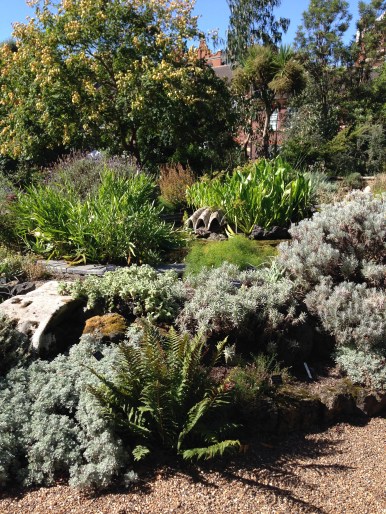
There are multiple sections of the garden and the contents of each is organized differently.  For example, in one section of small formal beds each represents a different part of the world and its medicinal plants as they were known in the 1600 and 1700s. The star of this area as you see below is an interesting built up rock garden, some rocks having come from the Tower of London and others from distant Polynesian volcanic islands. This area had been spruced up a bit in Victorian times with the addition of a pond water feature accented by a giant clamshell–the vignette tips its hat to the plant crazed late 1800s when British adventurers traveled the world procuring specimen plants to add to both public and private collections.
img_4246
The Pond Rockery

Also of note tucked in a corner of the Garden of Medicinal Plants is the largest outdoor fruiting olive tree in England and the world’s most northerly outdoor grapefruit tree–both of which thrive in the garden’s warm microclimate.

img_4258
Not such a big deal to a sunny California girl but a pretty big deal in cool, moist England!

The Garden of Medicinal Plants features formally ordered small beds highlighting plants deemed to cure various ills–many of which were the precursors to modern medicines. This area was especially interesting to Dave and by the time we were halfway through Zoe was looking to him for interesting information to add to her talking points.  Each small bed featured an exhibit citing the general medical arena in which the plants were thought to be useful and historical information of how those plants, in fact, do yield curative substances used today.  I am not sure you can read the titles on these but they are ENT & Lung Diseases, Analgesics &  Anesthetics and Oncology.

The Poisonous Plants Bed featuring a huge Castor Bean lurks behind the Medicinals. Behind the skull and crossbones section I saw the Abhorrent Arbour vining up on the side  of the Glasshouses (what Americans call greenhouses.) As its name suggests, vines with nose wrinkling qualities entwine the structure. Zoe noted that most plant material is left to its natural life cycle in the garden as the medicinal capabilities may be found in the roots, stems, leaves, seeds or mature pod casings at various points of development.

We wandered through the Atlantic Islands Border, featuring many rare and endangered plants of the Canary and Madeira Islands and Crete and the Garden of Useful Plants in which we saw plants grown for their fibers or other parts used in making needed household goods.

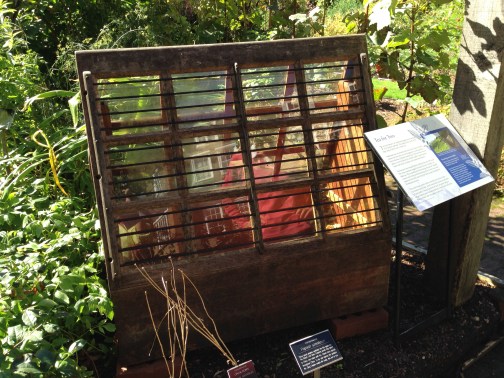
The Historical Walk introduced us to several people whose contributions to the world of botany and association with this garden are noteworthy.  I was especially interested in the story of Robert Fortune who was the garden’s curator when he left in 1848 on a trip to China.  He traveled on behalf of the East India Trading Company to collect tea plants for cultivation in the northern hills of India, then a British colony. He also perfected the Wardian Case which was a sort of mini greenhouse designed to transport seedlings successfully in the holds of great sailing ships through voyages many months or even years in length.
img_4275
Wardian Case

This intensively cultivated 4 acres also includes a World Woodland Garden, a Garden of Edible Plants, Sweet Pea Avenue, a Fernery (unfortunately closed for renovation) and many other delights. They offer lectures and classes throughout the year along with Family Days focused on child friendly activities. On our Sunday afternoon visit the lawn area bordering the cafe was full of families still dressed in their church clothes with “packed lunches”, blankets, books and bubble wands.

Our tour ended at a pair of gypsy style caravans used in educational programs.  The one pictured below features the life and pursuits of Dr. Sloane, the garden’s benefactor. The other, unfortunately in too much shade to photograph well, introduces the work of Dr. Carl Linnaeus, the Swedish botanist, physician and zoologist who formalized the modern system of binomial nomenclature. I was humbled to know that I have been writing scientific plant names improperly all my life. I learned that in the two name system of genus first, then species, the genus and species are always either in italics or underlined, the genus is always capitalized and the species is not. I stand corrected and will endeavor to do better!

img_4283
Learning about Dr. Hans Sloane

I’ll close this post with a few more photos of this lovely not quite secret garden. As always, there is never enough room to share every photo. I hope you’ll enjoy those I have selected and give a thought, if ever in London, to step away from the glitz and glamour of Kensington and Kew to see this tiny tribute to Great Britain’s contribution to the botanic world.


Wanted: stone cottage with a modest backyard…

Here is my first of several posts from gardens afar! Dave and I are in London for a bit over a week’s time. In a couple of days he will be off to attend his conference and I will, alas, STILL be on vacation.  After a stressful hiccup with our hotel arrangements we focused on  seeing the sights, deciding we could always sleep on any one of many very lovely park benches if need be.

We rode the London Underground from our temporary housing in Kensington to the Green Park station on our way to see what the other Queen has been doing in her house and garden.  Green Park is a lovely tree shaded city park with a well worn path leading right to her front gate. Even at 9 am the park had a number of family groups with their blankets spread out enjoying the start of a beautiful sunny day.

Clearly Queen E. was not expecting us as she had decamped to her summer residence in Balmoral, Scotland.  Luckily for us her absence from the palace during August and September each year gives the rest of us a chance to peek into the royal life.  Our tour was to include the Buckingham Palace State Rooms and a special exhibit called Fashioning a Reign: 90 Years of Style from the Queen’s Wardrobe. Although her interior decor is bit heavy on the gilding for my personal tastes, I can’t fault her taste in art and furnishings.  Great area rugs and lovely upholstery throughout! The exhibit of her clothing, which included a generations old christening gown (the one worn by the most recent royal baby), her wedding gown, coronation gown, and selection of special outfits from each decade since the 1920s, was captivating. Especially fun was the millinery collection featuring favorite looks over the years and introducing us to the designers who have served her under what are called Royal Warrants–in other words, hatmakers to the Queen. So sorry, Buckingham Palace allows no photography inside.

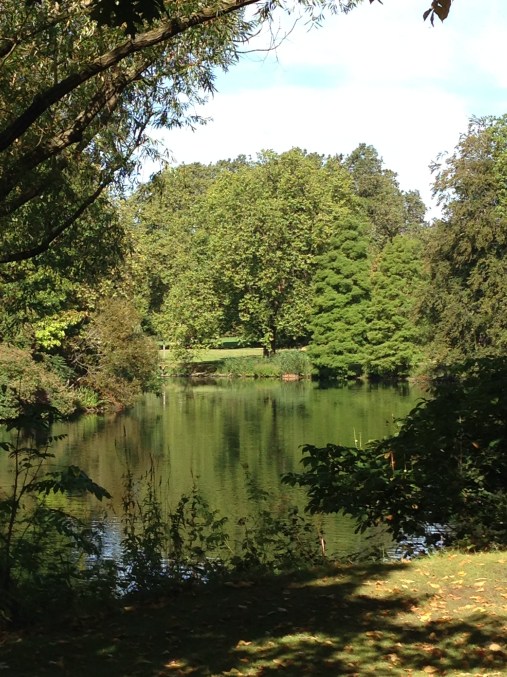
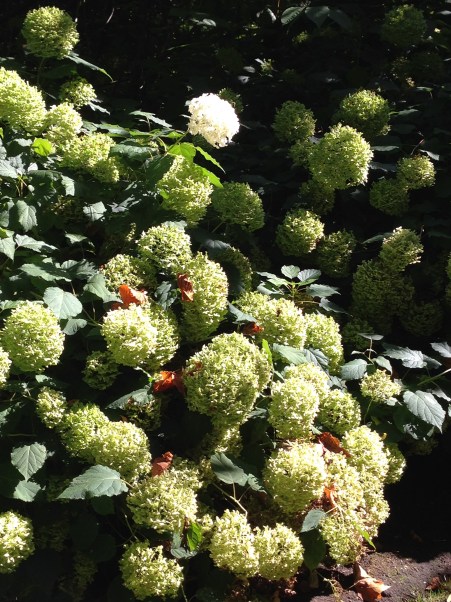
I was disappointed to learn that the Garden Highlights tours sell out within days of the new season’s ticket availability.  I did learn that Queen Elizabeth hosts over 8,000 of her countrymen/women at a series of garden parties each year in her 40 acre backyard. The Buckingham Palace gardens were not open to the public until 2008 when the August and September tours were initiated to raise funds for their upkeep. The gardens include a lake, a helicopter landing area and over 350 species of flora. The State Room tour ends in the the Bow Room which overlooks the broad back lawns so we did get a few glimpses of the south side of the garden as we exited. Have a look:

img_4219
Looking back as we were walking down the south side exit
img_4220
Small view of the 3 acre lake–a serene spot
img_4222
Wide swathes of ten foot tall Oak Leafed Hydrangeas
img_4236
Gigantic mop-head Hydrangeas finishing their summer

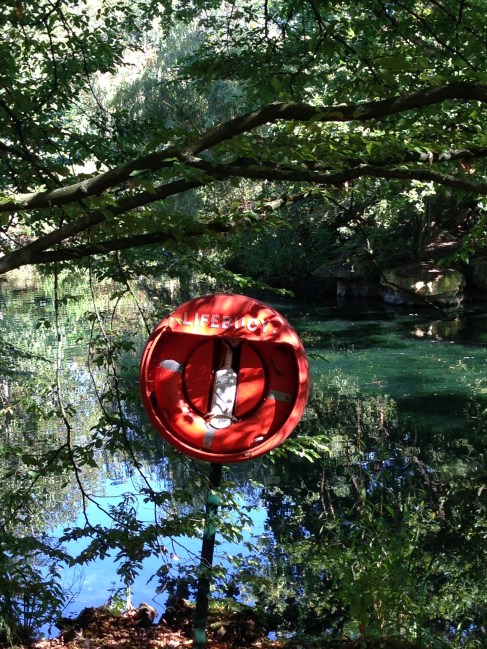
Can’t help but think the huge colonies of anemones and ferns were just a teaser as to what the larger herbaceous borders would look like.  I’ll leave you with this last photo–maybe a glimpse into a side of Queen E. we just don’t hear about.  This was taken on the edge of the lake which is quite close to the path leading to the exit.

img_4227
How do I get an invitation to one of these garden parties?

NEXT UP: The Pharmacist and the Physic

A tale of two plumbagos…

Let’s just get this out of the way before you think to make the observation–it is just a coincidence that the subjects of today’s post both have blue flowers! Most west coast gardeners are very familiar with the sprawling shrub commonly called Cape Plumbago, botanical name Plumbago auriculata or Plumbago capensis depending on your reference material. It is a staple of freeway landscaping in Southern California where the temperate climate encourages it to bloom year round.  Far fewer gardeners have made friends with its cousin Ceratostigma plumbaginoides, commonly called Dwarf Plumbago. Here’s a peek at both!

CAPE PLUMBAGO

IMG_4200

IMG_4206

Cape plumbago comes to us by way of South Africa and has earned its place in the record books as a workhorse shrub which is not too fussy about its conditions.  My south Orange County, CA garden had several hundred feet of very steeply sloped  ground, much of which was planted in this beautiful shrub. A single plant will grow into a loose mound 6 feet tall and 8-10′ wide making it a good choice to cover large banks or open areas.  If you need to keep it more under control just prune it back a bit in late winter.  I have room in my Central Valley garden for only the single plant you see in the photo.  It performs beautifully and fulfills the thankless function of covering a good bit of ground in the foreground of an established olive tree–ground which is almost untillable and an area of intense competition for water. Cape plumbago will be evergreen in areas of little frost.  True to its South African origins, frost will burn new growth and reduce your plant to a blackened mess but the shrub generally has good prospects for a spring recovery.  Cold tolerance is not a sure thing below USDA Zone 7 or 8. Recently I learned that seedlings of this plant vary widely in the intensity of the blue phlox type flowers. Mine is a very pale blue.  If you want to be sure of a more sky blue try to either purchase one of the named varieties such as ‘Imperial Blue’ or choose your plant when it is in bloom.

DWARF PLUMBAGO

IMG_4208

IMG_4207

You simply cannot find many plants bearing blue flowers as intense as those Ceratostigma plumbaginoides sports. This shrubby wirey-stemmed ground cover is treated as a perennial in most areas.  In my garden it breaks dormancy very late (June) and requires a long growing season to come into bloom, usually in late summer when the cool blue is a welcome sight in an otherwise parched landscape. Dwarf plumbago spreads by underground stems and it is purported to grow rapidly and widely in loose soil.  My colonies are a bit more restrained perhaps due to limited water and more compact soil than it prefers.  The fresh green foliage carpets (maybe more like an throw rug than a carpet!) areas beneath a grouping of miniature roses and a few clumps of under-performing daylilies. By the time the blooms are at their peak the foliage will be starting to redden for fall, providing additional contrast. In my garden the foliage dies back for the winter.  When late spring arrives I shear anything remaining above ground to stimulate the new bright green growth.

Temperate winter gardeners like myself have a tendency to dismiss deciduous plant material.  Because our landscapes do not spend the cold months buried under ice, snow or slush we seem to believe we are entitled to gardens that are green and blooming all the time, thus we gravitate toward evergreen trees and shrubs and ground covers (not to mention winter ryegrass and the flats of winter annuals!)  Because we don’t put our gardens to bed for the winter in the same way that many midwest and northeast gardeners do we also do not get to experience the thrill of the first crocus peeking up through the snow and many other early spring delights.  I can’t help but feel that the deciduous nature of the dwarf plumbago has been the deciding factor in its underuse in mild winter gardens.

I challenge you to expand your garden’s horizon with one new deciduous perennial, ground cover or shrub this fall–maybe the dwarf plumbago is the one for you! Dig it in, kiss it goodbye for the winter and wait for the rewards of spring.

Are you in the zone?

Picking plants whose intrinsic biological and cultural needs fall within the parameters of the soil and climate in which you hope them to thrive is perhaps the most basic gardening principle. The question “Will this grow in my zone?” seems as though it should be one with a yes or no answer. Nothing is ever that easy–not even understanding what your ‘zone’ is and what information that zone number is conveying.  There are several references  available to gardeners which tell us what zone we garden in.  Let’s look at a few of them:

USDA PLANT HARDINESS ZONE MAP

Nine times out of ten the zone number you see on plant tags and labels is the UDSA Plant Hardiness Zone.

A collaboration of climatologists, meteorologists and horticultural experts produced a lovely full color map first published in 1960 and updated in 1990. The USDA zone reference leaped forward to the digital age in 2012 with an additional update. There are no print maps produced of the 2012 update–you can access and download the maps from the USDA website http://www.planthardiness.ars.usda.gov or just type your zip code in the window provided on the site and you will be rewarded with your zone number.

But what does this magic number tell you?  The USDAPHZ (yes, they actually refer to it that way now on the website) is a scale which shows the average annual minimum winter temperature, divided into 10-degree F zones, during a 30 year historical period.  Each 10-degree slice has an “a” and a “b” part so the USDA Zones and corresponding temperatures start at 1a (coldest winter) and rise in 5 degree F increments to 13b (warmest winter). For example my zip code 93711 is in Zone 9b with average annual minimum winter temps of 25-30 degrees Fahrenheit.  Typically a plant label or description will state a range of zones or use the wording ‘hardy to zone__’ indicating the lowest zone number recommended for the plant. For gardeners in cold weather winter parts of the country this zone number is critical in determining whether a plant will “winter over” or be lost to temperatures simply too cold for the plant’s cultural requirements. Bear in mind that past weather records are not a guarantee of future weather. Additionally, all gardens have a variety of microclimates within them–valleys or low spots where cool air collects, warm pockets created by the reflection of the sun off concrete or blacktop, etc. The number is never a substitute for your experience and that of fellow gardeners in your area.  It is simply a place to start.

For those of us in areas characterized by milder winters and screaming hot summers the  USDAPHZ leaves us in a quandary.  If my plant choice is burned to a dry husk or wilted down to a barely recognizable lump by September it really is of no benefit to me to know  if it will winter over!  The need for a scale to identify heat tolerance easily must have inspired the creation of this next zone map.

AMERICAN HORTICULTURAL SOCIETY HEAT ZONE MAP

Cold is not the only factor which determines whether what you plant will survive and thrive in your garden.  Heat was finally given its due with the creation of this 12 zone map.  The zone number indicates the average number of days each year that a region experiences “heat days”–temperatures over 86 degrees F. The AHS designates this as the temperature point at which plants start to suffer physiological damage from heat. The zones range from Zone 1 (less than one heat day per year) to Zone 12 (more than 210 heat days). My garden is in AHS Heat Zone 9 which equates to 121-150 days annually exceeding 86 degrees F. When a label or reference lists the recommended zones they are listed from high (hottest) to low (coolest).

IMG_4193

The above label is a perfect example that the zones, whether hardiness to cold or heat tolerance, are only a starting point for your selections.  The ‘Blue Waterfall’ campanula’s hardiness number tells me that my winters are plenty warm in  USDA Zone 9 as this plant can tolerate winters in zones well below mine but I am pushing beyond the recommended AHS Heat Zone by a couple of notches. My colonies of ‘Blue Waterfall’ are sited in early morning sun only and get adequate water and have been very successful. I suspect  that if they were planted in anything close to the full sun they can take in cooler zones and they would be toast!

As recently as a few years ago the AHS website had a zip code zone finder tool similar to that of the USDA website.  This has disappeared from their site and other sites which formerly had links to it.  I suspect that AHS would like you to purchase their map.  The Society has also classified more than 2000 plants by AHS Heat Zones and offers that information in a reference manual called AHS Great Plants Guide. Their website, http://www.ahs.org, is packed with lots of gardening basics/resources and you can purchase both the book and the map online.

The excitement of having heat tolerance classifications for plants and a nifty full color  map to find our zone is dampened in that relatively few plant growers or garden centers mark their stock with the AHS Heat Zone. AHS is promoting a label format that will offer both cold hardiness, heat tolerance and a classification such as annual or perennial but until industry takes up the cause it is all just information under wraps unless you purchase the reference material and carry it around with you as you shop!

REGIONAL GARDEN GUIDE CLIMATE ZONES

Lifestyle, garden and travel gurus Sunset Publishing and Southern Living Inc. both have book format regional garden guides covering the geographical areas of their circulation focus.

The Sunset Western Garden Book began as a plant selection guide published in 1935.  In 1954 the first Sunset Climate Zone maps appeared, dividing its focus area into 13 climate zones.  Sunset refined and expanded the maps in 1995 delineating 33 climate zones covering 13 western states and a small part of Canada.  The Western Garden Book has been the “go-to” resource for practical gardening information and plant selection for generations of western gardeners.

When I moved to Georgia in 1995, my So Cal girls gave me a subscription to Southern Living and a copy of The Southern Living Garden Book to get me started in my new home. Amazing, this garden reference not only covers areas typically thought of as the South but also Kansas, Missouri, Illinois, Ohio, Pennsylvania, New Jersey, Maryland and Delaware.  Everyone must love New Mexico as both books lay claim to this state.  I feel badly for the gardeners in the Dakotas, Iowa, the Great Lakes states (2 Ms, 1W and New York) and all those little Eastern seaboard states past New York that they don’t have a publishing conglomerate looking out for them! The Southern Living Garden Book divides its domain into 5 zones: Upper, Middle, Lower, Coastal and Tropical, each followed by the word SOUTH.  Well, it is their book after all!

Both these stellar regional garden guides espouse that factors well beyond heat and cold ultimately affect the success or failure of your plant selections. Sunset lists latitude, elevation, ocean influence, continental air influence, mountains, hills, valleys, microclimates and soil as components unique to any geographic region that would make it a welcoming home for a plant with specific botanical needs. Southern Living emphasizes that the relatively short, but sometimes frigid, winters combined with hot and humid summers presenting unique challenges across its southern (and semi-southern) readers gardens.

Each of these guides presents detailed climate information zone by zone and not only gives you a number you can use for reference in identifying plant material’s suitability but also lots of general climatology and geophysical data that is really pretty interesting reading. My Georgia garden was in the Lower South zone which is described as “a region of short winters, early  February springs and hot, sticky, often dry and seemingly endless summers with nighttime temperatures usually no lower than the mid-70s.” My California Central Valley garden is in Sunset Zone 8, characterized as a cold-air basin with a long  constantly sunny growing season, high summer daytime temperatures and piercing cold winter north winds.  We sit right on the edge of Sunset Zone 9–the primary difference being that Zone 9 is a thermal belt sit at the base of foothills whose cold air can flow right into my Zone 8. There goes my opportunity to grow citrus commercially…

If you were to look at the USDA hardiness of my Zone 8a Georgia garden and Zone 9b California garden they look pretty similar, just as my AHS Heat Zone 8 Georgia garden cozies right up against my California garden’s AHS Heat Zone 9.  In fact, due to gargantuan differences in humidity, rainfall and soil types these two gardens are very different from each other.  The  additional factors used by these two regional gardening guides lead me to rely far more on their zone structure than looking at raw numbers of heat and cold only.

It is not totally uncommon to see the Sunset Climate Zones listed on plant tags for things that are grown in California–especially now that Sunset has partnered with growers to market the Sunset Western Garden Plant Collection.

You may also see plants tagged with any combination of the different zone numbers–USDA + AHS Heat Zone as it visible in the ‘Blue Waterfall’ tag above, USDA + Sunset or AHS Heat Zone + Sunset. Hopefully, the tag will tell you what reference is being used not just give you a number! Here’s a test for you below:

IMG_4189

You have a number range but whose zones are those?  This has to be a Sunset Climate Zone   indication because none of the other scales in use now have numbers as high a 24!

Are you ZONED OUT yet? The takeaway here is that we have all kinds of resources to help us plan our gardens using plants which have the greatest possibility of thriving in the setting we provide.  Use these resources with the foreknowledge that a zone is not a guarantee. Arm yourself with information, revel in your successes and tell those dead ones  that there are more just like them where they came from.

Xerihysteria!

Although the Central Valley of California has long been known as a region of no summer rainfall, the past several years’ lackluster winter rains and even more critical,  very low winter snow packs in the Sierras, has heightened our water awareness, both residential and agricultural, and is moving us to take seriously the need for less thirsty landscapes. Gardeners in my valley have been living a fool’s dream for many years.  We live in an area which receives less than 13″ average annual rainfall, with half of that being concentrated in the months of January, February and March.  We have built our dream gardens in a veritable desert with relatively cheap and available water–at least available in our minds. I can remember my mother talking about city outdoor watering restrictions as far back as 20 years ago. I have not an ounce of the requisite science to tell you why things NOW have gotten to critical mass–I just know that seems to be our current state.  My city limits outdoor watering to 2 days per week during very specific hours, other cities in my valley have total outdoor watering bans. Water rates are still reasonable compared to some other localities but increases are inevitably, on the horizon.   New homes now offer synthetic lawns or very limited square footage of lawn.  Cities are offering monetary incentives to remove turf and replant those areas with drought tolerant plants, mulch and rocks.  We are bombarded from all sides to move into the arena of low water landscapes.

I have long held some gardening principles which dance around the edges of water conservation;

I keep my more delicate and thirsty plant materials clustered close to the house where it is easy to give them a bucket or two of water if needed.

IMG_3790

I recognize the benefit of creating shade, both with trees and structures.

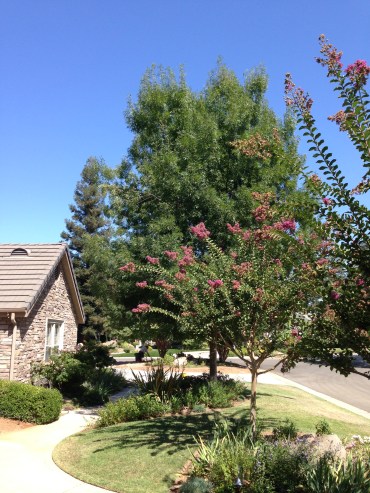
The Raywood Ash below, planted from a 15 gallon can in 2010, is large enough now to cast some very nice pools of shade on plants which would normally be brutalized by the sun all day due to their south and west exposures.  The two crape myrtles, formerly pruned to their knobby knees in search of increased bloom, are now pruned lightly after their first flush of flowers and a bit more in January with an eye toward developing a nicely branched small canopy (yes, this does decrease bloom to an extent.)

IMG_4181

We added trellis-work to our backyard pavilion to grow Eden climbing roses. The trellis, long since planted, provides needed support for the roses and some sun protection for the plants added below. Eventually the massed roses will increase that protection.  The back of the pavilion receives the shade benefit of the foliage from 3 mature Bradford pear trees.

IMG_0186

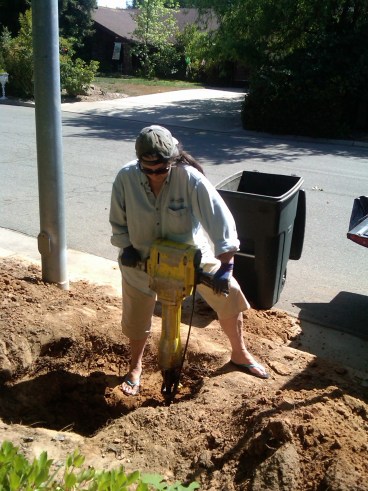
We work really hard to provide optimum growing conditions by double digging for new beds, amending our soil and adding compost to our beds yearly.  Yes, that is me behind the jack hammer!

IMG00191-20120508-1020

I try to focus on plants suited for our hot  and dry conditions. Plants native to Mediterranean areas and the American plains are good candidates.

On the not so successful side…we have found it a challenge to even condsider converting to drip.  We have an about 1/2 acre and 14 lines totals. As we have enlarged beds and eliminated small amounts of turf over the last 8 years our lawn and bed lines overlap each other in some parts of the garden and we lack good coverage in others.  We are just not willing to incur the expense or do the work to entirely replace our automatic sprinkler system. An even  greater challenge is my unwillingness to become an ornamental grass and rock girl.  I love my roses and much of my existing evergreen shrubbery. I have found most mature plant material to be more adaptable to reduced irrigation than we give it credit for. I have all ready rid myself of things I did not want in my garden and so now I’ll have to find a way to add in moderately waterwise plants which will not be too out of sync with the look I want and I level of care I am willing to give.

Our 2016 waterwise initiative has been to reduce the amount of turf the front garden.  Living on a corner lots results in a lot more front yard than is easily cared for.  We targeted 4 areas for turf removal-2 small and 2 large.  While our front lawn is of the Heinz 57 variety, the bulk of it is common bermudagrass. Permanent elimination of bermudagrass pretty much requires a chemical component.  I expect that when the permafrost starts to melt in those northern reaches the scientists will find viable roots from bermudagrass and when they go out for lunch they will return to a fully established lawn! As such, we needed to wait for the bermuda to break dormancy in order for the herbicide to be fully taken down into the roots.  Our weed control expert treated the areas in June and all was looking pretty bad within a couple of weeks.  Meanwhile I got a bit impatient and we actually dug out one of the small areas (about 25 square feet) before the grass was fully dead.  That area is pictured below.  It has been replanted with 3 Knock-Out roses which I have found to be very unfussy about water after their first year. The roses are underplanted with a single purple trailing lantana to act as a gound cover. We did reconfigure the existing sprinklers to provide enough water for the roses to establish and then 2 of the 3 heads will be capped off.  These plants look remarkably well considering our hot July and only about 5 minutes of water twice a week!

Looking for that feeling of satisfaction from actually completing something (you know like when you pay off the smallest of your credit cards so that it is gone then move on to the next smallest rather than putting all your money on the huge balance but still getting that bill, now a wee bit smaller, next month) we moved on to the second of the small sections.  All of you who have been to my home will recognize this stupid little piece of stand alone turf right by my front step.  With the backdrop of a well established and very healthy 3 foot high boxwood hedge this little 3/4 moon shaped area has the potential to be a showy little seasonally planted little bed.  I am just not sure I really want to go there!  We dug out the dead grass–much easier to dig the roots than when they were only half dead as in the first area–and my husband  exposed and temporarily capped off the sprinkler lines.  The bed was then double dug to a depth of about 18″, the soil being amended as it was returned to the bed. I added a 15 gallon ‘Natchez’ crape myrtle.  My heart’s desire was a pale pink blossomed tree to complement the stone and my purple front doors, rather than the white flowers of ‘Natchez’, but the small planting area with sidewalk on one side dictated a smaller cultivar.  In true garden ninja fashion I dug this tree in on a day when the temperature topped 109.  The tree responded by dropping every one of its leaves but you can see some new foliage emerging after about 10 days.  Hope springs eternal in the garden world! The jury is still out on what will go below the tree. This small area had 3 existing sprinkler heads which we changed from lawn pop ups to risers. We left the three for now and will evaluate the removal of 2 as time goes on.

IMG_4178

After these two smaller areas exposed the ins and outs of doing a good job removing turf and preparing these heavily compacted areas for replanting, my shovel loving-rototiller disparaging husband may be wavering on some mechanical aid for the two larger sections to come.

The driveway circle area has an irregular strip of turf about 6 feet wide and 60 feet long if you stretched it out in a line.  He has exposed the sprinkler heads and capped them off in preparation for the big dig. The strip of lawn on the side of the house starts out quite wide at the driveway edge then narrows to about 5 feet wide.  It extends about 80 feet beyond this large blue juniper.  I’ll keep you posted on our progress!

“Let’s just get rid of the lawn.” rolled off my tongue in last March. Easier said than done.  Especially if you want the greatest possibility for successful new plantings.  Two other gardening friends are working through this process as we are.  The questions and concerns seem endless.  How do I blend these new beds (with hopefully waterwise plantings) with my old beds to create consistency and rythym?  I see great new plants at the garden center that supposedly need no summer water–how can I integrate those in areas having some sprinkler coverage? How do I keep the mulch from washing off my raised areas? I see lots of ideas in magazines and books. Why can’t I find those plants in my retail nurseries?  We definitely have more questions and answers!

Two more blues, one coral pink for balance…

It is a fact that my current garden is heavy on pinks, blues and purples so don’t hold your breath waiting to see lots of photos of yellow flowers! My Georgia garden started out leaning that way also until I realized that the more mid range tones were just about invisible against a beige painted brick house which stood some 150 feet off the street.  Gradually the foundation beds in that garden became a riot of purples, blues, oranges and golds with a bit of white thrown in to calm everything down.  As no husband of mine (to date, at least) has said, “Go ahead, honey, just take the garden down to dirt and rebuild it however it tickles your fancy.”, I  have had to play the color hand I have been dealt in terms of mature flowering trees and established, healthy shrubs. I expect that is more the rule, rather than the exception, and I am fortunate to have a partner who may not totally get my vision but at least pretends to and will help execute most of my garden schemes!! Once you know what you have to work with you can then build on that palette with the addition of new shrubbery, annuals, perennials and ground covers.  With each selection you add not only color but also texture and a variety of shapes to your garden.  As garden areas mature and fill in you may find less need to add plant material just to cover bare places and shift your focus to adding plants whose particular blossom, foliage, scent or other characteristic really delights your soul!

The most visually pleasing gardens contain layers of plants whose characteristics complement and contrast each other.  Once the upper layers–trees, large scale shrubbery–are established, remaining areas can be planted in perennials and annuals.  As the perennials mature to larger clumps and drifts you may find less and less need for the seasonal exercise of “planting the annuals.”  Annuals and plants treated as annuals play a very important role in mixed beds and borders.  Individual perennials, by their nature, have very specific flowering periods and although some can be headed back for additional bloom flushes they often do not put out the prolonged show we all hope for.  Even with thoughtful planting of a variety of perennial groupings you can hope to always have something looking great but never expect to have everything looking great all at one time!  Annuals add flower power to areas where the perennial show has passed or is yet to come.  Better yet, reseeding annuals add the hope of another season of plants even if not in exactly the same place you put them the year before!

We are coming up on 8 years in our current home and I am still building the layers in this garden.  I have reached the point where I don’t routinely add seasonal annuals just for the gardening exercise. The first year we were here I plant 22 flats of pansies in November and untold more flats of other cool season annuals then repeated that with different selections again in April. Last November with continuing drought, a cabin in the mountains and mid 60s knees I planted only one–in the most visible area along my front walkway. I can still sleep at night.

I do plant a few interesting annuals every year.  The additions are more the result of enjoying the trip to nurseries far and wide to see what’s new than they are to fill bare spots.  I have learned that bare spots rarely stay that way for long.  Not infrequently I have forgotten something I planted in a spot a couple of years ago and it miraculously reappears as if it knows I am thinking about putting a shovel to its resting place. Here are three annuals I am enjoying this year:

IMG_4131

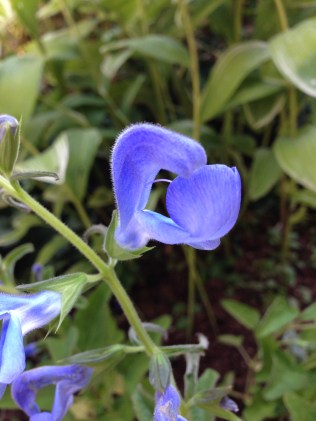
SALVIA PATENS ‘BLUE ANGEL’

Salvia patens is commonly known as Gentian sage.  In truth, this salvia is a what is called in the botanical world a ‘half-hardy perennial’.  Half-hardy perennials are treated as annuals in areas whose winter temperatures exceed the plant’s natural tolerance to cold air or soil. In its environment of origin, central Mexico, it grows and flowers year round.  In all but our mildest central California winters it has perished in the cold.  There are many cultivars of Gentian sage and according to garden resources ‘Blue Angel’ is one of the smallest in stature at just under 2′.  Because my efforts at overwintering these gems have failed and I am always starting with new plants I rarely see foliage exceeding 12-16″. However, the gorgeous striking clear blue parrot beak like bloom makes treating it as an annual ok with me. The larger photo shows the fully open flower and the lower right shows the bloom just getting ready to open. This is one of the salvias that prefers moist but well draining humus enriched soil and some shade. Recently I have read that Gentian sage has an easily dug tuberous root which makes it a good candidate to pot up and spend its winter in a sunny room.  I am going to try it!
AGERATUM HOUSTONIANUM ‘BLUE HORIZON’

Ageratum is summer annual so well known and loved that most people use its botanical name instead of its common name, Floss Flower.  Most commonly seen are the dwarf cultivars such as ‘Blue Danube’ and ‘Blue Blazer’ which at 4-6″ high edge literally thousands of garden beds ever summer.  ‘Blue Horizon’ will grow to 30″ in perfect conditions of rich, moist soil and morning sun only.  These plants went in from a 6 pak in late May and are about 20″ tall to date. The powder puff flower heads are about the size of my fist.  This ageratum’s tall sturdy stem makes it an excellent cut flower. The availability of these taller cultivars in my local garden centers has been sketchy at best.  I am going to try a a taller white variety from seed next year–I’ll let you know how it turns out!

SALVIA COCCINEA   unmarked variety but I believe it to be ‘Coral Nymph’

So I feel as though you need some relief from all the blue!  This salvia is very commonly found in garden centers and big box garden departments.  It is so ubiquitous that often times the grower does not even feel the need to identify it.  I bought several 6 paks in May marked ‘salvia pink’.  This sage is technically a perennial but is grown as an annual in all zones.  As is the Gentian sage, salvia ‘coccinea’ is native to Mexico.  I have had some success at these plants wintering over and they also reseed prolifically.  The foliage mound remains quite low at about a foot but the flower stems rise to the sky and wave in the wind. The blooms are a magnet for every hummingbird and bee around, including the huge bumblebees we have so many of this year. Not easy to photograph a moving bee on a moving plant with an iPhone but I think you can get the idea. To get the most continuous bloom deadheading is an essential but easy task as the spent stems can be snapped off with your fingers.  This sweet little ballerina of a quasi-annual is a great choice for a novice gardener–I just don’t think you can fail with her!

Can’t live without…

Every gardener has their favorite indispensable tools and accessories and I am no exception. I have a long history of being a sucker willing to try the great new thing in the marketplace for all my life’s activities. As a quilter I cannot pass by a new ruler designed to cut something I have been cutting all along with an old ruler, but this one promises to make the job just a little easier. In my baking life I have enough specialty pans for 10 kitchens and try to ease my guilt by loaning them to anyone who shows even a slight interest (madeleines, anyone?) I can’t even get into the excesses in the greater craft genre—stamps, die cutters, paper, wood, findings—oh, my! My claim to fame is that I am way more successful at gathering and organizing the supplies and accessories for a project than I am at actually sitting down to work on it. When my youngest son played Little League we lovingly called him “accessory boy” for the number of batting gloves, wristbands, guards of all types and custom Oakley prescription sunglasses needed for him to catch that ball behind the plate. Apparently you can be genetically predisposed to accessorize!

The stage being set you will be amazed to know I am pretty one dimensional and non-innovative (is that a word?) in my gardening accoutrements.  Here are a few of my favorites:

IMG_4141

CORONA BYPASS PRUNERS

I have been using this style of hand pruners for at least 35 years. Let me clarify–not these exact pruners–if I had a dollar for every pair I have lost in the garden or thrown away accidentally, we would be living in Paris now with a view of the Eiffel Tower! Every now and then a fresh young thing comes on the market trying to woo me away but I always come back to these. The larger pair is the Corona Classic Cut BP3180 which cuts up to 1″ diameter branches. The smaller is Corona Classic Cut BP3160 which cuts up to 3/4″. I have a third one yet a bit smaller, the BP 3130,  but I am sure you’ve have guessed that they are not pictured because they are currently lost in the garden somewhere. The middle size is my go-to pair of pruners for deadheading and general clipping back. It fits well in my hand, is not too heavy but gets the job done. My husband likes the larger ones and he gets to use them in return for keeping all 3 sharpened. He can be a rather over enthusiastic clipper if left unsupervised, not too much into the art of it and more into the “if I just cut it to the ground then I don’t have to worry about it for a good long while” school of pruning. As a left handed person these are the only pruners I have found whose lock to close mechanism (to the right of the spring in the photo) is accessible for me to operate with my thumb while I am holding the clippers. The locking mechanism is generally on the wrong side of the tool for me to use it one handed and I have to shift the clippers to my right hand then lock with my left–very cumbersome and really a deal breaker for me.

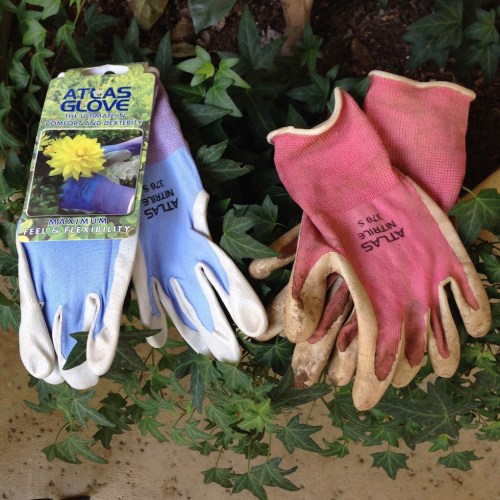
IMG_4137

ATLAS GLOVES

I resisted wearing gloves in the garden for decades and my hands and nails told the tale.  A few years ago I received a pair of these Atlas Nitrile 370 gloves as a gift from a young lady whose father owns a nursery and I was a changed woman!  These very lightweight yet strong and flexible gloves answered every objection I ever had about garden gloves.  The palms and fingers are coated with nitrile making them durable while the body is stretchy nylon/polyester.  I buy a size small so that they fit quite tightly but are still very comfortable.  These are the only gloves I  have ever had that allowed me to actually pull small plants out of 6 paks without damaging them.  It is a joy to be able to wear gloves to protect my hands without reducing my dexterity! I also use them when I paint rather than latex gloves. I machine wash them and hang them to dry.  Last year I found that I could purchase them in groups of 6 pairs through Amazon for about $18 (this may have changed) so I usually have several pairs in use and at least a couple in reserve. A++

IMG_4140

RAPICLIP SOFT WIRE TIE

I use several products to train and tie up vines and roses and this is my favorite.  A very fine wire runs through the center of the green tube which allows you to simply twist the ends together.  The gauge of the wire allows the tie to be cut with household scissors or your pruners. The soft exterior material is strong but easy on delicate leaves and stems and the green blends in with surrounding foliage so as not to draw attention to your support.  It weathers very well through heat, cold and rain and when I remove supports I keep the cut pieces to reuse.

IMG_4139

GREEN VINYL COATED PLANT SUPPORTS

This category comes as close as we will get today to accessories gone wild!  I have literally hundreds of these, in a variety of shapes and sizes.  The green vinyl coating disappears amongst your foliage and allows you to invisibly support all kinds of plant material.  They are easy to push in and pull out to move about your beds, relocating them to meet current needs. The half hoop supports come with ‘legs’ from 12″ long to 48″ long.  The half hoop part may be anywhere from only a few inches across or as wide as 18″ across.  The larger/taller ones are perfect to support great masses of floppy perennials such as penstemon or salvia which can tend to bury their neighbors at the peak of their growing/blooming season or, in my garden, fall over onto the lawn and get cut off by the lawn mower.  Smaller scale plant masses use the smaller scale supports.  The bloom stakes have an almost full circle at the top of a long stake and also come in lengths from about 12″ up to 36″.  Generally the longer stake will have a slightly larger bloom circle at the top. The idea is that you insert the stake in the ground at the base of the plant and then gently lead the bloom’s stem through the open part of the circle.  These are invaluable for plants that have flowers with long stems and heavy heads. The weight of the flower may lay the stem down on the ground or even break the stem.  The bloom support takes the weight of the flower head off the stem and allows the flower to stand tall and proud to be enjoyed by all!  I use these all the time on iris, calla lilies, asiatic and oriental lilies. Vinyl coated plant supports are available at many retail nurseries but I have found much more variety at online sources such as Gardener’s Supply or Plow and Hearth.

What do you use that you could not live without?  I’d love to hear about YOUR must haves!

Too cool summer blues

The only blue that gardeners in my HOT, HOT, HOT valley really want to see right now is the blue water of a cool swimming pool!  With our temps for the week forecasted to peak at 111 degrees on Friday it is hard to even think about getting out in the garden to see what’s happening. Late July to early August is the perfect time to cut back by half many perennials which have been blooming since early spring. This will force them to rest a bit, not expending too much energy in supporting blooms. This brief rest during our hottest time usually results in some new growth pushed in September and possibly additional blooming periods taking them up to the winter cold.  The complicating factor for me is that I have to get out to do that cut back starting around 6 am and only have a few hours until only crazy people are working in the yard!

Many plants have stopped blooming due to the excessive heat but I do have a couple of cool blues in bloom to share with you.

Platycondon grandiflorus ‘Sentimental Blue’ is a dwarf selection of the old fashioned favorite balloon flower found in our grandmothers’ gardens.

This cultivar has a very compact upright growth habit reaching from 6″-12″ tall and 12″ wide.  In the left photo at upper right you can see one of the platycondon’s characteristic hot air balloon shaped white buds. These whimsical flower buds open to a star shaped blue violet flower highlighted by darker blue veins.  Anybody notice a resemblance to another plant I have featured in previous posts?  Platycondon grandiflorus is in the same plant family, Campanulaceae, as the campanula or bellflower.  This is a great front of the border or bed perennial and reliably comes back for me every year. Plants grown from seed will take a couple of years to get well established. Although they perform better with weekly water, they have a deep fleshy root that, once established, seems to keep them going during lean watering periods. My plants came from six packs planted 4 or 5 years ago and they flower freely for 6 months of the year.

Tradescantia ‘Sweet Kate’ is an easy to grow perennial whose deep blue flowers are an eye catching contrast to its yellow green grasslike foliage.

The common name for this plant is spiderwort.  According to the Kemper Center for Home Gardening when the stems of spiderworts are cut, a viscous stem secretion is released which becomes threadlike and silky upon hardening (like a spider’s web.) You can also see the resemblance to one of its cousins, the wandering jew, that we all grew in hanging baskets in the 70’s! There are many garden varieties of spiderwort with flower color varying from white to blue to pink and near red but this one is unique in its foliage color. Individual flowers last only a day but the buds come in large clusters and once they get started they are rarely out of bloom through the summer months.  A single plant will form a tidy clump about 18″ X 18″. Although many tradescantia varieties are invasive self sowers and rampant spreaders ‘Sweet Kate’ is quite well behaved.  Give it moist soil and a partial sun only location for best success.

Stay cool and take time to smell the flowers this summer!

A summer survivor…

As our hot summer wears on many plants in my garden are looking quite peaked and forlorn.  Although it has been a cooler week here; in the nineties rather than the days of 105-108 degrees we’ve had for a few weeks, it is still a challenge to keep things going with our 2 days per week and limited hours of the day watering restrictions.  We continue to bucket bath and shower water to many of the more thirsty plants and are in the process of removing several areas of lawn in favor of more drought tolerant shrub plantings.  The later will not happen over night–we have had the lawn chemically killed but now must double dig those areas to make them ready for fall planting.  My long term goal is to have fewer garden areas which need intensive maintenance and significant water to keep them going.

IMG_4096

This interesting plant has proven to be a summer survivor–Talinum paniculatum ‘Limon’, commonly called Jewels of Opar ‘Limon’.

I added this succulent subshrub in the purslane family to my garden from a 4″ pot about 3 years ago.  It was another impulse buy but I am a sucker for plants with lime green foliage. A plant would have to have well documented zombie apocalypse characteristics for me to pass on those bright and happy leaves! Even after a bit of research I was still unsure of its sun tolerance so I stuck it in a pot of mixed annuals and perennials near the edge of my back patio.  The original plant was not cold hardy and was lost during the first crisp snap of that fall but every year since I have had many seedlings appear in the beds closest to the original pot’s location.  Based upon that I suppose ‘Limon’ could be a blessing or a curse (especially in those areas without cold to knock it back naturally) but I have found the unwanted seedlings easy to pull and really enjoy seeing where it will show up next!

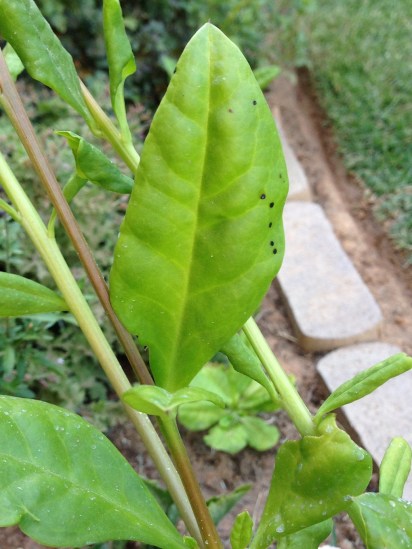
IMG_4098

The bright chartreuse foliage really pops in beds of mixed perennials and annuals whose leaves are more mid green.  The wee pink flowers appear as a gauzy cloud hovering above the foliage and are followed by tiny magenta seedpods.  It is very free flowering with new stems appearing frequently.  At any point most stems will have buds, flowers and seed pods in an airy jumble. Literature suggests this plant could get quite large but my foliage rarely exceeds 12″ and the slender flower wands extend its height to about 24″-30″. The first seedlings emerge very late in June but as the plants continually produce seed pods I then have new seedlings until the first frost.

In my garden the foliage is a magnet for a small white butterfly.  The dancing moms will pass by many other species to lay their eggs on the Talinum.  The quickly emerging and ravenous lime green caterpillars are almost invisible on the foliage and can decimate the plant in a day. Below you can see the tiny black eggs laid by the butterfly.  Unfortunately or thankfully, depending on your perspective, I had no caterpillars to photograph for you at this moment! When an individual plant gets too chewed down I harvest the flower wands to add to bouquets and just pull up the plant as I know there will be more to come. After all–we all have to eat!

IMG_4097

All in all, the Talinum seedlings are a welcome sight each year.  They provide exuberantly colored foliage and sweet little flowers, both filling in bare spots in the bed.  Though they are not totally without maintenance, the little they require is worth the reward!

Hip, hip, hooray!

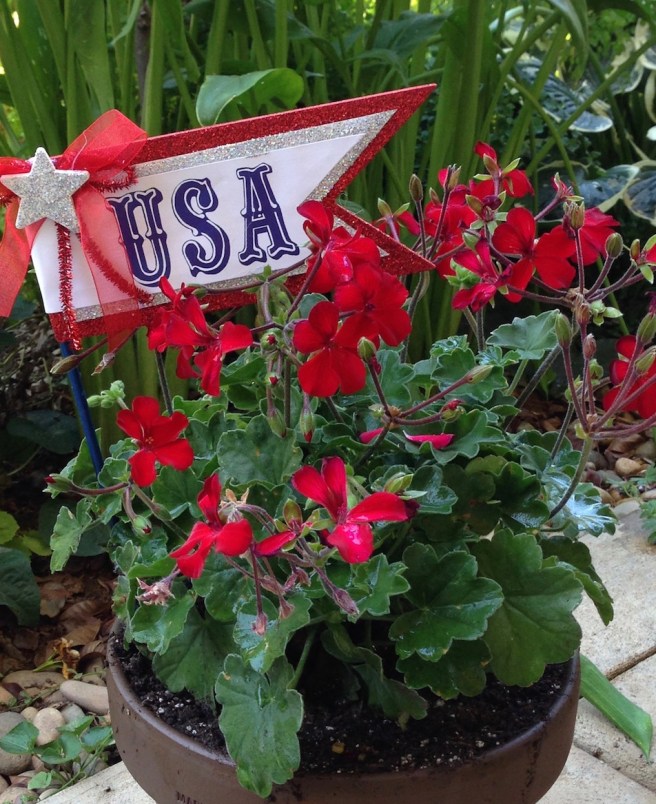
IMG_4084


Happy 4th of July to all my gardening friends far and wide!  This very clear but not too orangey red pelargonium is part of a 10+ year breeding program crossing ivy pelargoniums with zonal pelargoniums in search of hybrids with the best of both plants.  The Caliente series is heat and drought tolerant and flowers profusely.  Check out http://www.provenwinners.com for more details and to see photos of the other colors in this series.