I guess some plants just know when you’ve picked the right spot for them and they reward you in kind. Such has been the life of Salvia ‘Bon Bon’ since I dug it in near the base of our mailbox on March 20th of last year as part of the replanting of an area previously predominantly turf.
I’d like to say the ‘plan’ for this area was laboriously developed, plant by plant, using age-old principles of good landscape design. Alas, it came to be as most other parts of my garden have–with the statement of a broad goal (reduce irrigation) and whatever plant materials I find in my garden travels supplemented by stock from big box stores and the very few independent garden centers in my city. Sometimes the pickings are good, other times not so much. There is no benefit in developing a design for an area with a pre-planned plant list if those plants cannot be sourced fairly locally.
Having bought several selections new to me at the San Luis Obispo Botanical Garden’s fall plant sale in October 2017 I was still in salvia mode when I ran across a single sad 1 gallon ‘Bon Bon’ at a local nursery, Willow Gardens. It looked as though it had been hanging around awhile and while not especially appealing it was one I didn’t have and fit my broad parameter of being at least moderately xeric. I stand guilty of buy now and research later on this one.
March 21, 2018
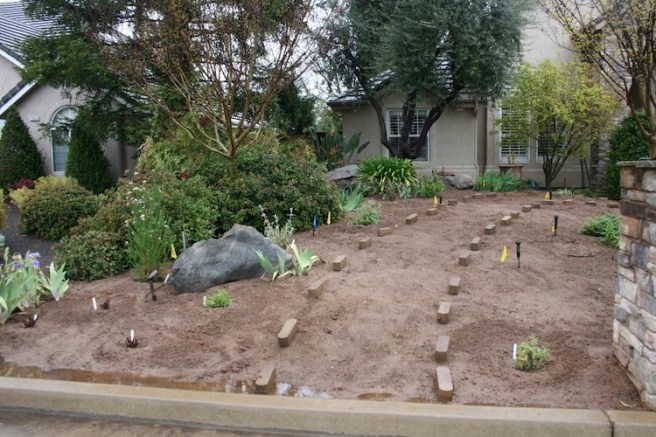
At planting it was not even worth a close-up pic but you can see it just to the left of the stone mailbox. Monterey Bay Nursery’s website described it as “a perky, cute little native hybrid of S. clevelandii ‘Aromas’ and S. leucophylla ‘Point Sal'” and as “a very tough, low diminutive dry garden ground cover for full to half sun.” While I can attest to its toughness–this spot has NO source of summer water and it is full on south facing–I am assuming the diminutive appellation is relative to other closely related salvias. Its size is described as about 30″ tall when in flower by about 36″ wide.
Settling in nicely on May 24, 2018At summer’s end–September 23rd, 2018–no rain since April, out of range of the irrigation system and no hand watering–I am looking way more worse for the wear after summer than ‘Bon Bon’Coming into bloom in late February 2018
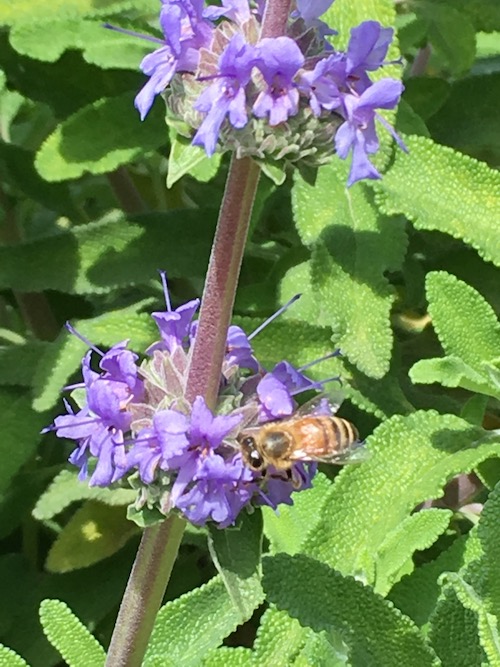
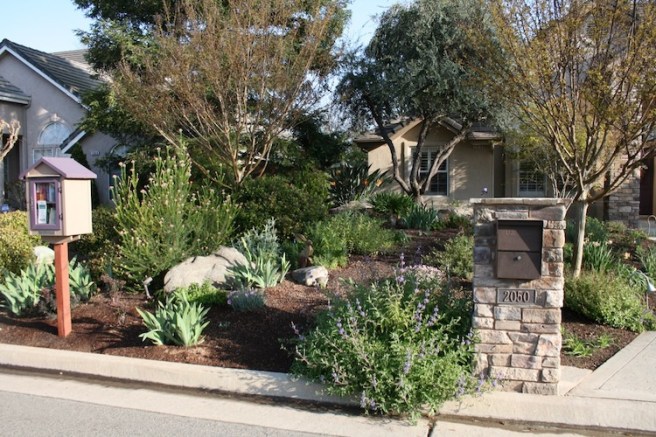
From only a slightly different angle this bed has filled out beyond my wildest dreams in the last year! Salvia ‘Bon Bon’ is a standout snuggled up against the mailbox’s stone column and awash in blooms and bees. I am still unsure if this is its normal bloom cycle. I recently added another to the opposite side of the front walk and it is also starting to bloom. This second spot is slightly less dry and I’m interested to see if the additional water results in a less robust plant. At just a year in the ground it is already at Monterey Bay Nursery’s mature size estimate. I am planning to tidy it up when these blooms are done and that effort will be the first I’ve made on its behalf since it was planted–my kind of minimal maintenance requirements for sure. I’ll let you know when it gets to be bigger than a coffee table! I’m giving ‘Bon Bon’ an A++ for its fledgling year.
The last few years stock tanks, traditionally used to water livestock, have been popping up in gardening magazine and websites repurposed in all kinds of creative ways. Even the largest sizes are relatively inexpensive in light of of the visual bang for your buck in the garden and they fit right into the upscale farmhouse home and garden vibe so popular now. On my trip to Austin last May I saw great examples of stock tanks used as both raised planters and water features. If you missed the Austin posts or just want a refresher check out both Howdy from Austin…digging under the Death Star and Howdy from Austin…Lady Bird Johnson Wildflower Center for stock tanks used in both residential and public garden environs.
It was just a stretch for my ranch raised husband to understand why I would would even want a pond made from a stock tank in our emerging lawn free front garden so I am starting small(er), easing into the idea by using an oval tank as a problem solver in our back garden. An inexpensive, non-construction dependent solution to an existing garden challenge is a lot easier sell than any type of pond which just looks like more maintenance to him.
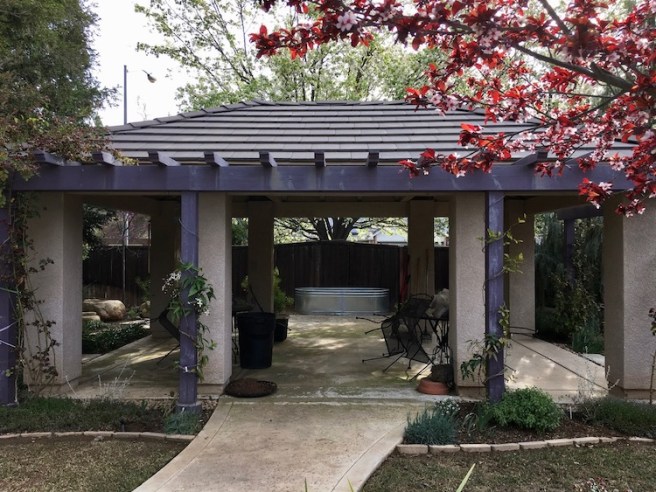
When we built our outdoor pavilion in the back garden in 2011 city code required the structure to be set in 15′ from our fence line. In our part of the city the fence line is considered to be our property line–hard to understand why we spend so much time and money trying to maintain that long strip between the fence and the street…but, oh well. Behind the newly built pavilion we added a second 10′ deep concrete slab to increase our outdoor dining options for large groups. The remaining 5′ deep border was home to a number of mature cherry laurel trees whose roots, along with the in-ground irrigation system was inextricably intertwined with the roots of the very large Bradford pear planted on the other side of the fence as part of the home original landscape. We laboriously removed those cherry laurels last summer, leaving the area bare. The effect of that root system on the fence is easy to see but the value of the shade tree in summer far outweighs the lifted fence. I am sure that when this fence eventually falls down we will have to install the new one with a ‘bridge’ over the root system to safeguard the tree.
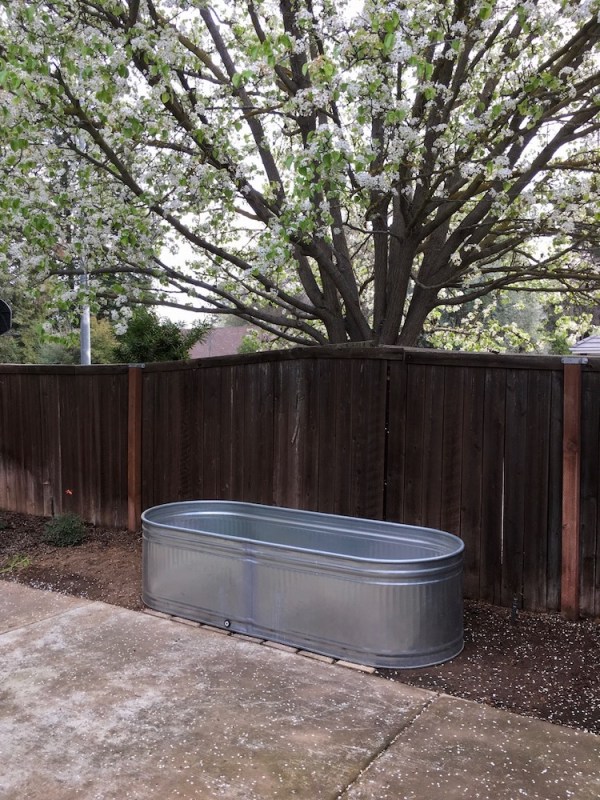
The stock tank will allow me to replant this area with the least tree root disturbance as possible. It is pushed forward to the edge of the patio to allow about two feet of clearance behind it to accommodate the worst of the root raised surface and still be level and plumb. An added bonus will be that the off the ground plant material will somewhat remove visual focus from the wonky fence. The two sprinkler risers which once watered the cherry laurels remain intact (I’m pretty sure we could never get them out without doing damage to the buried PVC) and they will be fitted with drip tubing and mini emitters on stakes to water the trough.
We call the area behind the pavilion the Secret Garden as it is not really visible from the house and only fully reveals itself as you approach this shady outpost in a very sunny back garden. In addition to just walking through the pavilion, stone paths on either side offer access to the Secret Garden. Above you can see the tank’s location as viewed from both ends of the paths.
The stock tank is centered on the pavilion’s columns and, when planted, will be a focal point drawing the eye through the structure when viewed from the pool. We typically have two 4 person wrought iron tables with chairs sited either side of center but I have been greedily gazing at websites with swinging beds…when the pavilion was built the cross beams were engineered for significant weight specifically for the addition of such a ‘lowcountry’ bed.
Since the full 3′ depth of the stock tank is not necessarily needed for successful planting and as a way of reducing the monumental amount of lightweight planting mix I’ll need to purchase to fill the 8′ long container I have been looking at alternatives to take up a little space in the bottom.
This is my current scheme but to fill out this layer and add a second one we will have to drink a whole lot of bubbly stuff! I plan to pull the tank’s drain plug out and affix a piece of screen over the drain hole. The bottles will hopefully provide little air space to prevent dirt from clogging the screen. May a layer of burlap over the bottles? I’m open to any suggestions y’all may offer, including an eco friendly alternative to the bottles.
I’m heading to the San Francisco Flower & Garden Show (bizarrely being held in Sacramento this year–going to have to get the back story on that while I’m there) and I hope to get some inspiration for plantings. The Sacramento location takes me right by a couple of my favorite Sacto area garden centers so hopefully next time you see this stock tank it will be fully planted!
Preparations for my youngest son’s marriage to his darling Laura have kept me out of the garden, both in focus and physically, for the last couple of months. In addition, we have had an incredibly wet winter here in the Central Valley of California–strictly an observation–not a complaint as anyone gardening here will never complain about rain, even when it comes day after day in torrents. A soggy winter can carry us quite far into spring before needing to think about supplemental irrigation!
The one project that has carried on, as the skies have allowed, is the front garden renovation started in earnest in the fall. Only a small area still remains to be double dug and amended and as much as I have had plants in reserve to work with I have marched right along behind the digging putting in perennials and small shrubs conducive to our goal of reducing the need for summer water.
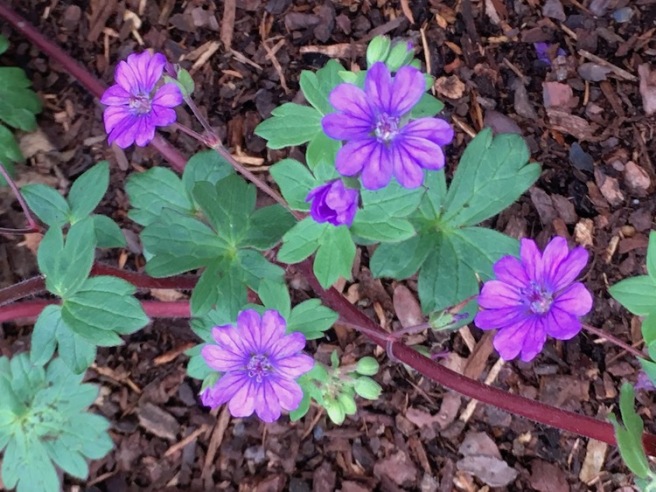
Many plants which have performed well for me have been dug and divided from other parts of the garden to incorporate into the new area. A few things which had languished unenthusiastically in their current homes have gotten new addresses also. One of those ‘unhappy in its starter home’ specimens is Geranium pyrenaicum ‘Bill Wallis’ whose blooms are pictured above.
I have been a collector of hardy geraniums for several years–I never leave a nursery or garden center without first checking their offerings for species and hybrids to add to my booty. Check out my post A tiny monster any girl can love… for a little info on the geranium vs pelargonium confusion. My zone is not terribly friendly to most of the hardy Gs although many of them thrive naturally in challenging climates all over the world–even with irrigation the air is simply too dry here in the summer months. Think the UK and much of Eastern Europe where they scramble and ramble to the point they are sometimes considered invasive! I consider them a challenge with rewards worth a little extra tending.
‘Bill Wallis’ has had a spot under a crepe myrtle tree in my front garden for more than two years, having been purchased on a now not distinctly remembered garden center ramble out of town. When I dug it up just after Christmas and moved it about three feet from its original home I swear it had only the same three leaves on it as when I purchased it and it had NEVER flowered. It’s new abode, in freshly double dug and very well amended earth was apparently the shot of adrenaline ‘Bill’ needed and the sad little clump, whose root mass had fit in the palm of my hand, sprung to life.
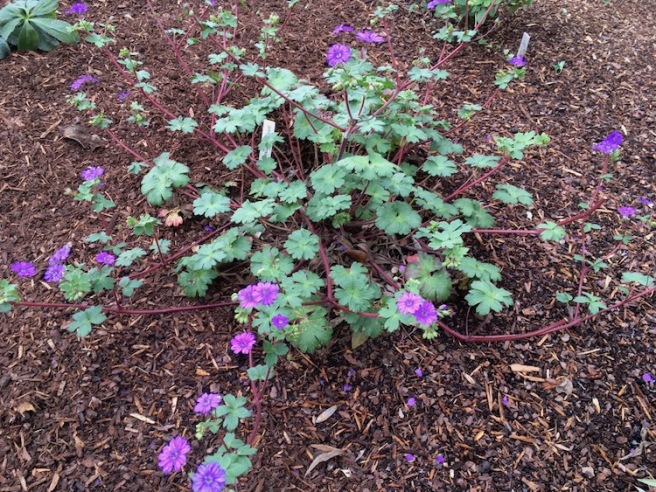
This is ‘Bill Wallis’ as seen on my first garden walk-around upon returning from Joshua and Laura’s North Georgia mountain wedding. My initial research after purchasing the little guy was that it would eventually form a large mound and, as it reseeds readily, could naturalize in ground that has been disturbed–not at all what my experience with the plant had been. Perhaps it was the ‘disturbed ground’ or the more fertile soil provided by copious amendment that was missing from the necessary cultural conditions needed to make Geranium pyrenaicum shine. Clearly February is not its natural blooming peak so only time will tell how it fairs through spring and summer. I especially love its sprawling red stems–cutting them back when the 1″ blooms are spent should produce new stems=new flowers. Fingers crossed on that! If I get so lucky as to have too many seedlings there will be plenty to pot up for gardening friends–how’s that for starting 2019 with a positive attitude?
I have a lot of garden travel on my calendar in late spring and summer, including this year’s Garden Bloggers Fling in Denver. Also have a dear friend moving to Arizona this year and that could require a new garden consultation–going to have to read up on all those spiky things! You won’t even have to pack a bag to join me as I see new places and new gardens throughout the year.
There are no finer blooms than those of the hellebores in late winter. The only even slightly negative thing I can say about these lovely nodding bells is that you almost have to lay on the ground on your back to photograph their blossoms! This is one of a half dozen or so I sited up the slight slope of a narrow long side yard on our corner lot. So indeed, I was literally in the gutter with my camera propped on the curb trying to get this picture.
This is Helleborus x hybridus ‘NW Cotton Candy’ (also sometimes labeled ‘NGN Cotton Candy’) in its first winter bloom. The lawn in this side bed was removed in 2017 and the area replanted between late 2017 and early 2018. This 1 gallon plant went in just about this time last year, at the tail end of when hellebores are in full bloom in the garden centers.
It is one of three and is tucked under the shady canopy of a mature Bradford pear. I have to give it stellar marks for vigor as this area is extremely dry shade with ample root competition for what little summer water is available. The trio was a little peaked through the hottest summer months but nothing more than to be expected of perennials not yet having settled into their new homes. The recent rains have helped tremendously and there is a nice first year show of blooms on each plant.
The Cotton Candy strain is one of a series of Northwest Garden Nursery hellebores produced from hand pollinated plants in the Eugene, Oregon garden home of Ernie and Marietta O’Byrne. The O’Byrnes have dabbled (their words–I’d call it way more than dabbling) in hellebore breeding since the early 1990s. You may be familiar with other strains in their wildly popular Winter Jewel series. I recently bought their ‘Ruby Wine’ which is almost black with a purple sheen. Although they are primarily breeders and wholesalers they do have select retail days throughout the year. Hellebore Garden Open Days each February offer opportunities to tour their garden. The 2019 Open Days are right around the corner–February 16th and 23th. Please visit their website http://www.northwestgardennursery.com to read all about the O’Byrnes and get a glimpse of their garden. Don’t miss clicking on the Gallery tab to see individual photos of their single flowered and double flowered strains–a feast for any gardener’s eyes!
I first came to adore these so called Lenten Roses when I lived in Georgia where they multiplied readily under the protection of tall pines. While I admire their variety and their propensity to ‘pollinate amongst themselves’ producing seedlings whose eventual blooms look nothing like anything you what actually purchased, I love none more than the ones I just call Mary’s hellebores which were seedlings from the garden of my dear friend Mary S. Transplanted from my Macon garden to my California garden–a very long over the garden fence trip–they did not reach blooming age until after we had left Georgia but now provide me with bountiful blooms and memories, growing vigorously and offering me countless seedlings to pass along to yet another gardening friend.
No, they aren’t really new at all but the wide variety of shapes, sizes and flower color in the genus Grevillea has certainly been more visible in American garden centers in the past decade as the prominence of Australian plants surges in gardens where climate and cultural conditions favor the so-called Mediterranean and sub-tropical plant families.
Grevillea is a diverse genus of over 300 species of evergreen flowering plants native to Australia, New Guinea, New Caledonia and other eastern Indonesian islands. The genus is named for Charles Francis Greville who sat in the British House of Commons from 1774 to 1790. He was a very close friend of Sir Joseph Banks, one of the organizers of the Society for Improvement of Horticulture, a precursor to the Royal Horticultural Society.
In my first iteration as a California gardener in the 1970s about the only Grevillea commonly used in Central Valley landscapes was Grevillea ‘Noellii’, a fast growing prickly shrub with fine foliage and with intricate dark pink flowers. For my minuscule first home lot its mature size of 3-6 feet tall and wide was just too overwhelming. I can’t say in the ensuing 40 years that I had thought much about Grevilleas until we returned to California in 2008 and I started seeing them popping up with great diversity in garden centers, especially in very temperate Southern California. Short or tall, upright, mounding or almost prostrate, there seems to be one for almost any garden situation as long as you have a sunny spot with good drainage. They are hardy mostly and 20 degrees C and drought tolerant. The only quirk of note is their intolerance to phosphorus–thus the need to be cautious with fertilizers.
In our seemingly never-ending lawn removal/bed replanting project I have added a few different species and cultivars of Grevillea. One of the first selections was Grevillea rosemarinifolia, pictured above, which I tucked under the loose canopy of a huge weeping juniper anchoring a spot of ground between our driveway and our side yard fencing. With rosemary like foliage, this species will mound up with layers of airy, nodding branches. As we periodically tidy up the juniper, more space for its eventual 4 foot height is made. Even with the dappled shade produced by the juniper’s branches, this area is in full on southwestern sun all day and gets precious little irrigation. Check out This eagle has finally landed… for some pics at the end of the post of this juniper in all its tree-like glory!
Planted in very late 2017 from a 4 inch pot this selection has proved to be a robust but well-behaved garden dweller, covered now with pinky red buds ready to burst into bloom.
My back garden holding area still has a few “new” Grevillea waiting for their permanent homes to be ready and I am on the lookout for additional ones to try. I am most excited about a little gal called ‘Pink Midget’ which will occupy a spot along the walk from my mailbox to my front door. I can’t wait to see the hummers fighting over a spot at their new nectar bar!
Our so-far mild winter is allowing us to continue work on our final front yard lawn removal. We’ve had just the right amount of rain to loosen up the soil and make digging less onerous but not so much that we have lost too many work days to puddles, sogginess and sinkholes.
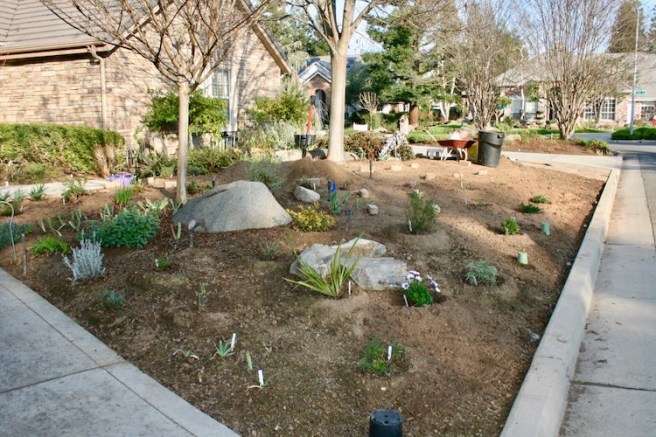
We are marching steadfastly from west to east with my sweet Dave in the lead, having both the tools and muscle. You can barely see him in this photo sitting on the ground behind the red wheelbarrow. This being our fourth time to the party he has got a pretty good system. The lawn was chemically treated in early fall–lawn removal by sod cutting machinery is not such a sure thing with a common bermuda lawn. The roots can be very deep and any small viable bits left behind will roar back as soon as growing conditions are right. I swear there have been viable bermuda roots found in fossils from prehistoric times!
He has divided the area into smaller, more workable sections. First, he uses a hula hoe to scrape off any above ground dead grass up into piles. To not sacrifice so much of our topsoil he then sifts through these piles, separating grass remains from viable soil–that’s is what he is doing sitting on the ground in the photo. The good soil is then moved off to a tarp to be reincorporated later. Next he tills the area and again picks out any grass roots, rocks, etc. including copious wads of the green netting that was the original sod’s underlayment. Step three is to double dig the section–one shovel depth’s down worth of soil is dug and off loaded to the side and then the newly exposed surface is dug a second shovel depth’s down. The rock, roots and various leftover construction material removal continues throughout the process. All the previously off loaded soil is returned to the bed and dug together along with whatever amendments I have selected for the area. I am exhausted just outlining the process! The last step is to grade the section to flow smoothly into large untouched areas at the bases of our mature trees.
As Dave prepares the beds I follow behind adding the plants. As with the areas already finished I am concentrating on more waterwise plants–hoping to create a balance the water needs of the existing mature landscape and the new. Unlike last year, my back yard holding area is not so flush with “plants in waiting” so planting is going slowly. Lots of bearded iris and daylily divisions have gone in along with a number of my favorite salvias. I am trying a few more new selections such as Cistus ‘Anne Palmer’ and Ceanothus ‘Hearstiorum’, both plantings of which will be in the bed’s ground zero for all day southern sun. Once these are established they should be very low water users which will allow me to eliminate several pesky, always broken, curbside sprinkler heads.
I am on always on the hunt for plants. Our recent Southern California overnight yielded two nursery stops and a few selections were checked off my acquisition list. Not to be found–and no surprise given the time of year–was another Salvia ‘Dara’s Choice’ to echo the one planted to the west of the front walk last year.
I probably should read my own blog archives so I can remember if ‘Dara’s Choice’ was purchased locally or, more likely, one of the salvias I bought at the San Luis Obispo Botanical Garden’s 2017 fall plant sale. The single gallon can specimen was quite small and unremarkable when planted but over the year it has grown to a beautifully shaped, slightly weepy mound with clear medium green quilted leaves. And in the last couple of weeks it has come into bloom. Not really a show stopper but not every plant has to be covered in big, blowsy flowers to have worth in my garden.
Mid photo you can see there are a good number of gracefully stalks bearing the small pale blue whorled blooms. The layered foliage performed very well, even though in the ground only a few months, throughout our very hot and dry 2018 summer. Its graceful appearance on the slope is worth repeating in the area we are now working. A little research reveals ‘Dara’s Choice’ to be one of the black sages, botanically Salvia mellifera. Apis mellifera is the scientific name for honeybees to which this plant is highly attractive. The foliage is wonderfully fragrant and its relatively low, mounding profile and broad spread makes it a great salvia selection for well-drained, sunny slopes. I am hopeful I will find one soon and who knows what other interesting plants I will meet along the way! Give us a few more weeks on this project for a complete coverage of what we’ve added to the mix of shrubs and perennials.
An overnight jaunt to Southern California allowed my husband and I a brief visit to the Rancho Santa Ana Botanic Garden to view their current exhibit of art in the garden entitled Origami in the Garden2 (actually the little above the line 2 as in the mathematical annotation for squared–no idea how make my keyboard do this.)
One of two standing cranes by Kevin Box which greet visitors to the exhibit
Rancho Santa Ana Botanic Garden spreads over 86 acres in Claremont, California and is the largest botanic garden dedicated to California native plants. Its mission is grounded by a philosophy of biodiversity and the importance of bringing real world conservation applications to the public through horticultural education, scientific research and sales of native plants. This garden is yet another public resource I never had the opportunity to visit in the decade+ that I lived in Southern California and today because our arrival is already late in the day and the light waning, we will only see a small part of the grounds. Visit their website http://www.rsabg.org for all the details about the garden, its events and resources.
There are no better words to describe this exhibition, an intersection between art and nature which will remain in the garden until April 14, 2019, than those on the website: “Origami in the Garden2 is an outdoor sculpture exhibition of larger-than-life origami creations. Created by Santa Fe artists Jennifer and Kevin Box, the sculptures capture the delicate nature of Origami, a paper art form originating in Japan and celebrated around the world. Crafted in museum quality metals, the artworks each tell the story of a single piece of paper as it transforms into a soaring bird, emerging butterfly, galloping pony and many other remarkable forms. The exhibition features the Boxs’ own compositions as well as collaborations with world renowned origami artists: Tim Armijo, Te Jui Fu, Beth Johnson, Michael G. LaFosse and Robert J. Lang.”
The guide we picked up at the entrance not only contained a map of the botanic garden’s various areas but an easy-to-read as you walked along guide specific to the location of each of the 16 outdoor sculptures celebrating art and nature through the lens of origami. Super cool was an Audio Tour phone number to call on your cell phone to hear additional information from the artists. As you stopped at each sculpture you dialed the number and at the prompt entered the audio tour number listed on both the map and the artwork’s signage. It was really fun to hear the actual artists talk about their pieces and the audio content expands upon what was on the printed placards by each piece. My husband took charge of navigating our route and queuing up the audio for each piece on cell speakerphone, leaving me free to let my senses take in the garden and my camera lens to wander. Unfortunately, this freedom had no immediate effect in improving my photographic skills but I looked very professional, as if I had an assistant along to do my legwork. By the time we had seen seen and heard about each piece it was past sunset and almost dark–and 4:58 pm, only 2 minutes shy of the garden’s closing. Here are a few of my favorites:
Crane Unfolding by Kevin Box
This sculpture is the first origami-inspired work by Kevin Box and is crafted from painted cast stainless steel on a steel base. In his words, “The origami crane is a symbol of truth, peace, beauty and long life. This crane reveals the meaning of its life as it unfolds into a star.” To him, the folded crane is a representation of what we see on the surface of life, while the unfolded crane is a representation of the beauty hidden beneath–there is more to life than what meets the eye.
Painted Ponies, a collaboration between Kevin Box and Te Jui Fu, a Chinese origami artist
Painted Ponies frolic in Fay’s Wildflower Meadow. They are fashioned from powder coated aluminum and represent an example of an origami technique called kirigami which means cutting paper. Scissors are used to make four cuts in the paper square and these cuts enable more easily achieving the detail needed for the ponies’ legs and ears. The symbol on the red pony’s hindquarters is a nod to the collaborative nature of this piece. The Chinese character of Te Jui’s last name, Fu, is enclosed in a box representing the metal sculptor’s surname.
Duo by Jennifer and Kevin Box
The white bird or dove is a global motif recognized as a symbol of peace and the human spirit. In nature, cranes mate for life. These painted cast stainless steel cranes symbolize that quality of pure devotion.
Duo occupies a peaceful space at the end of a stream bed in the Percy C. Everett Memorial Garden which features examples of grouping together plant material with similar water needs. I loved this large bubbling rock!
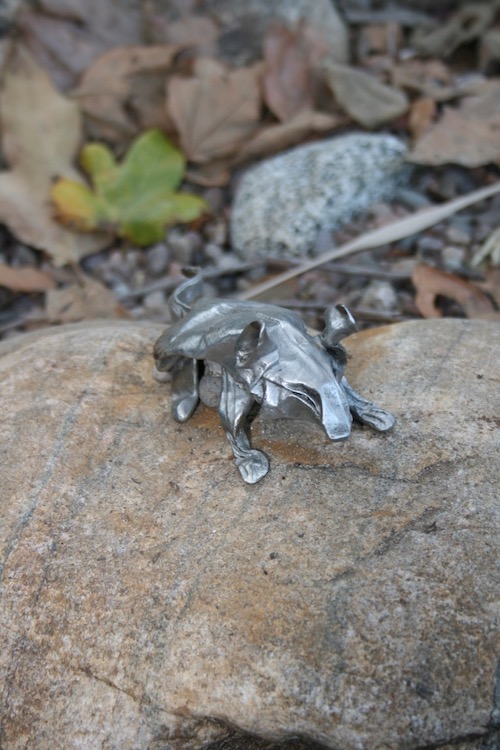
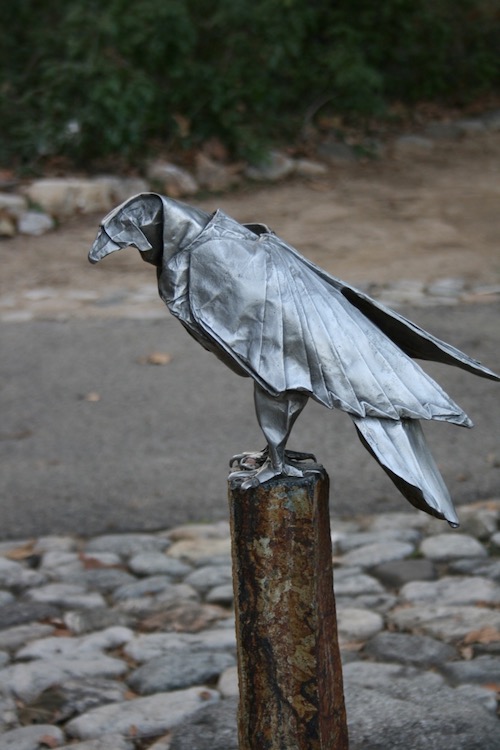
Who Saw Who? by Kevin Box, Tim Armijo and Robert Lang stems from a sort of after the fact collaboration. The raptor and mouse in their original origami forms were each cut from single sheets of paper: the mouse by Tim Armijo and the raptor by Robert Lang. Kevin Box cast each in bronze at different times and set them aside in his studio. It was not until he caught a glimpse of them later that they appeared to be looking warily at each other–predator and prey frozen in time and metal.
Seed Sower & Seed by Kevin Box, Michael G. LaFosse and Beth Johnson
Seed Sower by papermaker and origami artist Michael G. LaFosse and Seed by Beth Johnson were cast in patinated bronze by Kevin Box. The duo explore the role squirrels play in the life of a healthy forest.
Nesting Pair by Jennifer and Kevin Box
When Jennifer and Kevin Box built their home and studio together, they were reminded of two birds building a nest. The bronze casted olive branches symbolize peace and compromise and form the nest. The artwork emerged naturally at a time in their life together when they were discovering and accepting the need for compromise to build a happy marriage. The addition of the two cranes, mated for life, resting comfortably on a nest of compromise completes this beautiful and very personal piece. Thank you, Jennifer and Kevin!
Hero’s Horse by Kevin Box and Robert J. Lang
The origami Pegasus was folded from a single uncut square of paper by physicist Robert J. Lang based on a sketch designed by Kevin Box. The artists’ collaboration eventually produced a 25 foot tall fabricated metal sculpture now found in Dallas, Texas. This smaller version was then created from painted cast aluminum on a steel base. Kevin Box shares, “Hero’s Horse is a story of hope, reminding us that who faced with impossible odds help is on the way and good will always win the day.”
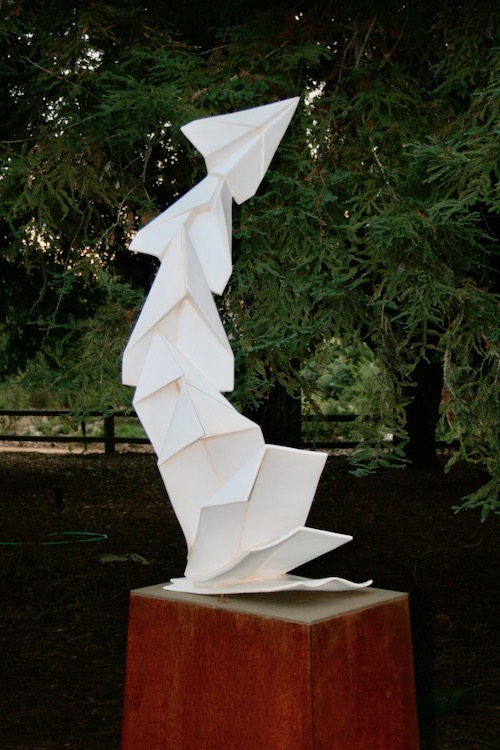
Folding Planes by Kevin Box
Seven simple folds transform a blank page into an airplane in flight. Each fold is symbolic of a choice or action to transform an invisible idea into a reality and repeats a common theme in Box’s work–the story of a piece of paper dreaming of flying.
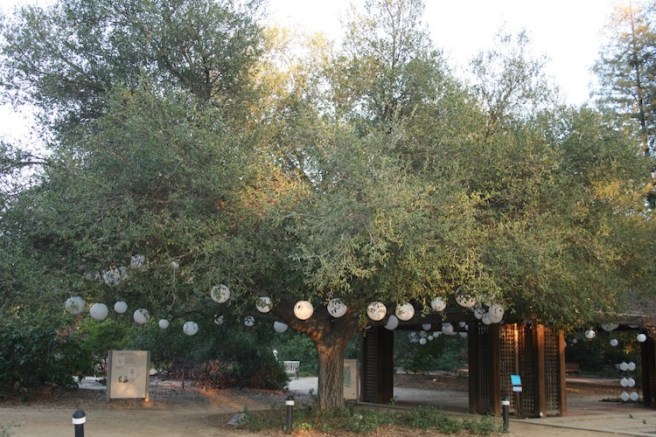
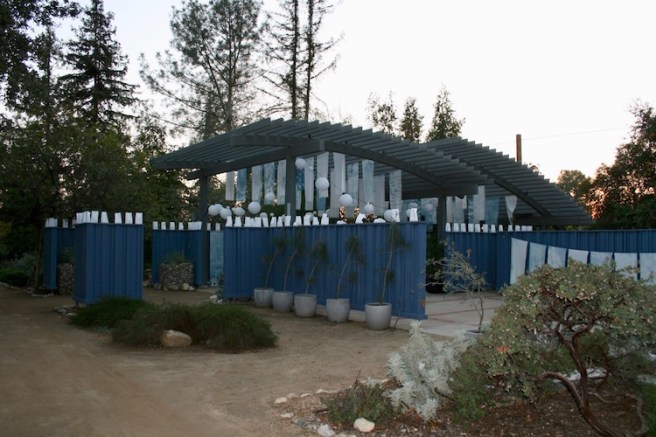
Selected nights throughout the run of the exhibition RSABG will be open in the evening with its pavilions and other structures festooned with luminarias and Japanese lanterns to see the sculptures by moonlight.
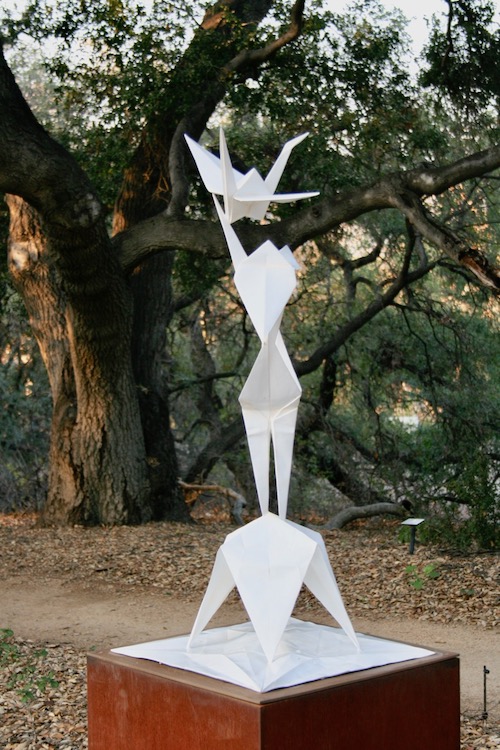
Conversation Peace by Kevin Box
The term “conversation piece” refers to an interesting or intriguing object that sparks conversation. In this interpretation of the game rock-paper-scissors, the paper has won by folding itself into a peace crane and flying just out of the scissors’ reach. This artwork represents the sculptor’s belief that conversation is the key to the peaceful resolution of serious conflicts, many of which arise from our misunderstanding of each other.
Rising Peace by Kevin Box
As we round the gift shop to our last sculpture we have almost totally lost the light. The Johnson Memorial Oval is a wonderful setting for Rising Peace, allowing it to be viewed from all sides. At a distance the family of cranes appear to be rising into the night sky.
Although my focus was to at least see each one of the 16 sculptures I did see many interesting plants. This time of year there is not much expectation that a California native plant garden would be awash in bloom and this one certainly displayed evidence of a long and droughty summer not long gone by.
A single cluster of flowers on XChiranthofremontia lenzii, an intergeneric hydrid introduced by Rancho Santa Ana Botanic Garden. This was a massive tree/shrub with just this one glowing spot of golden orange, clearly the reason its common name is Fremontodendron ‘Pacific Sunset’.
If you are anywhere in the greater Los Angeles/Inland Empire area you still have plenty of time to take in this inspiring exhibition. A more in depth reading of the written materials I picked up at the entrance revealed an extensive educational program and a retail native plant nursery on site. Although this garden is a 3+ hour drive for me I’ve bookmarked their website to check back now and then so I don’t miss interesting upcoming events I might be able to piggyback on to future SoCal trips.
P.S. Check out http://www.outsidetheboxstudio.com to learn more about metal sculptor Kevin Box, his work and collaborations with other artists!
I have never had spectacular success at growing lavender. My current analysis is that I have included most as ‘one of’s in mixed beds of perennials and roses which require much more summer water than is preferred by lavender. I’ve got the Mediterranean climate part of the picture right, just not the companions and cultural practices they favor.
In the lawn removal/bed design we completed very early this year I included a grouping of 5 Anouk lavender, Lavandula stoechas ‘Anouk’.
Anouk lavender lower center of photo
Although they did not bloom spectacularly well in their first summer I’m taking the position that they were settling in, just getting the feel of their new digs and will wow me in 2019. I feel confident that this new bed which is filled with unthirsty selections and receives good summer sun with allow them to flourish in most conducive conditions. And so the lavender bug is buzzing around my head again for the current and much larger remaining lawn removal effort. I plan to include another grouping of Anouk lavenders for continuity but have been keeping my eye out for a few other cold hardy varieties to pop in here and there. Not an easy task as new garden center stock virtually disappears by November 1st when holiday plants and Christmas trees seem to descend from nowhere.
When I visited Morro Bay the last week in October I squeezed in a little nursery shopping time and picked up a lavender with startlingly white foliage with plans to add it to the new bed diagonally across my front walk to play off the similarly hued foliage of an existing plant, Salviaapiana ‘Compacta’.
This is (as was marked) Lavandula stoechas ssp. pedunculata ‘Ghostly Princess’. In mid-November I dug it in what I planned to be a temporary spot as I was clearing out a few other elements which had been crowded into a small bed at the base of a crape myrtle–this bed will now be part of the larger bed opened up by the lawn removal. As I did with the first project last year I have spread plants in the original small beds further out into the newly opened areas to blur the old bed lines and allow them more breathing room.
In doing a little research on this plant it did not take long for me to fall down the botanical name rabbit hole. I have always identified L. dentata as the so-called French lavenders and L. stoechas as the Spanish lavenders. ‘Ghostly Princess’ was bred by PGA (Plant Growers Australia) Innovabred around 2013 and their informational material identifies it as a Lavandula pedunculata bred as a companion for their “The Princess” which apparently was a blockbuster introduction around 2003. They also refer to it as one of the French lavenders. Other sites label the plant Lavandulapedunculata ssp. pedunculata. After reading multiple site’s distinctions between lavender species and their common names (French, Spanish, etc.) I decided it was a global turf war this non-botanist really didn’t need to be involved in. I did learn that it is the ‘peduncles’ or rabbit ears on the top of the flower identify it as one of the French, Spanish or butterfly lavenders as opposed to an English lavender. Holy moly!
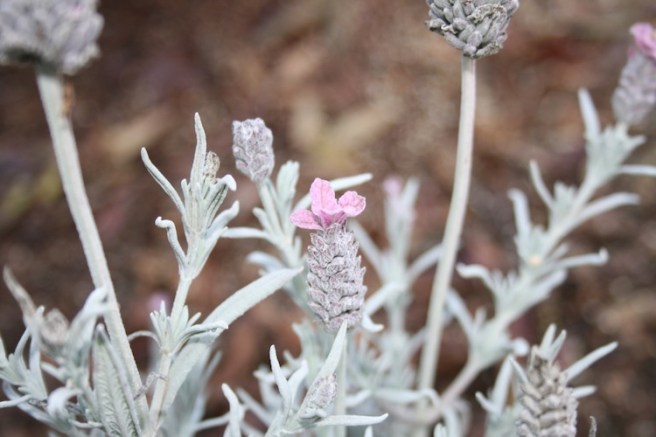
Bred for a prolonged flowering, a compact habit and cold hardiness the silvery foliage and pale pink petals are a stark contrast to the gray green/purple combo we see on many lavender varieties. Descriptions detail the pink bracts as having darker pink veins. Despite cold temps and a fair amount of rain my girl put on flowers the first week in December! Given a good start and time to develop a good root system through our moderate winter, I have high hopes for her royal highness.
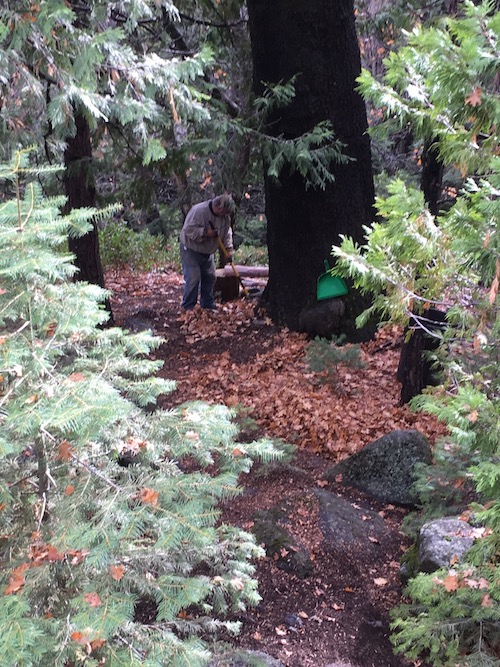
With the first snows of the winter in the forecast for the last week in November and our turkey dinner well settled, my husband and I headed to the Sierras to do the last tasks to fortify our small cabin outside the south entrance to Yosemite National Park as much as possible for the winter. Unlike many of the cabins in Fish Camp we have central heat and are able to spend a good bit of time there in the winter months but we must still prepare our deck for the snow slide off the roof, lay in a good supply of wood close in and, when at all possible, get up as much of the autumn leaf fall disposed of before it is covered by snow. The last is mostly to get a jump on clearing the ‘defensible 100 feet’ required by the fire folks once the warm, dry summer sets in. Note to Donald T: in case you are following my blog you can rest easy that we ARE raking our forest floor.
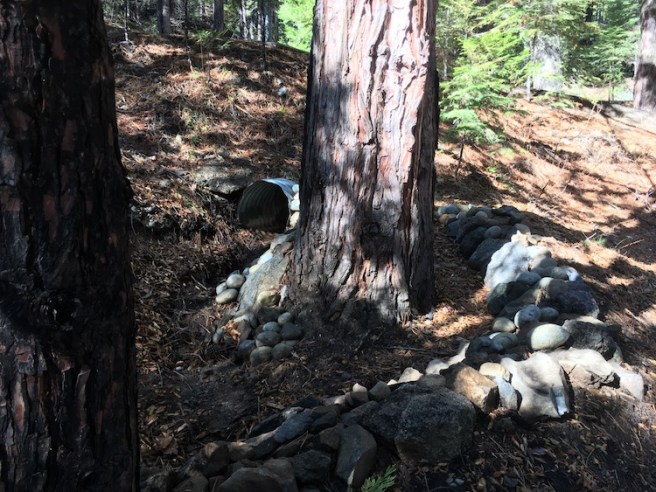
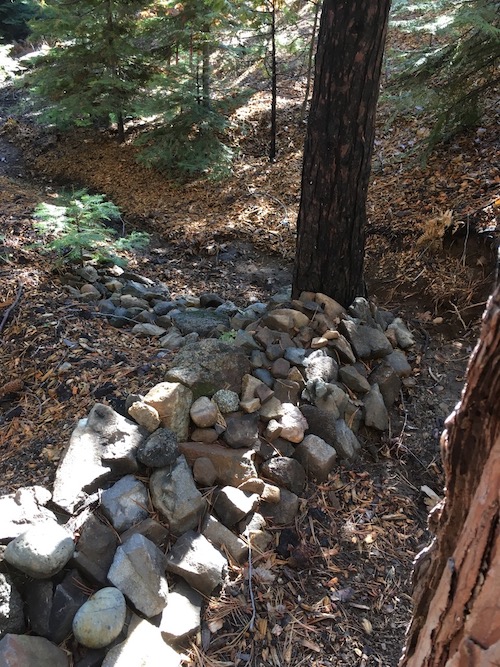
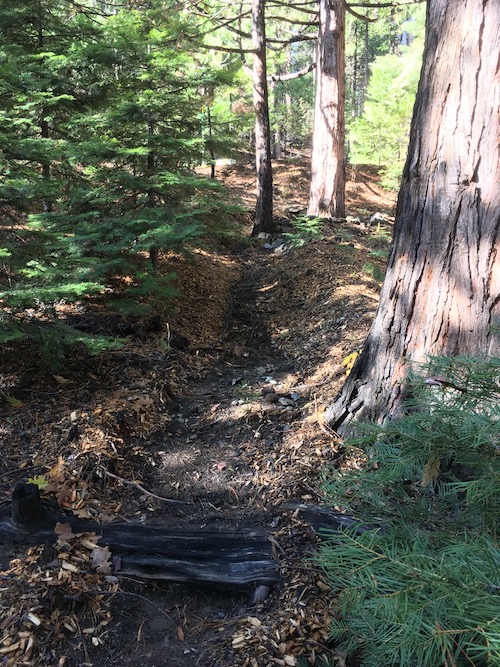
Our area is prone to fall rainstorms which can produce flash flooding and our cabin happens to sit much lower than the road. Water rushing down the road is directed into a culvert and then into a big metal drainpipe which runs under our driveway and out into what is euphemistically called a ‘seasonal creek’ by real estate agents. The steep slope of our property away from the road then carries it down to an actual creek just below the property. Last year obstructions in the pipe caused the water to back up in the culvert, jump the bank and virtually wash out our steep, curved, at that time dirt driveway. Fortunately a slight raise in the grade in front of our basement stopped the flow before we became an ark! And our seasonal creek seemed to be mysteriously creeping closer to the cabin…to that end we worked diligently this summer to clear both the culvert and the sub-driveway pipe. A neighbor with a backhoe pushed several years worth of downhill debris up to give us new and well defined culvert on the downhill side of the pipe so we could create a good path for the run-off. A fall afternoon’s worth of collecting rock from around the property and stacking it up resulted in what we have now dubbed El Pequeno Rio Armadillo–the Little Armadillo River, a nod to my husband’s childhood nickname. Having just had the first heavy rains of the fall I was anxious to see how our handiwork had fared and was pleased to see the banks held and the downhill flow of the rushing water was well within bounds of what we’d hoped for!
Of course, we have a huge tree right in the middle of the flow–earth and stones hopefully stop the water from jumping the bank toward the houseLooking down from the drain pipeLooking back ‘upstream’ from quite far below–the power of moving water from just one large storm has carved this perfect path
With snow on the ground since this visit, the threat of flood has diminished. However, with the spring snowmelt from the high Sierra we will again need to keep a close watch on where the Little Armadillo River wanders.
In the few years we have owned this vacation cabin, my husband’s work/travel schedule has been the determining factor of how much time we are able to spend in the mountains and with so much work to be done to make the 50 year old home habitable we really haven’t spent much mountain time actually having any fun. His 2018 mid-summer retirement has given us more freedom to enjoy the quiet and the beautiful vistas without feeling we need to be ‘getting something done’ every time we are there. With that in mind and Dave doing a little light raking (8 barrels worth) I thought it a perfect time to take a stroll and survey our small piece of the forest.
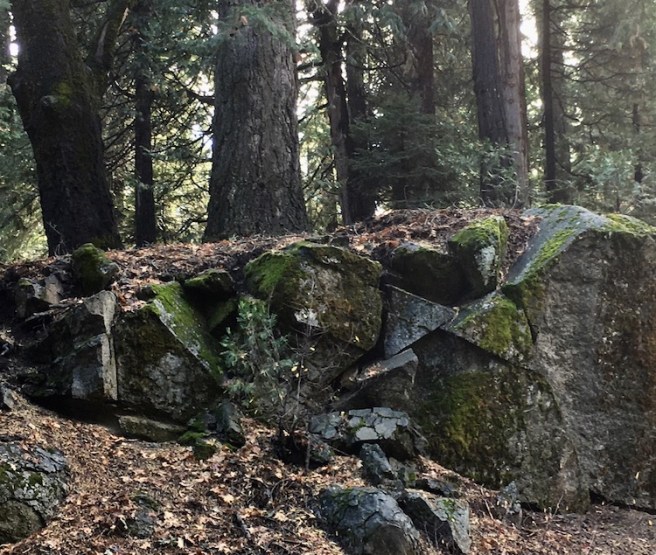
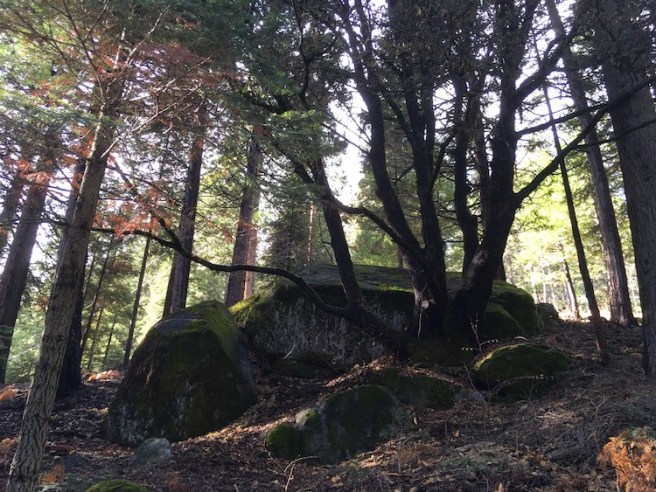
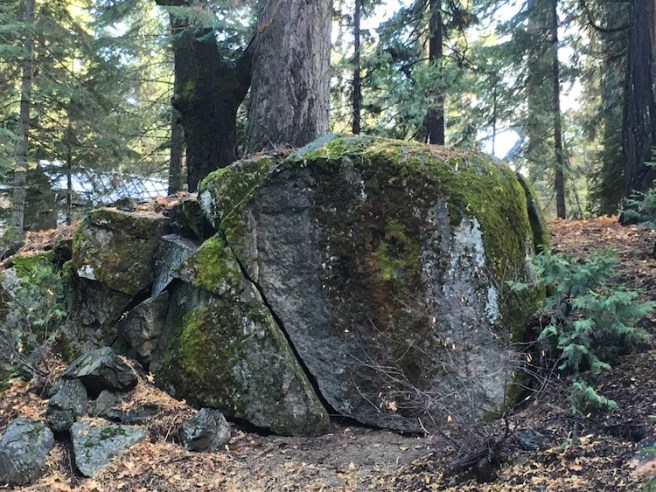
I have purposefully left the exposure of these photos unedited. Our land is only about an acre and slopes sharply down from street level with a smallish flat area midway for parking in front of the cabin. Our views up toward the street are always in dappled shade from trees, both conifers and deciduous hardwoods. I will be forever in awe of the huge granite outcroppings and boulders.
Just below street level This monster is perched on our neighbor’s property high over the creek bed below our propertyBeautiful life decorates the bouldersLooking uphill from the lowest point of our landOur only sunny spot is the meadow (or gully depending on my mood) visible from the back deck–happily inhabited by a great diversity of trees
Our local utility company is actively trimming or clearing trees too close to power lines. We have several marked to be limbed up but but none marked for removal as this one on the property next to us.
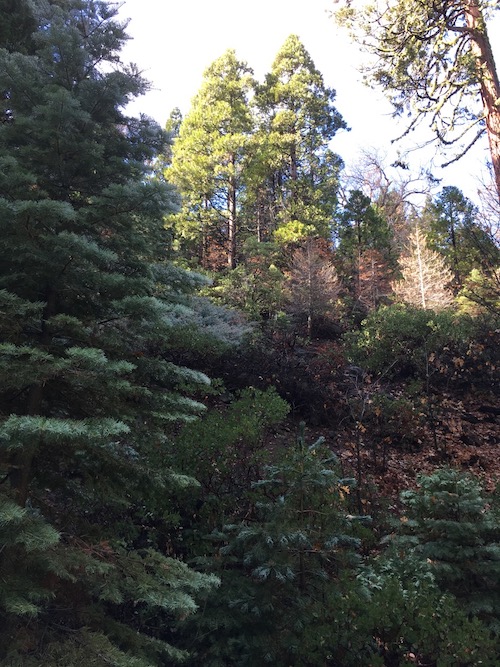
Even in late November there is a lot of plant life to be seen. I am clueless on about 90% of what is growing here but it is my goal to be able to identify most of what we have in the next few years. The top left photo is one of the manzanita varieties, I think–at least it is growing among a huge thicket of manzanita! In the spring they have small pinkish white flowers so I am not sure about the red blossom. I’ll take gladly take any guesses on the other three!
I am cautiously proposing white fir on this very young tree. I am amazed at all seedlings we have, especially given the continuing Central California drought conditions–just another example of Mother Nature’s drive to keep her offspring going.
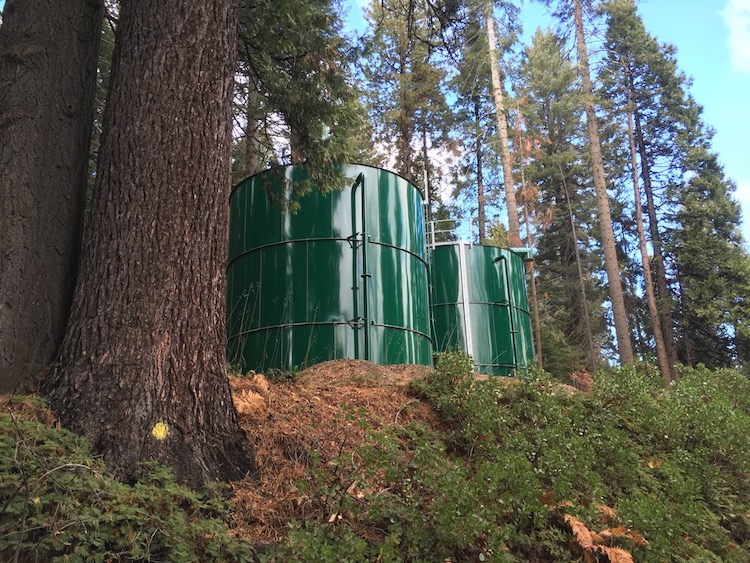
Tree felling required for the installation of larger water tanks just up the road from us resulted in great quantities of wood available for the water company’s customers. We have hauled logs down for various purposes and a neighbor cut up a half dozen nice ones for us to use as seating. Earlier in the year we arrived at the cabin one weekend to find a tree stump about 2 feet high and 48″ across neatly in place beside our wood pile. My husband had mentioned to a neighbor Gene G. that he need a stump on which to split logs and voila! one arrived via our go to heavy equipment neighbor Barry G. It is a fact that mountain people all look out for each other.
A small ginkgo on the roadside shows its colors
Just across the road from us this wee waterfall has been running for weeks.
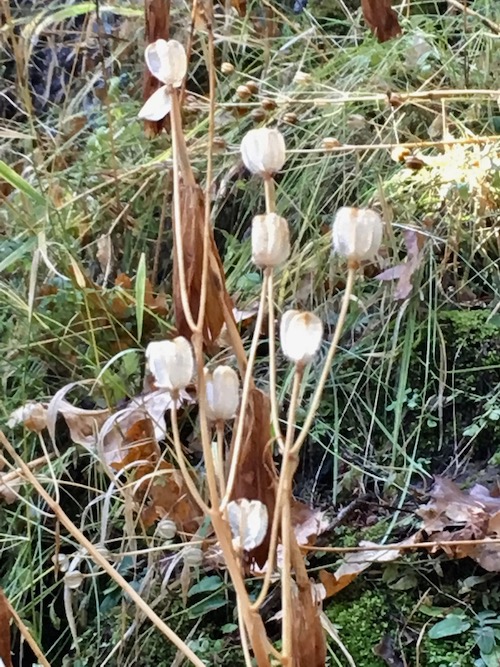
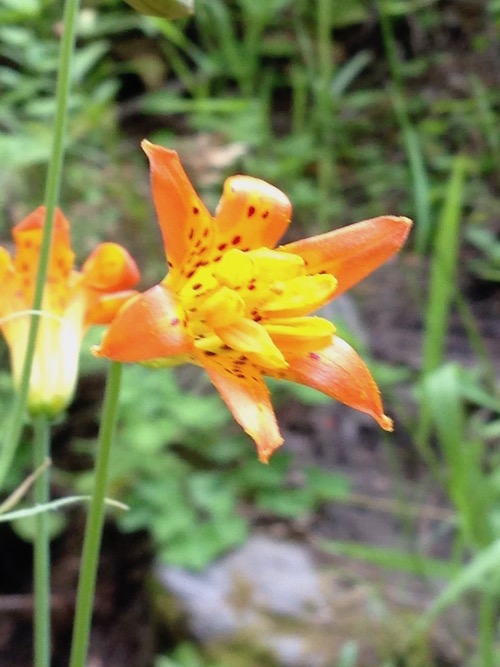
The seed pods are from the lily type plant below which I photographed in bloom in July.
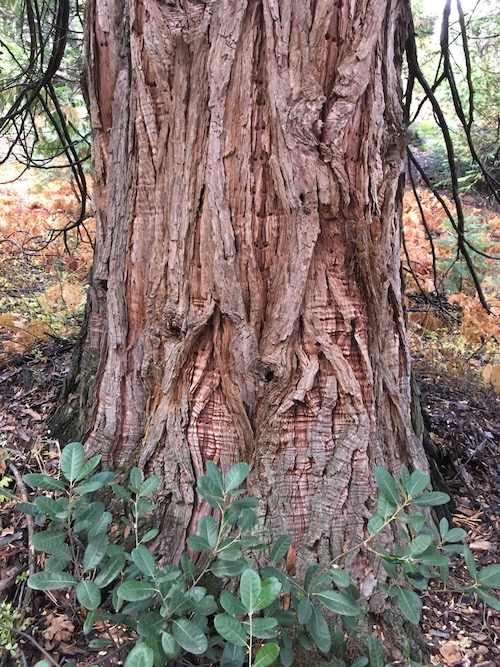
What tales this (cedar?) tree trunk has to tell…
Fish Camp lies a scant 50 miles north of Fresno just outside the southern gate to Yosemite National Park. At about 5200 feet in elevation and an hour’s drive away it is light years away from the hustle and bustle of the hot dry San Joaquin Valley. Although the population sign indicates 500 residents, I am doubtful of the number. We have one large hotel/resort complex, the Tenaya Lodge, but no gas station or restaurants. A small general store offers some staples and a pretty mean sandwich and potato salad when there’s enough traffic into the park to keep it open everyday. If you are ever passing through on Highway 41 to Yosemite at least give us a wave as you go by!
“THE MOUNTAINS ARE CALLING AND I MUST GO” John Muir
The Moraea iris is as ubiquitous to California gardens as fish tacos are to our trendy coastal restaurants. Before gardeners had ready access to a wide variety of ornamental grasses, phormiums and dianellas this evergreen perennial was one of the very few plants which fulfilled the need for a bold, contemporary and architectural element in the residential landscape. They are a landscaper’s staple here and if you drive down any residential street in my city you’d be hard pressed to find very many front yards without them. Only in the last few years has their popularity declined slightly as they do require moderate water to look their best and we now have many other choices that are less thirsty.
Dietes iridioides (D. vegeta, Moraea iridioides), commonly called the Moraea iris or fortnight lily, is an iris like perennial with fans of stiff, swordlike, dull green leaves. They are rhizomes which are almost always sold as container plants rather than barefoot and will form thick clumps of foliage over which bright white blooms seems to dance, butterfly like, throughout the year. In mild climates they may bloom year round. The flowers typically last a single day but in peak bloom periods there may be dozens on a large clump. The bloom stalks are segmented and a given stalk will produce multiple blooms throughout the season.
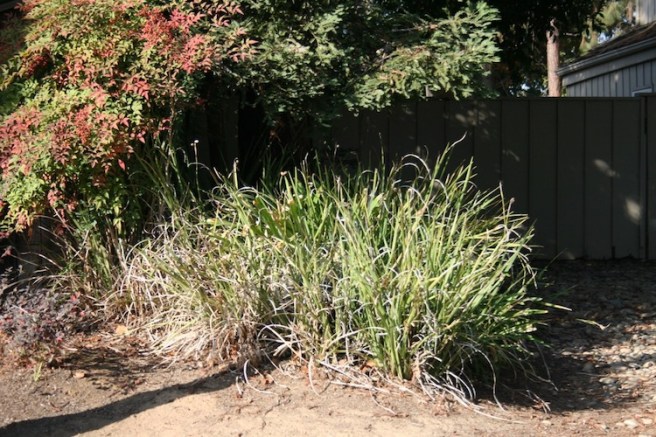
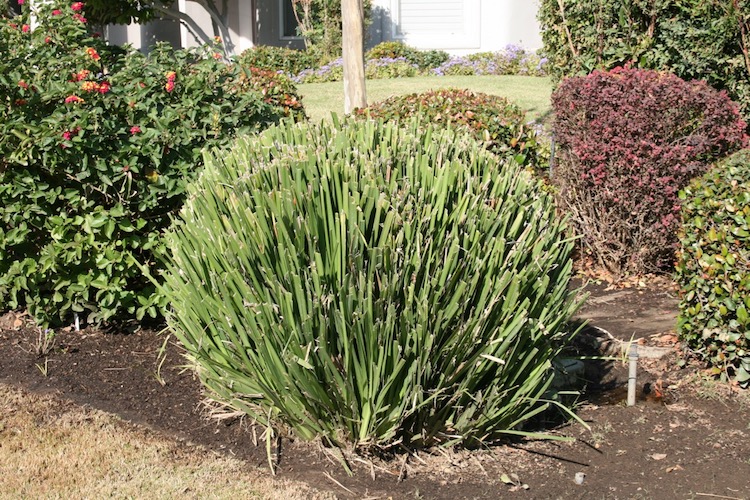
With all the good qualities having been mentioned–Moraea iris are among the most misunderstood, misused and as the result of these first two–misshapened–plants in California gardens today. They can grow to very large clumps and are commonly planted in areas too small to accommodate their mature size. Unless you break off the flower heads they will reseed prolifically, adding to the colony’s density and girth, seemingly exponentially. Their clumping nature really calls for them to be divided by spading them up and breaking apart the fans every 5 or 6 years during the winter. I know many gardeners but I don’t know one who has ever divided a Moraea iris–myself included. We let them grow and grow and then they look like this.
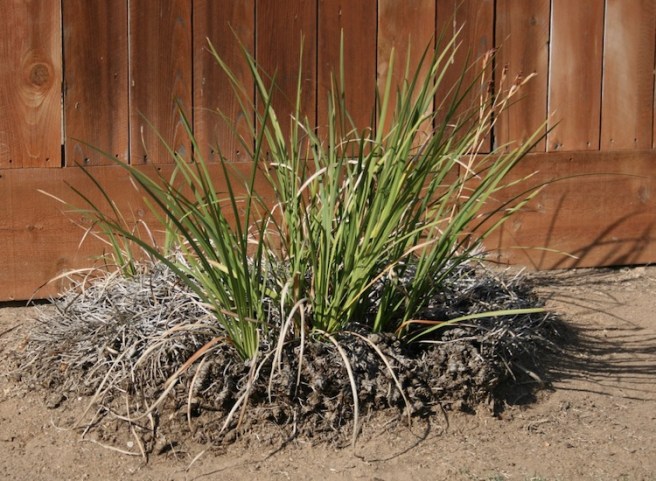
Then–when we just can’t stand it anymore and are upset by the diminishing bloom quantity–we whack them back or completely to the ground, producing these not so pleasing forms.
I am here to tell you not a single leaf that gets chopped off will ever grow again. New growth in the clump will be stimulated, making it ever so much denser and larger (which I am guessing was not the goal.) I have even seen the radical approach of mowing down the clumps like below.
New fans will emerge but nothing good will ever come of all that dead root and foliage left in the ground.
It’s a telling statement that in looking for photos for this post I could not find a single example of this plant in good shape in the square mile surrounding my home. Eveybody’s got them and they all look like crap!
And so, with all I know (and have done poorly in the past) of this perennial you will not be surprised to know that one of the first garden reno projects we tackled after purchasing our home in 2008 was to remove all the Moraea iris–14 clumps in total–from our landscape. Even today we pull up bird gifted seedlings that have wandered over from neighboring yards.
My recently retired husband (who may start looking for a job to get some rest) is all in on his dead lawn removal project which will clear the last turf from our front yard. And each of us doing what we do best, I am gathering new plant material in my holding area in anticipation of replanting the area.
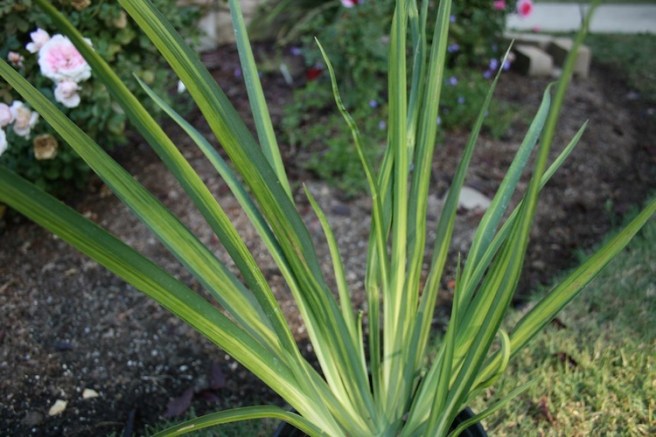
I surprised myself–and him–when I purchased a gallon specimen of the Moraea’s cousin which was marked as Dietes iridioides ‘Variegata’. I am not confident of the plant ID and think that it is actually Dietes grandiflora ‘Variegata’ or ‘Sunstripe’.
The medium green foliage with bright yellow stripes is a wonderful twist on the duller green and will light up the dappled afternoon shade location I have reserved for it. The bloom on this plant is the one you see at the top of the post and it lasted for several days, which is the hallmark of the grandiflora species.
Foliage closeup!
So here is my commitment to this ‘everything old is new again’ perennial: I will revel in your beauty and DIVIDE you as is necessary to keep you happy and attractive. I will never chop your lovely stripy leaves to the ground and I will harvest your seedlings to gift to my gardening friends!



























 Queen of the Dirt