Judy Adler gardens with nature in mind…

A few years ago while searching for garden tours on the internet I ran across the site for the Bringing Back the Natives Tour which takes place annually in the East Bay. Their site http://www.bringingbackthenatives.net is the home of not only the 14 year old tour, but also offers many resources for gardeners interested in native plants, water conservation, backyard wildlife habitats and much more. The May 2018 self guided tour included forty Alameda and Contra Costa County gardens, workshops and a native plant sale. Unfortunately May is a month overflowing with garden touring and educational opportunities (not to mention an intensive  work time in my own garden) and I have yet to be able to participate in the tour.

Their regular and very informational emails led me to sign up for a class last week end entitled Gardening With Nature in Mind and taught by environmental educator Judy Adler at her half acre garden in Walnut Creek. As with all Bay Area road trip type classes, it was an early departure from Fresno and a long day but well worth the drive.

We were a small class which allowed plenty of time for questions and to get to know each other’s diverse gardening interests and experiences. Judy’s home landscape functions as suburban farm, an ecological and horticultural laboratory, a wildlife habitat and a community educational resource. Her passion for nature and sharing the interconnectedness of all facets of the natural world is boundless. A walk around her garden and her so called “trespass area” offers learning opportunities and examples of sustainable gardening practices in play at every turn.

Adler 1

Judy’s home is one of two in a cul-de-sac adjacent to a Walnut Creek public school. Across the street lies an open area, once a mustard field, that belongs to the school district. Since 1996 Judy has shaped a half acre plot of this land into a biodiverse dry garden which reflects what is able to survive with only rainfall. In the shade of the oaks we learn about the Mediterranean Climate range across the world–areas marked by dry, hot summers and mild, wet winters. The logs you see “planted” in the ground are examples of hugelkulture, a horticultural technique where a mound created by decaying wood debris can produce a planting area with improved soil fertility, water retention and soil warming.

Adler 2

The spines on this acacia species native to Chile provide cover and protection for birds and other wildlife.

Berries of the evergreen toyon provide winter food for birds and the juicy fruits of the prickly pear has been food for both wildlife and man through the ages.

Adler 8

Piles of brush and trimmings are left to decay in place, offering additional wildlife habitat as they are on their journey to nourishing the soil beneath.

Adler 3

This area has many colonies of milkweed. As we encounter stands of now desiccated milkweeds plants, Judy shares a photographic life cycle book of the plants and the monarch butterflies they feed that she has produced as an educational resource.

Of course the area includes lots of spiky things–Judy’s lesson here was to make sure you know the mature sizes of those cute little succulents you put in the ground!

Adler 9

Looking back toward the hills behind the dry garden. In the foreground are stands of California native rye, Leymus triticoides, which has been fashioned into a maze for young gardeners to explore.

Adler 12

A short walk back up the street to Judy’s home offered a chance to admire the sculptural quality of the trunks of this group of manzanita.

Prior to class Judy had sent us all electronically a lot of reference material, including a plant list of her garden, a list of resources covering topics such as bee-keeping and permaculture and much more plus a little pre-class homework to learn to calculate rainfall volumes. Judy is all about the water. The fact is that she has very little to work with and is committed to being the best steward of her little piece of the earth’s resources, as well as carrying that message to the general public. I admitted to not doing my homework as our class moved into a discussion of rainwater harvesting. Had I done the math I would have not been so surprised to learn that a roof surface of 2500 square feet could yield almost 30,000 gallons of rainwater in an area receiving only 18 inches of rain a year!

adler-14.jpg

Here you see Judy as she explains the roof rainwater harvesting system she built with the help of friends and neighbors. The addition of a product called Gutter Gloves as an initial filtering agent allows rainwater to flow off her roof surfaces free of large debris, into a PVC pipe system that then provides a second filter and ultimately routes the water into one of the three 3,000 gallon water tanks just visible over her shoulder. The system is pressure operated with no pump involved. She also uses recycled fire hoses to deliver water to various parts of her landscape!

Adler 13Adler 15

A basic botany lesson introduces us to the characteristics of different pollinator insects and blooms in Judy’s pollinator garden give her an opportunity for a pop quiz to review what we have just learned.

Adler 17

This 1,500 gallon pond incorporates an upper tier bio bog to aid oxygenation. Judy shared that this pond teems with wildlife throughout the year and provides her with a wonderful observation spot.

Adler 21

This small greenhouse is in full sun part of the day. These recycled containers are filled with harvested water which warms in the daytime and heats the greenhouse when temperatures cool in the evening.

Adler 20

Raised beds with the remnants of the season remain as food and shelter for birds and insects.

adler-16.jpg

A pergola to the back patio supports native grape vines. The bright white foliage is a woody perennial shrub called germander which sports bright blue flowers in spring.

Adler 19

The resident hens participate in the patio goings-on. Judy uses the coop’s manure to enrich needy soil and enjoys both the eggs and the company her girls give her. The chickens are all rescues and relish visitors to the garden as they know there will be a little treat for them!

Adler 18

During our time with Judy she touched on many topics of interest to gardeners and wildlife lovers alike. Rather than an in depth coverage of any one facet we were able to get a little taste of a diverse range of related subjects and the resource materials Judy shared offered avenues for further exploration on an individual basis.

While my own gardening aesthetic probably will never rise to the level of sustainability Judy practices I absolutely admire the fact that she very clearly WALKS the TALK in all aspects of her life. Her enthusiasm, matter of fact style and plain language is appealing to adults and children alike and I am sure everyone in my class went home having learned at least one new thing–I know I did.

Leaving her garden you see this diminutive art piece with arms raised to the heavens. It is a perfect representation of the joy and peace Judy experiences by observing and being connected with life in all its forms. The art piece was the inspiration for her ebullient garden gate created by metal sculptor Mark Oldland.

Please visit http://www.diablonature.org to learn more about Judy Adler’s life and work.


Falling into the new season…

With the advent of a few cooler days–read that as high 80s and 90s–I am anxious to get out in my garden. June 1st through August 31st tallied 53 days with temperatures over 100 degrees, with a not quite record breaking run of 30 consecutive days between July 6th and August 4th. I am not sure why I am compelled to cite these statistics–Fresno’s summer weather is largely unchanged from when my family first moved here more than 50 years ago. I am going to have to go with my ability to get through the hot and dry days on my hands and knees as the wild card; I am still going to blame that on Mother Nature, just a different department…oh! did I mention no rain since March?

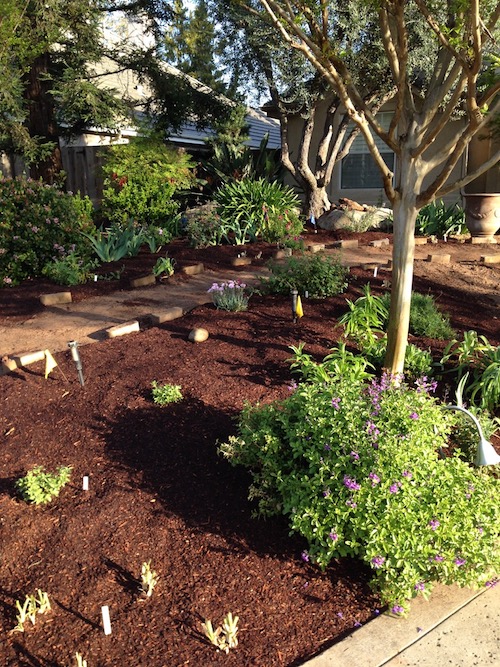
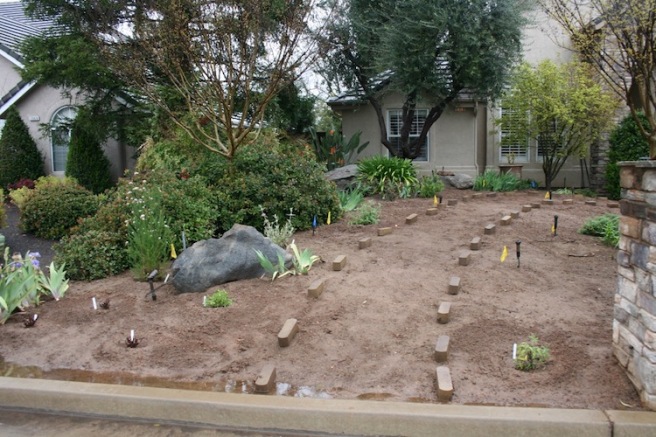
The new front garden west bed which replaced a failing area of turf weathered the summer pretty well. The pic below which I shared in an April post was taken in March after the bed was partially planted with a Heinz 57 selection of waterwise woody and tender perennials, daylilies, iris divisions and anything else I ran across that looked good to try.

slapped 2

At this point I was still considering a wide stone path from the street (near the eventual home of my in-progress Little Free Library) to the walk leading to my front porch and was visually defining the space with the brick.

Falling 1

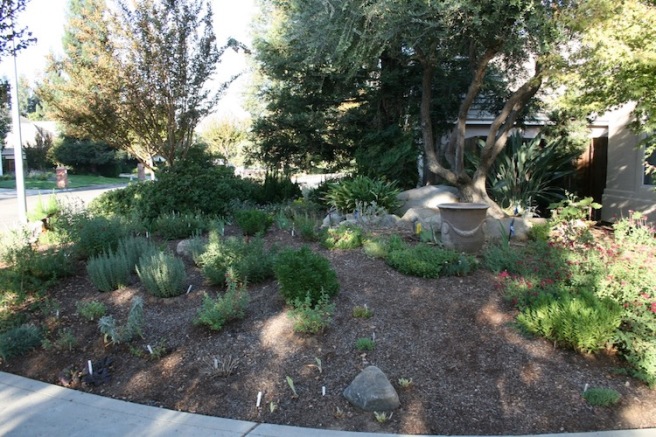
After my first planting wave I went ahead and mulched the bed down closely following the last good spring rain and in anticipation of the dry days to come. Notice the Salvia ‘Mesa Azure’ which was part of the original small half circle bed at the base of the crape myrtle tree has come on strong after a late winter cut back. The stone path is still under consideration.

The bed filled in nicely as May turned to June…

Falling 3

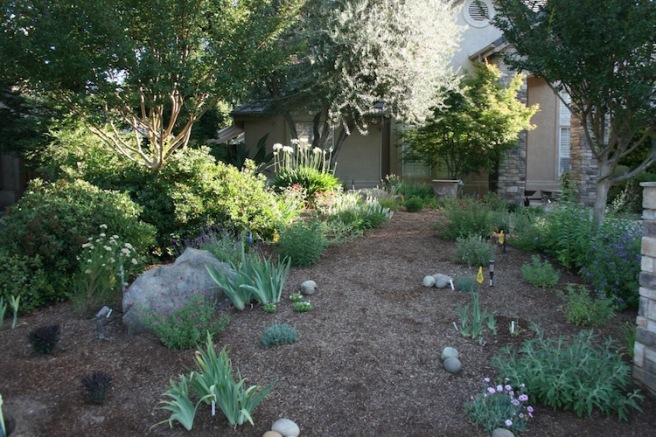
Even though this bed is south facing all but the very front has periods of dappled shade throughout the day. I abandoned the idea of the stone path and simply mulched everything down. The area had 2 sprinkler lines-one for the original bed perimeter and another for the turf. We were able to eliminate a number of heads immediately and have flagged the rest to watch through the summer. Although little in this area is thirsty, even drought tolerant plant material needs adequate water to get established.

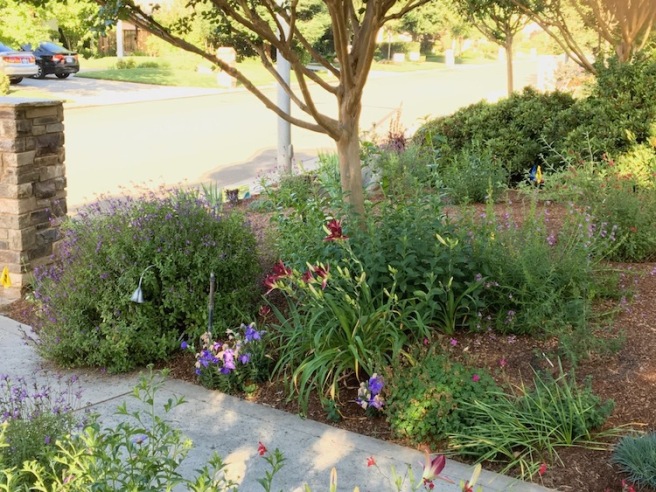
Both the new and old plantings performed very well.

Falling 5

Falling 6

I got good bloom periods from the daylilies, a variety of perennial dianthus, the new stand of lavender and a few of new semi-woody salvias. Only the Euphorbia ‘Blackbird’ which I was coveting for its burgundy foliage has been almost a total failure. I lost 2 of the original 3 planted. Replaced those and lost them again! In the very first pic of this post you can barely see them newly planted in the lower left corner. I am on the lookout for additional replacements and hopefully can get them in the ground soon enough to allow the roots to get well established through the winter.

Most of the plant material tolerated our dry heat really well for being in the ground less than 4 months as summer peaked. I did a little bucket watering here and there and believe that the bed will hold up next year on its own with only occasional irrigation.

Falling 7

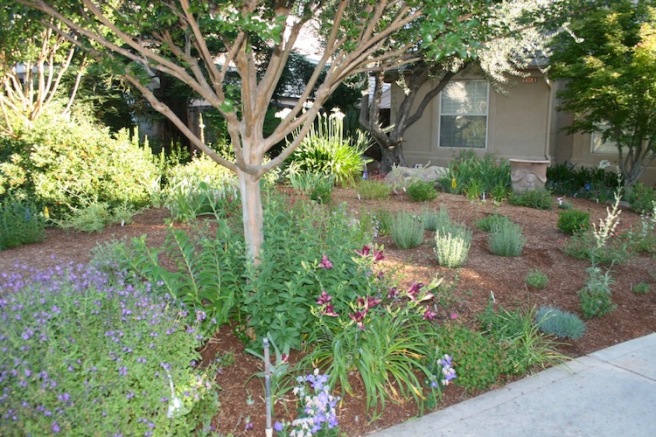
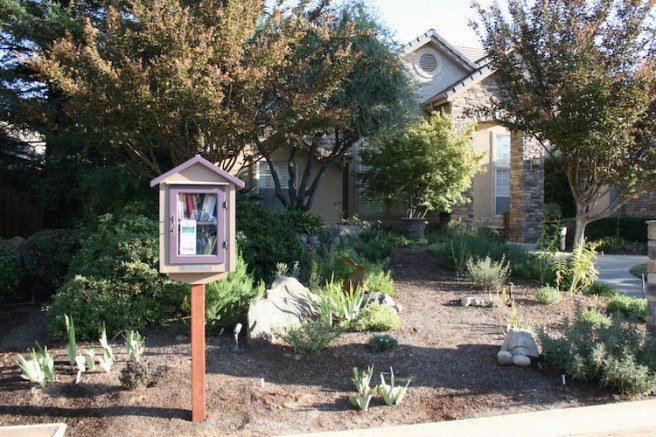
This is how the bed looked a few days ago. Yes–I finally got my Little Free Library in the ground! Even as much of the rest of the garden is looking a little draggy this area is still looking pretty good with plenty of healthy foliage.

Falling 9

Falling 8

The area around this small rock has proven difficult for a group of iris divisions and may end up sporting another large rock. In my efforts to avoid having sprinkler risers along the sidewalk I inadvertently created a few bone dry areas which just don’t get any coverage from the bed’s interior irrigation.

Falling 14Falling 12Falling 11

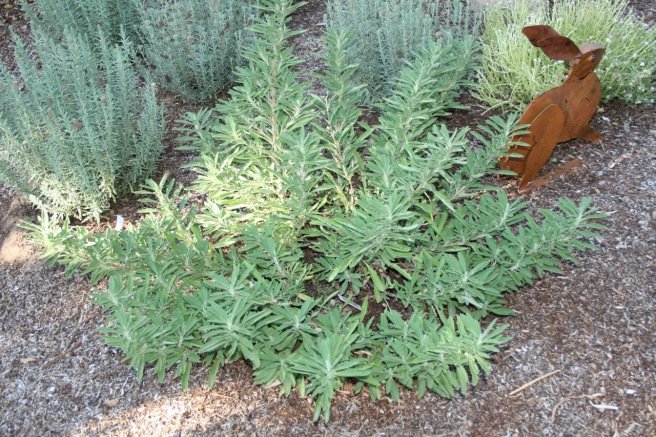
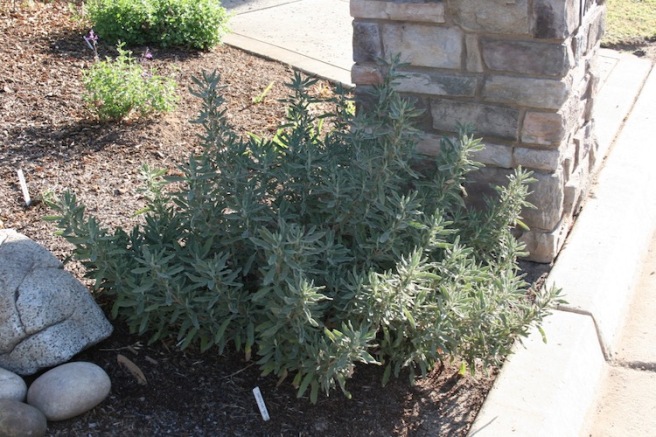
Three of my new woody salvias (top to bottom): Salvia ‘Dara’s Choice’, Salvia ‘Wild Bill’ and Salvia ‘Bon Bon’ all grew from scant quart container specimens to nicely behaved mounds of interesting foliage but, as yet, have not bloomed. These hardy growers were all purchased last fall at the San Luis Obispo Botanical Garden’s fall plant sale and overwintered in their containers before being planted in their current locations early this spring. I hope to make it to that sale again this year!

A couple of my other first year selections have not been so shy…

Falling 15

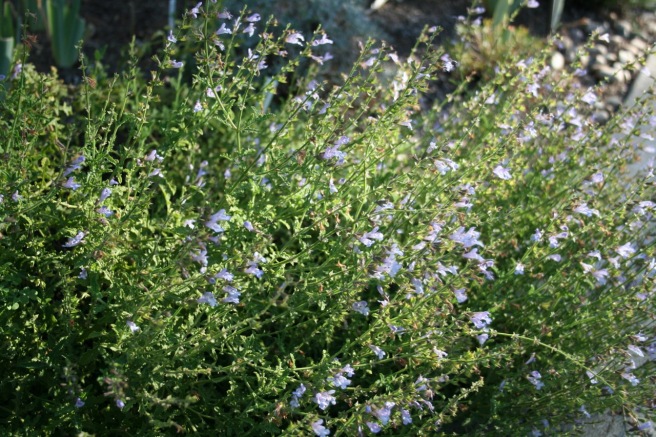
Salvia repens x namensis ‘Savannah Blue’ is a hybrid of two South African sages and although its sky blue flowers are small, they are plentiful. The foliage is reminiscent of that of small leafed scented geraniums.

Falling 17

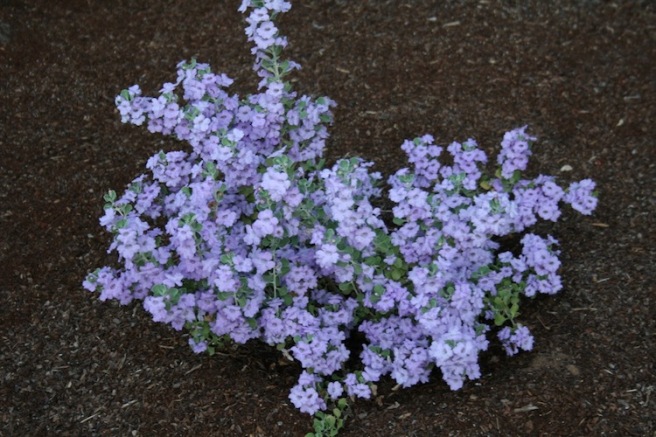
Leucophyllum langmaniae ‘Lynn’s Legacy’ bloomed heavily for 6 weeks mid summer after having a light show of flowers in early spring. This is purported to be quite a large plant at maturity and I have given it a lot of open space. Can you imagine this show on a shrub 4 feet wide and 6 feet tall?

With our spirits buoyed by the success of this turf free landscape and that of last year’s driveway circle lawn replacement project AND the strong back (loving heart) of my newly retired husband I just had the remainder of our front lawn treated for removal. I’ll have several weeks to narrow down my vision for this large wide open area. I’ve fallen all right–just not sure into what!


Howdy from Austin…party at Lucinda’s

My apologies that the Austin posts have been appearing in dribs and drabs. Lots of May travel pushed my own late spring garden tasks right on in to June and I have not caught up yet. Add to that some June travel, lots of mountain cabin maintenance (when the smoke from surrounding blazes was not too bad), my husband’s retirement and too many other distractions to list. I think these are supposed to be my Golden Years…

I like to introduce posts about private gardens with a nice wide photo of the garden’s street side vista to let you take in what any walker, runner or bicyclist would enjoy as they pass by on their daily routine. This time I’m going to introduce you to the garden creator first, as she sets the stage better than any wide shot could.

Lucinda 46

Lucinda Hutson is a cookbook author, garden and lifestyle author and lover of all things “Texican”. Lucinda is a self described tequila aficionada and the golden nectar is the focus of her latest book, Viva Tequila! Cocktails, Cooking and Other Agave Adventures. She was born and raised in El Paso, Texas and has lived in and gardened on her urban Austin cottage property for over 41 years. Her website (www.lucindahutson.com) entitled Life is a Fiesta with Lucinda! is a party for both your eyes and your spirit.

Lucinda 47

How can you not love a gardener who wears purple cowboy boots??

Lucinda 43

Lucinda 1

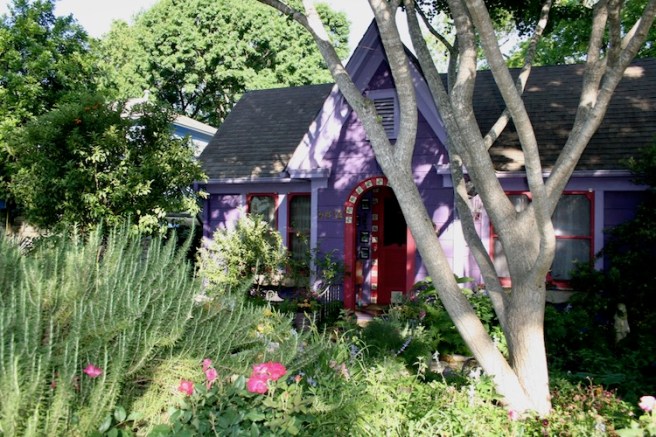
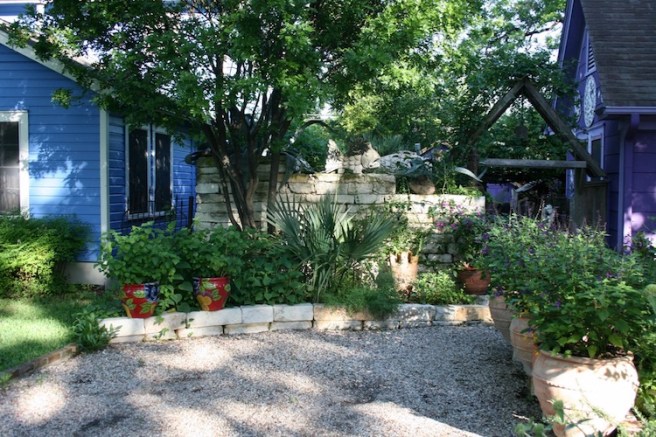
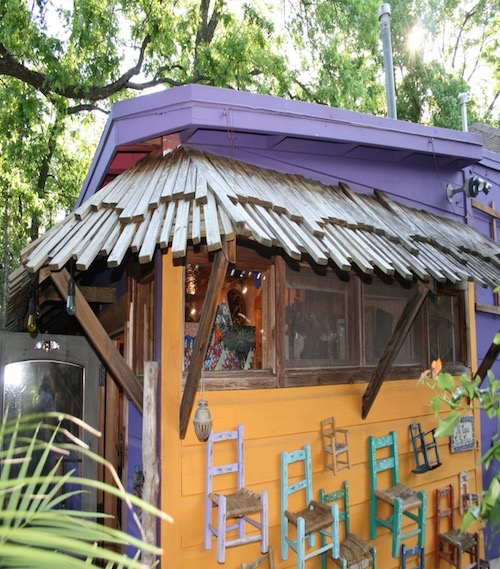
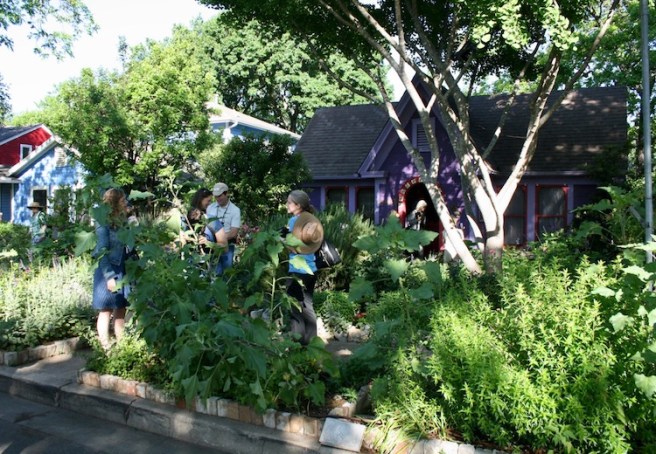
We arrive at Lucinda’s casita “La Morada” (little purple house) in a dappled early morning light that only exaggerates the cottage’s whimsical, Texas style fairy tale aura. Being a girl whose own garden graces a home with a purple front door and matching trellis work, how can I not be tickled by this brightly colored bungalow? The bright white trim allows the bold colors to pop while also acting as a unifying detail. Lucinda has done what we all secretly want to do–she has painted her home to delight herself rather than for resale!

The sculptural tree trunk is that of a ginkgo tree, planted by Lucinda 36 years ago from a five gallon can. She shared that it is one of the oldest and tallest ginkgo species in Austin.

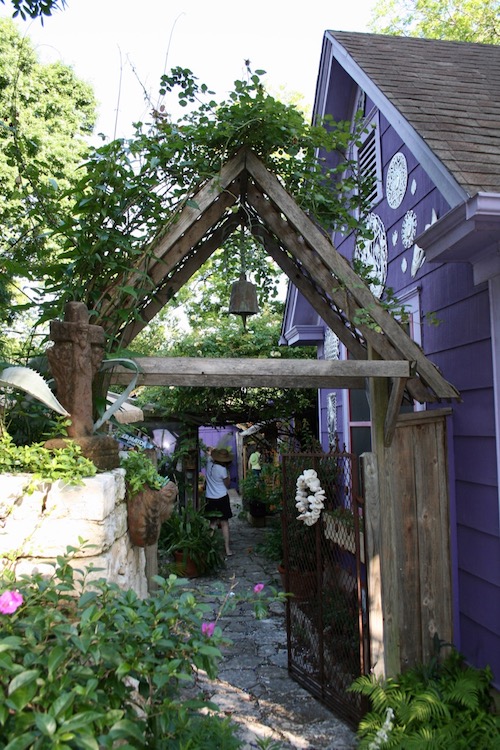
A purple house deserves a pink door in my book and the floral themed tile accents set the tone for the layer upon layer of detail the rest of the home and garden offer. Just to the left of the arch you can see Lucinda’s tiled house number leap right off its purple backdrop.

Lucinda 36

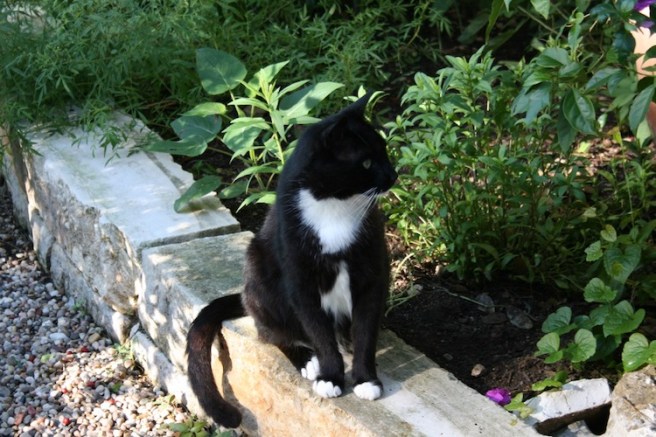
Sancho, the resident gato, keeps a watchful eye on his garden’s visitors.

Lucinda’s garden was originally an organic herb garden, an integral part of her life as an author of books and articles about cooking and entertaining. But as many gardens do, it evolved over time into a gathering spot for friends and neighbors and a place for Lucinda to try new plants and observe the constant buzz of nature around her.

Lucinda 45

At the time of our visit the front garden was predominantly green, some plants having finished their early spring flowering and other summer bloomers not yet at their prime. Please go to her website and take the photographic garden tour and you will see much abloom plus an great display of vining  and climbing beauties ablaze with bright flowers.

Lucinda graciously invited those who desired to go through her home to reach the back garden as a way of spreading out the traffic flow in the small space. I decided to take the gravel path, passing the shady woodland area, into the wide side courtyard.

Lucinda 3

Lucinda 4

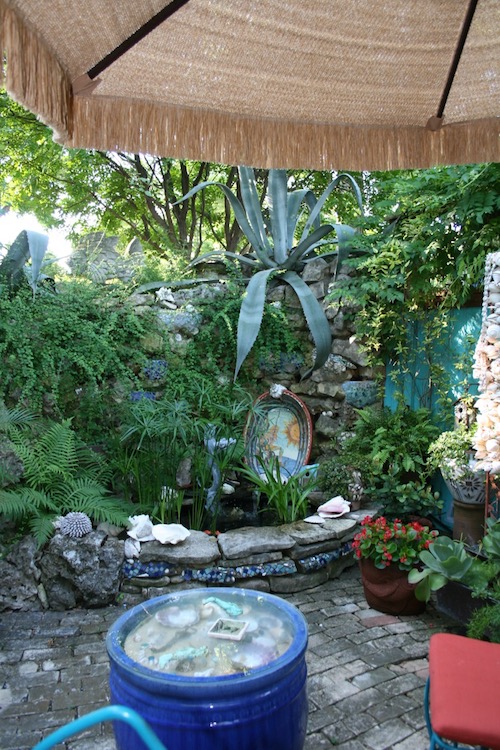
This side courtyard is appropriately called the Fish Pond and Mermaid Grotto and is awash (no pun intended) with all things of the sea.

Lucinda 8

This lushly planted area abounds with a great variety of foliage and blooming plants, including many pots.

Lucinda 34

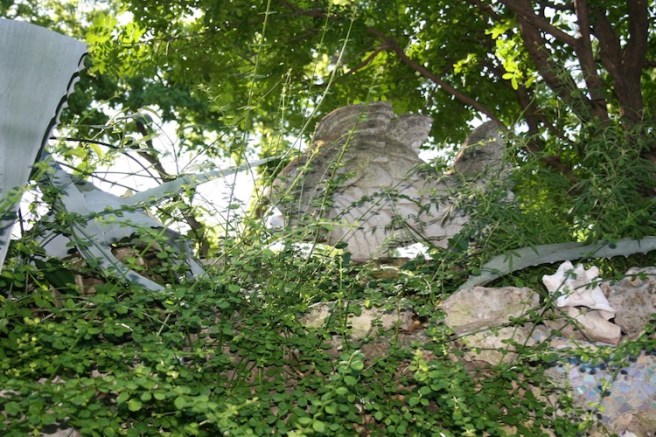
Even the stone wall behind the pond has a fish swimming across it!

Lucinda 7

The mermaid altar rises from a sea of copper troughs in which succulents and sansevieria are planted, as if on the sea floor.

Lucinda 35

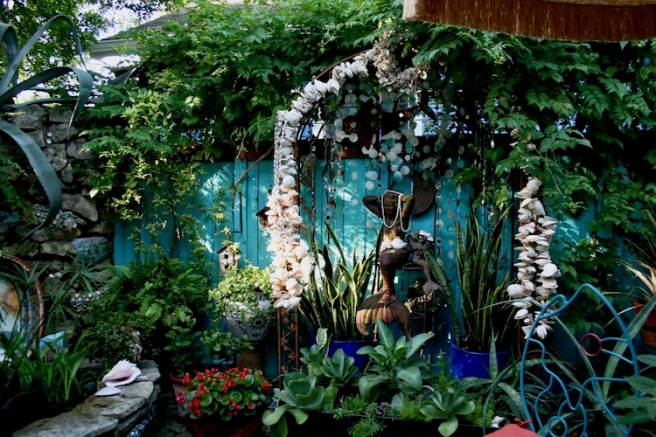
On the cottage side of the courtyard this Haitian mermaid and friends swim in a sea of purple.

Lucinda 38

Colorful pots echo the purple and hot pink color theme.

Lucinda 12

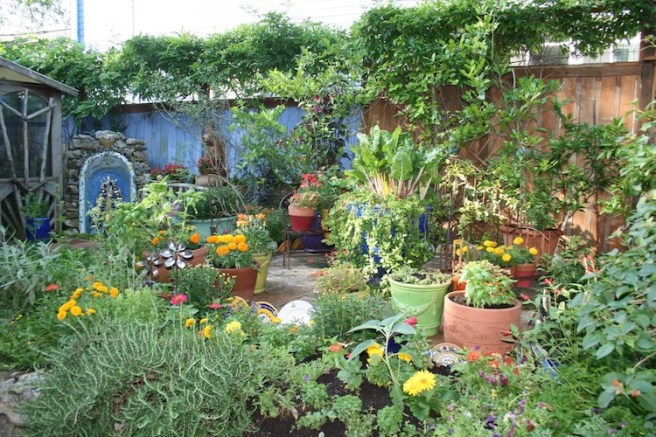
An open area with seating perfect for relaxing with a glass of iced tea separates the Pond and Mermaid Grotto from the Kitchen Garden, where the cool blues and purples of the sea give way to yellows and oranges evoking the Texican theme.

Lucinda 16

All manner of vegetables, herbs and edible flowers grow in raised beds and containers. You can get a glimpse in both photos (near the greenhouse) of Our Lady of La Tina in her bathtub shrine keeping an eye on all that grows here.

Lucinda 14

Lucinda unabashedly admits that her garden is both water and labor intensive. Although she has an extensive drip system many hours, especially in the hottest parts of summer, are needed with a hose in hand, making sure every little corner and pot has been covered.  Winter is not without effort as she must move many succulents and tropicals to the greenhouse or garage for protection from the cold.

Lucinda 31

In the last three photos you can see little snippets of the numerous plates Lucinda uses to border her Kitchen Garden raised beds, a play on her “garden to plate” theme. Not to leave the cutlery out, these shiny cuties pop their heads up from the herbs and veggies.

Lucinda 32

Lucinda 33

This unique corn themed mosaic window frame is right across from the Kitchen Garden and easily visible from Lucinda’s kitchen.

Lucinda 15

The Interior Patio packs a lot of goings on into a compact area. As you round the end of Lucinda’s cottage she has displayed her colorful collection of wooden Mexican wicker seated chairs.

Lucinda 29

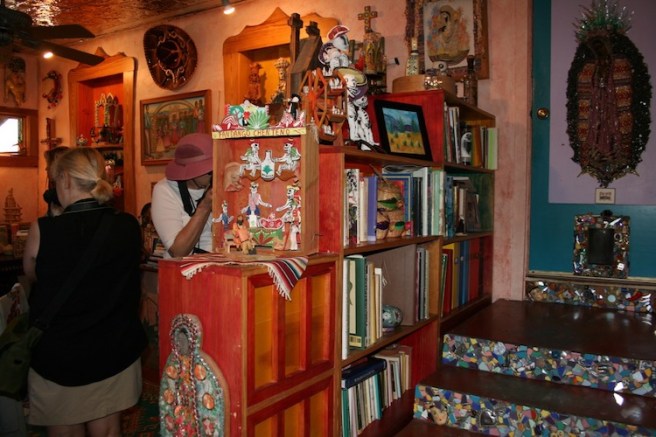
This entrance to her collection of Latin books, artifacts and collectibles is called the Stairway to Heaven.

Lucinda 30

I took just a peek but a few of my fellow bloggers found a lot to see!

Lucinda 20

A potted green room divider separates the cottage from the balance of the garden. I love the unique “awning” wrapping the corner and extending across the back of the house.

Lucinda 19

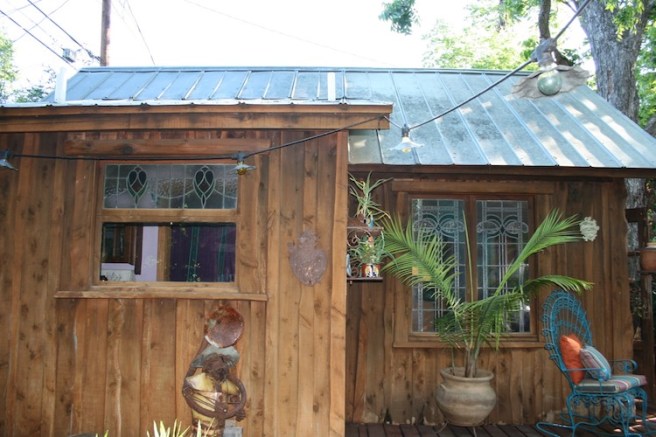
A large wood deck offers umbrella covered dining opportunities and the gateway to Lucinda’s Creative Cathedral, an aromatic cedar cabin where she does all her writing.

Lucinda 23

The cabin offers a dark, cool haven in contrast to the brightly painted and lavishly decorated garden exteriors.

Lucinda 24

This great spot in Lucinda’s garden is perfect for plant display or to have a bite to eat. The multitiered benches are covered with weather friendly oil cloth.

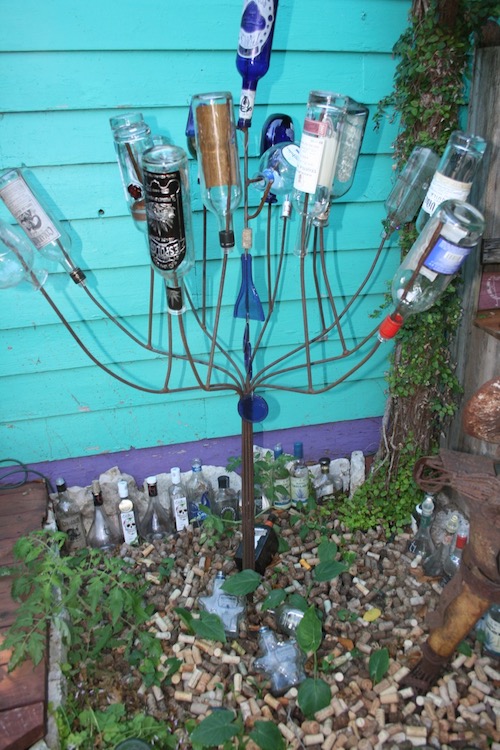
The back part of the garden houses the Tequila Cantina including a unique tequila bottle tree.

Lucinda 28

Notice the mulch–bottle corks! No found object fitting Lucinda’s themes goes unused.

Lucinda 26

Lucinda 25

An outdoor shower is handy just in case anyone imbibes a bit too much. An open area of flagstone patio allows Lucinda to set up her party tables, chairs and fixings in whatever style suits the to-do!

Lucinda’s garden is intimate in size and in its ability to give you a window into her life and personality. Few of us are bold enough to live life as large as this garden does.

Lucinda 48

Lucinda 45

We admired, lingered, chatted, took pictures and notes AND I’m sure a few of us probably asked to come back again, like reading a book the second time to catch all those things you missed the first time. Lucinda’s garden is like a party everyone wants to be invited to!


A minor miracle…

With the dry hills surrounding California’s Central Valley once again exploding as if by spontaneous combustion and my own garden in its holding on for dear life and trying to survive ’til September mode I witnessed this minor miracle a couple of days ago.

small miracle 1

First, a little backstory is needed. The Garden Bloggers Fling each year is blessed with many enthusiastic sponsors whose underwriting enables participants to experience 3+ days of great private and public gardens, meals to energize us and get some really fun goodies to take home for use in our own gardens. In addition, we often have gardening professionals representing our sponsors touring with us and providing us with the benefit of their knowledge and experience.

This year David Salman, founder and chief horticulturalist of High Country Gardens, toured with us and presented a short program while we lunched at Austin’s Zilker Botanical Garden. Based in Santa Fe, New Mexico, High Country Gardens has been a pioneer in sustainable gardening for over 25 years, offering quality drought resistant, native and unique plants. David has personally developed many of the plants found in High Country’s catalog and I will always remember him as the gentleman who hopped off the bus with a baggie to collect some seed from a shrub on the roadside because it was the native of something he had long wanted to propagate. As part of our swag bag we each received a lovely gift certificate to order something fun from High Country’s mail order website.

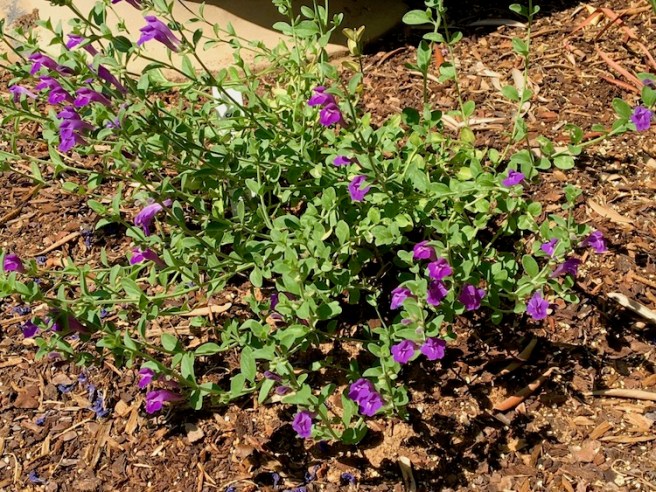
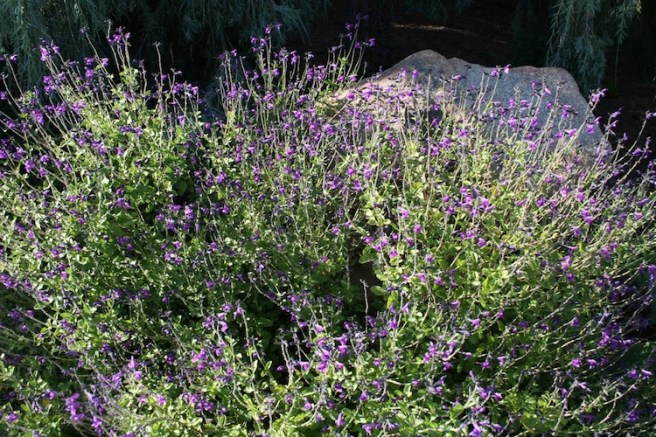
By early June I had wound down enough from Austin to study the offerings at http://www.highcountrygardens.com and made my picks. Two of the the plants I ordered were perennials I saw growing well in Austin: Callirhoe involucrata (poppy mallow or wine cups) and a Scutellaria hybrid with dark violet blooms. While the Scutellaria (skullcap) I saw in Austin I think was the native I have never seen any skullcap for sale in any local retail nursery so I wanted to give one a try! My final pick was just for fun—Buddleia alternifolia v. argentea–common name silver butterfly bush or silver fountain butterfly bush. Please note on the plant tag above I have misspelled the variety name.

Now we are all over the butterfly bush in California but what we have here is primarily B. davidii, a reliable and tough summer bloomer for us. B. alternifolia is described as a spring bloomer and has arching willow like branches with cascading panicles of lavender flowers. Ultimately a large shrub at 8′-12′ by 8′-12′ it is highly attractive to butterflies and hummers plus friendly to bees.

When my mail order box arrived I quickly got the poppy mallow and skullcap into the ground as our planting window here had really all ready run out. Crossed my fingers and dug them in! Uncertain about a location for the Buddleia, given its mature size, I added its little 5″ deep pot to a mix of containers still needing a home. It was only about 3″ tall but had some nice healthy leaves on it. The tiny pot fell on its side and got lost in the shuffle and thus went untended and unwatered FOR WEEKS. By the time I noticed it the little guy was no more than a 3″ stick with a couple of yellowed leaves and dry as popcorn.

With nothing to lose at this point I stuck it in a smallish pot (can’t even think what died in this pot) and tucked it into an area that would at least get some sprinkler water a couple of days a week. Now only a few weeks later, I have not only new vegetative growth but the wee fellow is blooming! Just the little bit of hope that a discouraged gardener needs at about the time she is thinking a condo with a 5 foot square patio is looking pretty good!

minor miracle 3

minor miracle 4

By the way, the poppy mallow (wine cups) continues to struggle but I am confident that it will get a foothold and be beautiful next year. The dark violet skullcap is having a stellar first summer, especially given it’s tardy planting. It has made a tidy little mass about a foot wide and is blooming well. Thank you, David!

Howdy from Austin…digging under the Death Star

In addition to her award winning blog Digging, Pam Penick’s garden creds include founding the Garden Bloggers Fling in 2008, an eight year run as a garden designer and freelance writing credits in well known garden magazines such as Garden Design, Country Gardens and Wildflower. In her spare time (?) she has authored two books, Lawn Gone! and The Water Saving Garden, and organizes an annual series of Garden Spark Talks in her home featuring local designers and garden experts.

Penick 1
A little borrowed landscape as you approach Pam’s home

My Central California summer shares the heat and drought challenges Pam faces. She calls Austin’s scorching summer sun the Death Star and confides that she does the majority of her gardening in the spring and fall, as I do, and tries to relax in her pool, as I do, through the dog days. Having seen many of Pam’s garden elements from reading her blog over the last few years, I wasn’t sure I would see anything new but I hoped to expand my knowledge of the proverbial ‘spiky things’ that thrive in her landscape. An additional garden challenge for her is what Texas gardeners coyly refer to as ‘deer pressure’. When I lived in Georgia we called ’em like we saw ’em–those #$%&@#ing deer! Periodic torrential rains necessitate well thought out systems of dry stream beds and terracing to direct water away from home foundations and slow runoff down to mitigate erosion, hoping that your plan allows some of that water to percolate down into the landscape. Pam has approached her garden’s challenges with apparent good humor and the willingness to keep trying until she focuses in on the right solution.

Penick 4

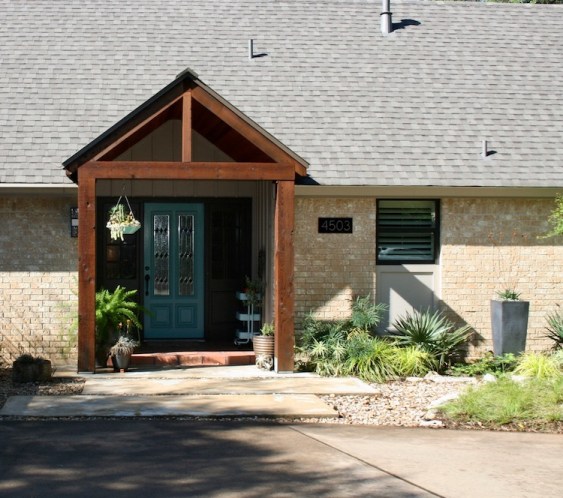
Pam describes her home as a “nondescript 70’s ranch”–the fact is that most of us live in nondescript ranches or bungalows or colonials of some vintage. Not to imply that all gardeners regard their homes as brick and mortar backdrops for their effort but for me it’s the garden that makes the home, not the other way around. Pam has added an edgy vibe through her use of contemporary materials and architectural plantings plus a pop of color with her aqua front door.

Penick 3

To the left of her front door this trio of rusty metal planters hold heat lovers not favored by her antlered friends and their families. On the bus Pam shared with us the story of being given the tall metal pipe (which is also sunk into the ground several feet) and the ensuing harrowing effort it took to get the large toothless sotol (Dasylirion longissimum) into its new airy perch. The squaty one is a whale’s tongue agave (Agave ovatifolia).

Penick 7

To the right Pam has planted a variety of leafy green and gray plants tucked up to the foundation, bordered by a gravel path to the back garden. Spring comes very early to Pam’s garden and thus many of her spring bloomers are well past their time.

Penick 10

The rusted metal spiky ‘plant’ was added to the tall container to give it a little more vertical interest.

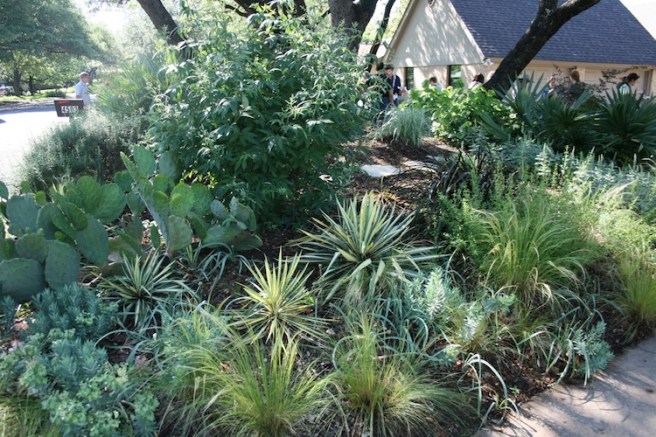
Pam’s front garden is mostly shaded by mature trees. A hill-like planting area provides a place to add a variety of shrubs, succulents and a few perennials which soften the circle driveway.

Penick 6

Penick 5

Penick 8

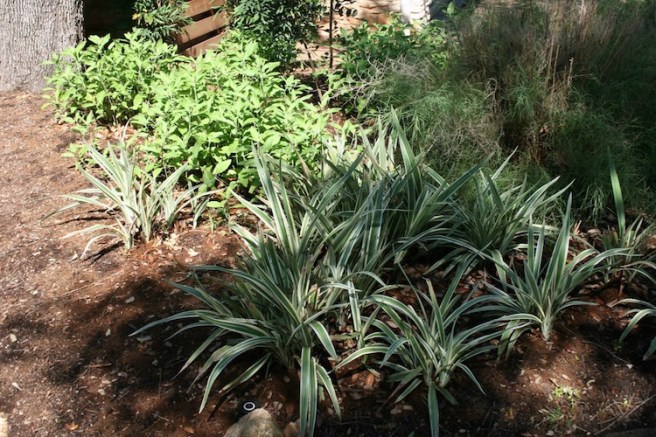
Across the driveway a stepping stone path winds toward the back garden. The area features a semi-circle ‘lawn’ of ‘Scott’s Turf’ sedge (top photo, far left) and a shade illuminating patch of flax lily (Dianella). Recently Pam posted photos on her blog of a newborn fawn resting in this shady patch, apparently waiting for mom to return from shopping or lunch!

There is a party going on in Pam’s back garden! She has created a strolling garden of exploration, with lots of places to sit, relax and enjoy the many views.

Penick 25

In a relatively compact space Pam has created multiple garden rooms and seating areas, layering in potted cacti and succulents which do not require her daily attention through the hottest parts of the Austin summer.

Penick 26

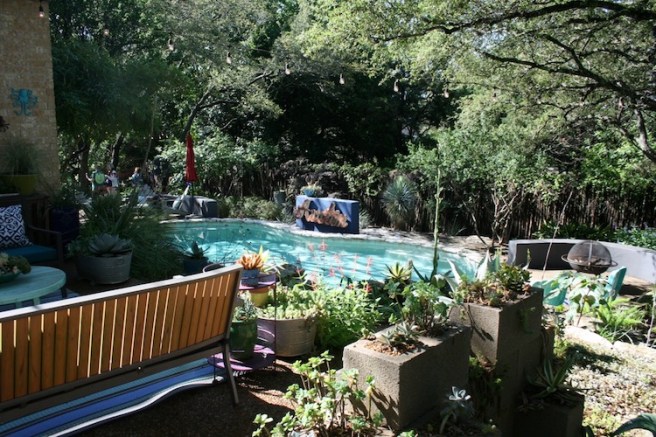
The very private and shady back garden is lit up in its center by a curvy, cool aqua pool.

Penick 29

Ok–so where can I get one of these that says FRESNO? The rustic sapling (Juniper?) fencing seems to disappear into the shade.

Penick 28

One of two elevated comfy seating and eating areas. The lot slopes down from the house to the fence and these raised areas offer great garden and pool views. Pam has used lots of interesting containers to add green at many elevations, softening the brick facade and prominent use of stone to make the downhill slope transitions.

Penick 11

The extension of her home into the back yard in a sort of upside down T shape makes this first raised area totally private from the deck just a few feet away.

Penick 32

Penick 30

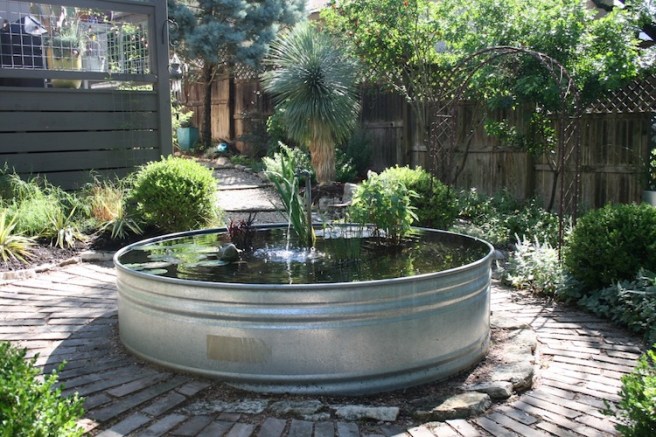
The deck offers a perfect dining spot with a view of the pool, plantings and Pam’s favorite garden feature, the stock tank pond surrounded by a stone sunburst patio.

Penick 17

Penick 13

Penick 19

Pam’s garden is clearly a very personal space and these two little bricks dedicated to her children and set into the sunburst patio are right on the top of my list of favorite Penick garden elements.

Penick 18

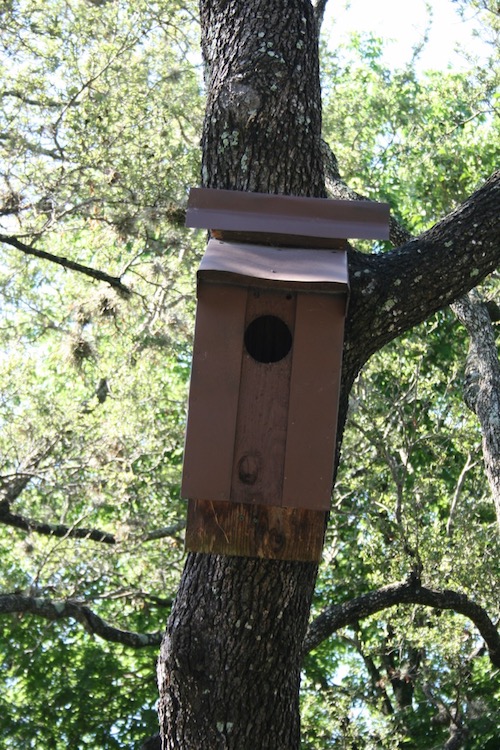
Pam’s goal to welcome non-deer wildlife is brought up close on her deck with the nesting box she installed for her resident screech owls to raise their family each year. I am going to tell you one more time to check out her blog at http://www.penick.net for several posts from May 2018 chronicling her screech owl family’s progress.

Penick 16

In a shout out to Austin’s famous bridge bat colony this rusty bat hangs in repose over the deck.

Penick 12

Steps away from both the pond and the pool this vintage meets contemporary conversation area beckons. The pool patio walls offer additional seating and a spot for Pam’s pooch, Cosmo, to sunbathe.

Penick 14

Penick 21

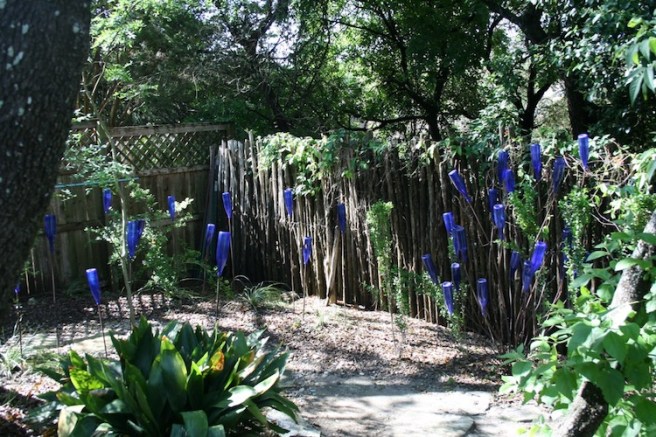
I’ve never met a bottle tree (bottle hedge? bottle shrub?) I didn’t want for my own and this one is no exception. The cobalt glass sparkles in the dappled shade. Pam’s lot beyond the pool drops off pretty sharply and there are many massive stones to scramble over. She told me they were all ready in the landscape when they purchased the home and conjectured that the stones might have been unearthed when the pool was dug and then just spread out across the property rather than hauling them away.

Penick 15

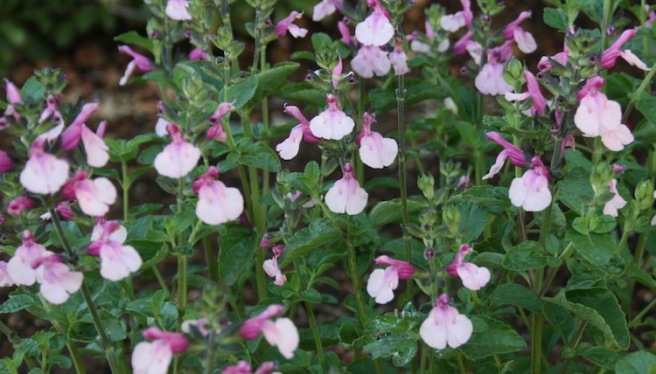
Salvia guaranitica echo Pam’s color choices in much of her garden art.

Penick 23

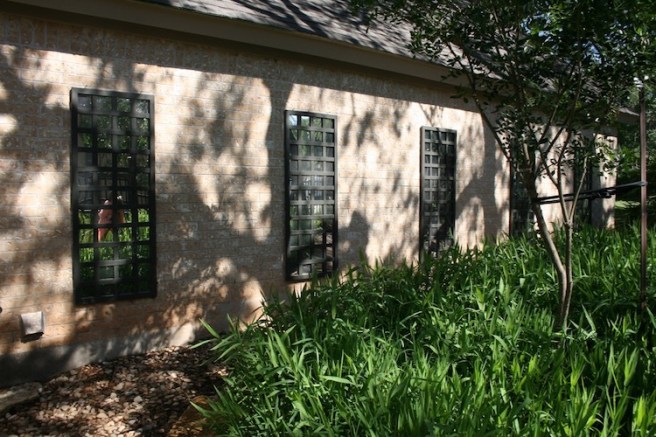
You leave the back garden via a very wide side yard. This grouping of lattice framed mirrors draws you along the path and makes what would have been the ubiquitous blank wall of the back of her garage shine! Pam gave us the tip that the mirrors are plexiglass rather than glass, giving the reflection a wavy interesting feel and making it less attractive and hazardous to birds.

Penick 24

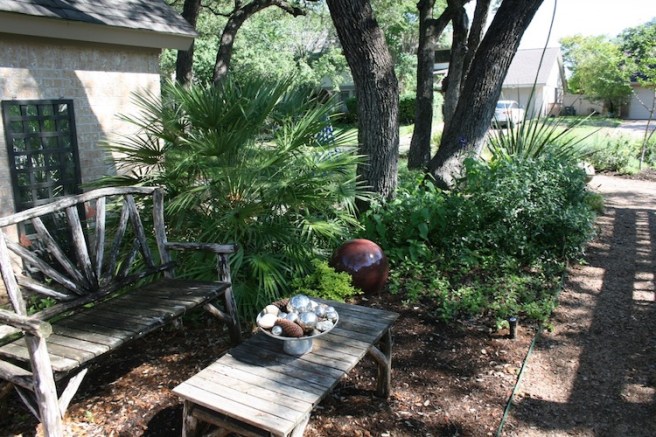
This rustic and shady seating area is secluded from street view by carefully placed plantings. I am truly convicted now that I must add more seating and feet propping up spots throughout my garden.

Penick 27

Penick 33

As I make my way back to the front a contemporary blue tuteur rest upon a lawn of ‘Berkeley’ sedge in perfect color harmony with a trio of ceramic globes.

Despite a whole lot going on, Pam has developed her garden into spaces that are visually calming through repetition of plant and foliage shapes. She has chosen a really nice balance of contemporary and vintage throughout which seems to evoke the Texas ambience which has enveloped me since I arrived. Giving old stuff new life and combining it with modern materials and architecture keeps Austin funky and fun.

Run…do not walk to check out Digging:Cool Gardens in a Hot Climate (www.penick.net) If I was savy enough to offer you links to the individual posts I mentioned about the fawn and the owls, I would. But then you might not spend a delightful hour or two just scrolling through her great variety of posts, including a bevy of garden travel destinations she takes us to through her wonderful photography. I would start by clicking on the tab New? Start Here to get an overview of her extensive site–you’ll love it!

Dancing Dolls…

Dancing Dolls 1

Readers with good memories may recall I was suffering from an acute case of Salviamania in the early spring of 2016. I posted My sage advice to you is… in May and then 2016 Salvia update… as a follow-up later that year. I was truly obsessed with collecting every introduction in a few salvia series such as Monterey Bay Nursery’s Turbulent Sixties and Western Dancers introduced by Suncrest Nurseries. Since that time I have added additional cultivars from those series and others but until early this year had not been able to successfully introduce the long sought after Salvia microphylla hybrid ‘Dancing Dolls’ to my garden. Many of these named varieties are almost never in my local garden centers–both these series are filled with older introductions and I recognize the store’s buyers must attempt to provide a good mix of the hot new things plus the old standards. That dream of someone calling to check what’s on my list for this season before the orders are placed is not likely to ever become reality. Do they not know that I am the Queen of the Dirt? I find the greatest selection when shopping on the coast and in Southern California and even then being able to check another one off my list is pretty exciting. Two previous purchases of ‘Dancing Dolls’ in 4″ pots got lost in the shuffle somewhere along the way–I see them in my photographic record of what I have purchased but have no idea whatever happened to either of them!

Finally found another a couple of months ago and got it planted in the newer lawn free plantings along my front walk and I have been rewarded with its plentiful and perfectly colored lavender and pale pink blooms. ‘Dancing Dolls’ shares it 2004 parentage with ‘Shell Dancer’ which grows in my back garden but the colors are less creamy and much more clear and sharp. I love the way she plays so well with other lavender and dark purple blossoms.

Dancing Dolls 2

I am feeling as if I need to start scratching that little salvia itch again!

Howdy from Austin…almost above the clouds

After a whirlwind trip to University of Georgia in Athens which saw me on the ground for less than 24 hours sandwiched between a couple of 2 hour flights from and to Austin I fell into my Texas hotel room for a night’s rest. Up and out bright and early on Saturday morning I joined my fellow bloggers on the bus in anticipation of the day’s adventure. I learned that the 2018 Garden Bloggers Fling had gotten off to a bit of a rocky–no, I mean rainy start as many of my companions commented on today’s promising weather.

Over the next two full days we would tour 10 private gardens plus spend a little time at the Zilker Botanical Gardens. Rather than sharing them with you strictly in the order we visited, I am going to mix them up over many days alternating large and small, formal and funky, dry and lush–hoping to give you a broad vista of what Austin gardeners are doing.

After winding up into the hills overlooking downtown Austin and the University of Texas Tower there was still more climbing to do to get to the always-in-progress garden of Ruthie Burrus.

Austin Burrus 1

So here’s were we hopped off the bus at street level. In Ruthie’s own words her 2 acre property is “all about pollinators, native plants, and taking advantage of views and natural surroundings.” No where is this more well illustrated than on the long walk up her driveway. I expect there is probably a golf cart in play to get the mail and haul the trashcans back and forth because it is not a casual stroll but a lung pumping ‘lean into it’ hike. I’m going to walk you up in pictures rather than words!

Austin Burrus 4

Austin Burrus 2

Austin Burrus 3

Austin Burrus 5
Halfway there

Austin Burrus 8

Austin Burrus 6

Austin Burrus 7
Glancing back to make sure we haven’t lost anyone!

Austin Burrus 9

Austin Burrus 10
The beautiful limestone Texas ranch house comes into view

The Burrus garden came to life into 2012 with the joint goals of a private retreat with ample outdoor entertaining spaces and a landscape which would provide natural habitat for butterflies, bees, hummingbirds and moths to flourish. The ever-changing wildflower meadows which flank the driveway showcase native wildflowers, annuals and perennials amongst a backdrop of evergreen and deciduous hardwood trees and mature shrubbery. Ruthie’s garden is both a Certified Wildlife Habitat and a Certified Monarch Waystation. They have also built in a roof and gutter rainwater retrieval and storage system which includes a 10,000 gallon galvanized tank to provide chemical free irrigation to their gardens.

Ruthie has invited us to approach her back garden through her home. Her home has tremendous visual appeal–a variety of traditional Texas materials all pulled together to exude casual elegance. Liveablility always enhances a home beauty and this newer home has the warm feel of one lived for generations.

Austin Burrus 15
Stone and stucco highlight the variety of facades through the shade of mature oaks
Austin Burrus 11
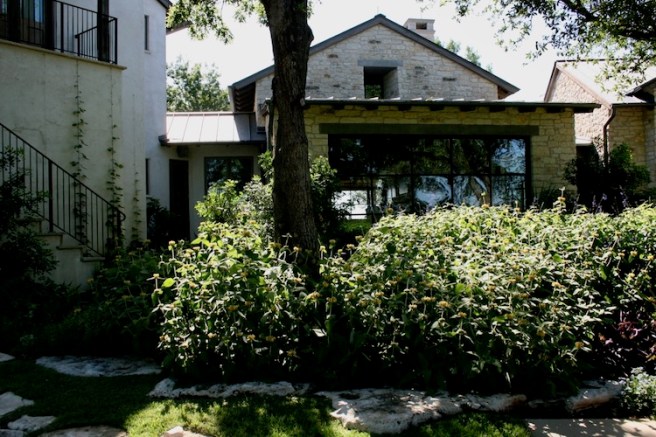
This large colony of Jerusalem sage was just coming into bloom–I expect by afternoon it is in full sun
Austin Burrus 18
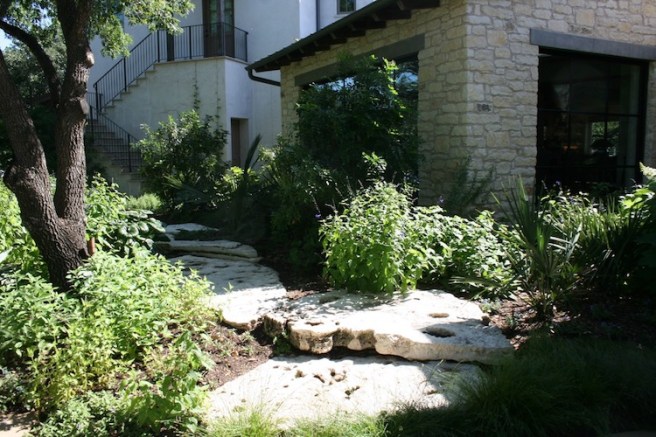
Paths of massive stones wind among the beds
Austin Burrus 17
A small side porch offers a welcoming rocker
Austin Burrus 14
Long views to the distant hills from the front walkway

Ruthie shared that this side of her home is cool in the mornings and can be scorching in the afternoons. We enjoyed the dappled midmorning shade and I expect the front garden would look very different in full sun. I especially admired how Ruthie has used masses of a single species to fill large beds and borders. No frenzy of mixed color, just quiet drifts of many greens punctuated now and then with a drift of flowering perennial color.

Austin Burrus 19

The Burrus front door is protected by a deep overhang and was totally in shade at the time of our visit. Even with my unsophisticated photography I think you can get that this is the reward for the long walk up the driveway. You can see straight through their home, across the pool to the skyline of Austin.

Austin Burrus 22

Stepping out onto this beautifully styled outdoor living area the full impact of their bluff location is everywhere.

Austin Burrus 20

The pool is a classic rectangle with a dark interior which I think allows your eye to focus on the skyline rather than the individual element of the hardscape.

Every choice Ruthie made for her inviting seating area is perfect and focuses on the homeowner’s connection to her garden and nature.

Austin Burrus 24
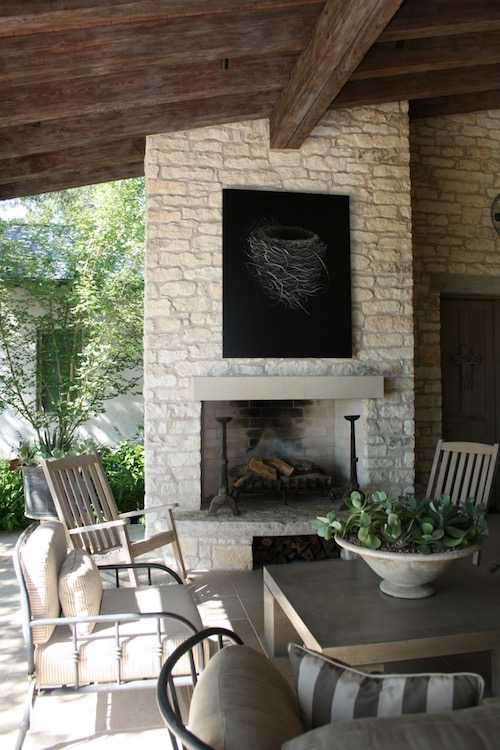
Dramatic artwork depicting a nest over the woodturning fireplace
Austin Burrus 23
Simple stone bowl planted with a single succulent species
Austin Burrus 25
Rustic wooden container with mixed succulents

The garden wraps around the house on both sides. To the right there is a step down to a serene mixed perennial bed, beautifully viewed from the slightly elevated lawn. It strikes me that no area was deemed not important enough to create a beautiful view from the home’s interior.

Austin Burrus 26

The back garden itself is quite shallow with a narrow lawn and bluff bordering beds whose contents provide color and interest without detracting from the views. As you walk the garden to the left in a circle which will eventually bring you back to the crest of the driveway there is so much to admire.

Austin Burrus 27
Large dining area adjacent to a wall of windows allowing more great views from the interior
Austin Burrus 29
Perennial and rose filled beds–I’ll volunteer to pull weeds here any day
Austin Burrus 28
Tucked up close to the house is a great masonry and stone pizza oven–only a few steps from the dining area
austin-burrus-35.jpg
Another view of the Ruthie’s Garden Haus which I featured in the Austin sneak peak post

The Garden Haus anchors Ruthie’s Provence garden, a gravel filled area adorned with plantings of lantana, bee balm, roses and citrus trees. The haus is constructed entirely of vintage and salvaged materials and features rock gleaned from their property. Ruthie assured us that her haus is a very functional garden shed on the inside–not at all cute–I remain unconvinced and lustful for my own little stone house all the same.

Austin Burrus 37

Jim Peterson, editor of Garden Design magazine and a loyal Fling sponsor, interviews Ruthie on video as she tells the story of her unique garden structure, adding that the climbing Peggy Martin rose inspired her desire for an old house to support an old rose.

Austin Burrus 34
Just past the Garden Haus, Ruthie has hidden substantial storage and outdoor staging space for pots and supplies behind the rock walls–the open lawn offers lots of play space for the grandkids
Austin Burrus 30
This peak through the fence and across the neighbor’s property offers a view of the Texas Colorado River
Austin Burrus 32
As we come full circle back to the front Ruthie has tucked in a fanciful play area including a rustic platform tree house

As our group gathers around to start our downhill trek a murmur runs through the crowd that we have been offered the chance to go up to the 3rd floor observation tower above Mr. Burrus’s office space. I am not sure everyone got to climb up the narrow staircase to the small open air viewing platform–so sorry for those who missed it!

Austin Burrus 36
We passed through Mr. Burrus’s office with its killer skyline view

Austin Burrus 38

Another single file climb ended in a small circular platform with 360 degree views. The architecture of the home was so interesting from this drone’s eye view. Only room for 4 or 5 people at a time, we each tried for a quick photo then gave our spot over to the next person on the stairs.

Ruthie walked back down the long driveway with our group and as we pulled away on our bus bound for our next garden destination I could see her with gloves and sun hat, bent over in her meadow–the scene would have made a beautiful impressionist painting entitled Garden Woman at Work.

June bloom…

June is National Perennial Gardening Month! Simply put, perennials are plants which produce new growth for more than two years. They are garden mainstays which, with periodic cutting back and division, will flower year after year. Most successful gardens have a balance of trees, shrubs, annuals, biennials and perennials planted with a plan for successive bloom or interest through all four seasons.

Not all perennials are alike.

Some have fabulous blooms, other are grown primarily for interesting foliage.

Some may be viney climbers, others mounding clumpers and still others tall fountain-like sprays. There is a perennial to fit just about any color, shape or size you desire.

June bloom 4
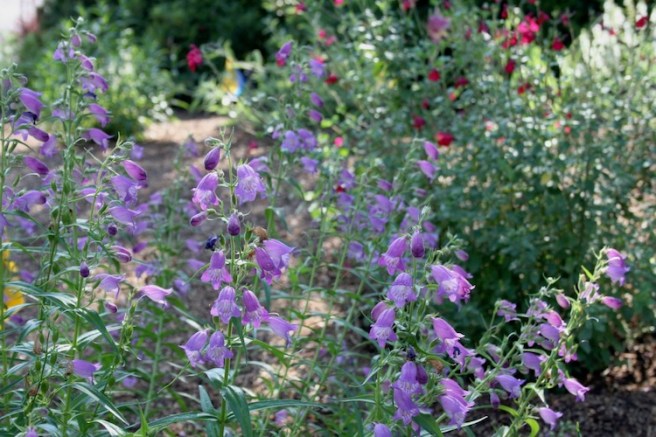
Penstemon ‘Midnight’ just coming into bloom

Some develop woody/twiggy stems requiring more tidying up, others are herbaceous with soft stems and foliage throughout their season.

June bloom 5
Salvia greggii unknown variety but in need of a little nipping back!

While a few are evergreen, many will die to the ground to take a rejuvenating winter nap. Still others sort of look as though they are hovering between life and death, rewarding you with a renewed vigor as spring approaches.

Areas with severe winter weather conditions often grow perennials which they treat as annuals (not enough growing season/soggy roots cause rot) by replacing them every year. Conversely, we in often very mild winter climes sometimes need to encourage perennials to go dormant as the soil/air temperature may not get low enough to give them the message naturally. Just like your 3 year old who doesn’t want to take as nap–you as the parent know how much the rest will benefit the kiddo’s overall demeanor–so it goes will recalcitrant perennials.

While June is the perennial garden’s special month, take heed! In hot summer areas like mine this is the month for PLANNING the perennials you want to add to your garden–NOT PLANTING them. Fall is the best time to get most perennials in the ground to give them time to put down good roots and take advantage of whatever winter rain might grace your garden.  Arm yourself with knowledge about the optimal growing conditions for each perennial plant you are considering as seriously as your would for a shrub or tree purchase. They are built to last!

A few more June blooms from my garden…

June bloom 6
Penstemon ‘Purple Riding Hood’
June bloom 9
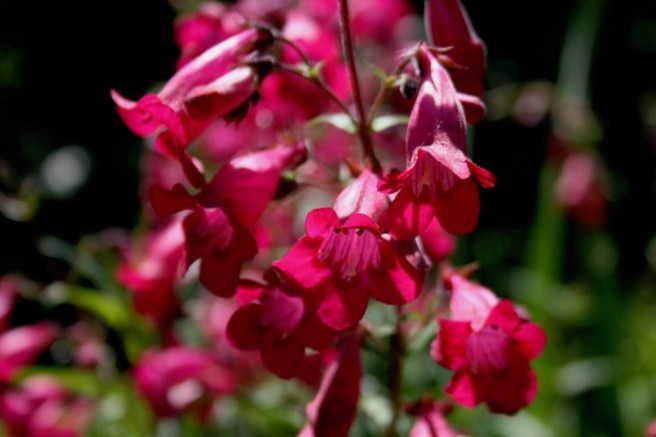
Penstemon ‘Garnet’

Good resources to research perennials to add to your garden include the old stand-by Sunset Western Garden Book, the New Southern Living Garden Book, Armitage’s Garden Perennials by Allan M. Armitage and California Home Landscaping from the Creative Home series. The website http://www.perennials.com has an excellent database of over 4000 plants and several great articles on choosing, planting and maintaining your perennial garden.


Austin pre-Fling road trips…Friendly Natives Nursery

Kolodzie 11

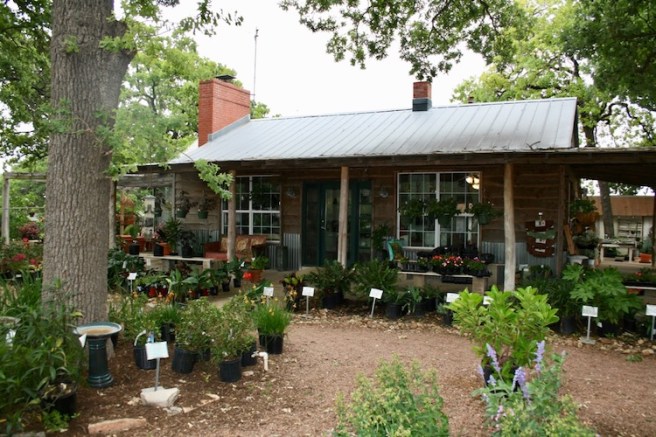
I found all the Fredericksburg natives to be very welcoming and friendly but none more so than Matthew Kolodzie, owner of Friendly Natives Nursery. His retail nursery and design-build firm sits amongst a shady grove of 150 year old post oak trees just a few blocks off Main Street.

Kolodzie 5

This day Matt and his small staff were busy ‘resetting’ the plant materials for the new season and straightening up after a windy night had left lots of large specimens laying down. With my camera clearly taking wide shots and my notebook in hand he may have easily recognized that I wasn’t a local shopping for native plants. When shared that I was from California he was very interested in what brought me to him–I described the Garden Bloggers Fling event and how I had found him through Central Texas Gardener (shout out to this great publication/tv show/blog who signed on as a Fling sponsor). He immediately encouraged me to bring the whole group to visit and asked me to share with one of our leaders, Pam Penick, his appreciation for her blog. I am not sure how his education as an engineer brought him to his passion for landscape design focused on native and well adapted plants but he clearly has a deep commitment to his role as an advocate and educator for those wanting to live with gardens evocative of Texas Hill Country style.

Kolodzie 1

The Friendly Natives property was owned in the 1900s by the local monument maker. Matt shared that there are still gravestones here and there that were left behind and one of the smaller outbuildings has written records of the stonemason’s orders on the wall. One of two small homes on the grounds acts as the cashier and gift shop area. It has been nicely restored and I would have been happy to just hang out on the porch all day.

Kolodzie 2

Kolodzie 10

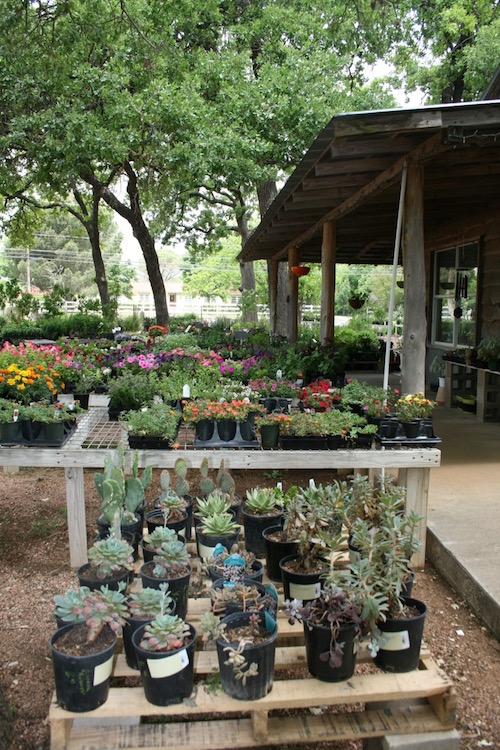
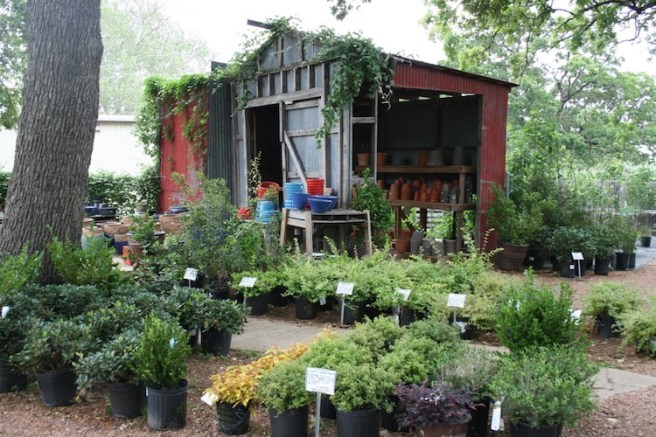
A nice variety of well maintained plants are arranged under trees and around seating vignettes. I was crazy over the potting shed pictured below.

Howdy 6

Matt and I talked plants for much more time than than he probably had to spare. I saw several interesting plants that I would love to try in my garden but the age old issue of ‘you can’t buy it unless someone grows and sells it’ came up–I did jot a few names down to survey my mail order sources for availability.

I met two of his three lady chickens. All three are called Michelle after Michelle Obama. Matt joked that all they ever said was “barack, barack” so the name just seemed appropriate. As we chatted, he leaned over to move a pot so that the gray Michelle could find a tasty morsel in the moist soil underneath.

Kolodzie 3

I loved the foliage combination of the variegated Silene dioica ‘Clifford Moor’ and the Salvia lyrata, or lyre leafed sage. I am game for pretty much any sage and this is one I have never seen in my area.

Kolodzie 7

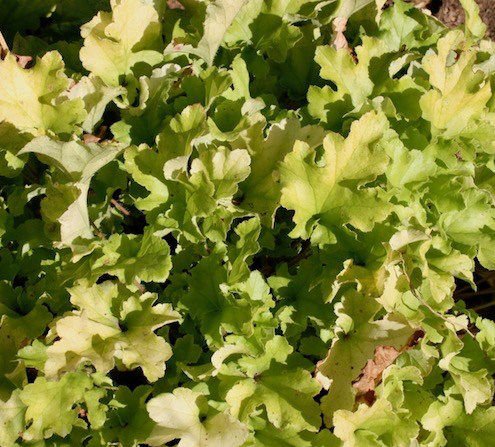
Another foliage standout was Heucherella ‘Solar Eclipse’ shown below. The heucherellas are crosses of selections of heuchera and tiarella. Tiarella as a genus is much less tolerant of sun than heuchera are. I expect the crosses seek to get the best foliage variegation combined with greater sun tolerance.

Kolodzie 8

A casual query to Matt about where I might find a few well done residential landscapes to photograph brought an offer to jump in his truck and take a ride! Only a few blocks down toward Main Street were a residential landscape he had recently completed and the grounds of a local bed and breakfast he had refurbished. I also learn that the small front gardens of two local restaurants near the Japanese Garden of Peace were his work. Not wanting to take up any more of his time I declined his very kind offer of a guided tour and bade him good-bye, reflecting on what an asset he is to his community. He is clearly the kind of plant professional who is generous with his time and knowledge without regard to whether you actually have business to give him. He is the kind of nurseryman that you then return to when you have defined your project because he remember how well you were treated on your previous encounter.

Koldzie 18

This wide side yard, almost the size of a second city lot was installed by Matt Kolodzie to include a covered dining area, a graceful fountain and a fire pit under the mature canopy of existing trees.

Kolodzie 13

This is the imaginative yard on the other side of the same home–also a very wide space with significant exposure to the street. Although not part of Matt’s design I wanted you to see the watering cans lined up on the stone planter playing the role of garden art! I saw this rustic fencing which I believe is made from native juniper trunks, executed in many variations all over Central Texas.

Below is a series of photos from Matt’s garden project at the Sugarberry Inn. The inn is anchored by a vintage home. Additional modern cottages were added on one side. The entire property backs on Town Creek.

Kolodzie 20
New waterwise streetscape installed under existing trees
Kolodzie 14
Central Texas has given me a whole new appreciation for the architectural qualities of the Hesperaloe flower stalk

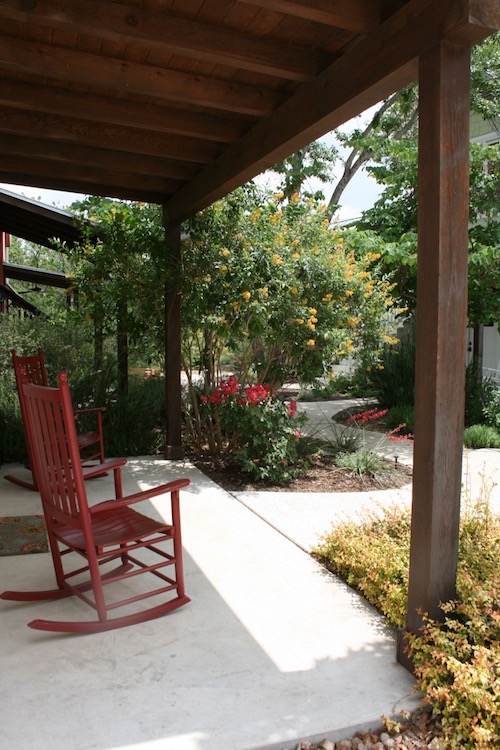
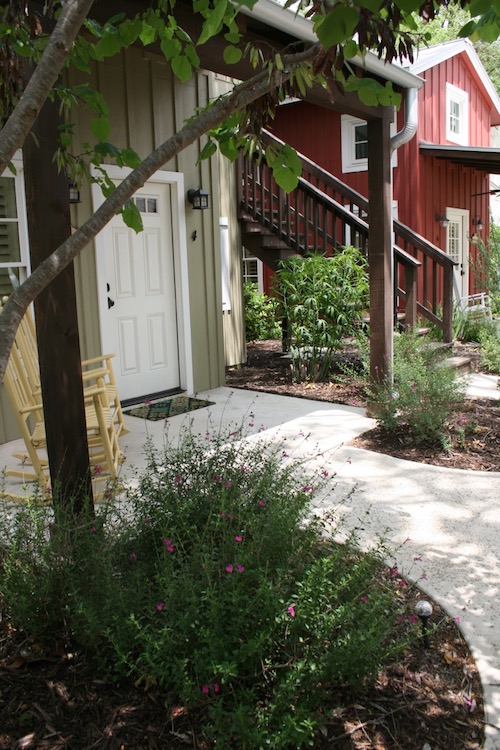
Each of of the little cottages has a rocking chair front porch. The plantings are repeated throughout and include salvias, rosemary, Texas redbud, abelia and a gorgeous cinnamon colored rose which echoes the siding color.

Kolodzie 21

Kolodzie 16
This one is my choice!

Kolodzie 18

This serene end of day relaxing area is at the far end of the little row of cottages. The creek is behind the outdoor fireplace and just down a small slope. I can see this design being perfectly suited to a small residential garden as well.

Kolodie 17

Kolodzie 22

A winding path from the fireplace seating area leads to a slightly downhill seating vignette. This dry creek bed was designed to carry runoff from the property down to the creek. Matt told me that it had proven itself in recent hard rains.
Kolodzie 19

Pretty plantings wind from the cottages to the rear of the original home which serves as the office. This was a pretty dang cute B & B–walking distance to Main Street’s shops and restaurants and the museum. Too bad you probably couldn’t afford to live there year around.

Kolodzie 24

Kolodzie 23

I really enjoyed the short time I had in Fredericksburg. The drive from Austin was relatively easy with little traffic, the town’s history and architecture compelling and the unexpected Garden of Peace the cherry on top. I rate this road trip 5 stars!


Howdy from Austin…The Natural Gardener

Nat Gardner 1

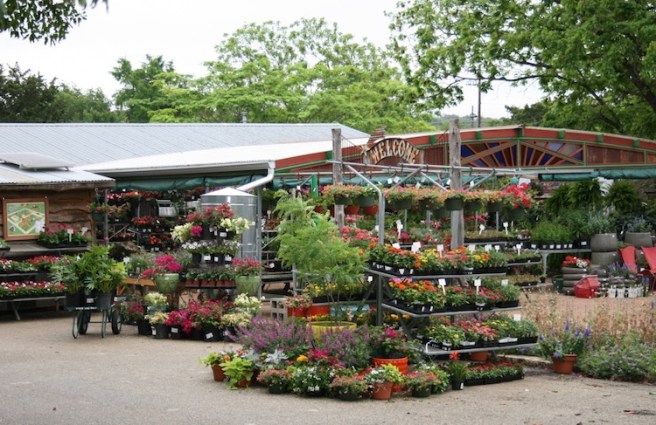
On my first day out on my own before the Garden Bloggers Fling Austin 2018 officially began I managed to squeeze in a quick visit to The Natural Gardener, a destination garden center in South Austin known for its pioneering work in organic gardening and sustainable living. This family, dog, picnic, photographer friendly gardening experience was to be the luncheon destination for my group on Friday during my absence and I figured if it rated a spot on a packed itinerary; it should not be missed. I am still dodging and weaving around angry skies at this point in the day but again my pre-Fling visit did not suffer the gully washing rains that my group would contend with a couple of days later.

Nat Gardner 3
Of course, the colorful annual offerings were right out front
Nat Gardner 5
There was no shortage of spiky things
nat-gardner-7.jpg
Only been in Austin one day and all ready I love the rustic wood and galvanized vibe
Nat Gardner 8
All the pollinator friendly perennials are colorfully tagged to show you what critters favor them

If I were an Austinite, The Natural Gardener would be in my ‘drop by once a week to see what’s new whether I needed anything or not’ category for good quality and well-tended plant materials but the shop’s main draw for me would be all of the other fun experiences and activities appealing to gardeners and non-gardeners alike. Its eight acres offer quiet areas of contemplation, places to swing and sway, lots of garden ideas to adapt, animals to pet and even an enchanted forest. Established in 1993 by John Dromgoole on a neglected farmstead after the site of his Oak Hill organic gardening business fell to the widening of Highway 290, The Natural Gardener has grown to be a vital community resource which includes display gardens, teaching gardens, farm animals, the retail nursery and many areas of wildlife habitat. Check out http://www.naturalgardeneraustin.com to see all this delightful spot has to offer. I’ll show you just enough to wet your appetite!

Nat Gardner 9
The Frog Pond
Nat Gardner 10
The Organic Garden with the Compost Tea House in the background–lots of good educational take home material is available 
Nat Gardner 11
These greens are looking good!
Nat Gardner 12
The Hill Country Stream
Nat Gardner 13
This petite stream was one of my favorite vignettes
Nat Gardner 35
The Herb Garden
Nat Gardner 16
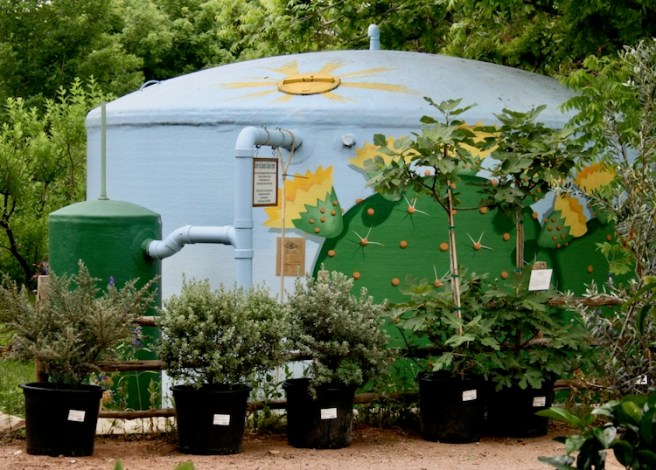
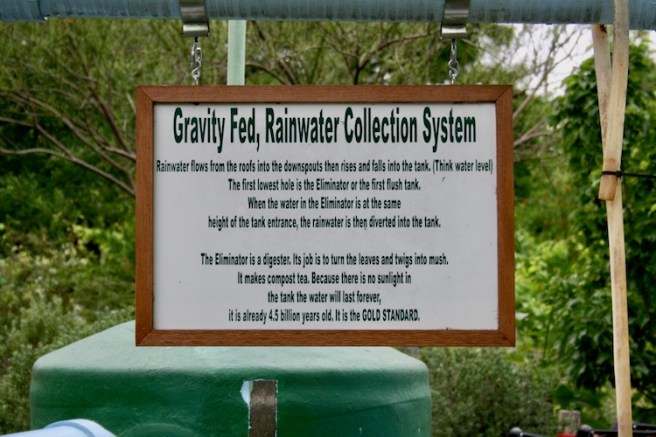
Fun painted VERY LARGE rainwater collection tank
Nat Gardner 15
A small part of the sustainable living picture in play–they practice what they preach
Mellitia reticulata
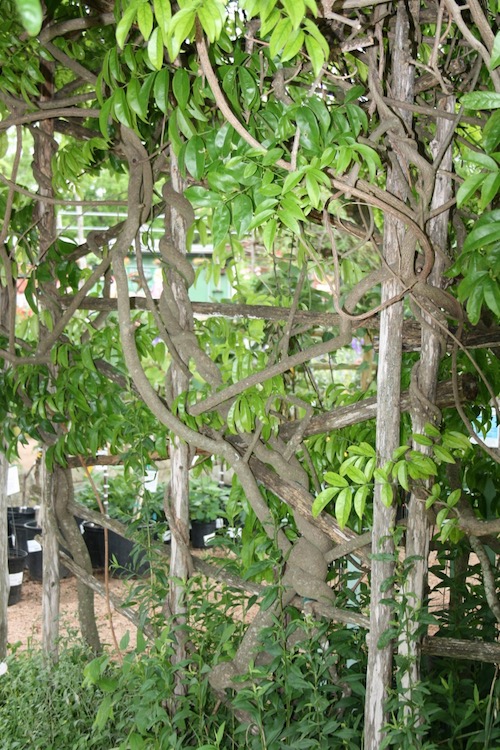
The arbor marking the return to the retail area is almost indistinguishable from the gnarled trunks of the Milletia reticulata vine
Nat Gardner 17
Looking back into the gardens from the other side of the arbor–notice the Certified Wildlife Habitat sign
Nat Gardner 20
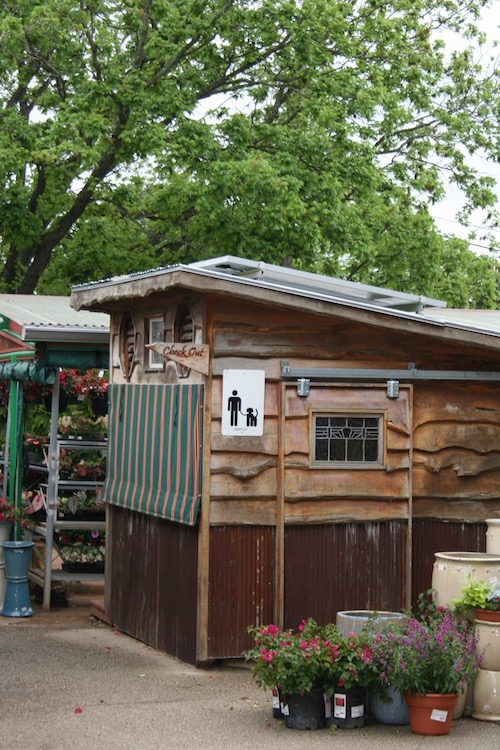
Loved this natural edged planed wood plank siding used with the rusted corrugated metal on the check out shed not in much use due to the weather

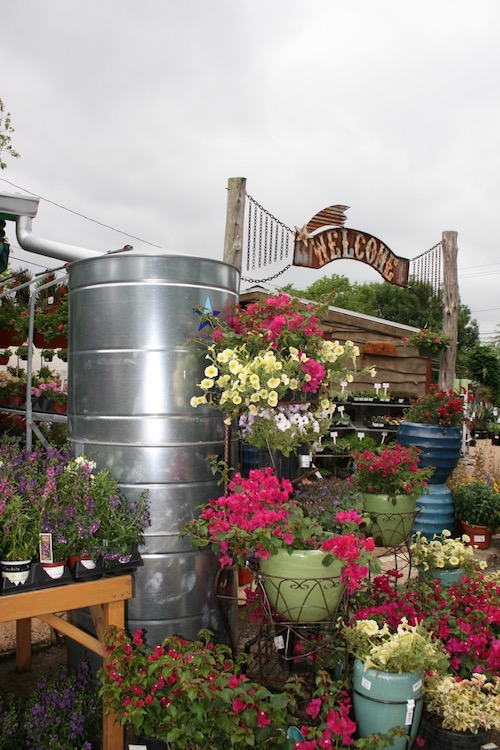
Two of the rainwater catch tanks tucked in all over the retail nursery area–they are almost like garden art!

Nat Gardner 21
As I walked up the road I found this whimsical metal gate and a bike hanging around just it case it might be needed
Nat Gardner 22
No interesting thing goes unused
Nat Gardner 23
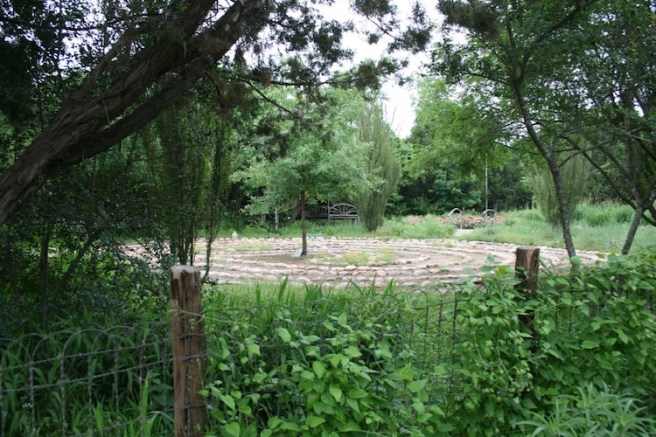
The Labyrinth and its surrounding benches are a quiet contrast to the garden center and display garden’s bustling activity
Nat Gardner 26
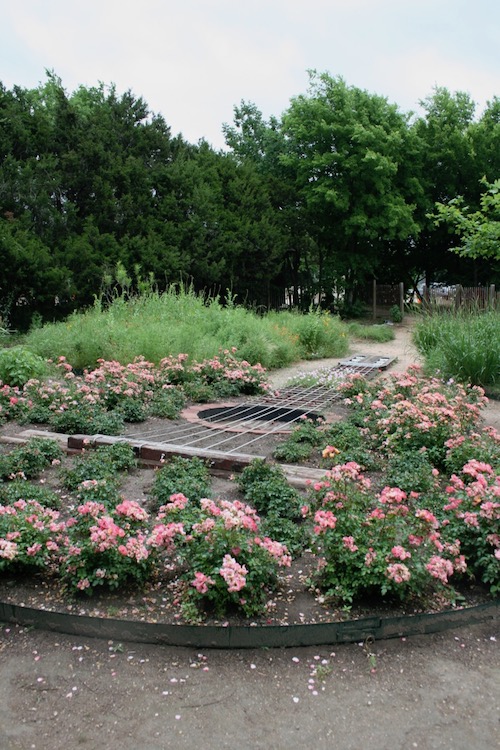
Willie Nelson’s guitar captured in apricot carpet roses
Nat Gardner 24
Entrance to the Enchanted Walk through the woods
Nat Gardner 33
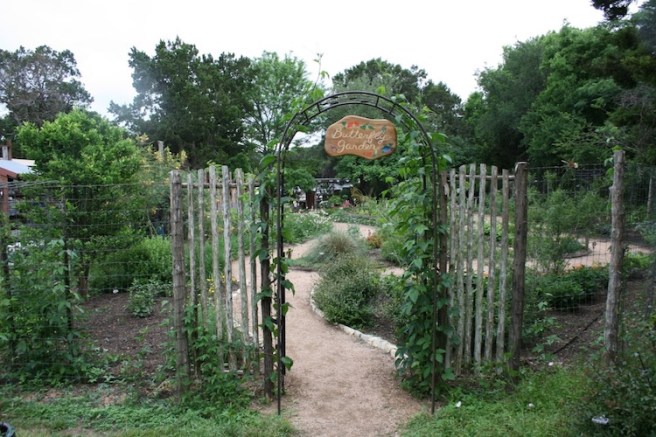
The Butterfly Garden
Nat Gardner 29
Leaving the Butterfly Garden
Nat Gardner 30
Maypop passionflower vine
Nat Gardner 28
The Natural Gardener’s passion for its mission is clear in the sign identifying their outdoor classroom space!
Nat Gardner 34
The Farmhouse Store is a treasure trove for gardeners, birders and butterfly lovers all

Although I almost never purchase plants when I travel out of state (California’s laws about bringing in live plant materials are very specific) I always go to the independent local garden centers to see what’s going on. It’s easy to get the gardening pulse of a region by seeing what’s being sold to the gardeners with boots on the ground, so to speak. With the two Texas plant purveyors I’ve seen so far I am really impressed with the time and energy both have devoted to creating almost magical display gardens to give their customers an idea of what things really look like in the ground and in combination with other plants. Both have worked hard to be garden coaches and create gardening communities–far above and beyond just selling plants. The Natural Gardener’s brochure says it all!

Nat Gardner 2