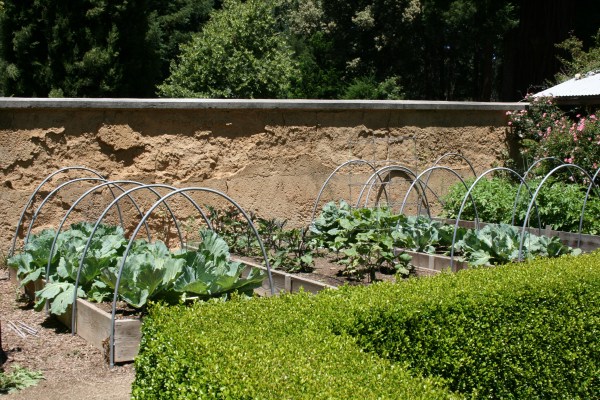
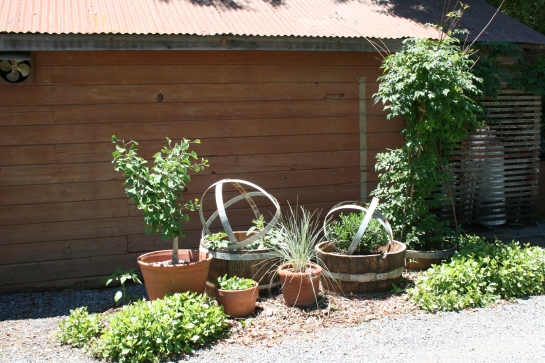
Two more blues, one coral pink for balance…

It is a fact that my current garden is heavy on pinks, blues and purples so don’t hold your breath waiting to see lots of photos of yellow flowers! My Georgia garden started out leaning that way also until I realized that the more mid range tones were just about invisible against a beige painted brick house which stood some 150 feet off the street.  Gradually the foundation beds in that garden became a riot of purples, blues, oranges and golds with a bit of white thrown in to calm everything down.  As no husband of mine (to date, at least) has said, “Go ahead, honey, just take the garden down to dirt and rebuild it however it tickles your fancy.”, I  have had to play the color hand I have been dealt in terms of mature flowering trees and established, healthy shrubs. I expect that is more the rule, rather than the exception, and I am fortunate to have a partner who may not totally get my vision but at least pretends to and will help execute most of my garden schemes!! Once you know what you have to work with you can then build on that palette with the addition of new shrubbery, annuals, perennials and ground covers.  With each selection you add not only color but also texture and a variety of shapes to your garden.  As garden areas mature and fill in you may find less need to add plant material just to cover bare places and shift your focus to adding plants whose particular blossom, foliage, scent or other characteristic really delights your soul!

The most visually pleasing gardens contain layers of plants whose characteristics complement and contrast each other.  Once the upper layers–trees, large scale shrubbery–are established, remaining areas can be planted in perennials and annuals.  As the perennials mature to larger clumps and drifts you may find less and less need for the seasonal exercise of “planting the annuals.”  Annuals and plants treated as annuals play a very important role in mixed beds and borders.  Individual perennials, by their nature, have very specific flowering periods and although some can be headed back for additional bloom flushes they often do not put out the prolonged show we all hope for.  Even with thoughtful planting of a variety of perennial groupings you can hope to always have something looking great but never expect to have everything looking great all at one time!  Annuals add flower power to areas where the perennial show has passed or is yet to come.  Better yet, reseeding annuals add the hope of another season of plants even if not in exactly the same place you put them the year before!

We are coming up on 8 years in our current home and I am still building the layers in this garden.  I have reached the point where I don’t routinely add seasonal annuals just for the gardening exercise. The first year we were here I plant 22 flats of pansies in November and untold more flats of other cool season annuals then repeated that with different selections again in April. Last November with continuing drought, a cabin in the mountains and mid 60s knees I planted only one–in the most visible area along my front walkway. I can still sleep at night.

I do plant a few interesting annuals every year.  The additions are more the result of enjoying the trip to nurseries far and wide to see what’s new than they are to fill bare spots.  I have learned that bare spots rarely stay that way for long.  Not infrequently I have forgotten something I planted in a spot a couple of years ago and it miraculously reappears as if it knows I am thinking about putting a shovel to its resting place. Here are three annuals I am enjoying this year:
IMG_4131

SALVIA PATENS ‘BLUE ANGEL’

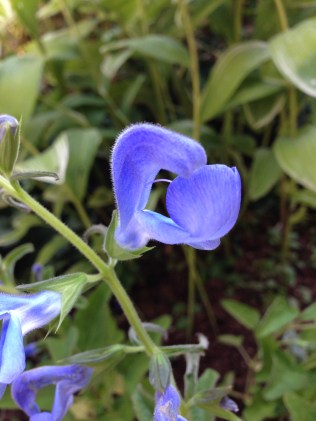
Salvia patens is commonly known as Gentian sage.  In truth, this salvia is a what is called in the botanical world a ‘half-hardy perennial’.  Half-hardy perennials are treated as annuals in areas whose winter temperatures exceed the plant’s natural tolerance to cold air or soil. In its environment of origin, central Mexico, it grows and flowers year round.  In all but our mildest central California winters it has perished in the cold.  There are many cultivars of Gentian sage and according to garden resources ‘Blue Angel’ is one of the smallest in stature at just under 2′.  Because my efforts at overwintering these gems have failed and I am always starting with new plants I rarely see foliage exceeding 12-16″. However, the gorgeous striking clear blue parrot beak like bloom makes treating it as an annual ok with me. The larger photo shows the fully open flower and the lower right shows the bloom just getting ready to open. This is one of the salvias that prefers moist but well draining humus enriched soil and some shade. Recently I have read that Gentian sage has an easily dug tuberous root which makes it a good candidate to pot up and spend its winter in a sunny room.  I am going to try it!

AGERATUM HOUSTONIANUM ‘BLUE HORIZON’

Ageratum is summer annual so well known and loved that most people use its botanical name instead of its common name, Floss Flower.  Most commonly seen are the dwarf cultivars such as ‘Blue Danube’ and ‘Blue Blazer’ which at 4-6″ high edge literally thousands of garden beds ever summer.  ‘Blue Horizon’ will grow to 30″ in perfect conditions of rich, moist soil and morning sun only.  These plants went in from a 6 pak in late May and are about 20″ tall to date. The powder puff flower heads are about the size of my fist.  This ageratum’s tall sturdy stem makes it an excellent cut flower. The availability of these taller cultivars in my local garden centers has been sketchy at best.  I am going to try a a taller white variety from seed next year–I’ll let you know how it turns out!

SALVIA COCCINEA   unmarked variety but I believe it to be ‘Coral Nymph’

So I feel as though you need some relief from all the blue!  This salvia is very commonly found in garden centers and big box garden departments.  It is so ubiquitous that often times the grower does not even feel the need to identify it.  I bought several 6 paks in May marked ‘salvia pink’.  This sage is technically a perennial but is grown as an annual in all zones.  As is the Gentian sage, salvia ‘coccinea’ is native to Mexico.  I have had some success at these plants wintering over and they also reseed prolifically.  The foliage mound remains quite low at about a foot but the flower stems rise to the sky and wave in the wind. The blooms are a magnet for every hummingbird and bee around, including the huge bumblebees we have so many of this year. Not easy to photograph a moving bee on a moving plant with an iPhone but I think you can get the idea. To get the most continuous bloom deadheading is an essential but easy task as the spent stems can be snapped off with your fingers.  This sweet little ballerina of a quasi-annual is a great choice for a novice gardener–I just don’t think you can fail with her!

Can’t live without…

Every gardener has their favorite indispensable tools and accessories and I am no exception. I have a long history of being a sucker willing to try the great new thing in the marketplace for all my life’s activities. As a quilter I cannot pass by a new ruler designed to cut something I have been cutting all along with an old ruler, but this one promises to make the job just a little easier. In my baking life I have enough specialty pans for 10 kitchens and try to ease my guilt by loaning them to anyone who shows even a slight interest (madeleines, anyone?) I can’t even get into the excesses in the greater craft genre—stamps, die cutters, paper, wood, findings—oh, my! My claim to fame is that I am way more successful at gathering and organizing the supplies and accessories for a project than I am at actually sitting down to work on it. When my youngest son played Little League we lovingly called him “accessory boy” for the number of batting gloves, wristbands, guards of all types and custom Oakley prescription sunglasses needed for him to catch that ball behind the plate. Apparently you can be genetically predisposed to accessorize!

The stage being set you will be amazed to know I am pretty one dimensional and non-innovative (is that a word?) in my gardening accoutrements.  Here are a few of my favorites:

IMG_4141

CORONA BYPASS PRUNERS

I have been using this style of hand pruners for at least 35 years. Let me clarify–not these exact pruners–if I had a dollar for every pair I have lost in the garden or thrown away accidentally, we would be living in Paris now with a view of the Eiffel Tower! Every now and then a fresh young thing comes on the market trying to woo me away but I always come back to these. The larger pair is the Corona Classic Cut BP3180 which cuts up to 1″ diameter branches. The smaller is Corona Classic Cut BP3160 which cuts up to 3/4″. I have a third one yet a bit smaller, the BP 3130,  but I am sure you’ve have guessed that they are not pictured because they are currently lost in the garden somewhere. The middle size is my go-to pair of pruners for deadheading and general clipping back. It fits well in my hand, is not too heavy but gets the job done. My husband likes the larger ones and he gets to use them in return for keeping all 3 sharpened. He can be a rather over enthusiastic clipper if left unsupervised, not too much into the art of it and more into the “if I just cut it to the ground then I don’t have to worry about it for a good long while” school of pruning. As a left handed person these are the only pruners I have found whose lock to close mechanism (to the right of the spring in the photo) is accessible for me to operate with my thumb while I am holding the clippers. The locking mechanism is generally on the wrong side of the tool for me to use it one handed and I have to shift the clippers to my right hand then lock with my left–very cumbersome and really a deal breaker for me.
IMG_4137

ATLAS GLOVES

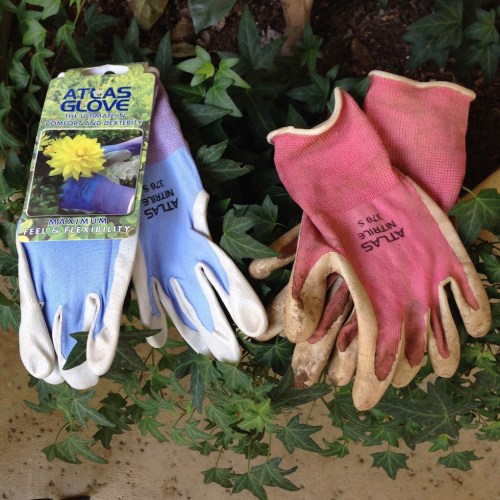
I resisted wearing gloves in the garden for decades and my hands and nails told the tale.  A few years ago I received a pair of these Atlas Nitrile 370 gloves as a gift from a young lady whose father owns a nursery and I was a changed woman!  These very lightweight yet strong and flexible gloves answered every objection I ever had about garden gloves.  The palms and fingers are coated with nitrile making them durable while the body is stretchy nylon/polyester.  I buy a size small so that they fit quite tightly but are still very comfortable.  These are the only gloves I  have ever had that allowed me to actually pull small plants out of 6 paks without damaging them.  It is a joy to be able to wear gloves to protect my hands without reducing my dexterity! I also use them when I paint rather than latex gloves. I machine wash them and hang them to dry.  Last year I found that I could purchase them in groups of 6 pairs through Amazon for about $18 (this may have changed) so I usually have several pairs in use and at least a couple in reserve. A++

IMG_4140

RAPICLIP SOFT WIRE TIE

I use several products to train and tie up vines and roses and this is my favorite.  A very fine wire runs through the center of the green tube which allows you to simply twist the ends together.  The gauge of the wire allows the tie to be cut with household scissors or your pruners. The soft exterior material is strong but easy on delicate leaves and stems and the green blends in with surrounding foliage so as not to draw attention to your support.  It weathers very well through heat, cold and rain and when I remove supports I keep the cut pieces to reuse.

IMG_4139

GREEN VINYL COATED PLANT SUPPORTS

This category comes as close as we will get today to accessories gone wild!  I have literally hundreds of these, in a variety of shapes and sizes.  The green vinyl coating disappears amongst your foliage and allows you to invisibly support all kinds of plant material.  They are easy to push in and pull out to move about your beds, relocating them to meet current needs. The half hoop supports come with ‘legs’ from 12″ long to 48″ long.  The half hoop part may be anywhere from only a few inches across or as wide as 18″ across.  The larger/taller ones are perfect to support great masses of floppy perennials such as penstemon or salvia which can tend to bury their neighbors at the peak of their growing/blooming season or, in my garden, fall over onto the lawn and get cut off by the lawn mower.  Smaller scale plant masses use the smaller scale supports.  The bloom stakes have an almost full circle at the top of a long stake and also come in lengths from about 12″ up to 36″.  Generally the longer stake will have a slightly larger bloom circle at the top. The idea is that you insert the stake in the ground at the base of the plant and then gently lead the bloom’s stem through the open part of the circle.  These are invaluable for plants that have flowers with long stems and heavy heads. The weight of the flower may lay the stem down on the ground or even break the stem.  The bloom support takes the weight of the flower head off the stem and allows the flower to stand tall and proud to be enjoyed by all!  I use these all the time on iris, calla lilies, asiatic and oriental lilies. Vinyl coated plant supports are available at many retail nurseries but I have found much more variety at online sources such as Gardener’s Supply or Plow and Hearth.

What do you use that you could not live without?  I’d love to hear about YOUR must haves!

Too cool summer blues

The only blue that gardeners in my HOT, HOT, HOT valley really want to see right now is the blue water of a cool swimming pool!  With our temps for the week forecasted to peak at 111 degrees on Friday it is hard to even think about getting out in the garden to see what’s happening. Late July to early August is the perfect time to cut back by half many perennials which have been blooming since early spring. This will force them to rest a bit, not expending too much energy in supporting blooms. This brief rest during our hottest time usually results in some new growth pushed in September and possibly additional blooming periods taking them up to the winter cold.  The complicating factor for me is that I have to get out to do that cut back starting around 6 am and only have a few hours until only crazy people are working in the yard!

Many plants have stopped blooming due to the excessive heat but I do have a couple of cool blues in bloom to share with you.

Platycondon grandiflorus ‘Sentimental Blue’ is a dwarf selection of the old fashioned favorite balloon flower found in our grandmothers’ gardens.

This cultivar has a very compact upright growth habit reaching from 6″-12″ tall and 12″ wide.  In the left photo at upper right you can see one of the platycondon’s characteristic hot air balloon shaped white buds. These whimsical flower buds open to a star shaped blue violet flower highlighted by darker blue veins.  Anybody notice a resemblance to another plant I have featured in previous posts?  Platycondon grandiflorus is in the same plant family, Campanulaceae, as the campanula or bellflower.  This is a great front of the border or bed perennial and reliably comes back for me every year. Plants grown from seed will take a couple of years to get well established. Although they perform better with weekly water, they have a deep fleshy root that, once established, seems to keep them going during lean watering periods. My plants came from six packs planted 4 or 5 years ago and they flower freely for 6 months of the year.

Tradescantia ‘Sweet Kate’ is an easy to grow perennial whose deep blue flowers are an eye catching contrast to its yellow green grasslike foliage.

The common name for this plant is spiderwort.  According to the Kemper Center for Home Gardening when the stems of spiderworts are cut, a viscous stem secretion is released which becomes threadlike and silky upon hardening (like a spider’s web.) You can also see the resemblance to one of its cousins, the wandering jew, that we all grew in hanging baskets in the 70’s! There are many garden varieties of spiderwort with flower color varying from white to blue to pink and near red but this one is unique in its foliage color. Individual flowers last only a day but the buds come in large clusters and once they get started they are rarely out of bloom through the summer months.  A single plant will form a tidy clump about 18″ X 18″. Although many tradescantia varieties are invasive self sowers and rampant spreaders ‘Sweet Kate’ is quite well behaved.  Give it moist soil and a partial sun only location for best success.

Stay cool and take time to smell the flowers this summer!
A summer survivor…

As our hot summer wears on many plants in my garden are looking quite peaked and forlorn.  Although it has been a cooler week here; in the nineties rather than the days of 105-108 degrees we’ve had for a few weeks, it is still a challenge to keep things going with our 2 days per week and limited hours of the day watering restrictions.  We continue to bucket bath and shower water to many of the more thirsty plants and are in the process of removing several areas of lawn in favor of more drought tolerant shrub plantings.  The later will not happen over night–we have had the lawn chemically killed but now must double dig those areas to make them ready for fall planting.  My long term goal is to have fewer garden areas which need intensive maintenance and significant water to keep them going.

IMG_4096

This interesting plant has proven to be a summer survivor–Talinum paniculatum ‘Limon’, commonly called Jewels of Opar ‘Limon’.

I added this succulent subshrub in the purslane family to my garden from a 4″ pot about 3 years ago.  It was another impulse buy but I am a sucker for plants with lime green foliage. A plant would have to have well documented zombie apocalypse characteristics for me to pass on those bright and happy leaves! Even after a bit of research I was still unsure of its sun tolerance so I stuck it in a pot of mixed annuals and perennials near the edge of my back patio.  The original plant was not cold hardy and was lost during the first crisp snap of that fall but every year since I have had many seedlings appear in the beds closest to the original pot’s location.  Based upon that I suppose ‘Limon’ could be a blessing or a curse (especially in those areas without cold to knock it back naturally) but I have found the unwanted seedlings easy to pull and really enjoy seeing where it will show up next!
IMG_4098

The bright chartreuse foliage really pops in beds of mixed perennials and annuals whose leaves are more mid green.  The wee pink flowers appear as a gauzy cloud hovering above the foliage and are followed by tiny magenta seedpods.  It is very free flowering with new stems appearing frequently.  At any point most stems will have buds, flowers and seed pods in an airy jumble. Literature suggests this plant could get quite large but my foliage rarely exceeds 12″ and the slender flower wands extend its height to about 24″-30″. The first seedlings emerge very late in June but as the plants continually produce seed pods I then have new seedlings until the first frost.

In my garden the foliage is a magnet for a small white butterfly.  The dancing moms will pass by many other species to lay their eggs on the Talinum.  The quickly emerging and ravenous lime green caterpillars are almost invisible on the foliage and can decimate the plant in a day. Below you can see the tiny black eggs laid by the butterfly.  Unfortunately or thankfully, depending on your perspective, I had no caterpillars to photograph for you at this moment! When an individual plant gets too chewed down I harvest the flower wands to add to bouquets and just pull up the plant as I know there will be more to come. After all–we all have to eat!

IMG_4097

All in all, the Talinum seedlings are a welcome sight each year.  They provide exuberantly colored foliage and sweet little flowers, both filling in bare spots in the bed.  Though they are not totally without maintenance, the little they require is worth the reward!

Hip, hip, hooray!

IMG_4084


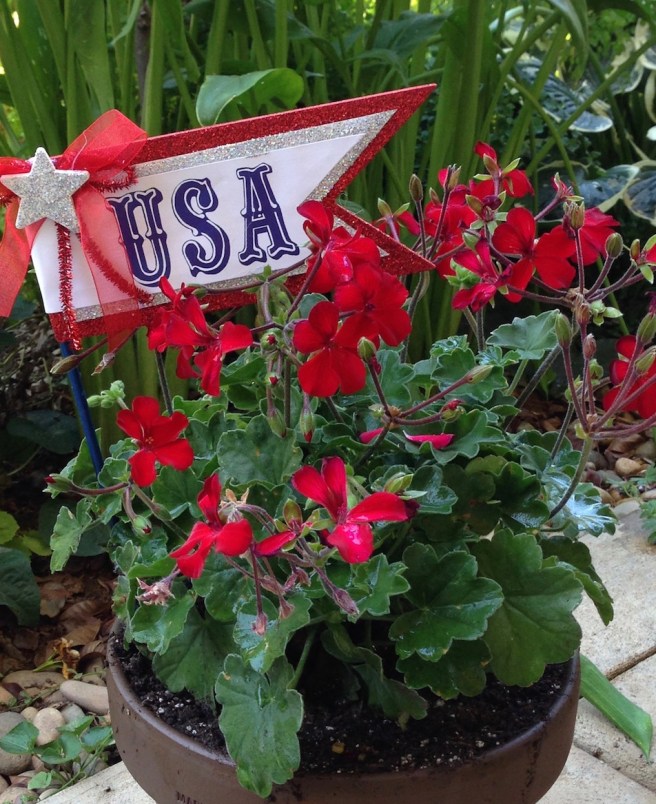
Happy 4th of July to all my gardening friends far and wide!  This very clear but not too orangey red pelargonium is part of a 10+ year breeding program crossing ivy pelargoniums with zonal pelargoniums in search of hybrids with the best of both plants.  The Caliente series is heat and drought tolerant and flowers profusely.  Check out http://www.provenwinners.com for more details and to see photos of the other colors in this series.

Howdy, stranger…

On one of my garden center rounds earlier this spring I picked up a few 4″ pots of plants that were totally new to me.  My usual M.O. would be to at least Google a plant to make sure I have somewhere to plant it with the appropriate sun and soil requirements but on that day I just threw caution to the wind–after all the little 4″ guys are not too costly so I could afford to make a mistake or two.  Upon arriving home I did a bit of research and found a spot for each in the garden.  Over the next few weeks I’ll share with you how these finds have done.

I was immediately drawn to the delicately veined and heart shaped blue green leaves of Origanum rotundifolium ‘Kent Beauty’.

IMG_4016

This ornamental oregano is a perennial cousin to the culinary oregano grown in herb gardens.  The pink and chartreuse bracts look a little like hops and tend to nod downward. While I planted mine in the ground I think a better use might be hanging over the sides of containers which are higher off the ground–giving a better view of the bracts.  Full sun and well drained soil are best.  As I am cautious with full sun for anything new in my hot summer garden, mine is sited where it gets a bit of afternoon shade.  Apparently this causes the bracts to color up less so if it makes it through the winter I might relocate it  to a bit more sun next year.

So far I am giving this one an ‘A’.  It has bloomed continuously for about 8 weeks and makes a delicate little filler which doesn’t look as though it will morph into a garden monster while my back is turned!

Mendocino madness #5 at last…

I amazed even myself by keeping fairly close to the schedule necessary to meet my goal of seeing all five gardens open to visitors for the 2016 Garden Conservancy Mendocino Open Day program.  If you are arriving late and would like to read more about the work of the Garden Conservancy and their Open Days Programs across the United States go back to my June 19th post titled “A little Mendocino madness…”

My last stop took me even further inland to the community of Hopland to see Frey Gardens.  Hopland is a hamlet just off Highway 101 about an hour north of Santa Rosa.  The climate is more like the hot, interior valley in which I live and so I was excited to see a few more beds and borders drenched in inland sun from which to get inspiration and encouragement.

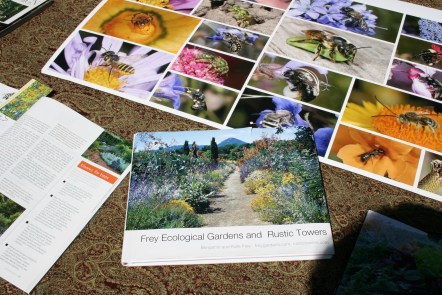
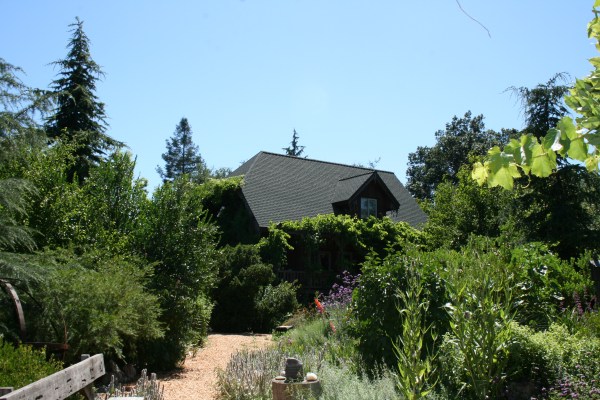
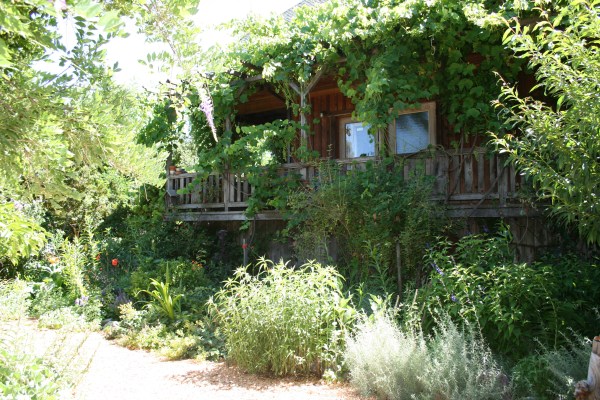
Both Kate and Ben Frey were greeting guests as I entered their gardens. In the hour I spent in the gardens there was not a time I did not see them engaged with groups of visitors, naming plants and explaining drip irrigation (Kate) or talking about the property’s many unique structures (Ben).  Kate Frey is a garden consultant, designer and freelance writer who specializes in sustainable gardens that encourage biodiversity.  She had provided a table filled with educational materials to pick up and had her book  The Bee-Friendly Garden available for purchase.  It was then I recognized that her name was familiar to me from articles she has written for Fine Gardening magazine.  Kate has garden creds too numerous to mention but I do want to share that her gardens won medals in 2003 (silver-gilt), 2005 and 2007 (gold) at the Chelsea Flower Show in London, England. Ben Frey is a rescuer of wood.  He is the 10th of 12 children and both of his parents were physicians. Ben has been building things with recycled materials since he was eight years old and has spent the last 30 years rebuilding barns, wineries and old houses–using the reclaimed wood to make fanciful furniture, gates and other structures.  A trip to Switzerland kindled a fascination with the Swiss chalet style of building and the rustic home you see in the photos was built by Ben using reclaimed materials. Ben built all the structures needed for Kate’s Chelsea Flower Show prize-winning gardens.  They are truly a team in both work and life.  Check out their website http://www.freygardens.com for more about both Kate and Ben.

IMG_1470

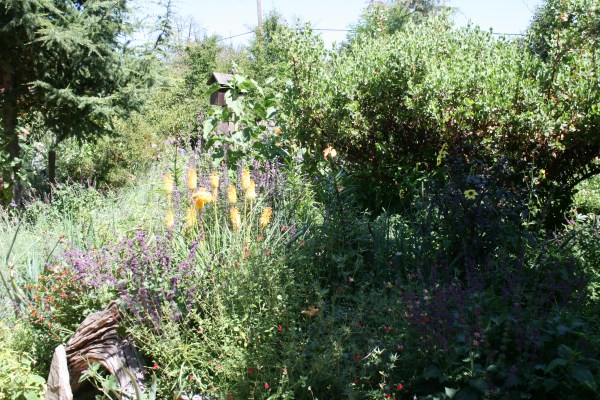
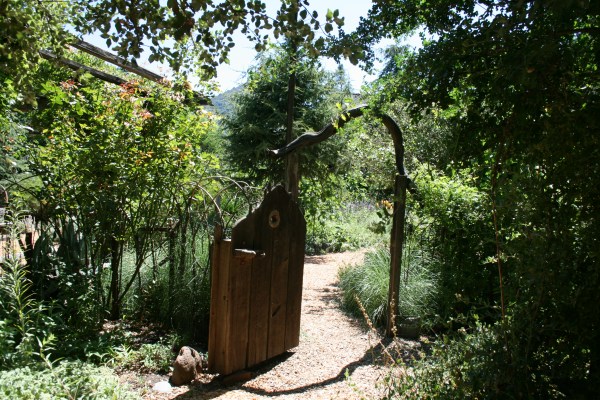
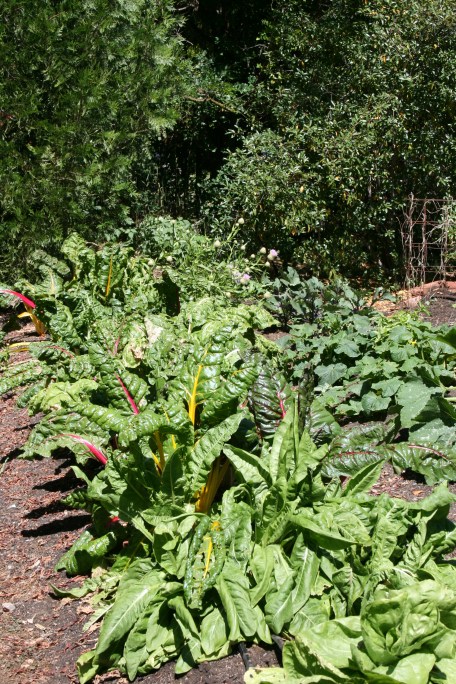
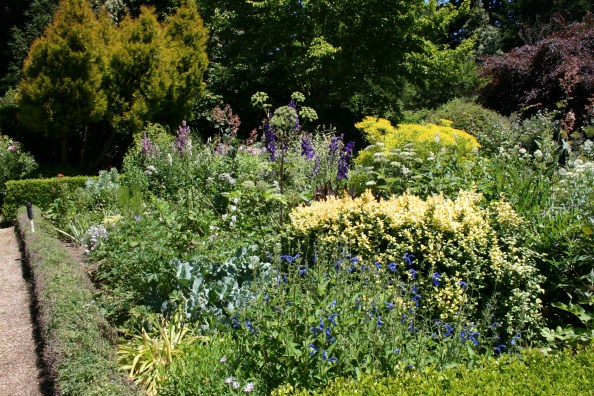
Frey Gardens is a once acre sustainable, habitat garden.  The garden is only six years old and is composed of a mix of native plants and others that attract and support a variety of insects and birds and is planted in a naturalistic style.  A vegetable garden occupies one corner and it is all connected with wide winding mulched paths.  My impression was that of a much larger property and gardens which were decades old.  There is a sense of enclosure, shutting out the real world beyond the gates and a coziness that invites you to sit a spell in the shade.  People LIVE in this garden and they LOVE it. Take a walk around with me.

IMG_1494

IMG_1483

IMG_1478

IMG_1479

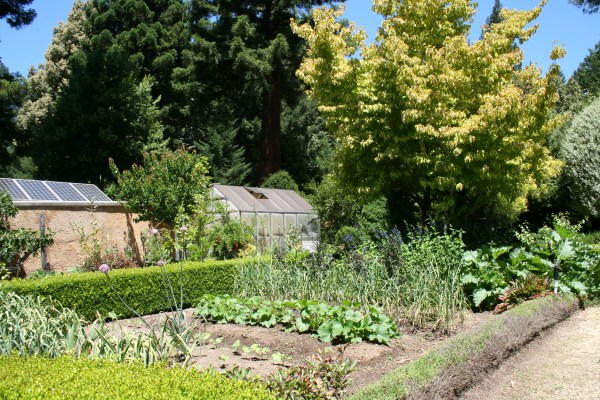
Imaginative uses of all kinds of materials are visible throughout Frey Gardens. This shipping crate stores tools and equipment and the adjacent roof provides a shaded area in which to work.  The small greenhouse showcases Ben’s love of reclaimed wood.

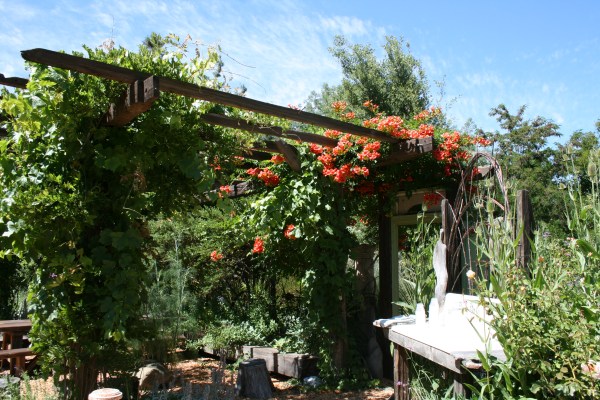
Who wouldn’t kill for this great sink just outside the vegetable garden? The rustic trellis is smothered with blooming Campsis radicans, or Trumpet Vine.

IMG_1471

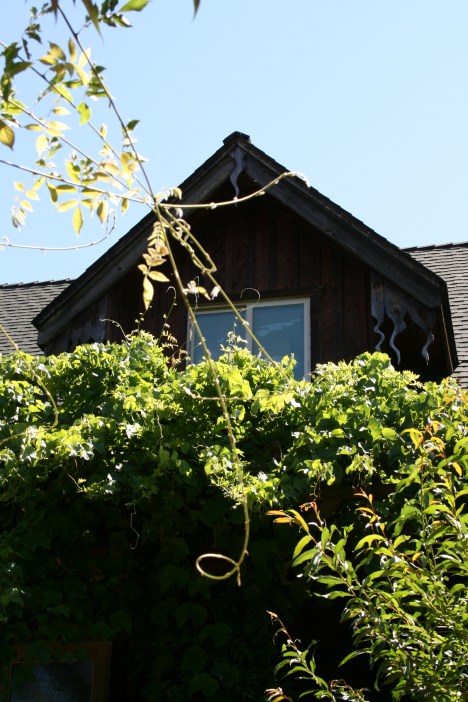
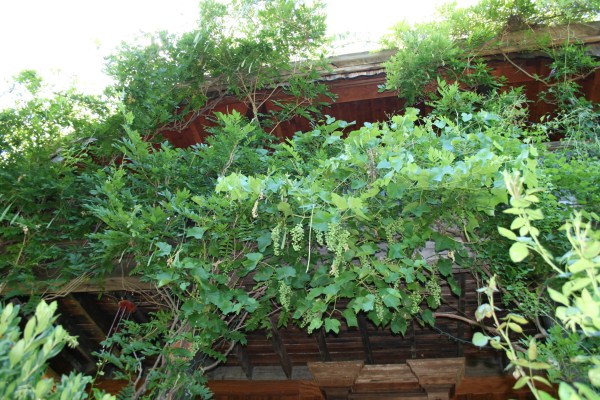
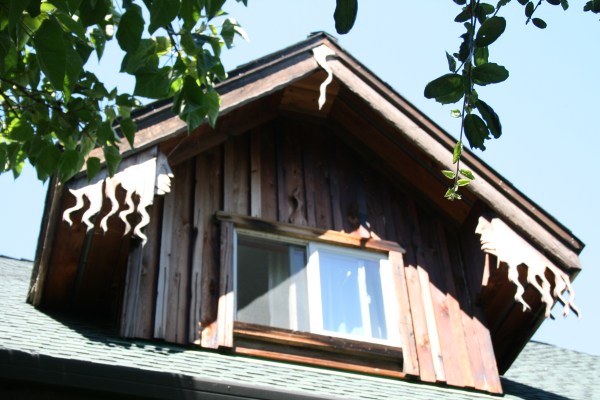
You caught just a glimpse of the house in the first photo but you need to see more.  The raised foundation is deeply planted with a riot of shrubs and perennials.  Vines scramble up the rustic wood siding without regard to conventional wisdom.  The front porch railing, roof and second story fascia is covered by grape vines whose fruit is just starting to show.  The grapes live compatibly with a huge wisteria vine–either one of these within six feet of my siding or fascia would cause my sweet husband to drop over dead so I will be pleased to report to him that it is all thriving and the house doesn’t seem any worse for wear. Check out the great ornamentation Ben has incorporated into the fascia on the dormer windows!

IMG_1486IMG_1485IMG_1492IMG_1491

The exuberance of this home and gardens and the couple who tend them both was so appealing and so encouraging that I would visit this one again and again if the opportunities arise–there would be something new at every point as perennials wax and wane throughout the season.  Feeling pretty satisfied with my Mendocino whirlwind road trip I bid the Freys goodbye, headed toward my stay for the night in Santa Rosa.  Kate reminded me to stop at California Flora in Fulton if I had the chance–all this and nursery recommendations, too!

My takeaway from Frey Gardens? Do your research–learn about the plants which are attractive to the birds, bees and bugs you want to encourage in your garden.  Manage your garden as a haven for them by offering food, water and places for shelter and nesting and minimizing or eliminating elements toxic to them.

So happy to have had y’all along for the ride but it’s now time for me to get back to work in my own little half-acre.  I’ve seen many ideas I would like to incorporate into my own garden and, as always after seeing fellow gardener’s efforts, I’ll return to it with renewed enthusiasm.

More Mendocino madness…#4

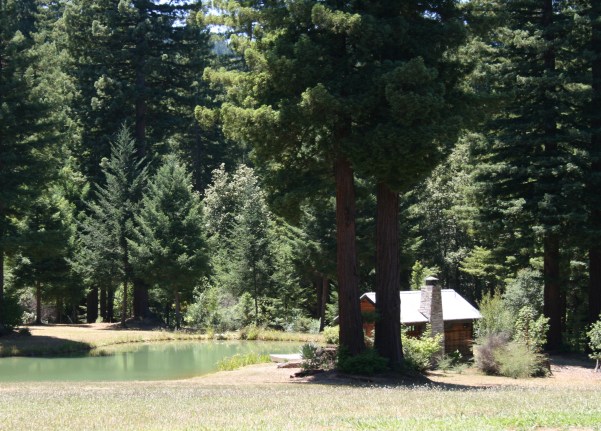
With my apple juice and jams safely packed in the cooler I headed down Highway 128 just a few short miles to the next garden, Wildwood,  on my 2016 Garden Conservancy Open Day itinerary. Even though this  family home has a Highway 128 address I had to wind quite far back into the woods along a gravel road dotted with small cottages and a barn to reach it.  A slight breeze ruffled the branches of the huge trees and the air was alive with bird sounds but there was not even a hint of road noise from the highway.

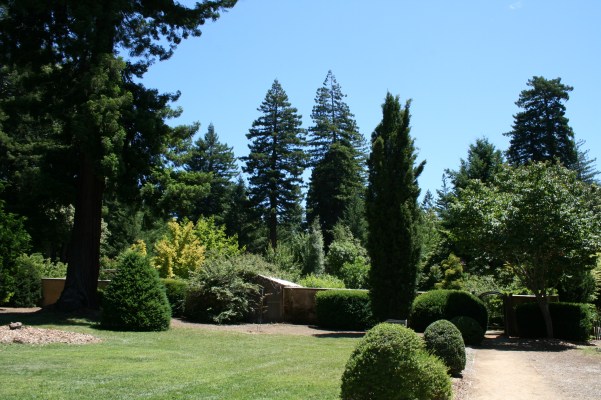
From the parking area the home was unassuming and almost anonymous in style.  As I followed the host’s direction down a short pathway the view opened to the back of home which felt European to me with a smooth stucco exterior and robin’s egg blue shutters.  Although it was past its prime bloom, a fabulous climbing rose rambled up to the second story and along the upper floor’s balcony.  Taking in the long views from the home I was entranced with a tiny log cabin at the edge of a large pond, referred to by the owners as the Pond House.  The main garden area to be visited was a very large walled potager which was almost invisible in its setting of redwoods and other tall evergreens but promised all manner of gardener’s delights.

IMG_1468

IMG_1447

IMG_1469

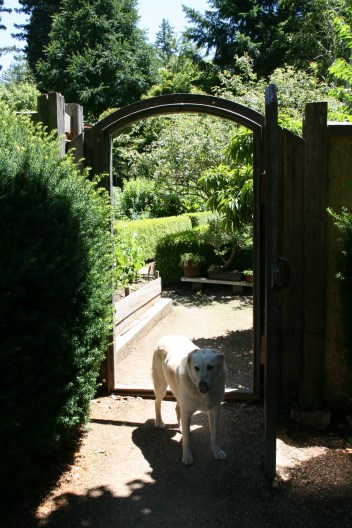
Of course, there was a garden dog to greet me at the gate which was almost hidden from view by a pair beautiful fresh green yews.

IMG_1467

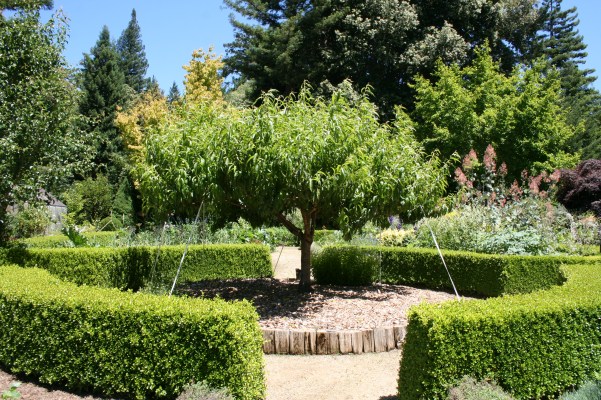
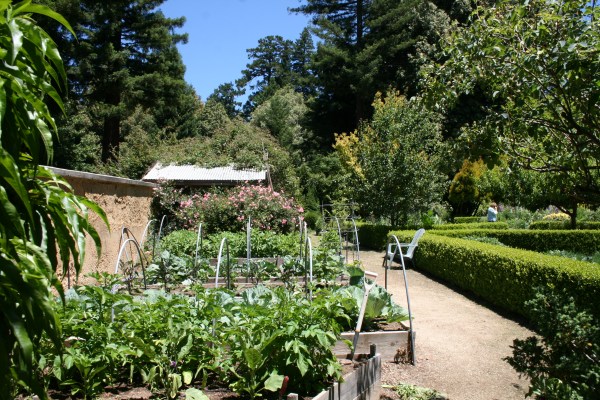
In the French kitchen garden, or potager, gardeners have intermingled vegetables, fruit, flowers and herbs since medieval times.  Plants are chosen for both their edible and ornamental natures and are put together in such a way that it looks beautiful while providing food for the household. The traditional potager contains symmetrical geometrical garden beds which surround a center element.  Wildwood’s potager was anchored by a large peach tree pruned in a manner the homeowner observed on a trip to Japan and which allows for easy harvest of the fruit. The beds were defined by loosely clipped boxwood hedges and connected by compacted earth paths.

IMG_1460

The surrounding 4 quadrant beds were filled with vegetables and flowers.  There were at least a dozen fruit trees within the walls of the garden and additional vegetable beds surrounding the 4 quadrants, hugging the walls in areas with the most sun filled exposures. The size of the garden visitors in the picture below will give you an idea of the massive size of this enclosed garden area!

IMG_1449IMG_1461

IMG_1448IMG_1462IMG_1459

Here are two more vignettes from this all encompassing garden space, including a a shot of an very unusual variety of penstemon I covet for its unusual foliage.  The homeowner could not recall the name but did tell me the mail order nursery he ordered it from so it WILL be mine soon!

I was in awe of this massive ‘nurse log’ visible in a shady back corner of the garden. A nurse log is a fallen tree which, as it decays, provides a rich, moist setting for seeds to germinate and grow.  This nurse log was about 6 feet tall as it lay on its side and the garden’s back fence had been built to allow it to remain in place where it fell.

IMG_1463

My takeaway from Wildwood? You can have it all–flowers, fruit, veggies and herbs.  The traditional tenets of designing a potager can be adapted to even a very small garden space providing you with tangible rewards for your efforts.

LAST STOP: FREY GARDENS

Mendocino madness #3…

The geography subtley shifted as I descended from the rocky Mendocino coastline through the deep and dark Navarro Redwood Forest and into the Anderson Valley to visit my third garden of the day.  The Anderson Valley boasts rolling green hills dotted with vineyards, orchards and small farms.  I passed many large and architecturally interesting wine tasting room as I rolled down Highway 128.  Although I am not a wine lover I am constantly amazed at the varied and unique compounds built by the wineries in the Napa, Sonoma and Mendocino Valleys.  Every type of architecture is represented from metal roofed, wood sided barn like building to the most ornate re-creations of French and Italian stone castles.  Many maintain beautiful garden spaces worthy of visiting on their own merits but alas, that day, I had no extra time!

The Apple Farm is a thirty acre family farm which has been worked in harmony with the land by three generations.  The Farm, originally a rundown farm labor camp, was discovered and purchased by restauranteurs Sally and Don Schmitt in 1984 to be their homestead,  growing both food and flowers and raising their family with a connection to the land.  Their daughter, Karen, and her husband Tim Bates now manage The Apple Farm and it has developed into a multi-faceted venture.  You are greeted by the Farm Stand as you enter the property.  Fresh apples, quince and pears of many varieties are for sale along with their Farm’s own apple juice, apple cider syrup, homemade jams and jellies and much more.

IMG_1446

The potting shed/greenhouse was created at the back of the shell of an existing building and it is there I was greeted by Karen and invited to enjoy a refreshing apple juice spritzer as we chatted about life on the farm.  The potting shed is County Living magazine material–both utilitarian and aesthetically pleasing.  I was fascinated by the common jasmine vines twined around all of the ceiling rafters.  Karen said it had escaped INTO the shed at one point and was so beautiful when it bloomed that she has simply let it have its way.  Because the potting shed has a door closed at night, a quasi greenhouse environment  has been created for the vine and it blooms about a month earlier than it would if it were outside.  Unfortunately, I missed the blooming time and she had just cut it back to encourage the new growth–it was still lovely.

IMG_1437

IMG_1440

The Apple Farm is a lovely setting in which to host family gatherings, weddings or just about any other event you can suggest.  Karen and her family will help gather up the professional help you might need and feed you to boot if you choose.  I got the impression that if you propose it and it is at all feasible she will work to make you dream come true!  There are many lovely settings for dining or just relaxing.  One of my favorite was this small grove of mulberry trees which have been pruned and managed to provide a leafy canopy for intimate dining.

IMG_1441

The Farm also offers the opportunity to stay in one of their apple orchard guest cottages or in their original guest room which is now called the Room With a View.  I learned about their Stay and Cook opportunities where you stay the night and assist in the preparation of the family meal using many of the fruits and vegetables they grow.  There is no formal curriculum, just the chance to get a taste of working on a farm and taking part in preparing a shared meal.  You can go to their website http://www.philoapplefarm.com to find out more about the history of the farm, the family, and the adventures you might plan to absorb a little of life on a working farm.

The Apple Farm’s garden lies just behind the potting shed.  It is exactly the right garden for this setting–relaxed and a little bit boisterous, overflowing with veggie beds and perennials and roughly enclosed by a variety of tall shrubs and fruit trees in a loose hedge like fashion. The whimsical metal rod structure of the trellised vines on one side is repeated in the freeform structures used as vegetable supports.

Food,  flowers, fruit and fun are all mixed up and invite you to come in a sit a spell to take it all in.

IMG_1425

I took the opportunity to wander down the gravel driveway toward the closest of the orchards and was rewarded with more beautiful vignettes.

IMG_1436

IMG_1443

I found the Himalayan blackberry hedgerows from which Karen makes jam each year and enjoyed a long view of  one of the orchards framed by a backdrop of redwoods.

I know that what looked like a serene respite to me is, in truth, a flurry of activity.  Maintaining a working family farm takes all hands on deck and if you are not doing a task you are probably planning for what needs to be done next.  I’ll leave you with a photo that to me spoke volumes about this family farm.  These apples and all the other farm products (and animals) are lovingly tended to and nurtured by hand using sustainable farming methods.  No matter what else you do–someone’s got to climb that ladder and pick the fruit!

IMG_1432


My takeaway from The Apple Farm? Let your garden be a reflection of the ambiance of both your setting and your lifestyle. Strive for harmony between your garden design and the surrounding structures and ornamentation.

NEXT STOP: WILDWOOD

Mendocino madness…#2

I traveled from just above the hamlet of Mendocino down Highway 1 and turned inland near the community of Albion to reach my second garden stop on the The Garden Conservancy’s 2016 Mendocino Open Garden Day—Digging Dog Nursery and its surrounding gardens.  Digging Dog is a small family run nursery, both retail and mail order, and among many of my gardening friends it falls in the ‘big dog’ category along with Plant Delights in NC and Heronswood in Kingston, WA. The folks at Digging Dog are propagators of high quality plants including tried and true garden favorites as well as new varieties which have proven themselves as versatile performers in terms of easy care, year round interest and long blooming periods.  I especially loved that most of the plants are sold in small pot sizes which encourages me to try many different plants and gives me the opportunity to tuck well developed but small root masses in my closely packed perennial beds!

I was fortunate to meet Deborah Whigham who, along with her husband Gary Ratway, founded this wonderful garden resource and are blessed to be in this garden every day.  Deborah and Gary both hold degrees in Ornamental Horticulture and Gary also has a Landscape Architecture degree.  They went in search of land on which to start their nursery in 1984 and Deborah confides that she believes they found the perfect spot—their 14 acre homestead boasts 7 acres of redwood forest and about 3 1/2 acres of gardens.  The nursery occupies about 2 acres and is composed of multiple greenhouse areas, both covered and uncovered depending on the needs of the plants. The temperate climate of the Albion Ridge is conducive to growing a wide variety of plants from all over the world. Deborah regards herself as only a co-creator of this space, in partnership with the universal forces of nature.  She has seen her gardens bear witness to the passage of time as they are ever-changing. Deborah feels she has acted as parent and nurturer to the gardens as they developed and now is the child of older, wiser and more mature gardens from whom she learns something everyday.

The gardens are home to elderly digging dogs Neptune and Maya—see 16 year old Maya below with Deborah, the adorable nursery manager Boobah (very small chihuahua on a large pillow!) and several nursery cats.  They all seem to know just how to greet visitors to take the stress of the day down a notch and might even come to join you if you sit a spell during your visit.

A small demonstration area near the front of the nursery has a selection of lovely perennials to pour over.  Nursery staff were both welcoming and a wealth of knowledge.  The demo area is surrounded by the many greenhouse plots.  It is as if the towering redwoods are holding these plants in their protection!

The gardens both border and surround the nursery areas.  Mature borders and beds showcase the variety of plants for sale, offer inspiration for plant combinations and an insight into the conditions in which specific plants are happiest.

IMG_1391

IMG_1392

IMG_1404

As I meandered through many shrub walled garden rooms with the light ever-changing,  I  wonder at how each spot can seem expansive yet intimate at the same time.  I loved the use of the ‘long view’ coupled with the borrowed vistas of the surrounding terrain–I was literally drawn through the garden by the garden’s energy and the mystery of what was to be found around the next bend.

I could have spent all day in these beautiful gardens, not knowing whether I enjoyed the serenity or the energy more. Seeing so many plants which struggle in my hot valley garden perform so vigorously and lushly encouraged me to keep on trying.  The owner Deborah told me that although this past rainy season was kind to them, they are always mindful of water use and are fortunate to have the resource of 5 ponds and a 10,000 gallon storage tank on their land.

IMG_1400

Reluctantly I retrieved my wagon of precious finds (including several new hardy geraniums) and headed to pay my bill.  On my way back to the front of the nursery I smiled to see this evidence that there is always something to be done in the garden.

My takeaway from the gardens surrounding Digging Dog Nursery?  Spend more time doing what you love.  Spending less time worrying about whatever it is being done the ‘right’ way.  Have fun with your life and your garden.

NEXT STOP: THE APPLE FARM