Sacramento’s WPA Rock Garden…

Long before I started blogging about gardens, my own and those of others, I visited public gardens in every city I found myself–I used to sit down with the local telephone book; now my iPad miraculously organizes all a city has to offer. A recent trip to Sacramento left me some open time and my tablet provided a few smaller garden suggestions that looked as though they might be a perfect fit for my limited touring time. The WPA Rock Garden’s story turned out to be much more a tale of what wasn’t there rather than what was.

The WPA Rock Garden is a scant one acre tucked between Fairytale Land and the Duck Pond north of the Sacramento Zoo in William Land Park. The Works Progress Administration was a Depression-Era work relief program put into place in 1935 by Franklin D. Roosevelt as part of his New Deal. The WPA put unemployed craftspeople to work on projects to improve communities all over the country–their efforts often recognizable by the use of indigenous building materials, commonly the local stone. The WPA Rock Garden was constructed in 1940 as a place of quiet respite within the park.

The first challenge was recognizing the garden–no signage was evident. I had seen  photos of a lovely sign erected in the late 1990s but I clearly missed it. The meandering rock work, the signature of many WPA projects, was my only clue that I was in the right place. Not surprisingly, the garden was in poor condition at the end of a very hot and dry summer.

WPA 1

WPA 2

I found my way in via this path. The hillside gradually slopes up to the back of the zoo (chain link fence).

WPA 9


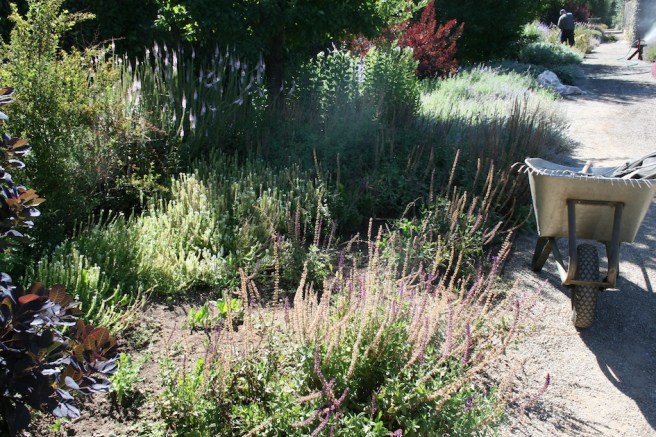
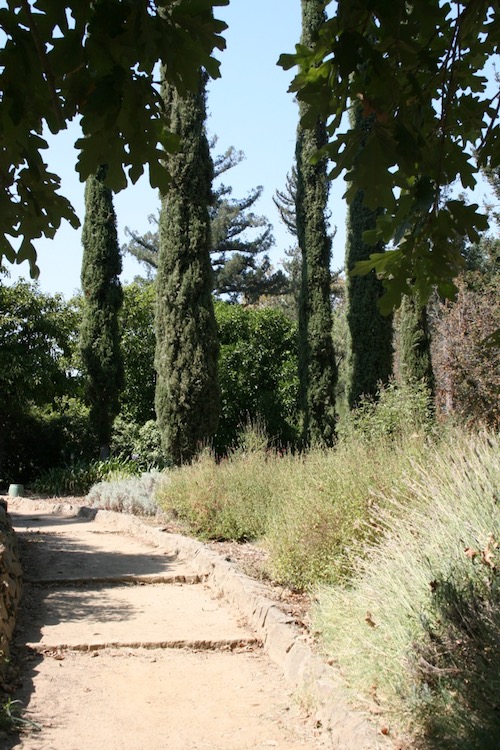
There was virtually no color to be found, even among the scruffy stands of native and non-native drought tolerant plantings. You see all of the color I saw except some white oleander just too high to photograph.
WPA 10

WPA 8

WPA 12

There were a number of bench areas to relax. I enjoyed a respite from the 95 degree heat on the shaded curved bench, closed my eyes and could envision what this garden could have been and still could be with its pleasing layout, meandering paths and multiple vistas.
WPA 11

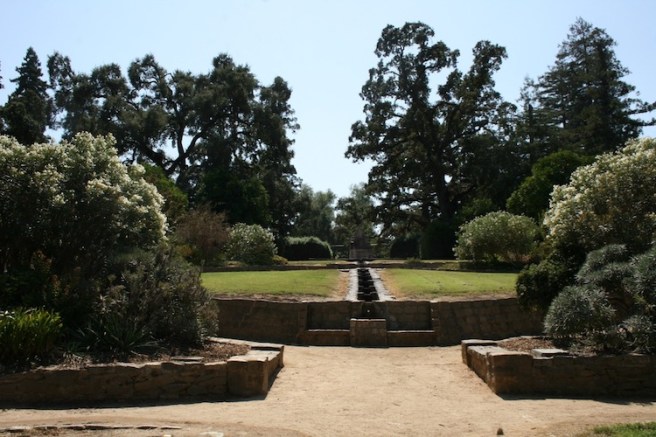
Sort of by accident I found myself at what I think is intended to be the entrance to the garden.


A monument to Charles Swanston, one of the late 1800s pioneering businessman of Sacramento sits on a knoll to the back of this grassy area. I assume at some point water filled the pool at its base and then flowed down this rock raceway. Dry as a bone now, just like the rest of the garden.
WPA 15

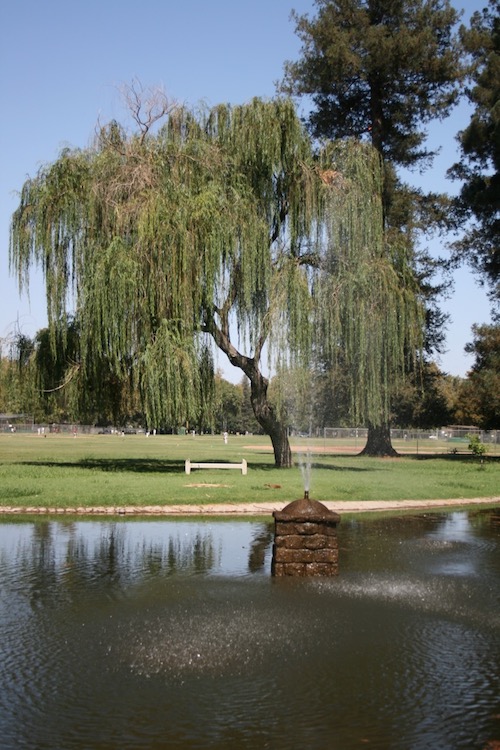
This cooling view is directly across the street from the garden and the memorial to Mr. Swanston–known to residents as the Duck Pond.

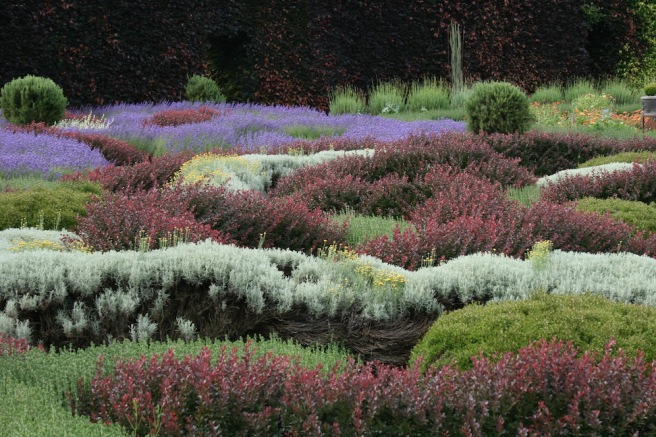
It was in my research into the Swanston monument that I was drawn into a more recent history of this once remarkable garden space. If you Google WPA Rock Garden and just look at the IMAGES you will see a garden that bears no resemblance to the garden I visited. Exuberant bursts of color pop from mixed evergreen and deciduous backdrops. Stands of herbaceous and woody perennials line the paths. Blooming vines scramble over the pergolas and children pose standing atop large rocks. Where was THIS garden–what happened here? Numerous newspaper articles, magazine articles and blog posts, mostly from the early 2000s to about 2012, extol the pleasures of this unique space. I even find a feature article filled with photos in Pacific Horticulture from April 2005–PH is pretty much the gold standard of horticulture publications for me. It was from these articles that I learned the real secret of the WPA Garden and her name is Daisy Mah.

Like many WPA era projects, the original garden declined once funds were depleted and the area remained neglected for decades. Horticulturalist Daisy Mah started her career with the Sacramento Department of Parks and Recreation in 1980 as the lead for the McKinley Park Rose Garden. After tiring of the monoculture of the rose garden she transferred to the William Land Park in 1988 and took the WPA Garden on as her own. At that time it was little more than an overgrown patch of ivy. Her first vision was that of a rock garden filled with alpine plants. The realities of Sacramento’s hot dry climate set in and she recognized that drought tolerant plants from the Mediterranean climates of the world would have a greater chance of success. This was pretty radical thinking in the late 80s and early 90s when public gardens (and many home gardeners) were all still living in a pretty starry eyed world of roses, hydrangeas and bedding plants—and we thought water was a never ending commodity. Over the ensuing 25 years Daisy Mah created and maintained the garden so beautifully represented in all those articles. In October 2013 Daisy Mah retired, moving on to travel and I am sure other garden pursuits. The last 4 years have not been good for many gardens in hot and dry California and public gardens in my state are under special scrutiny to be good stewards of resources. Daisy’s garden has surely suffered the loss of her passion, vision and daily ministrations.

Check out these two links for great photos of the WPA Rock Garden at its finest.

http://www.gardensforgoldens.com/2012/09/29/inspiration-from-the-wpa-rock-garden

http://www.pacifichorticulture.org/articles/daisy-may-and-the-wpa-garden

Exploring the history of Sacramento’s WPA Rock Garden has affirmed for me the importance of local gardeners taking on the advocacy role for their community garden sites–they are living symbols of our never ending efforts to surround ourselves with nature’s beauty. The WPA stone structures endure and offer a template from which a garden may rise again. We all need a little help sometime!


A Year in the Garden…Filoli in September

My monthly treks to Filoli in Woodside draw to a close with this last visit. It has been amazing to walk alongside this historic garden’s journey each month, observing its seasonal rhythm and getting behind the scenes insight into what it takes in time and labor to keep it going. The garden’s class and event schedule is on my radar now and I plan to make many more visits, even if not in such a regular pattern.

I mentioned last month the sharp decrease in garden visitors from the throngs I encountered March through July and today was not much different. Although very few garden lovers were strolling the grounds, the garden was alive with staff and volunteers checking tasks off their to-do lists as they readied the estate for fall.

Preparing for Fall is the focus for our last morning garden walk. It was easy to observe almost every bullet point on the fall checklist instructor Mimi Clarke had included in our notebooks. Things to do around the garden include:

Planting new trees and shrubs. Cool weather and more rain make autumn the ideal time to plant. Roots will have enough time to establish before winter cold sets in and they will have a head start on spring. These tiny Irish yew trees were started from cuttings and grown up in the Filoli greenhouse. The goal here is to eventually have a continuous row to act as a screen for behind the scenes work area.

Sep Filoli 51

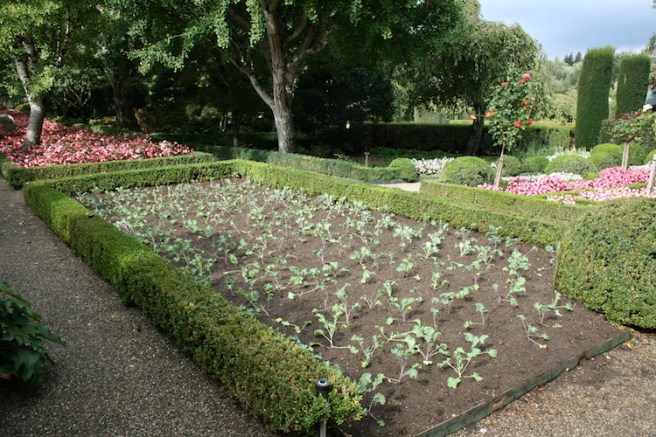
Planting perennials and cool season annuals. The bed below was home to pink petunias through the summer and is now replanted with seedlings for ornamental cabbages.

Sep Filoli 52

Autumn is the time for lawn repairs and renovation.

Sep Filoli 18

A small window remains for perennial plants to be trimmed back and neatened up. Too much later in the season and any new flushes of growth will be damaged by cold. The goal is to have any new growth hardened off before winter dormancy sets in.

Sep Filoli 15

Cutting garden beds are neatened up; cutting back appropriately to the specimen; leaving seed pods or berries to feed winter birds or complete removal and composting of spent annuals.

Sep Filoli 2

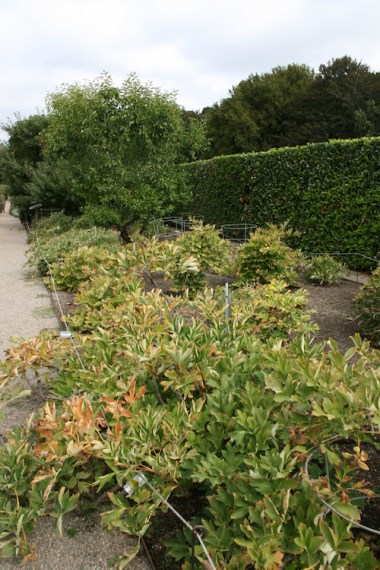
Some herbaceous perennials, like these peonies below, are left to continue ripening. The flowering shoots have already been cut back to new growth.

Sep Filoli 1

The time is right to plan out any other maintenance tasks or projects, keep close watch on the irrigation system, making changes as weather and moisture requires, and clean up dead and diseased foliage throughout the garden.

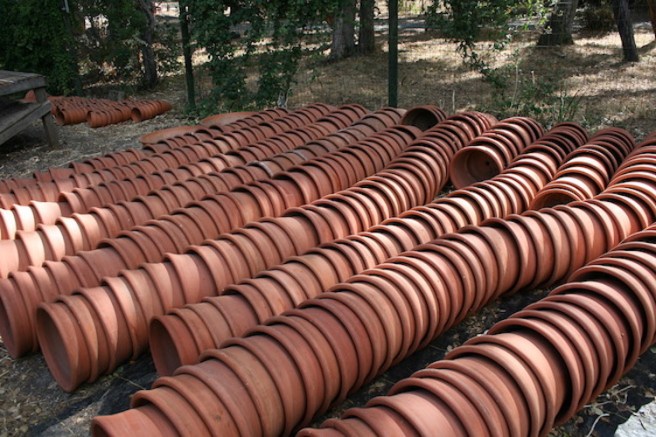
Since we last walked the area housing the spent potted daffodils from spring, the bulbs have been knocked out of the pots and cleaned up for winter storage and the pots cleaned and readied for late winter planting.

Sep Filoli 42

Sep Filoli 43

While much of the Filoli Cutting Garden is in its normal seasonal decline, one area burns brightly–the dahlia bed. Last month we observed the foliage making itself known, most plants from 12-24” tall. The first pinching to promote strong branching had just been done. Here is today’s look.

Sep Filoli 14

And a few favorites–

Dahlia 'Gits Attention'
Dahlia ‘Gits Attention’


In a few short weeks these too will be done and the tender tubers lifted to be stored for the winter. The thought of having this fresh and vibrant late summer color has inspired me to try a few dahlias next season!

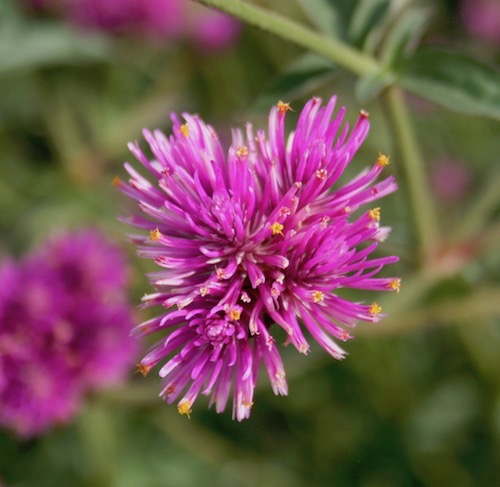
Another Cutting Garden inhabitant caught my eye. The bold fuchsia of this Gomphrena ‘Firecracker’ draws attention from afar.


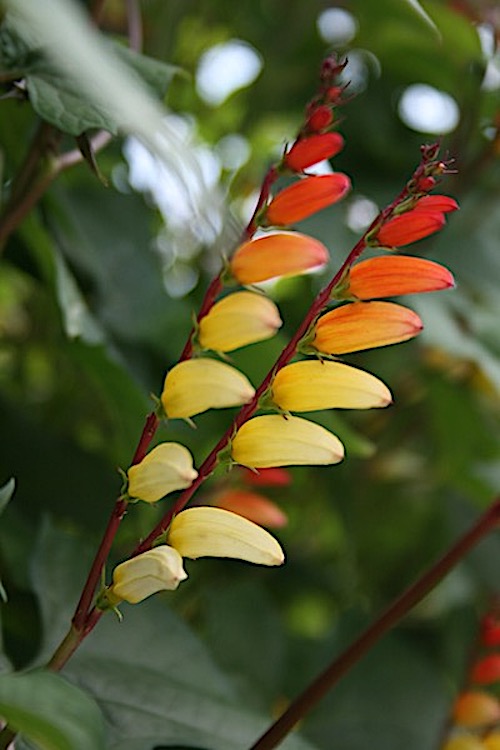
Many of the cutting garden flowers used in the house and Visitors Center are grown inside wire “greenhouses” to protect their delicate blossoms from pests and critters. The wire sides of these enclosures offer many opportunities to showcase annual vines. This one caught my eye. It is in the morning glory family and called Ipomoea lobata or Mina lobata. Common names found in reference material include exotic love vine, Spanish flag and firecracker vine. I know my gardening BFF Judi will love this one! I am adding ‘try a few annual vines’ to my gardening bucket list. Seed packets are inexpensive and the commitment much smaller than to a perennial vine.


On the subject of vines–this one was not yet blooming when I passed it last month on my way from the Sunken Garden to the Potting Shed. This month I could see it all the way across the Walled Garden and had to make a detour from our walk about to snap a few photos!

Sep Filoli 19


Sep Filoli 20

Commonly called silver lace vine, Fallopia baldschuanica or Polygonum aubertii, is an easy going perennial vine with a wild heart. It is fast growing (12-15 feet per year) and will scramble over anything in its path–in this case it cloaks a long brick wall at least 15 feet in height.

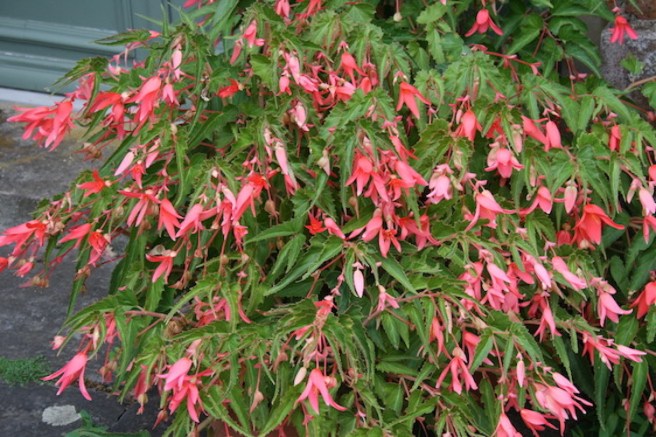
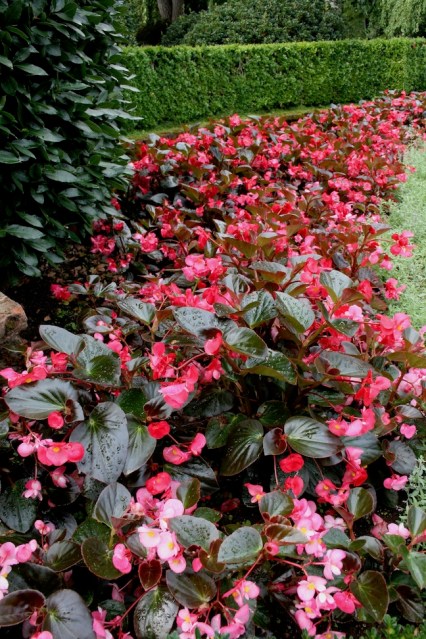
Begonias were on display throughout the Walled Garden, both in the ground and in pots.

Sep Filoli 25


Sep Filoli 33

As we were heading for the Area 2 Shop and to check out the large scale compost operation which deals with all the spent annuals and pruning bounty, I stuck my head into the Garden House, an ornate brick structure which is the focal point of the Walled Garden–the only time I have seen it without an activity in progress.

Sep Filoli 27A

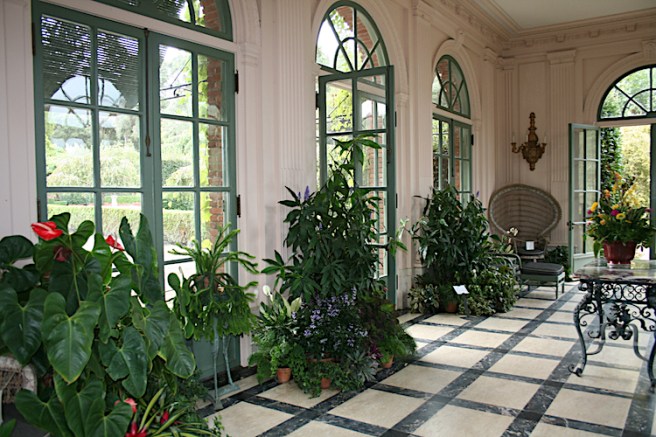
With french doors on all four sides this conservatory style outdoor room offers vistas of both the Walled Garden and the Sunken Garden.

The ambiance and architecture was very different at Area Shop 2–the hub for all activity in the Sunken Garden, the Terraces to the west of the manor house and the Meadow.


The Gentlemen’s Orchard is the last stop on our prepping for fall tour. This 10 acre orchard of mixed fruits lies to the east of the parking lot and was established in 1918 with 1,000 trees to provide the family and their guests with a year-round selection of dessert fruit. Today 150 surviving trees are being preserved along with a newly planted collection of rare period fruit cultivars. We sampled apples and grapes as appetizers to our lunch!


Back at our classroom we celebrated our ‘graduation’ with snacks and lunch. Each participant had the opportunity to present a project of their choice, putting new-found knowledge to work in solving real life garden issues. Projects ran the gamut from landscape renderings to a fledgling app which would send alerts to your smartphone based on your garden maintenance schedule. Our farewell task was to pot up our rooted cuttings from the August class session. These eight monthly sessions not only provided a good garden education foundation but an interesting look into other gardeners’ challenges and successes. While we may toil in our personal gardens mostly as individuals (so far not even my best friends have offered to come over and pull weeds with me) we also benefit hugely from our local and regional garden communities. In that way even our most solitary of efforts can become a valuable source of inspiration and fellowship.

So good-bye to and from Filoli for now–we’re best friends now and I get wait until we have a chance to get together again.

Sep Filoli 49


Now THIS is a Labor Day…

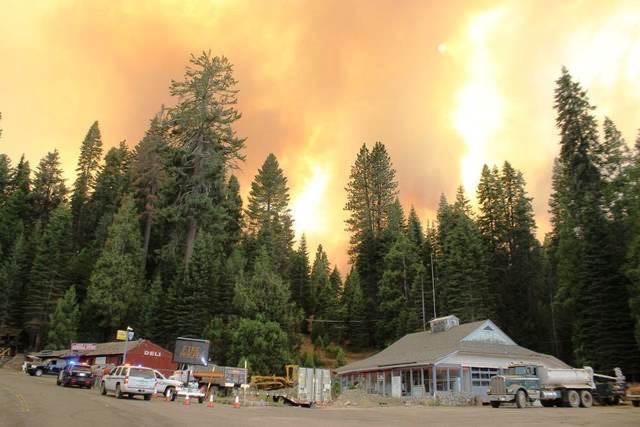
Labor Day weekend—last hurrah of summer–has been celebrated the past few years at our cabin in Fish Camp just outside Yosemite National Park’s south entrance. The Fish Camp Volunteer Fire Association holds its annual fundraiser at which residents of this tiny community enjoy one another’s company and live entertainment, eat a great meal and become spirited bidders in the live auction. This year this small enclave of residents and vacationers found itself in the national news with the drama of the Railroad Fire which broke out on August 29th just south of Fish Camp near the historic Yosemite Sugar Pine Railroad. Highway closure and mandatory evacuations were immediately put in place and remain as of today. The news photo below shows the fire roaring just south of the Tenaya Lodge with the General Store and old gas station in the foreground. Our place is in the trees behind the structures and in front of the fire.

Labor Day 2

Labor Day 3

The immediate and heroic response of multiple firefighting agencies–both local and traveling from other parts of California–in the first two days saved our small area of homes. Seven structures very close to the fire’s starting point were lost and some damage done to the beloved Sugar Pine Railroad’s historic railcars. The developed area of Fish Camp is now surrounded by a ‘cold line’ from which to fight any additional flare-ups. Unfortunately the fire continues to march to the east and southeast of Fish Camp and is now estimated at about 10,000 acres, 23% contained, with over 800 firefighting personnel in play. Additional areas have been evacuated, the highway remains closed and the local utility faces steep challenges in its attempt to restore power to affected areas. There is no expression of gratitude equal to the efforts of these firefighters and my every thought is focused on their safety.

So, here in the hot valley for the holiday weekend, my husband decided to tackle a little ‘rock relocation’ we have been talking about for a couple of weeks. In June 2016 we removed lawn from several very large areas on our corner lot. Previous posts gave you a peek at the replanting last fall & early spring 2017 of the large roundish bed nestled between our two driveways. The window to work the ground even a little and replant closes here in late May and so the last area has simply remained dirt (and spurge) throughout the summer. It is a very long and narrow side whose curving front connects to the north side of one driveway.

Labor Day9

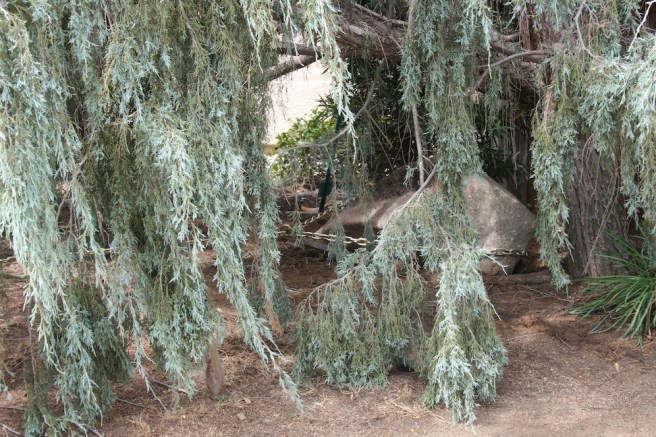
Three Bradford pear trees and this large weeping juniper, most likely ‘Tolleson’s Blue’, will remain as anchors to the bed as will several podacarpus tucked up against the fence. These mature trees provide our back garden with privacy and some sun protection for plants in the back which rest in their canopy. They also present tremendous challenges to doing much soil amendment and even planting anything larger than a gallon size can. Rather than preplanning what goes where my landscape philosophy may end up being finding where we can dig a reasonable sized hole and THEN decide what to put in it!

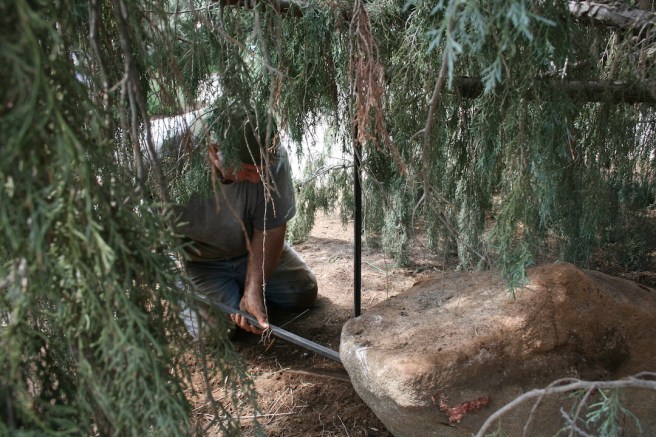
There are two huge granite boulders up against the fence under the weeping juniper and it is MOVING DAY for the smaller one! Now, sweet Dave and I have moved several other very large rocks in the garden in the last few years and our process has seen some refinement over time. For the first rock (and smallest) we convinced a friend who thought he had come for Sunday dinner that he would provide just enough extra manpower that he and Dave could muscle it to its new resting place. I am not sure he has ever accepted another Sunday afternoon invitation…

#2 rock signaled the start of the rock moving equipment acquisition–we bought a pry bar and managed to lever the rock, one side after the other, to its new home. That worked very well after realizing that me sitting on the pry bar was only effective until the rock moved and took the pressure off the bar…

We got pretty serious with rock #3–our largest effort to that point–digging out around it to allow the pry bar underneath and a thick nylon rope to be looped several times. Tied that puppy to the pick up and dragged it forward 3 feet. This Sunday afternoon spectacle brought out quite a few neighbors who, I am sure, thought we were nuts.

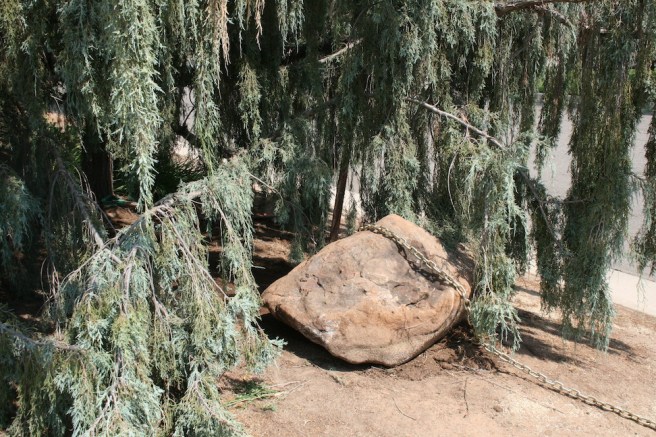
So that brings us to Labor Day 2017. Maybe you are thinking–why are these people moving these rocks?? The whole landscaping with groups of large granite rocks is kind of a “thing” here–sort of a companion to the mature olive tree brought in as a focal point. The rock people (that’s a real job) load ’em up on the flatbed and come equipped with a crane to set them into place according to the landscape designer’s plan. The rocks act as focal points and are great starting points around which to build plant groupings. After almost 20 years, this garden’s landscape has matured to the point that many of our large rocks are totally hidden under mature shrubs–so we’re just bringing them out into the light again. In the case of what we will now refer to as the Labor Day rock, it will take up some real estate which used to be turf near (no longer under) the weeping juniper and decrease the need for additional digging to add pant material which may well be covered by the juniper’s arms in another couple of years.

Check it out!

Labor Day 14

First challenge…avoid running over the sprinklers.

Labor Day 13

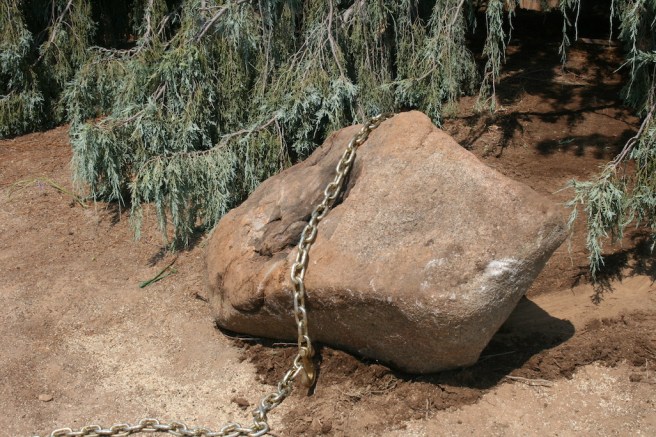
Notice we have upgraded from nylon rope to a chain…

Labor Day 11

Hope to now pass the chain under the rock rather than around.

Labor Day 12

Getting ready for another go.

Labor Day6Woo-hoo!

Labor Day 5

A few positional adjustments and we’re there. A little digging in tomorrow after dinner will help it settle in.

Labor Day 4 A man, a chain and a rock–now that’s a love story, huh?

Thank you to all who labor, making contributions to the strength, prosperity and well-being of our nation—whether by keeping us safe from fire and flood, working the land to feed us or teaching our children; the future of this country is in your hands.


A Year in the Garden…Filoli in August

Filoli was eerily quiet as I arrived for my monthly class in this quintessential country estate of times gone by. The forecast was for a day in the low 70s which for me would be a relief from a summer with weeks on end of temps surpassing the 100 degree mark. Unlike the efforts of many home gardeners who are about ready to call it quits by this time of year, Filoli’s formal beds benefit from the June changeout of plant material from spring to summer (and staff to make it happen…I must have misplaced my own staff) and were bright, bold and thriving!

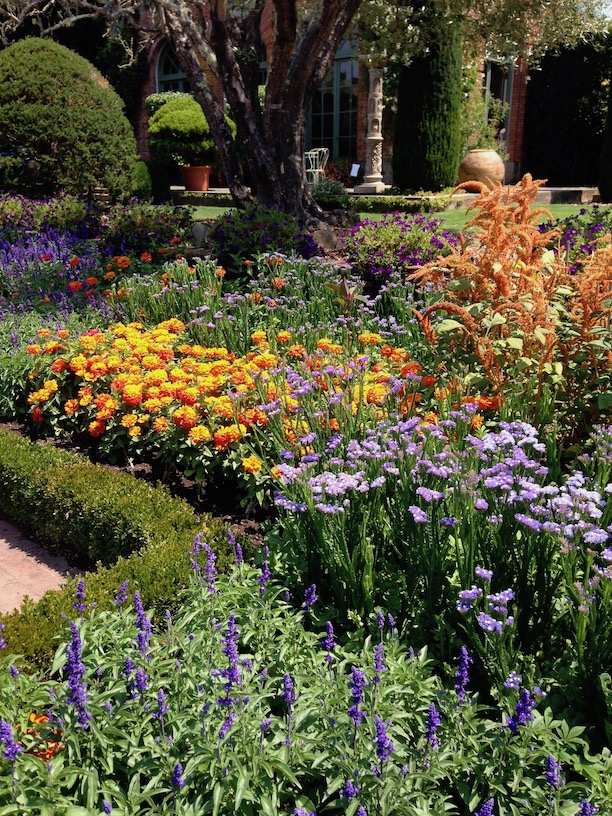
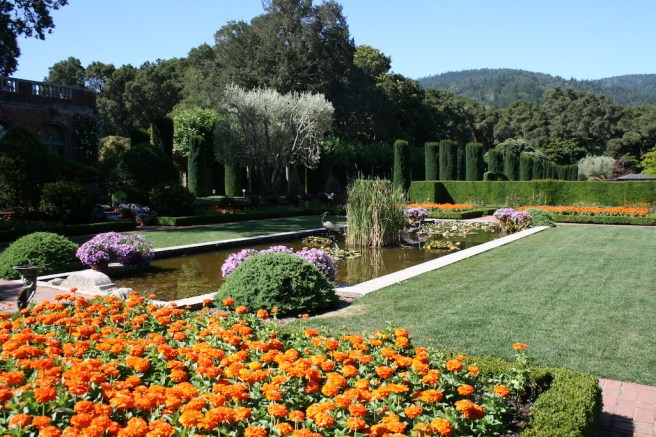
The play of the morning sun turns the sea of orange zinnias to gold! The bold color scheme of the Sunken Garden almost glows in full sun under blue skies.

Aug Filoli 16

The blue mealy cupped salvia and lavender statice, barely past seedling stage last month, have come into their own. All of the annual flowers seen here are started from seed and grown out in the estate greenhouses.

Aug Filoli 6

This butterscotch colored Amaranthus was interesting. Commonly called amaranth or love lies bleeding, there are many ornamental varieties as well as whole grain varieties used as a food crop. Most of the ornamental ones I have seen are in the red and burgundy tones–slipped my mind to ask our instructor, Mimi Clarke, later in the day for the cultivar name.

Aug Filoli 3

I also enjoyed seeing the pops of white along the northwest wall provided by really nice stands of Cleome. A taller variety, the flowers topped 5 feet. I am going to find a sunny spot in the back of one of my borders to sow a packet or two of these next spring.

The garden and gift shop area was dressed for late summer also. The plants for sale often mirror what is prominent in the garden at any given point–today was a bit of an exception with this nice display of succulents.

Aug Filoli 2

Aug Filoli 1

My usual route through the Walled Garden to my potting shed classroom allows me to check in on those disappointing begonias I noted last month. They have filled enough now to give me a grudging smile.

Aug Filoli 7

The less formal areas southeastern areas of the garden reflect more of the late summer doldrums all gardeners experience: perennials not quite fully cut back in hopes of encouraging an second flush of bloom, cutting garden annuals nearing the end of their prime time and roses looking like they have had a long, hot summer. Every month I find these areas to be a comfort. Even with a hard working staff there are always more maintenance tasks than time and hands to do them–just like my garden!

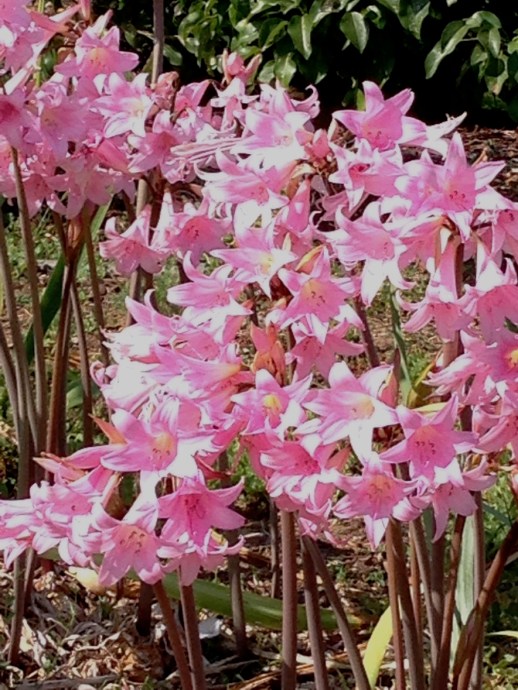
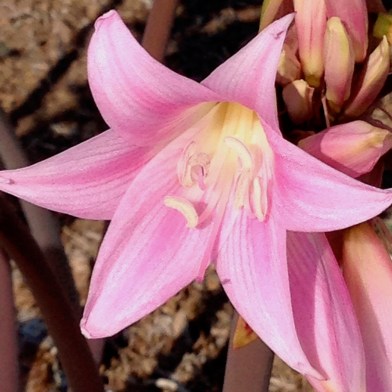
A highlight this month where the clumps of naked ladies blooming everywhere! The bulbs of Amaryllis belladonna and Lycoris squamigera both produce straplike leaves which die back in late spring, followed by long naked stalks topped with clear pink blooms.

Aug Filoli 10


Aug Filoli 8

I believe these to be the Amaryllis rather than the Lycoris due to the symmetry and more pointedness of the petals and the color of the stalks but I wouldn’t put money on it! They are in areas clearly visible from the paths but not close enough to examine on hands and knees without walking into the planted areas. Both plants are great naturalizers and resent being moved. They were very popular with 19th and 20th century gardeners and remain so today–although many folks who have them ‘inherit’ them with their property rather than having sought them out to add to the garden.

Propagation is today’s classroom and garden walk topic. As we had covered seed collecting earlier we would concentrate on asexual propagation today with our hands on focus being propagation by cuttings. The major methods of asexual propagation are cuttings, layering, division and budding/grafting. Propagation by cuttings involves rooting a severed piece of the parent plant; propagation by layering flip flops the process by rooting a part of the parent plant and then severing it. Propagation by division is accomplished by digging up the parent plant and separating it into several parts or separated off plantlets that have set down roots away from the parent plant; budding and grafting allow you to join two plants from different varieties. Excellent written material walking us through each of these propagation methods is included in our class notebooks–I have propagated by division countless times but have little experience with the other three techniques.

Mimi’s go-to advice of knowing your plant and using good references is especially apt as you try your hand at propagation. A plant’s basic genetic and structural properties can point you to the method and time at which it can be most successfully propagated. The fibrous crowns of daylilies are perfect to tease off new plants by division while a plant with a tap root like Queen Anne’s lace cannot be propagated in this fashion. Even the seasoned professional gardening staff at Filoli consult their reference materials to find out the specifics for the plant they seek to reproduce. One of her recommended text is the American Horticultural Society’s tome Plant Propagation which is well organized by plant and written at a practical level for a non-scientist–good step by step photos also.

So today we will take a look at Filoli’s propagation set up, take some cuttings from the estate and prepare them just as the staff gardeners would. The hope is that they will be sufficiently rooted for us to pot them up to take home in September.

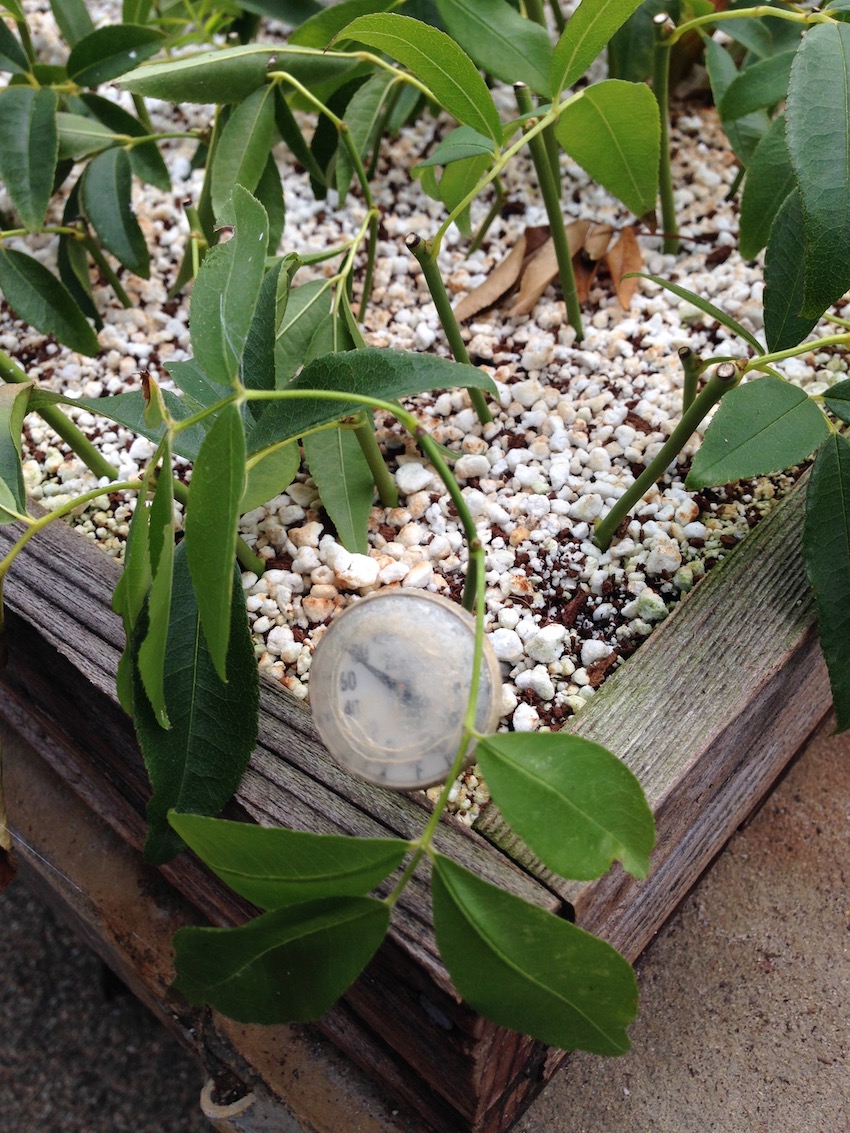
Before we head out into the garden we get a quick primer on rooting media and containers. Filoli gardeners construct propagation flats, sized perfectly to sit two deep on the tables in the propagation house (prop house), but any box that will provide suitable drainage can be adapted. The rooting media (soil) should be clean, porous enough for root aeration and drainage but also capable of water and nutrient retention. An easy mix to start with would be 50% peat moss and 50% perlite–dampened, mixed and pressed into your rooting container. Let’s head into the garden!

We stop outside the propagation house to see what is hanging out in the cold frames. Cuttings which have rooted well are potted up (usually to 4″ pots) and moved outside to acclimate. There are a number of cold frames throughout the ‘working’ areas of Filoli and at any given time they contain a mixture of potted up rooted cuttings, divisions and grown out plants waiting to be switched out in the display areas or bound for the retail shop.

Inside the propagation house, pots and flats–check out Filoli’s perfectly sized wooden rooting boxes–are arranged on the concrete tables on either side of the structure. These tables are original to the prop house, which dates very early in the estate’s history. The tables provide bottom heat to the cuttings by means of a piped hot water system tucked up under the table top–also original and still working well. Overhead misters and fans provide the ongoing constant moisture needed for root development. Temperature of the rooting media is monitored by a thermometer in the box or pot and adjustments are made to the climate as needed. Everything is labeled with the plant name, date and often where the particular cuttings were taken in the garden.

Our next stop was one of the large greenhouses adjacent our classroom–this one houses many of the potted tropicals that rotate through the house and a host of succulents plus anything else that just needs a temporary home inside. We are catching this house at a time just past the last large annual changeout (June) and before flats are seeded in the fall with next year’s spring annuals. Mimi tells us that much of what we see today will have to be moved in a month or two out to house hundreds of flats of newly germinated annuals.

Aug Filoli 23

The greenhouse features a wide center walkway going from doors on either side. The perimeter window walls have permanently fitted table space. The double wide center table seems to only allow access from one long side and it initially appears very hard to reach anything more than an arm’s length away. I was fascinated to find that this very wide and long (maybe 30 feet long and 15 feet wide?) table sits on a system of galvanized pipes that allow it to be rolled from side to side with little more than one person’s effort–thus eliminating the need for a walkway on both sides and increasing the overall storage space.

Aug Filoli 24

Additional cold frames are found on both sides of this greenhouse. In the winter months they will be covered to prevent heat loss.

Aug Filoli 27

In the center of the above photo you can see pots of young Taxus baccata ‘Stricta’, the Irish yew, which is one of Filoli’s signature plants. Prominent in the original estate landscape, many of them on the grounds are decades old and there is a constant need for replacements. The original yews were started from cuttings taken from trees at Muckross, the Bourn family estate in Ireland. The cuttings were then planted at Mr. Bourn’s Empire Mine until Filoli was ready for landscaping. Every Irish yew replacement is grown from a cutting of one of the original plants.

Aug Filoli 11


We came upon this artful stack of wine boxes in the covered work area behind our classroom–looks like some quick minded gardener had snagged them to use as boxes for rooting cuttings and starting seeds. Some of my classmates opine that they were perfect in size and shape and muse about how they could explain to their spouse that they need to buy all their favorite wines by the case now so they could have these great boxes as a bonus!  On to a lightening fast lunch so we can get back out in the garden to get our cuttings!


Mimi had planned for us to take cuttings from Weigela florida and Aloysia triphylla (lemon verbena), both robust deciduous woody shrubs that we had talked about on earlier garden walks. Special request cries arose for Philadelphus (mock orange), Hydrangea anomala petiolaris (climbing hydrangea), and a specific camellia. Clippers and brown paper bags for collecting in hand we’re off!

Everyone takes a turn at snipping, looking for supple disease free whips to harvest. On the left you see the brick wall of climbing hydrangea. Having done our research in the classroom on each of the proposed selections we had learned that this slow to establish but eventually very aggressive deciduous vine is best propagated in the spring when it is just beginning to produce new roots at the nodes to help it cling to its support (wall). Armed with the knowledge that the success rate for our late summer cuttings may not be high, we are still going to give it a try–I read recently a quote “If you are not killing plants you are not stretching yourself as a gardener.” So there. Now if I can only get the man I share a checkbook with to adopt that philosophy…

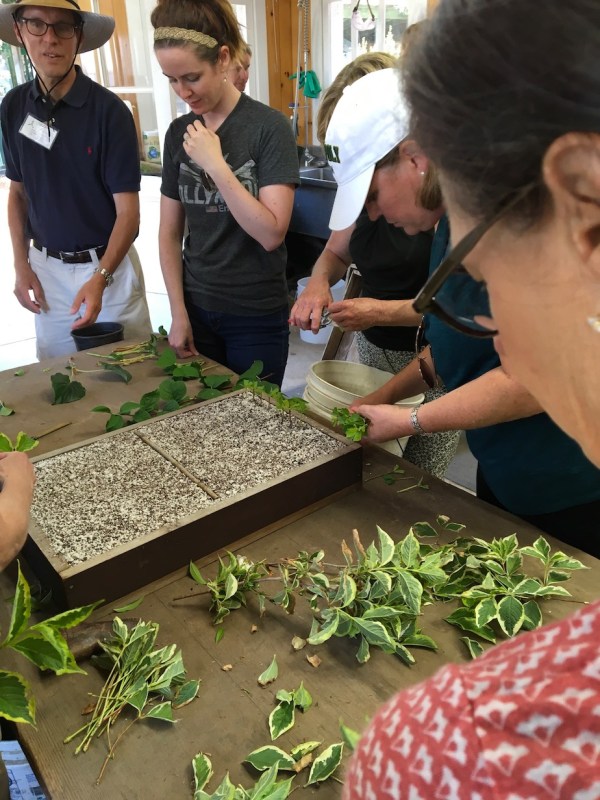
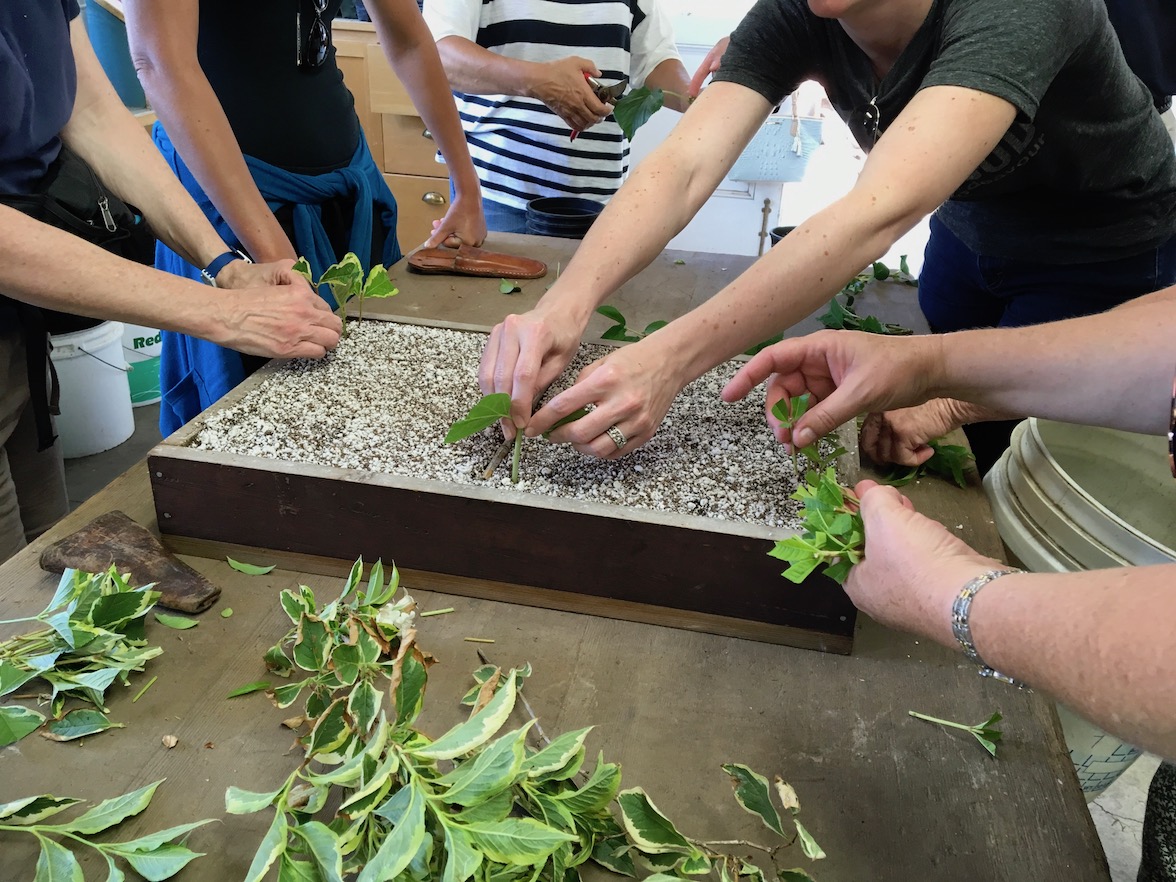
Back in the potting shed our booty is spread out by variety and we get a quick demo on where individual cuts should be made so that every cutting has a node which will be down in the rooting media and one exposed to the air which will produce new growth.

Aug Filoli 29

We divvy up into teams and to prep our plant’s cuttings and organize our rooting tray, keeping like cuttings together in tight rows. Labels are made and added to the tray at each point where the plant type changes. We are sharing our tray with the Saturday class it is amazing how many cuttings we got into our half. You can see above we originally started to fill the tray from both sides but ended up relocating them to our designated space. ‘Tray management’ may seem to be a facetious concept but it really critical in knowing what and when you’ve planted and keeping your propagation efforts organized.   Just like so many things in life that you think you will remember exactly what and how you did something (on the day you actually did it)–the reality is that a week later it is all going to blur together!

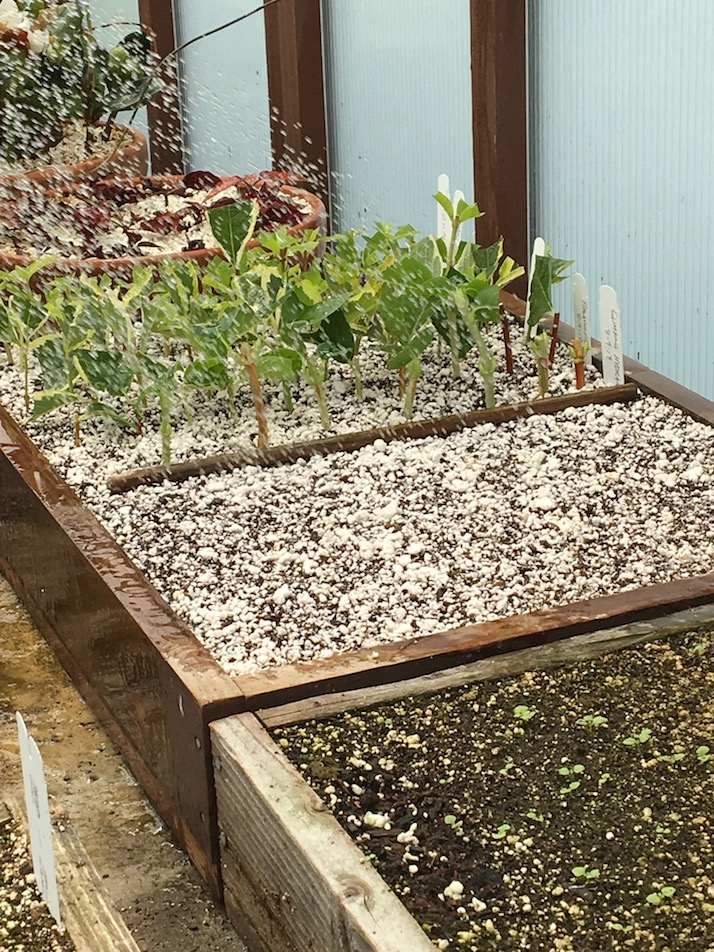
Like a dozen proud parents we walk our tray to its place in the propagation house. Mimi Clarke gives it a gentle spray. If gardeners gazing with pride and love can make plants root these babies ought to be 2 feet high by next month!

The September meeting will be our last meeting of A Year in the Garden. We will close our time together talking about winding down the garden in fall. Our individual projects are due and we’ll have the opportunity to see what everyone else has done–no pressure here–and hopefully have well rooting cuttings to add to our own gardens as reminders of the time we have spent at Filoli.

Aug Filoli 13
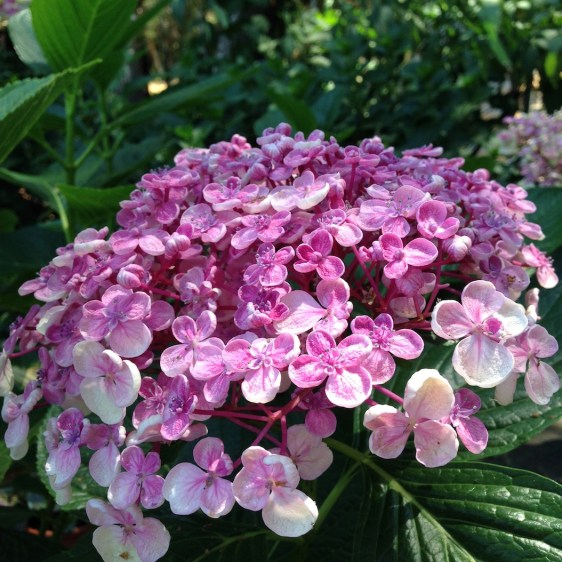
Hydrangea macrophylla–possibly ‘Ayesha’–with beautiful cupped sepals.


No purchase required…

When we first returned to California in 2008, my husband maintained an office in South San Francisco and frequently worked several days a month at Stanford University Hospital. Being more a Southern California girl than a Northern California one I took advantage of his time there to tag along and explore the South Bay in search of public garden adventures and good plant shopping. On one of my first days in Palo Alto, I stumbled on the Elizabeth F. Gamble Garden which to this day remains one of of my favorite garden go-tos. On that same day, needing a place to kill a little time before picking David up at the hospital, I stopped by the Stanford Shopping Center to get a cold drink and sit a bit.

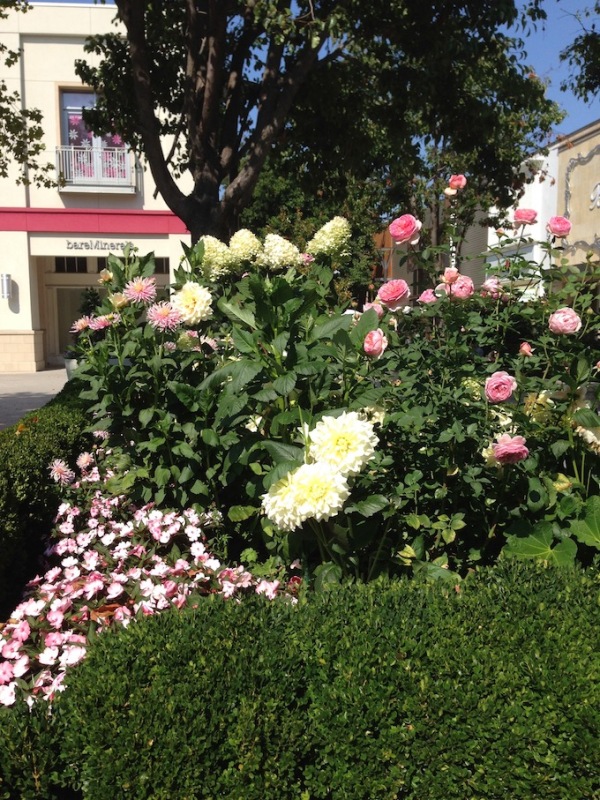
The Stanford Shopping Center is an open-air shopping and dining experience just minutes from the Stanford campus. It is home to some of the most luxurious raised bed and potted plantings I have ever seen. On my visit that day I never even opened the door to any of the 100+ stores–I spent my entire time there walking the wide promenades filled with comfortable cushioned sofas, chairs and glorious blooms. Massive pots were home to small scale trees, hydrangeas, camellias, dahlias and companion plantings and acted as screens and focal points. The raised beds in both sun and total shade were filled with annuals and perennials to complement the bed’s evergreen year round plant material. Since that day, every time I am in Palo Alto I spend some time in this outdoor center–often taking a book or my laptop and finding a shady spot to relax and people (and plant) watch.

Not long ago I heard a life altering rumor that the Stanford Shopping Center had redesigned their plantings in response to California’s continued water issues and all was now native grasses and drought tolerant selections. Booo…even in my understanding of their civic mindedness I was in mourning. After all, I cannot keep a hydrangea alive–much less grow them 8-10 feet tall and wide in pots larger than jetted tubs–but at least I could revel in them beautifully combined with roses, impatiens and violas for a little while with a visit to the SSC. Last week on my monthly South Bay trip for my Filoli day I went up a day early and had an afternoon to fill. I downed a protein shake for strength, gritted my teeth, grabbed my camera and headed to see what havoc the drought had wrought on my beloved garden haven.

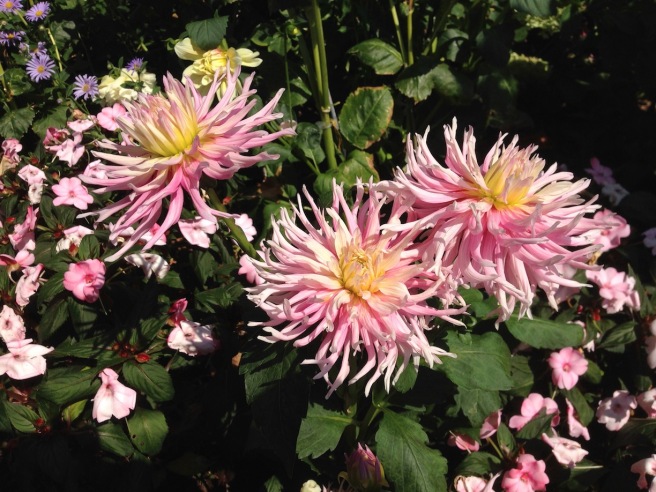
I was excited to see that while some of the plantings were less luxurious than in previous years and many of the planters had been converted to more permanent plantings needing less seasonal change-outs–all was not lost! The thirstiest selections were fewer and farther between but no less meticulously maintained as in previous years. Have a look.

SSC 18

SSC 13

SSC 8

SSC 1

SSC 14

SSC 17

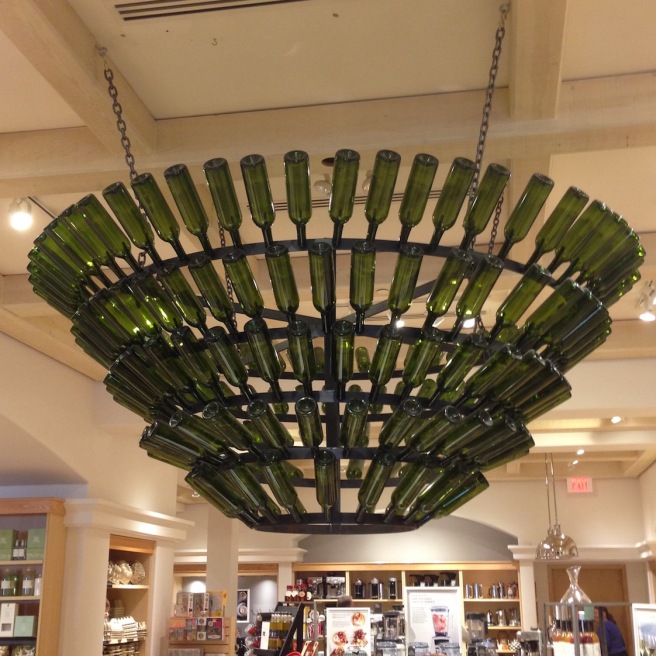
SSC has a lovely Williams-Sonoma–this great bottle ‘tree’ is the centerpiece of one side of the store.

SSC 9

SSC 10

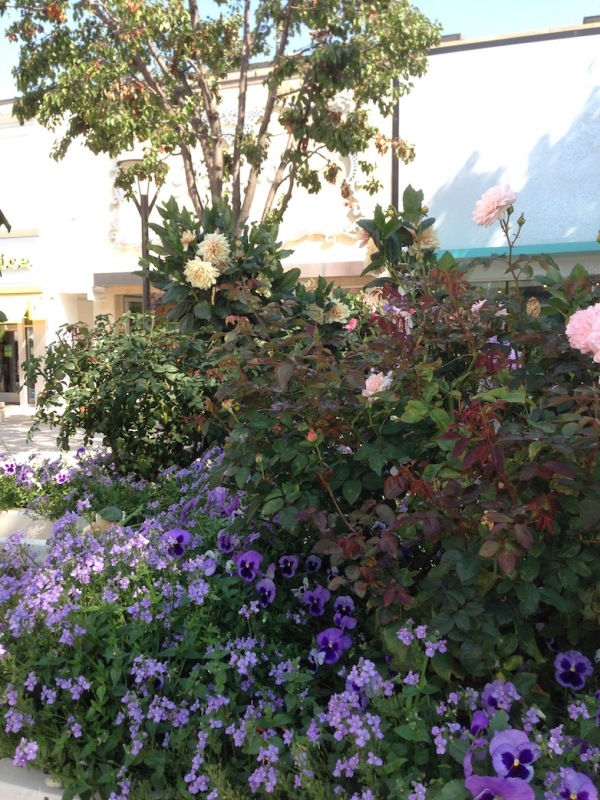
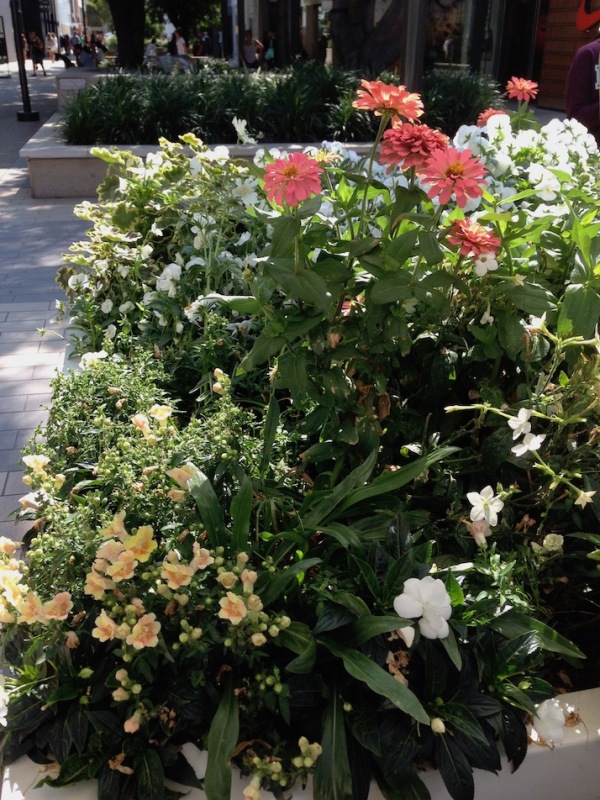
Part of the core walkway of the center is in total shade. I especially loved these gorgeous raised beds boasting greens and purples–a great example to refer back to in planning an exciting shade plant combo.

SSC 11

SSC 12

Good to know the earth has not fallen off its axis. There are still beautiful raised beds and planters to delight the gardeners who may have the need to actually shop for something other than new plants. Palo Alto’s temperate climate allows these plant displays to endure for months on end. Winter, however mild, does come to the South Bay and I think this will be the year I will plan to see what the Stanford Shopping Center offers (horticulturally) for the holiday season. Isn’t it always true that you never really appreciate something until you think you may have lost it? Truly no purchased required to enjoy these fruits of someone else’s labor.

SSC 7


Casa Mariposa…

2017 Garden Bloggers Fling Director Tammy Schmitt (check her blog out at ts-casamariposa.blogspot.com) flung open her own Bristol, Virginia garden gate for us to see her exuberant cottage style garden. I knew I would love this garden when we entered through a gate crowned with a freeform trellis created by a long dead but quite sturdy vine trunk!

Schmitt 1

This precious little Clematis was making its way up the trunk as fast as it could. This downward facing bell shaped flower is not one I see often in California.

Schmitt 14It is easy for those of us who garden in areas with short mild winters and long, long growing seasons to forget that many Zone 7a gardens like this one may be  blanketed with snow well past when we have all ready fertilized our lawns and deadheaded our roses for the first time .

Keeping that in mind, the riotous summer foliage and flowers in Tammy’s back garden are all the more impressive to me. Her garden is completely organic and features many native plants and ornamentals that attract birds, butterflies and other wildlife. While perennials stay in place through the cold season, all Tammy’s pollinator friendly annuals are sown from seed while all else sleeps.

Schmitt 3

Schmitt 12

I love the fact that this garden has no 5 or 6 foot privacy fence and can be enjoyed by Tammy’s neighbors as well as the wildlife and family dogs. This creative gardener met the challenge of her 5 rescue dogs’ favorite pastime of running back and forth in front of the low wire and timber fence by clearing the plants from their preferred footpath and rechristening it a dog run. Not even visible to those enjoying the garden but perfectly “dogscaped” for her pooches.

Schmitt 11

A hand dug river bed over 60 feet in length ending in a rain garden prevents runoff from entering the storm drain that flows to the Chesapeake Bay.  Volunteers from reseeding annuals are free to take root in the river bed, adding to its very natural feel.

Schmitt 10

Tammy has a great way with pots, with dozens forming living walls on either side of the steps into her home. There are some interesting posts on her blog chronicling her search for a way to get these yearly pots going through the winter weather to get the best jump on spring.

Schmitt 5

Absolutely going to use this great idea for marking plants–mini clay pots with the plant names on the bottom casually top supports which disappear into the sea of green.

Tammy has been using a product called Penetrate from one of the Fling’s sponsors, John & Bob’s Smart Soil Solutions, to improve her clay soil.  We had an opportunity to be John Valentino’s audience as he filmed a promotional spot for the products in Tammy’s back garden.  It was interesting to hear the science behind the line of organic products and a few good questions from our group added to the filming, making us a truly captive (and quiet until called on!) audience. Thank you, John!

Schmitt 17

A quick note to my Central Valley readers–John & Bob’s is a Fresno company. My Fling swag bag included both literature and sample products to try. We all know great gardens start with the soil–I am going to put several of these products into play in my garden. John cautioned us that these are not overnight fixes but I am willing to put the time in if I can reform my clay soil even moderately! I’ll keep you posted but in the meantime, check out what these local soil superheroes have to offer at http://www.johnandbobs.com

And it is so obvious that Tammy Schmitt loves to garden–thank you to her for the three years of blood, sweat and tears it took to organize the 2017 Capitol Region Garden Bloggers Fling. As a first year participant I had no idea what to expect. One description I read called the Fling “summer camp for gardeners” and I think that is quite apt. I spent time with new friends away from the normal routine of my life, shared stories and experiences, saw some beautiful scenery and created memories to last a lifetime. 2018 will mark the 10th anniversary of the Garden Bloggers Fling and that anniversary will be celebrated in its ‘home town’ Austin, Texas. Don’t worry–I’ll be there and by way of photos and words–you can be, too!

Virginia Gardener’s Virginia garden…

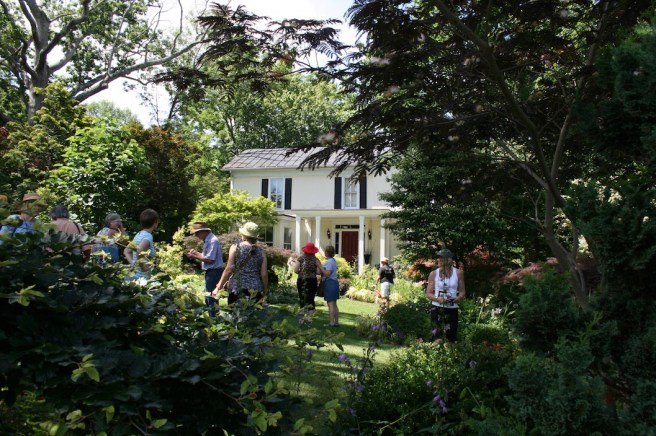
Virginia Gardener and her husband were married on their Middleburg estate shortly after purchasing the property in the 1970s. They share a passion for classic historic homes and the c. 1790 home on Seven Springs Farm met their hearts’ desires. Smack in the middle of Virginia horse country, the surrounding garden offers long views of rolling fields and distant hills.

Virginia’s property leads with her veggie garden and barn as any proper farm would. The plots for crops were not overly large but were chock full of really healthy looking produce, flowers and a bit of garden art here and there.

VAG 1

VAG 2

Virginia had walked down the driveway to welcome us. As we followed her back up toward the house it was hard not to be distracted by the views.

VAG 4

VAG 5

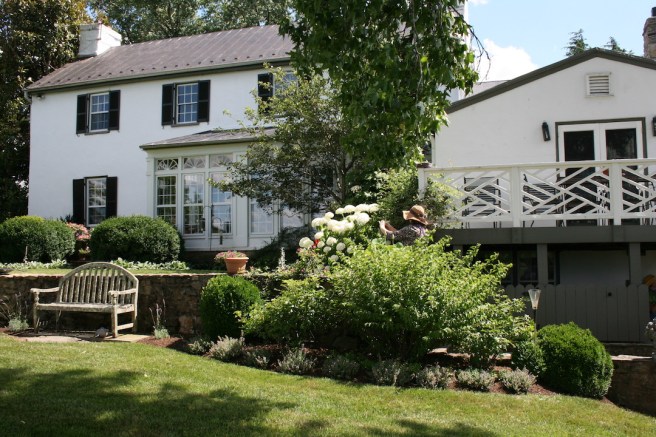
The gracious home comes into view. I am sure that 220+ years did not pass without changes to the house to meet the needs of the day but the home’s architecture remains  marvelously cohesive.

VAG 6

The garden is divided into many distinct areas; both sides of the home feature a little more formality while the back has an open family friendly lawn.

As we rounded the home on the stone end we enter the herb garden near this charming small structure which I believe Virginia identified as the original spring house.

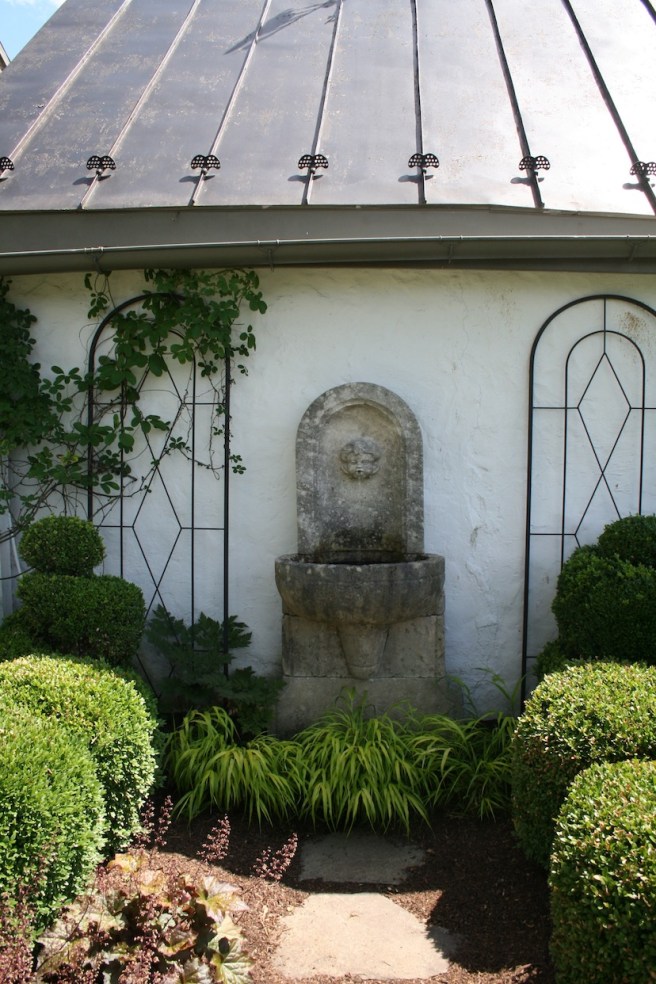
This vignette on the side of this rustic outbuilding features an ancient looking fountain framed by symmetrical boxwoods and iron trellises.

VAG 9
A classic sundial provides a centerpiece for the herb plantings

VAG 12

Meticulously maintained boxwood hedging of several heights separates the herb and secret garden from the broad expanse of the back lawn.

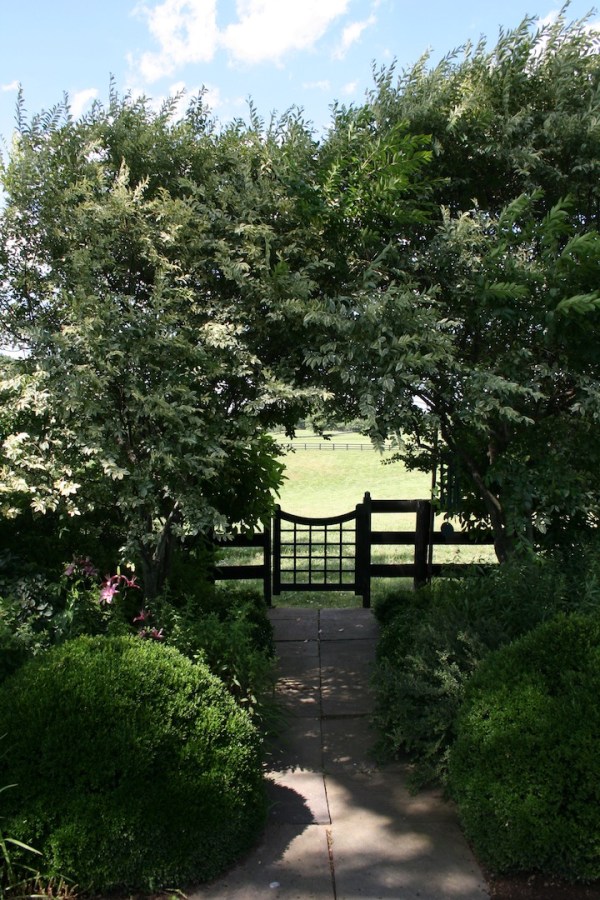
The perennial borders provide an area of transition from the lawn to the greater expanse of rolling grassland beyond the low rail fence. I loved that Virginia has provided numerous openings from the garden to the open fields, each one different and each one acting as the frame for a view worthy of a landscape painting.

VAG 13
No shortcut here but a lovely place to rest and enjoy the garden

VAG 14

VAG 19

VAG 15

Looking back at the home. The stone wall is a beautiful way to accomplish the elevation change and makes a nice background for the plantings. Classic boxwood define corners and walkways throughout the garden.

VAG 17

VAG 18

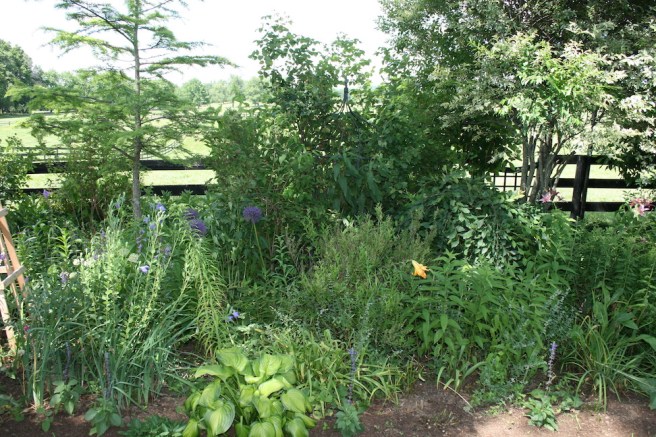
The perennial borders were not riots of color but had lots of variety so that there would always be something  in bloom.

VAG 20

Deciduous and evergreen trees and shrubs, in addition to a variety of conifers, give the borders year round structure and interest, allowing the seasonal plants to wax and wane as they choose.

VAG 21

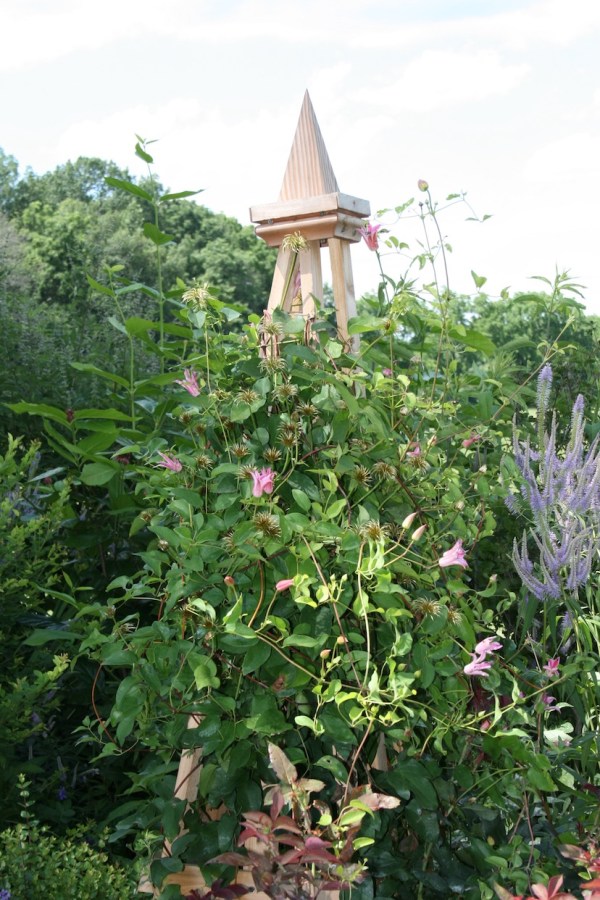
Wooden obelisks were staples of the border, offering vertical interest and a place for a variety of scrambling vines. Here you see one of the nodding bell shaped Clematis with blooms in all stages.

VAG 23

I would have been happy to sit on one of the gardens benches or up on the raised deck fitted for outdoor dining for the rest of the day enjoying this exquisite countryside.

VAG 22
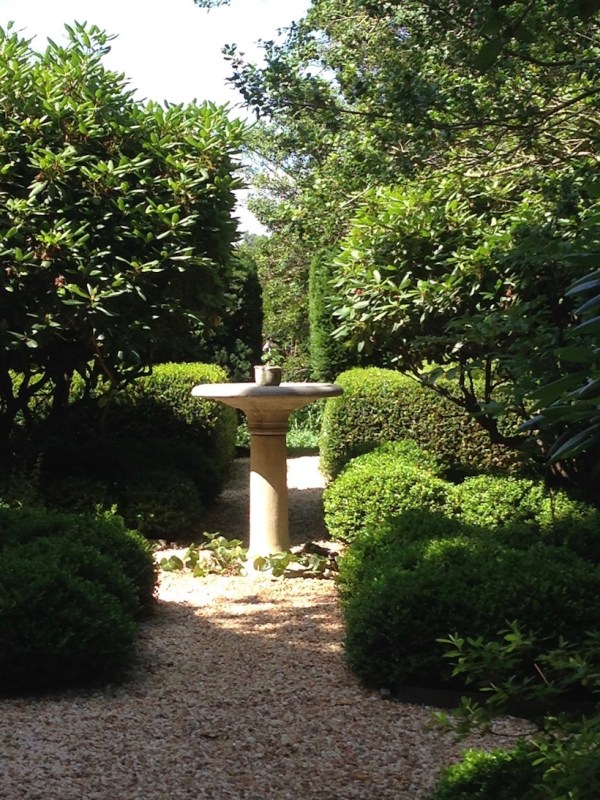
I want this birdbath!

VAG 24

Hands down this was my favorite place in Virginia’s garden. Another elevation change was accomplished with stone steps and this U shaped wall delineated a restful spot with a perfect view. Please take note of the bronze animal walking the back wall. I was not the only one who mistook it for coyote–several of us discussed it with interest for several minutes before a local took pity on us and identified it as a fox…you know, like in fox hunting…in horse country…duh.

VAG 25

VAG 27

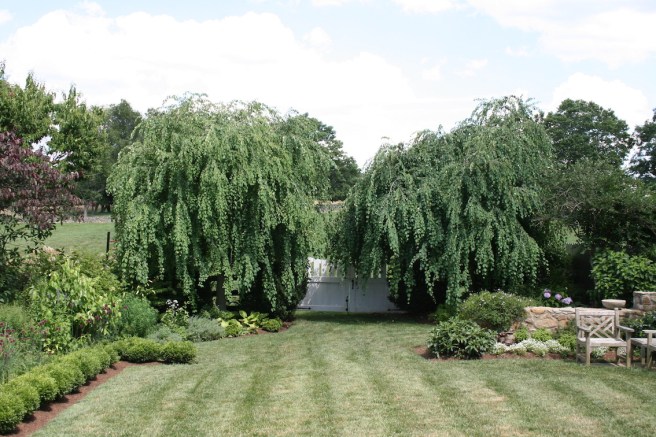
These beautiful weeping trees (maybe Katsura?) camouflaged a wide side gate.

VAG 30

One of many great garden art rabbits.

VAG 28

Yet another gorgeous framed view!

VAG 36

A formal boxwood garden takes you from the sunken stone area up toward the shady swimming pool. Symmetry and sight lines rule.

VAG 31

The back of this calming pond accommodates another elevation change.

VAG 33

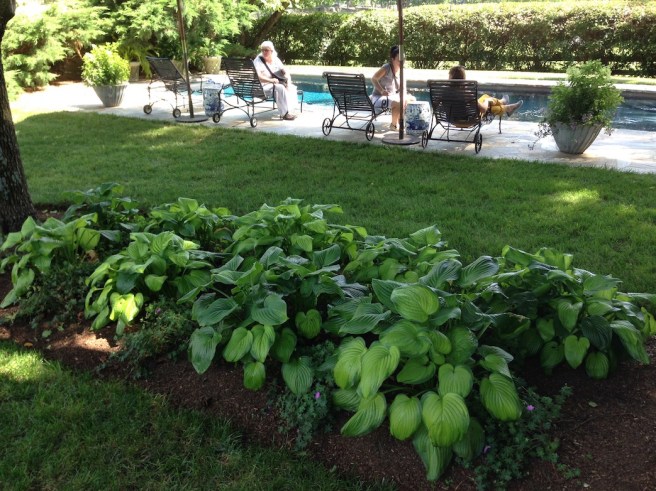
The faint limey green in these hosta leaves almost glows in this shady bed which delineates the boxwood garden from the pool area.

VAG 7

After several minutes rest in the shade by the pool and a glass of cold lemonade we weary garden bloggers bid good bye to Virginia Gardener and her Virginia garden. The distinct rooms of this garden estate have evolved over decades and speak to me of the cool mostly green gardens I remember so well from my years living in the Deep South. When you can achieve a beautiful garden that is also practical and looks good without spending every waking hour on maintenance, you have arrived!

VAG 26

United States Botanic Garden

Located at the foot of the United States Capitol, the United States Botanic Garden (USBG) was established by Congress in 1820. George Washington had a vision for a botanic garden which would demonstrate and promote the importance of plants to our young nation. Today, three garden spaces make up the USBG: the Conservatory, the National Garden and the adjacent Bertholdi Park. Approximately 65,000 plants are maintained for exhibition, study, conservation and exchange with other institutions.

The Terrace Garden entrance to the Conservatory offers a peek-a-boo view of the United States Capitol building.

USBG 13

This gigantic shallow container, housing an interesting mix of tropicals and conifers, is the Terrace Garden’s focal point.  The architectural conifer in the background bed appears to sprout from the super-scaled dish garden!

USBG 12

Although I am not a huge fan of the heavy humid air of indoor conservatories, my analysis of this day’s prevailing weather was that inside the big glass house could not be any worse so…

The Garden Court acts as an anteroom for the plant life of the Tropics. The mirror image shallow reflecting pools are beautiful and the aqua tile and sparking water offer visual relief from the sultry day.

USBG 20

USBG 15

That would the Tropics be without a massive Ficus aurea?

USBG 16

Additional collections from around the globe are housed in several auxiliary glasshouses that surround the two story main conservatory. I walked all over the world on these wide flagstone paths!

The National Garden, established in 2006, was originally conceived in the late 1980s to features roses which had been declared the national floral emblem in 1986. The concept was later broadened to include native Mid-Atlantic plants (dubbed the Regional Garden), pollinator attracting plants and a fountain celebrating the First Ladies.

USBG 7

The Rose Garden

USBG 6

The First Ladies Water Garden

USBG 10

Above and below–small sections of the Butterfly Garden. Many evergreens are incorporated here to maintain garden interest during the dormant season.

USBG 9

Views of the Regional Garden

USBG 1

USBG 2

USBG 4

As with many of the gardens I visited on and around the National Mall, this garden was being used for rest and respite by both adults and children. There were folks eating lunch, reading the daily paper and just absorbing the surrounding nature. Large enough to provide a bit of insulation from the hustle and bustle outside its fences but small enough to pop in on from the street without needing a map to find your way out.

USBG 11

A Year in the Garden…Filoli in July

So let’s take a detour 3000 miles west of the wonderful gardens I saw as part of my recent trip to Washington D.C., Maryland and Virginia to check in on one of the San Francisco Bay Area’s most beautiful garden estates. I have a single public garden and two private ones still in the wings to share so don’t think the party on the East Coast is over quite yet.

I was a bit late getting on the road to Filoli, limiting my pre-class photo opportunities. I have been watching these pollarded trees since February. Take a look at how they have developed.

I think by October the leafy allee will be complete–then in a month or so the pruning process will start all over again. Just another example to remind me that this estate was built during a time of prosperity and by people with substantial resources to provide the regular maintenance required by this, and many other examples on the property, specialty pruning technique.

July Filoli 5

I arrived in the Sunken Garden just in time to catch this interplay between a visiting heron (birdwatching friends–feel free to correct me on this) and the bronze herons who inhabit the pond.

July Filoli 4

A bit too early in the day for these to be open.

July Filoli 2

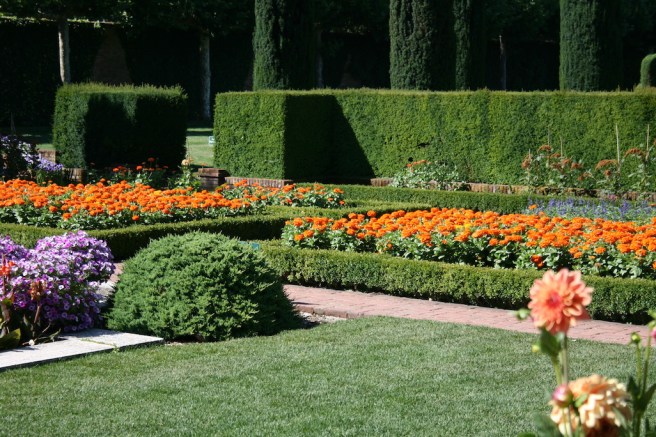
On my June visit the garden staff was busy clearing out the last of the spring annuals, amending the beds and putting in the summer color. Bright orange Zinnias take center stage in the boxwood edged beds, complemented by blue Salvia farinacea. Some of the last planted pots of blue pansies remain and new pots packed with petunias in purple tones have been added.

July Filoli 6

July Filoli 3

Bed areas adjacent to the steps down to the garden are accented by small stands of apricot dahlias.  In spite of the fiery color scheme, the summer garden seems quite restrained in comparison to the spring planted beds just past.

July Filoli 7

No buds last month…in full bloom today!

I will admit to being a little disappointed in the new planting in the Walled Garden, which lies between the Sunken Garden and the Rose Garden. Although I recognize that Filoli attempts to keep the all the gardens planted in the style of the 30s and 40s when much of the landscape was enriched by the estate’s second owners, Mr. and Mrs. William P. Roth, the rows of small pink begonias fell flat for me and the pale lavender petunias just disappeared into the strong sun.

July Filoli 10

In the Rose Garden, much was still in full bloom. A good bit of deadheading was called for on some of the earlier bloomers and that worked out well for one of today’s class topics–Pruning Principles II.

In March we concentrated on the basics of pruning–why pruning is needed, what tools are available and how to make a good cut. We also learned the 4 basic pruning methods: pinching, thinning, heading back and shearing. Most of our practical application in the garden involved spring flowering shrubs that flower on old wood such as the flowering quince which is pruned immediately after blooming to permit new wood to develop for the following season’s growth. If I could take a pruning class every month year after year, I would still sign up for another. Pruning is an art and, as such, improves with practice. As a hobby horticulturalist I still do not have a wealth of pruning CONFIDENCE even though I have a pretty good intellectual grasp of the how-tos!

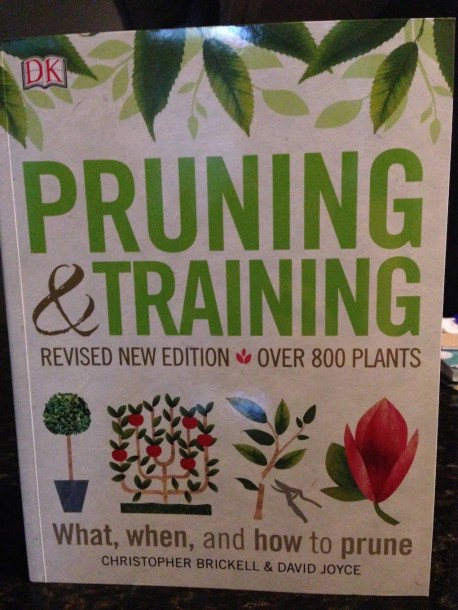
Yet again, instructor Mimi Clarke stressed the importance of understanding the plant’s natural habit, when it blooms and whether flowers are produced on new growth or last year’s growth. Know what you are pruning and how it grows before you even get your clippers out of their sheath. Her reference recommendation from March lingered in my head–the American Horticultural Society: Pruning and Training by Christopher Brickell and David Joyce. I found the newest edition (2017) online. I am not sure why the book no longer bears the AHS logo but I am reasonably sure it has nothing to do with the actual content and wanted the most recent edition.

July Filoli 22

There are very specific instructions, including timing and technique for hundreds of plants. Many plants that don’t have their own listing are included at the end of each section with a notation to “prune as_____________” with reference to a plant whose pruning scheme is similar. I bought the paperback so I could feel ok about dragging it around the garden and filling it with notes!

On our garden walk in search of plants needing a snip or nip we stopped at the Rose Garden where Mimi showed us examples of correctly deadheading roses to encourage new blooms. The three Ds (dead, diseased, damaged) come into play here. Mid summer is a good time to thin out some of the interior growth, especially when the inevitable black spot, rust or powdery mildew are present, to increase air flow and generally shape thing up. For many years I have done a pretty hard cut back midsummer on both roses and perennials and find that little bit of downtime now pays me back two fold in a more healthy and longer flowering period into the fall. Even an old gardener needs a little validation now and then.

July Filoli 18

Check out the height of these roses in relation to Mimi. In our discussion we agreed that it may be time for these quite old roses to be pruned back really hard in January to decrease their overall size and reinvigorate them.

We wandered toward the Perennial Border and found the staff gardeners nipping into the Veronica ‘Pink Damask’ and salvias that had been spectacular less than a month ago.

July Filoli 11

Most of the fabulous garden photos we see in the magazines and books are of plants at their absolute peak. The truth is that most perennials, even those with relatively long bloom periods, are only at that peak for 2 or 3 weeks in a season. Secondary bloom flushes can be stimulated with a dedication to deadheading. Even if you have ignored the spent flowers many perennials will signal their needs to be tidied up a bit by developing new growth at the crown. Below you see the Teucrium chamaedrys used as a border in the knot garden.

July Filoli 17


IMG_2559

In the lower photo the Teucrium (commonly called wall germander) is the bright green in the lower left corner. In June, it was not yet in bloom. The bloom detail above shows that it will only be another week or two before all the germander will need to be sheared back. Another bloom is not guaranteed but the least you have done is to neaten it up for the fall.

We finished our morning with a pass through the orchard. The variety of fruit trees call for a variety of pruning schemes–the key, of course, is to know your tree and how it produces fruiting wood. There’s a nice crop forming on the row of espaliered apple trees.

July Filoli 19

Thank you, Mimi, for the wonderful written resource material included in our notebooks! I can use all the visual aids I can get to work through my pruning challenges.

Pest Management was our afternoon topic. Within the 2 hour window to cover this never ending subject Mimi stated the obvious: no way we can even mention every insect or disease, much less how to handle it. She took a practical approach: you will have pests, whether insects, rodents or disease AND your goal will be to MANAGE them as best you can.

Mimi’s philosophy on problem solving starts with trying to prevent those problems from ever showing up in your garden. Prevention starts with a healthy garden. To that end: LEARN to ask the right questions when buying plants; DIVERSIFY your plant selection; PREPARE your soil and REGULATE your irrigation practices.

Determine what population level (disease or critter) is acceptable to you. Eradication may not be a practical goal. Then look at CONTROL on four levels, using chemical controls as your last resource.

CULTURAL CONTROLS might include selection of resistant varieties, companion plantings, sanitary practices, pruning and proper use of fertilizers and water.

MECHANICAL CONTROLS can include mechanical devices such as paper collars around plant stems or sticky barriers on trees, hand picking of pests, water blasts and traps appropriate to the critter.

July Filoli 20

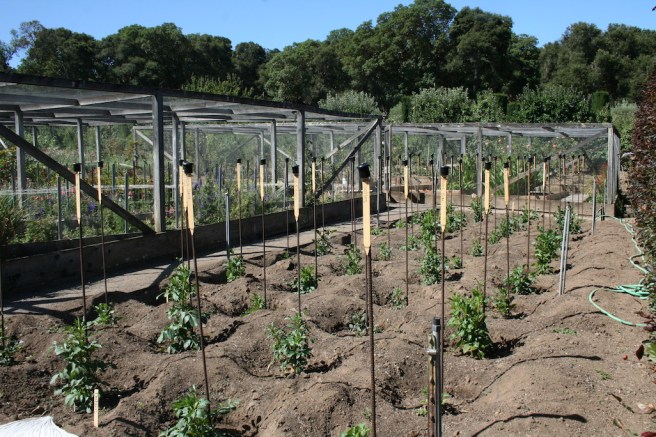
Filoli’s staff garden grows their berries totally encased in wire structures to discourage raccoons and deer. Below you see row cages that can be placed over seedlings for protection.

July Filoli 21

July Filoli 13

Even parts of the extensive cutting garden used for arrangements for the house and Visitor Center are permanently covered in wire mesh. The staff gardeners creatively fashion new cages, collars and trap routines to keep all the wildlife under as much control as is practical.

BIOLOGICAL CONTROLS are defined as any activity of one species that reduces the adverse effect of another and might include the introduction of parasites, pathogens, predators or competitors.

CHEMICAL CONTROLS are used when non chemical approaches have failed.

Mimi lists these steps to use when you detect a pest, weed problem or disease in your garden:

  • Correctly identify the problem
  • Determine if you can tolerate it or if it needs to be corrected
  • If your goal is correction, use mechanical/physical controls above first
  • Still need help, determine if a biological control is available
  • When pesticides are your last resort, read labels carefully and choose the product that has been identified as the most effective
  • Apply proper amounts in confined areas

I really appreciated this process driven approach to pest management. My tolerance for insect pests and weeds has grown as I have aged. I no longer even have an expectation of a weed free or non-beneficial insect free garden–although I would still pay BIG MONEY for a snail free garden. I am not alone in jumping past the first 3 types of control and landing on my feet with a chemical control in my hands! My goal will be to make pest management a more thoughtful process in the future.

Our class year is winding down. In August we will spend our entire class time in the greenhouses exploring plant propagation. September will bring a overview of fall cleanup and the presentation of our individual projects.

July Filoli 12

The dahlia tubers have been planted. I hope we will get to see this in full bloom before our Year in the Garden comes to a close.


Bays and coves…

Was the way a fellow garden blogger described the the undulating borders and beds as we took in the big picture of the The Plains, Virginia front garden of Linda Hostetler. Her neat, cream colored stucco home sits smack on the main street of this little village with a population of about 200. Linda is a graphic artist turned landscape designer and she has used her narrow and very long one acre lot to compose a cottage style garden packed with trees, shrubs, conifers, perennials, annuals, bulbs and ground covers organized into hundreds of vignettes curated to delight the eye and senses.

Hostetler 1

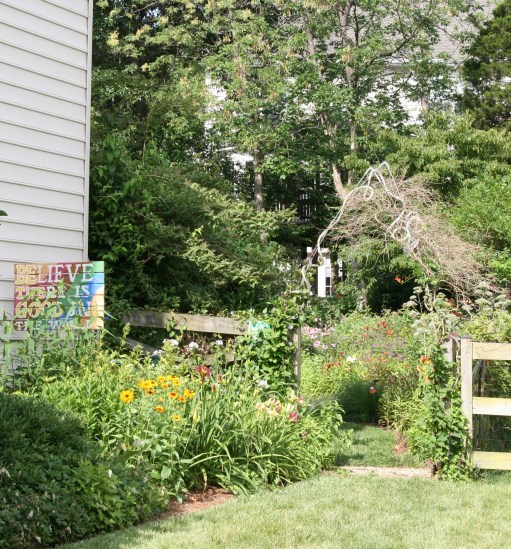
A little screening  from the busy street offers an alluring view of what’s to come!
Hostetler 9

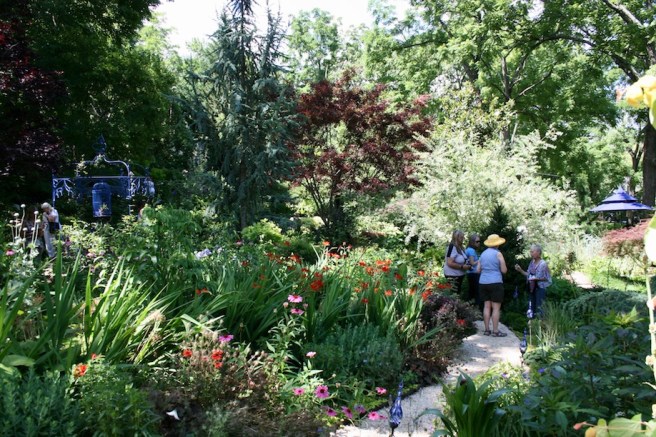
Linda repeats variations of the primary colors red, blue and yellow throughout her garden to create visual rhythm–keeping your eyes and your feet moving through her numerous plant collections.

Hostetler 10

Hostetler 3

Hostetler 5

Japanese maples, both green and red, are a staple in the Hostetler garden and are used as focal points and architectural elements. By the way–we are still in the front garden which is probably 1/5th of the total garden space.

Thriving colonies of what I think are ladybells (Adenophora) and Agastache are loving the sunnier areas of the front garden.

There are plenty of shade dwellers also–notice the red, blue and yellow foliage working in harmony.

Hostetler 6

Linda has used structure, in the form of pathways, conifers and other evergreens, low walls and hedges to define garden spaces and views. Her use of more than one path choice to move you through the garden offers the chance to see plantings from multiple angles and in different light conditions. As we start to wander toward the back garden via the side yard the first choice must be made–up or down.

I chose the pathway furthest from the house. Densely planted on both sides the path is not even visible from the lower one.

Hostetler 11

The lower path at its ‘trailhead’.

The upper path appears to lead us to…?

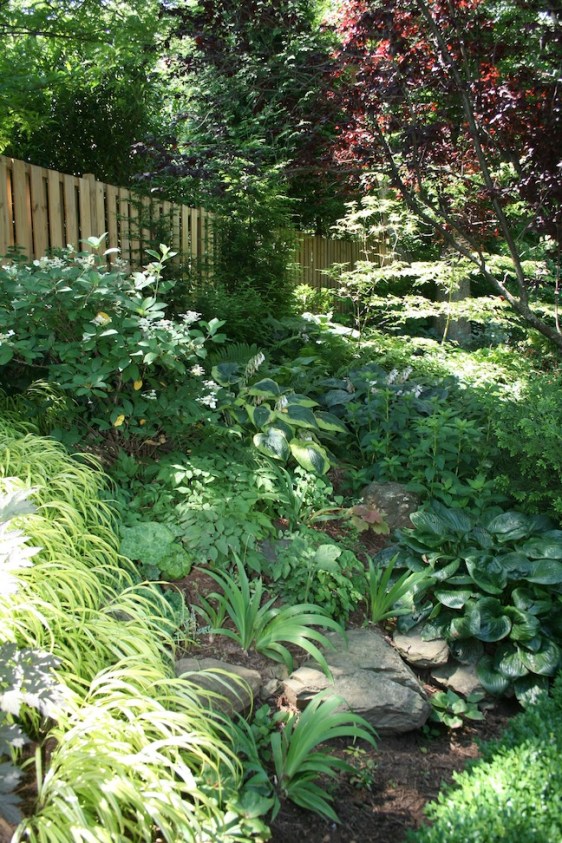
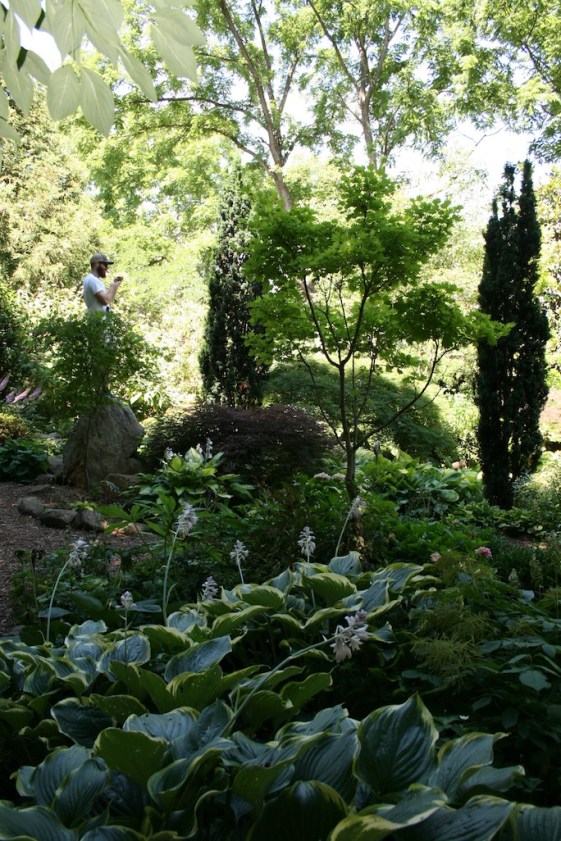
My route was a woodland walk with civilization mostly obscured. Hydrangeas, ferns, hostas, Solomon’s seal and other dappled light lovers guided my way.

Hostetler 16

The path opens up and a few stepping stones down bring me to the charming back patio.

Hostetler 17

You can see a fellow visitor arriving by the lower route, stopping to photograph a rustic birdhouse. Linda has used a variety of garden art and artifacts throughout–and while they all look very random at first glance–each is as carefully placed as the plant grouping it highlights. Notice the curve of boxwood acting as a low wall to define this part of the garden from the pathway.

Hostetler 19

A serene rock pond is the focal point for this patio area. The path on which I entered is actually above and behind (see the hanging basket on the tall tree trunk?) and circles around and down to the right of the waterway, allowing me to see it from above before I have even arrived at the patio level.

Hostetler 18

Another example of Linda’s use of small boxwoods to define a curve. These greens and whites really sparkled in the dappled light.

Hostetler 20
The barn–what a wonderful structure around which to build garden elements!

Hostetler 21

This stacked stone bed provides an ending point for the patio area and the starting point for the rest of the garden which I’ll call the lower back garden. Buckle up! We are going on a wild ride!

Hostetler 23

One of dozens of gorgeous conifers, large and small, which provide year round interest and structure in the Hostetler garden. This specimen sits proudly at the gateway to the lower garden and just begs you to come on down.

Hostetler 26

Hostetler 25

This first level is the sunniest area in the garden and surely the gathering spot for family and friends. Multiple pathways, gravel, stone and mulched lead off from this open spot to all reaches of the garden. Linda’s pathways take you places you did not even know you wanted to go to! Ramble around with me…
Hostetler 29

Cobalt blue is the color of choice for garden ornamentation–market umbrellas, metalwork and glass objects sport this happy hue.

Hostetler 31

The garden is on so many levels that wonderful views can be found at every turn of the path. I wish I had thought to count the blue market umbrellas throughout the garden–I am guessing there are at least a dozen, each with a comfy spot to sit beneath it.

Hostetler 32

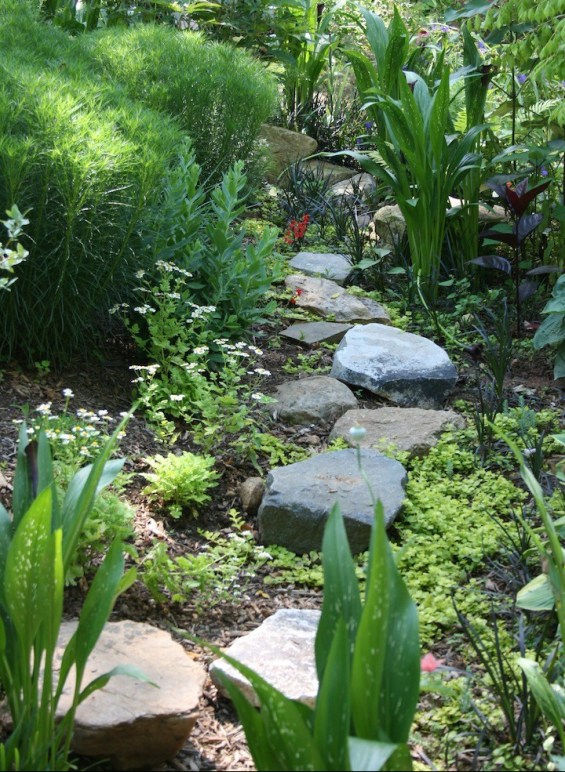
Even from the highest paths there are lovely views up toward the fence line. This semi-shaded area sports all manner of greens nestled among large rocks.

Hostetler 33

The ‘high road’ takes us from shade to sun and back again. I love the way the elevation and sighting of the paths make them invisible–offering access to all part the garden for maintenance but no distraction from the layers of foliage and colorful blooms.

Hostetler 34

Standing on this rock to get the long view doesn’t quite make it–maybe a small helicopter?
Hostetler 36

Hostetler 40

Linda and her husband dug this 16 X 24 foot pond and its 90′ stream to provide food and shelter for the garden’s resident amphibians. A small seating area is suspended over the water’s edge, offering a shady spot to watch the wildlife.

hostetler-45.jpg

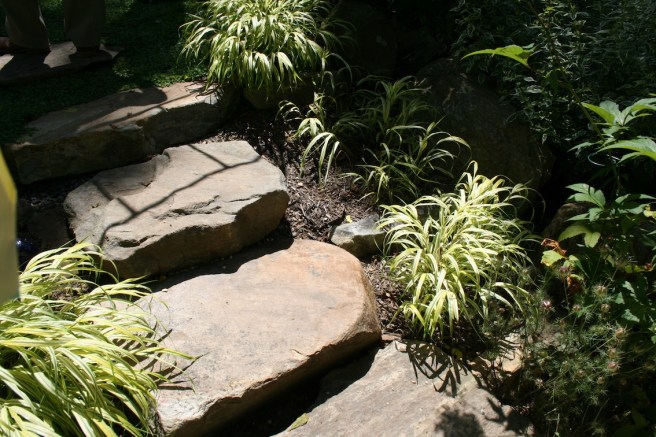
I loved the uses of stone throughout the garden as pathways, accents, interest and structure. Look at these great chunky steps taking us back up from the pond area to the more central part of the garden.

Hostetler 46

Hostetler 42

Linda and her husband have created a garden that is the end of the rainbow for a plant junkie like me. Sadly for us, she was unable to be onsite during our visit. I would have liked to ask her about her design process–all of those paths and elevation shifts carefully planned out on paper or developed in stages as the spirit moved her? Master plant plan or “I love this and I’ll find a place for it.”? The garden is so relaxed and welcoming one could easily be fooled into thinking it just developed itself–if only that could happen I would have a garden just like this one!