The gardens of the Theodore Payne Foundation 2017 Native Plant Garden Tour have opened my eyes to new groups of plants to explore. My challenge will be to do the research on their adaptability to a colder winter and how to integrate the ones I like best into all ready established garden areas. I’ve pick just a few more to share in this post and one more and then we can move on to other topics and tours!
A GARDEN IN TOTAL HARMONY WITH ITS HOME–the Kramer garden in Atwater Village
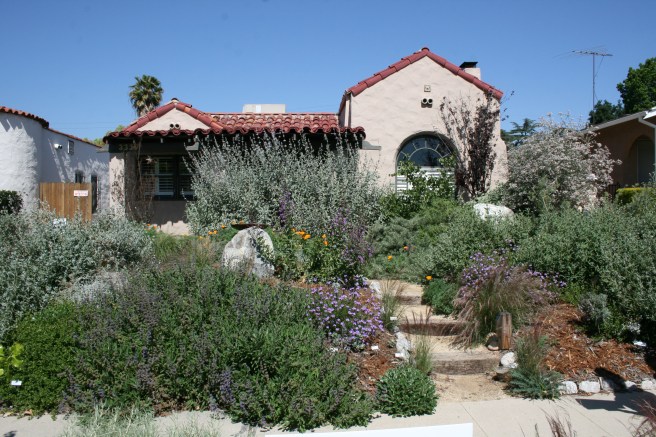
California native gardens are designed to complement many home styles from starkly modern to Craftsman post and beam but no architectural style seems to be as well suited as the quintessential Spanish bungalow.
This homeowner redesigned her back garden using many natives in 2010. The front garden was installed in 2013 and mixes meadow and coastal sage scrub elements with some carefully designed topographical changes, adding lots of interest to a small and originally flat lot. The large mounding plant front and left is a nice stand of Salvia clevelandii ‘Allen Chickering’.
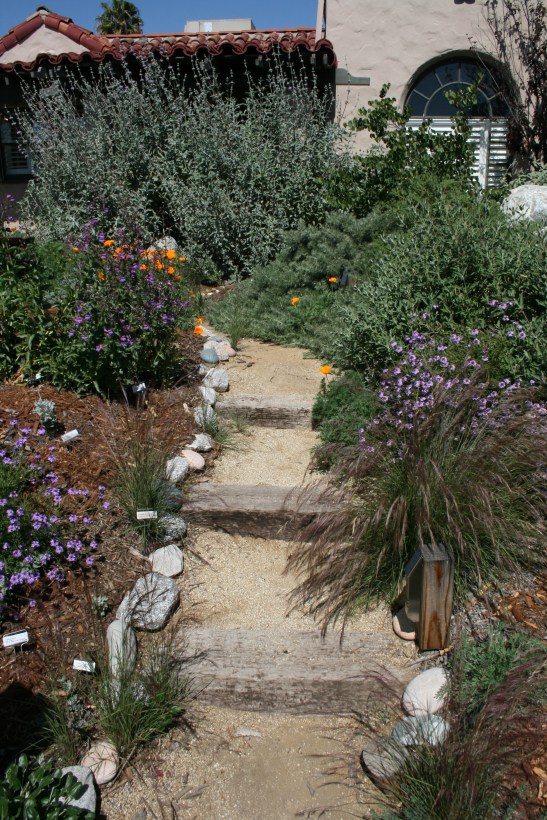
This railroad tie and compacted earth walkway leads you up and through the garden in a meandering fashion allowing you to see a wide variety of color, texture and form on the relatively short walk to the front porch. The grasses left and right are Aristidapurpurea, common name purple three-awn. The lavender pops on either side are Verbenalilacina ‘De La Mina’. The darker purple mound to the right of the path is Penstemonspectabilis var.spectabilis or royal penstemon.
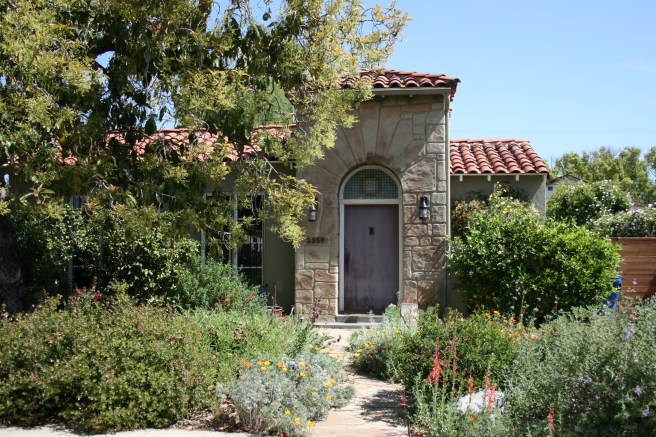
As the narrow path takes you to the porch steps by way of the small driveway you pass the phenomenal salvia which is almost as tall as the home’s roofline (look at the previous photo for a better perspective). The plant is marked Salvia ‘Vicki Romo’ but the Theodore Payne docent on site believed it was mismarked and actually was Salvia ‘Desperado’. My references list ‘Vicki Romo’ at a compact 3 ft. and this whopper is at least 10 feet tall. Another interesting specimen is the Artemisia californica ‘Canyon Gray’ seen in the front left and again just behind the clump of orange poppies on the right. The grayish foliage provided a pleasing midpoint between the greens and the grayish white foliage of many of the garden’s selections. This artemisia is finely textured and very soft to the touch. I saw this in others gardens later in the day in large mounds 4-6 ft. wide. As with all artemisias, good drainage in a must. Repeated in this garden were many of what I now know are staples in the Southern California native garden: dwarf coyote bush ‘Pigeon Point’, red-flowered buckwheat (foreground above) and saffron or Conejo buckwheat.
The Kramer home has a deceptively large back garden–probably 3 times the depth of the front. The narrow, deep lot lends itself perfectly to a series of garden rooms. This is clearly the homeowner’s garden playground with a less restrained palette and lots of variety, including some of the finds you just pick up and dig in because you thought they looked interesting!
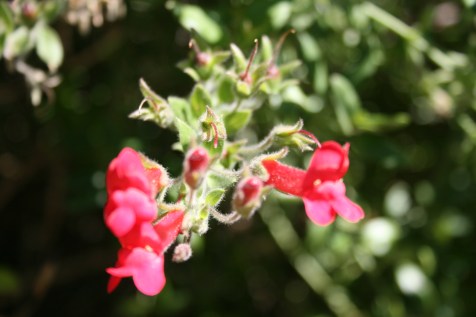
Galvezia speciosa–showy island snapdragon
MATURE TREES AND WOODLAND SHADE–the Miller-Coon garden in Atwater Village
Just a short ride passing through the “village” part of this community led me to another wide flat street of small, neat homes. Parking was at a premium and I ended up about 2 blocks from the next tour garden. The short walk yielded several great yards so just imagine you are walking down the street with me and take a look!
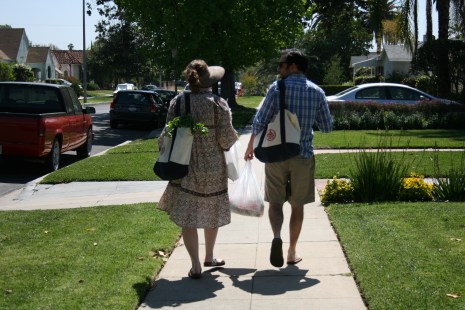
A side note–as I got out of my car I fell in step behind this couple walking home from their grocery trip to the little village area about 3 blocks away. They had their bags and their Starbucks cups in hand and were strolling home on a great day to be outside. The couple turned into their driveway just across the street from the garden which was my goal and I was momentarily jealous of the walkable, small city within a big city lifestyle they were obviously enjoying!
The Miller-Coon garden has been on tour every year since 2003. It is somewhat more relaxed and relies heavily on a mix of mature trees and shrubs and lots of reseeding annual wild flowers.
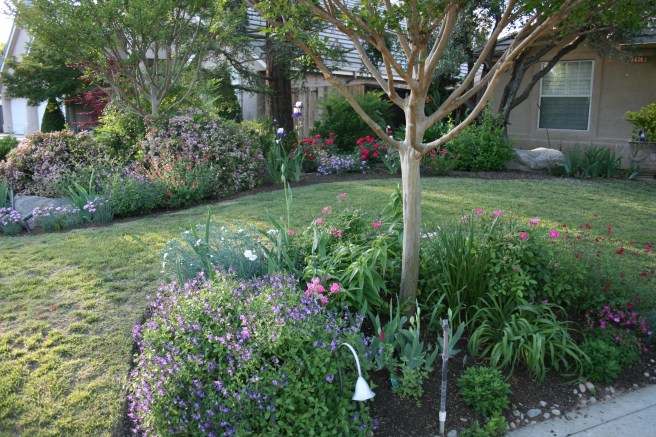
It is a diminutive front garden dominated by a large Torrey pine and 6 different native oak species. In this photo you see the pine in the background, our native redbud, Cercisoccidentalis, and one of several species of manzanita on the property. The violet blooms in the foreground are elegant clarkia (Clarkia unguiculata) which returns each year from seed.
My take away from the Atwater Village gardens–you can pack a lot of gifts in very small packages! Although both of these streets are definitely in the “flatlands”, you don’t always have to play the hand you are dealt. Both homeowners added dimension, interest and additional planting space to their gardens by altering their topography with very gentle mounds and curves.
NEXT UP–I travel to a unique neighborhood in Silver Lake where the historical standard is to have two homes on a single lot.
Although I still have several more gardens to share with you from my recent visit to Southern California on the Theodore Payne Foundation Native Plant Garden Tour and given that I have two more big garden tours coming up in the next two or three weeks, I thought I hit pause on other folks’ gardens and let you see that I DO actually garden.
We have had an abnormally wet spring and everything in the front garden has benefited from the extra water. At mid-April, to not have turned on the irrigation systems by now is phenomenal. Last year I added pops of rosy red in the form of the Double Knock-Out roses and a few of the perennial salvias–you can see the Salvia ‘Killer Cranberry’ in the mid righthand side of the photo. I think they really wake up the predominantly purple, lavender, pink scheme and will provide strength when the paler colors wash out in the heat of the summer. The earliest of the iris are blooming with others ready to come on. The perennial dianthus I have been adding over the last few years are nice big blue green clumps this year with the first few pink or white flowers open.
This foundation bed by one of the front sidewalks is looking especially good! The pair of tree roses (‘Renae’) has exploded into bloom. Geranium ‘Tiny Monster’ and Salviafruticosa add a little violet and blue relief from all the pink. I featured this salvia in a post last spring when I added it to the bed. I love the blue gray foliage against all the other clearer greens. It has tripled in size from last year and is covered in blooms. The ‘Pink Dancer’ Indian hawthorn (lower left) has finally come into its own after several years of very few flowers. I told you that 2017 was going to be the best garden year ever!
Here we go again! My schedule for the second day of the Theodore Payne Foundation 2017 Native Plant Garden Tour is ambitious so I do my eating and driving on my own time and arrive and my first garden of the day just at the 10 am opening bell.
A CHALLENGING HILLSIDE–the Rice-Siwolop garden in Beachwood Canyon
This recently renovated Mid-Century Modern home had perhaps the smallest front yard I have ever seen!
This massive 7 ft. retaining wall rose from the narrow public sidewalk to enable these gardeners to have a small strip of level ground which you see in the photo below. This very narrow bed, anchored by the broken concrete walkway, was planted in California fuchsia (Epilobium ‘Silver Select’) and Silver Carpet aster (Corethrogyne filaginifolia ‘Silver Carpet’). And yes…those are the tops of the car parked on the street that you can see in that photo! The similarly narrow bed to the left of the steep steps held other silver green and gray native plantings and the superb non-native specimens of Euphorbiabourgeana and Agave parryi in the center photo.
So I am thinking–having spent more time locking up the car than I did in this garden that I will be way ahead on my schedule! The next garden is about 100 yds. uphill on the same street and as I pass by the street level garage I see the back yard is open also. An extremely narrow sidewalk flanked by the house on one side and another very high retaining wall on the uphill side leads to a funky two level wood staircase which takes me up into the back garden.
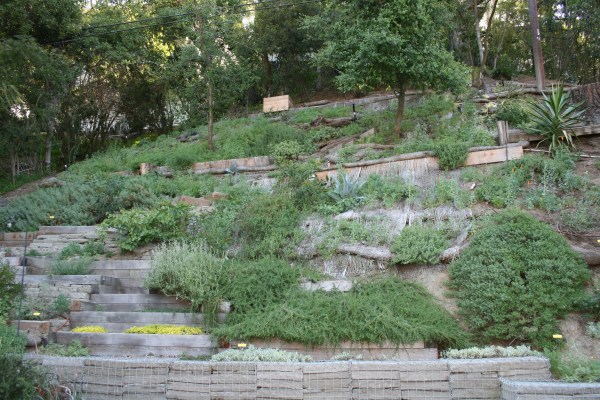
Holy slope! The back yard melds a wild and untamed slope with the man made elements required to make it accessible. The hillside is stabilized by a gabion wall, hemp and wattle erosion netting and large drifts of native plants.
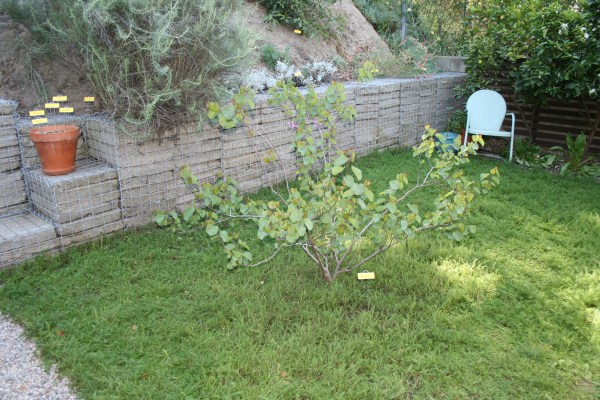
The gabion, which you can see at the bottom of the photo, has its own story. Neither side of this lot has enough room for any mechanical digging apparatus access to this back slope. The terraces on the hillside were hand dug and the dirt hand carried down to the very narrow flatland. It was then screened and mixed with cement for stability and formed into the square blocks which fill the wire cages to form the gabion running the width of the yard. So…the slope is actually retaining itself!
Thoughtful placement of the timbers forms a set of steps which allow access to the upper levels for planting and maintenance. Natives anchoring the hillside included my new favorite Erigonum fasciculatum (California buckwheat), Pigeon Point dwarf coyote bush, Hearst’s ceanothus, Salvia leucophylla (purple sage), several types of manzanita and in summer, a wide variety of reseeding annual wild flowers.
A small lawn of common yarrow (Achillea millefolium) is home to native redbud, Cercisoccidentalis, and offers a soft contrast to the more industrial feel of the hardscape. This property was truly an example of taking what you have and adapting your garden style to fit the site. Bravo!
As I walked up the hill to my second garden I passed several really well done landscapes, all using their steeply sloped lots to best advantage. Take a look…
ALMOST TO THE HOLLYWOOD SIGN–the Kohler-Koch garden
Another Mid-Century Modern, another orange door! A standout feature of this front garden was the immense stand of lavender which occupied almost half of the slope. The combination of the lavender and the succulents seemed a bit of a disconnect for me up close but when you stood back and took in the home’s landscape in the context of the hillside it sort of worked itself out.
The back garden was planted in 2013 and offers a laid back style with naturalized scenery year round-interest. The homeowner reports lots of wildlife from the surrounding hills.
There is definitely a sunny side and a shady side to this back garden. This beautiful Palo Verde (Cercidium) tree anchors the sunny corner. You can get just a peek at the river rock wash descending the hill. The bed area behind the retaining wall incorporates additional drainage mechanics to direct water rushing off the slope in a rainstorm.
The Salvia sonomensis was a bee magnet and I think its season is just getting started. More creeping and mat forming than upright this species spreads to about 4 ft. wide and needs exceptional drainage, preferring gritty soil.
A mature pine provides a shaded spot just outside the home’s kitchen. Just as in the previous garden, the flat area is quite narrow but used really well, offering places to eat outside, rest and read a book or just observe the nature surrounding you.
My takeaway from the Beachwood Canyon gardens–steep slopes front and back presented challenges for these gardeners. A combination of good planning, thoughtful use of a variety of hardscape options and erosion control deep rooting plantings can tame the wild while preserving the expansive views offered by slopes on small lots.
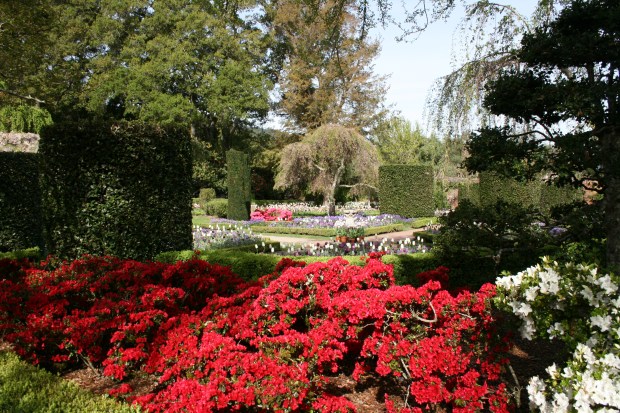
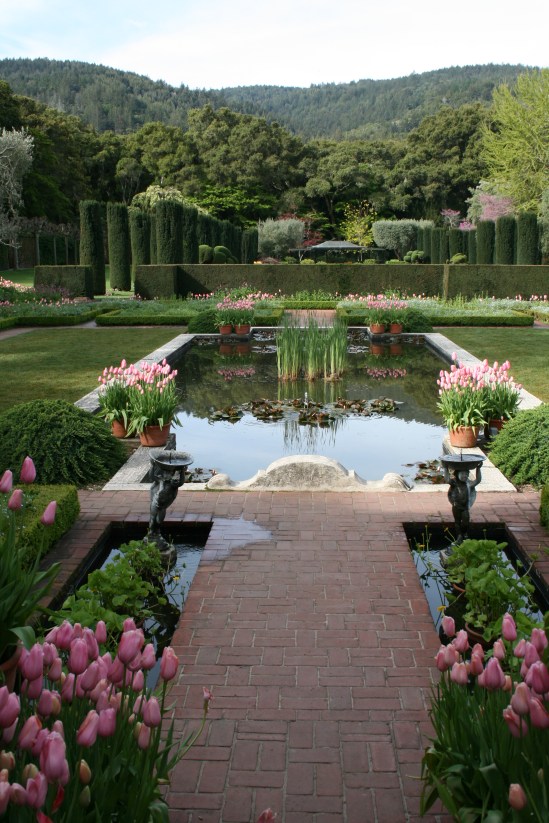
What a difference a month makes! The potted daffodils have been retired, the tulips are waning and the gardens at Filoli have burst into bloom. Especially light traffic allowed me to arrive with almost an hour to walk the gardens before I needed to be in my potting shed classroom. As Filoli was not yet open for day visitors, I was fortunate to have the opportunity to revisit a few plants which were not quite out in March and take photos in a virtually empty garden.
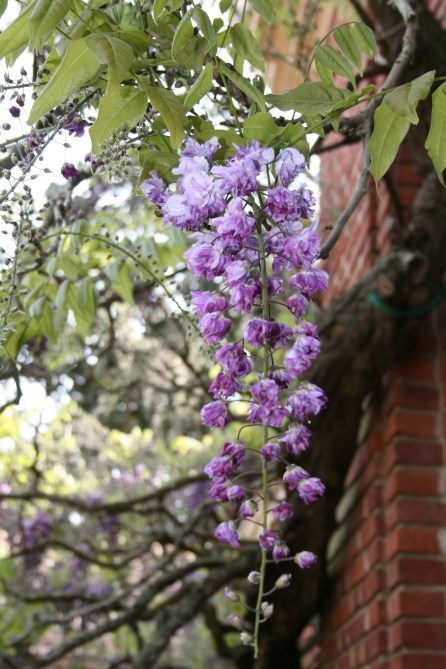
Of course, my first stop was the courtyard now dripping in wisteria. Different varieties were in different stages from just barely in bud to full bloom–both purple and white. The smell was heavenly! This first one drapes the door of the gift shop and is Wisteriafloribunda ‘Violacea plena’.
It is a beautiful double with shadings from light to dark purple. The white silky wisteria, Wisteria brachybotris ‘Shira Kapitan’, was just getting started.
The grouping of Wisteria brachybotris ‘Murisaki Kapitan’, yellow Lady Banks roses and weeping cherry was stunning. The wisteria bloom detail below reveals that the flowers in each amethyst inflorescence has a spot of yellow, tying in perfectly with the rose clusters.
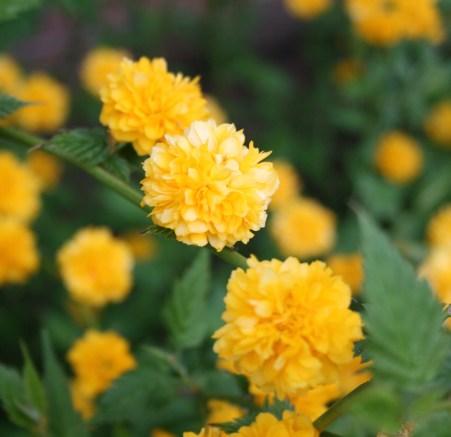
With time running short I cut through the walled garden to make my way to the greenhouse area. Along the way I saw not only another gorgeous wisteria but also a grouping of Kerria japonica ‘Pleniflora’ making a bright statement against the red brick wall of the garden.
Kerria is a deciduous shrub with an open arching form. It can grow quite large with a spread of 8 ft. and a height of 6 ft. Its position as the backdrop for a stand of agapanthus gives it room enough to spread out as the season progresses. As the flowers do not stand up well to strong sunlight, the somewhat shaded area will help the kerria blooms hold their color.
Soil Management was our morning topic. Instructor Mimi Clarke reviewed the four key components of soil composition: mineral soil, organic matter, water and air and we learned the terms needed to understand and discuss soil: soil profile, soil texture, soil structure and soil reaction. The takeaway here was that virtually none of us are blessed with the loamy soil (40% sand, 40% silt and 20% clay) perfect for most plants. While we cannot change our soil’s texture we can change its structure with the addition of organic matter and thus improve conditions gradually over time. No magic bullet, no specific formula and definitely not overnight. We discussed the differences between and the merits of compost and mulch. We finished the morning with a discussion of both organic and synthetic fertilizers. This unit in our notebooks has some great reference material including an overview of the various types of organic fertilizers available and how they are best used and a scaled down home gardener batch recipe for Filoli’s potting soil. Thank you, Mimi!
The focus of our afternoon garden walk was Landscape Perennial and Annual ID. Just as she had for our Tree and Shrub ID walk, Mimi provided a reference sheet for each of the selections on our list. So great to be able to walk, look, listen and take photos knowing you have all the hard facts all ready on paper to refer back to rather than trying to write down the details as you go along. While there was masses of blooming material on our walk, many of the plants we were focused on were not yet blooming–running a little late this year. As on our previous walks, our group is very enthusiastic and tends to slow Mimi up on her walk schedule. But, no matter, we always have next month to revisit anything we missed!
Most of the perennials and annuals on our list were very familiar to me and so I tended not to photograph them, especially if they were still only foliage. Take a look at a few interesting plants that caught my eye as we rambled:
Choysia ternata or Mexican orange is an evergreen shrub with glossy dark green leaves and covered in clusters of small fragrant white flowers in late winter and early spring. Although I had read about this shrub I had never actually seen one. It was beautiful and the scent of orange blossom was heady. Reference material indicates that this shrub is fast growing and can reach 6-8 ft. The several I saw were more in the 3ft. range but looked quite mature so they may have been a more compact cultivars rather than the species. Below you see detail of both buds and blooms.
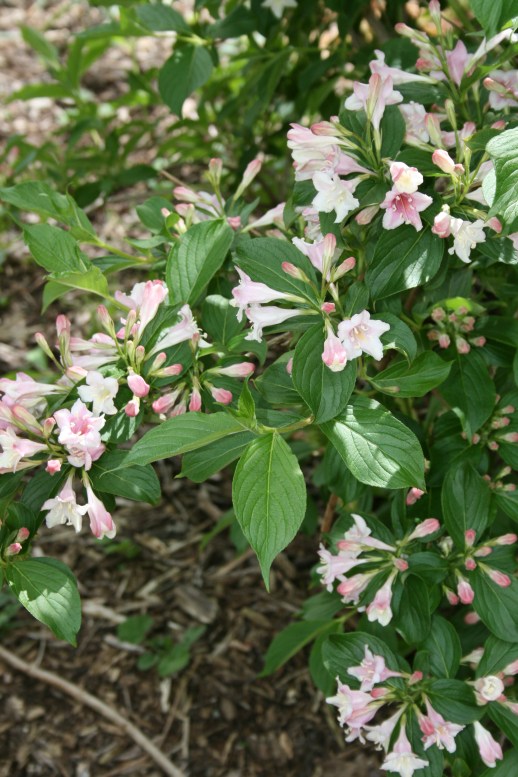
Weigela florida is a large deciduous shrub with long arching branches that almost reach the ground. This shrub was quite common in Georgia but I think many California gardeners in very temperate zones are not as drawn to deciduous shrubbery when there is so much available that gives year round green plus seasonal flowers. Weigela is not especially interesting after it finishes its bloom period and can get pretty rangy. They definitely benefit from yearly pruning of the oldest stems to the ground to increase production of dense new growth and blooms the next year.
There are a number of named cultivars and hybrids with flowers ranging from white to deep pink and foliage varying from bright green to burgundy. The plants I saw were quite young, very open and loose.
Yet another deciduous shrub I don’t often see in Valley gardens is Deutzia gracilis, or slender deutzia. As with the weigela, deutzia are not especially attractive when not in bloom and probably best used in a mixed shrub border where they can blend in with other foliage when they are not flowering. Although somewhat smaller and more fine textured than the weigela, deutzia also has slender arching stems and benefits from cutting back the wood that has all ready flowered severely to outward facing side branches.
These three shrubs are all best in full sun to partial shade in really hot climates and need regular water.
One of the annuals highlighted on our walk was Viola cornuta ‘Jersey Jem’, as seen below.
This little tufted pansy was bred by Filoli staff and it not available commercially. Every year the gardeners collect the seed from the violas as they wane and then use that to raise seedlings to plant the following year. Although these plants will be removed in another month or so as Filoli resets their display beds to summer, with a shaded spot, regular pinching and deadheading they could last well into summer in a home garden. Lucky US–next month as part of our Seed Collecting unit we will get to harvest ‘Jersey Jem’ seed to take home for our own gardens!
We also made a return trip to the Camperdown elm I shared with you in my February post. The bare branches are just starting to leaf out in a few places and the tree was covered with pale green seeds which, from a distance, made the elm look as though it were flowering.
Filoli is a garden of long views. They have been ever-changing over the three months of class so far. It is difficult to narrow my favorites down to a few from this trip. Take a look.
And the short views are just as impressive!
Looking forward to good gardening days ahead for us all and many more great road trip gardens to share with you!
After viewing six lovely gardens in the San Fernando Valley, I climbed up Benedict Canyon Drive on a veritable Mr. Toad’s Wild Ride to drop down on the other side into the LA Basin. I continue to be amazed that after, all the years I lived in Southern California, this was my first trip through the hills NOT driving on a freeway! Only minutes from the glitz of Rodeo Drive a man made (woman made?) urban oasis overlooks Laurel Canyon and offers a place of respite for the owners, Dan and Susan Gottlieb, and the flora and fauna they nurture.
This one acre steeply sloped site has been in the making for over 25 years. When Dan first showed Susan the home, she was distressed that the ivy covered slopes provided no habitat for the birds–and so the labor of creating this environmentally sensitive and sustainable chaparral woodland began. The garden is a National Wildlife Federation-certified Backyard Wildlife Habitat and a Xerces Society-designated Pollinator Habitat.
Dan and Susan are environmental philanthropists and photographers. Susan pursues her passion for conservation not only with this native garden but also by serving on the President’s Advisory Council for the National Wildlife Federation and in her work with both the Theodore Payne Native Plant Foundation and UCLA’s Institute of the Environment and Sustainability, among other organizations. The Gottliebs own G2 Gallery, a wildlife and nature photography gallery in Venice, CA which donates all proceeds of sales to environmental causes.
After seeing the garden on in 2003 on the first Theodore Payne Native Plant Garden Tour, Huell Howser, the late KCET television personality and host of “California Green”, devoted an entire episode to Susan’s conservation work. The garden has its own website http://www.thegottliebnativegarden.com where you can find a host of photographs, plant and wildlife lists and a great Wildlife Journal whose posts give you a look at what the Gottliebs see on a daily basis in their garden.
Now for the bad news–I was not very far into this fascinating ecosystem when my camera let me know my last CF card was full. Having little battery left on my phone, I have only limited photos of this great garden. So I’ll show you what I have and if I’ve left you hungry for more, hop on over to the garden’s website. Or go to http://www.theodorepayne.org and click on the 2017 tour information for photos and plant lists of ALL this year’s gardens.
Most of the homes on this street have minimal front yards. A shady courtyard leads you to the Gottlieb’s front door. A special treat for garden visitors was that this garden was accessed through the home. Dan and Susan have a wide variety of art in many different forms, both inside and outside. As you approach the large glass doors opening to the patio, the views capture you.
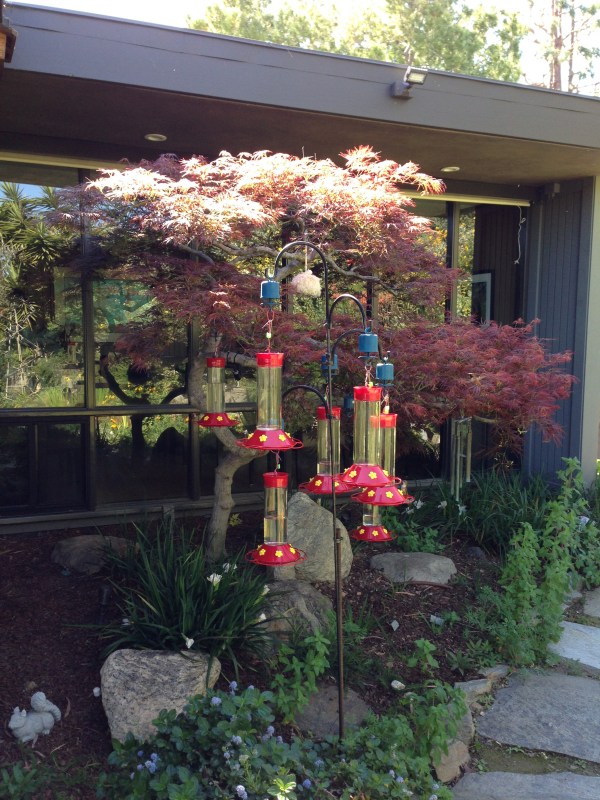
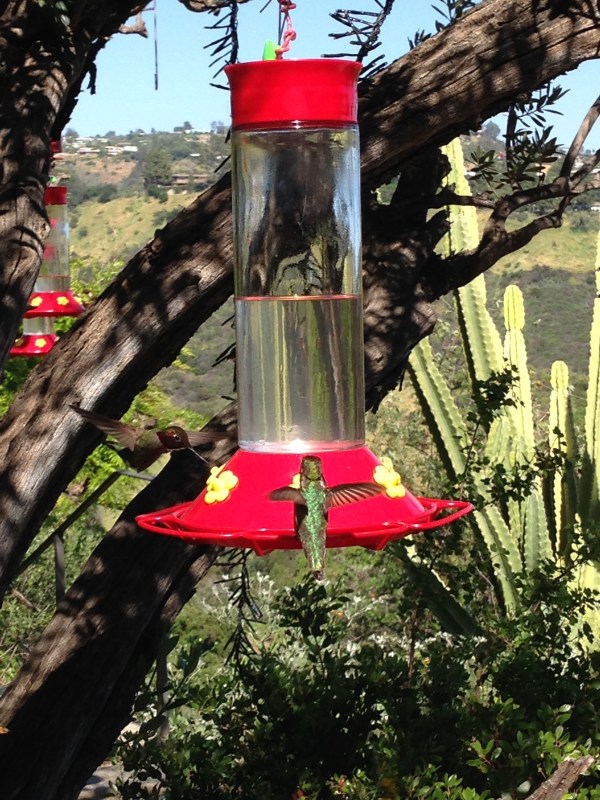
Both Dan and Susan have a special affinity for hummingbirds and, although I did not count them, they must have over 30 feeders just on the patio area. There were literally hundreds of hummers hovering around feeders grouped in clusters and hanging on shepherds hooks.
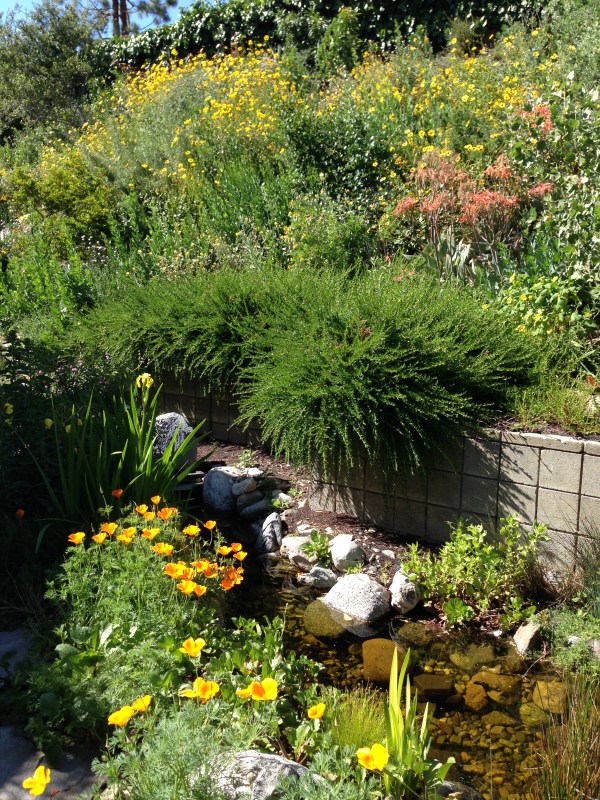
The Gottlieb home is on a very steep street and thus they have a significant slope retained by a block wall on their uphill side. Here you see a small section of the slope where water runs down the slope into a calm little stream bordered by colorful sun loving natives.
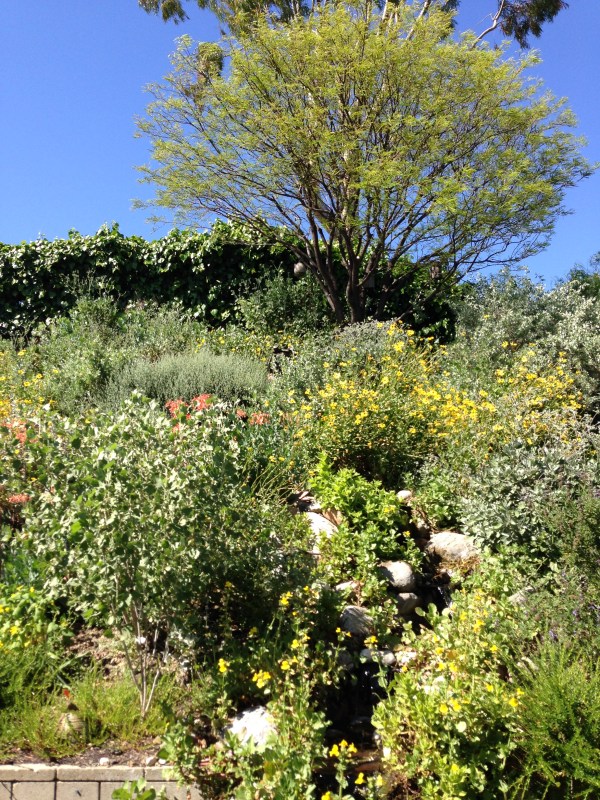
The Erigonum fasciculatum that I have seen in so many of this day’s gardens shines here as a slope cover draping down to camouflage the utilitarian block wall.
All of the planted areas are exuberant and filled with such variety I could not hope to even give you a partial list. What struck me about this long and very steep slope was how restful all that variety was even though the palette tended more to the lighter, more yellow green than to the darker greens.
The Gottliebs have designed an interesting solution to allowing their cats to have time outside without putting them in the position of being either predator or prey. Wire mesh tunnels run from cat doors in the side of the home to a number of points on the slope- sort of like an elevated train track for the kitties.
Succulents play a role in the patio area and especially liked this cheerful collection!
The patio and its compact surrounding beds and beautiful pool are only a small fraction of the garden property. Dan and Susan Gottlieb have made their steep slope down into the canyon accessible with a series of wooden walkways. On tour day groups of people wander up and down the slope stopping to admire the variety of form and texture making notes about plant combinations. Susan drifts among her guests answering questions and pointing out plants of special note. Although I walked the entire slope, my camera had already failed me so I have nothing to share save my impression of what a stunning habitat the Gottliebs have created, with the intent of returning the landscape to what it might have been before we all came in digging and building.
This lovely new book tells the story of the garden and features Susan’s photography. The book is also packed with interesting topics, in prose and pictures, including an introduction to P22, the bachelor mountain lion who lives in the Griffith Park area; LA Bird Day; a short list of reasons to “go native”; native alternatives to invasive species and profiles of many Southern California and national organizations dedicated to environmental causes. All proceeds for the sale of the book go to environmental causes.
My takeaway from the Gottlieb garden–I will attend this tour next year just to have another opportunity to spend time in the beautiful habitat they have created and graciously share with others interested in biodiversity, native plants and water conservation. It will be my FIRST garden of the day, not the LAST, and I will come prepared with extra batteries, CF cards for the camera and fresh legs to explore the slope into the canyon more fully.
NEXT UP–I’ll check in on Filoli in April and next week I’ll share the TPFNPGT Sunday gardens.
So I am back to share a couple more of the predominantly native plant gardens I saw this past weekend on the Theodore Payne Foundation 2017 Native Plant Garden Tour. Having returned home, assembled both my thoughts and photos I won’t quite finish my Saturday garden visits in today’s post. The last garden I saw on Saturday was the Gottlieb garden in the Laurel Canyon area of Beverly Hills. The Gottlieb native plant garden is one of the most renowned native plant gardens in California and has a great back story in addition to being an amazing garden so I will give it its own post. The Sunday gardens (11) will be broken up into at least 3 posts over the next couple of weeks. Wednesday I am back to Filoli for my April class and I know you will want to see what’s going on up there, too!
STILL IN THE SAN FERNANDO VALLEY–The Jacobsen-Bennett garden in Sherman Oaks
The Jacobsen-Bennett home is a neat stucco home sitting on a small corner lot. The front and side gardens, about 3,300 sq. ft, wrap the home and feature both chaparral and woodland plantings.
In the foreground of this large street side bed you can see two of my new favorite plants. At the very front and dead center in the photo is Erigonum grande var. rubescens, or red flowered buckwheat. This very well behaved native makes an 18″ mound about a foot high. In summer the sturdy upright branch tips will be topped with clusters of rosy red flowers. The green spreading mounds behind the red buckwheat is Erigonumfasciculatum ‘Bruce Dickinson’ which also covered the slope in the Klemm garden in my previous post. I saw this California buckwheat and its cousins ‘Theodore Payne’ and ‘Dana Point’ in MANY gardens on this tour and I never saw them woody or overgrown. Reference materials puts their spread at about 4 ft. and their height varying from 12″-36″. ‘Theodore Payne’ is amongst the lowest growing of what I saw–very ground hugging. California buckwheat is a water miser, great for slopes and erosion control and will have whitish pink flowers from late spring to early fall. Did I mention this is the year of the buckwheat? I am absolutely researching the California buckwheat for use in my climate. Below you see the foliage detail for both:
A lovely dry creek bed and native Carex pansa meadow harmonize with the surrounding hillsides.
For me the highlight of this garden was the flow to the side yard–an area that is often neglected on corner lots (including my own!) The creek bed meandered right down the side with naturalized plantings on either side. You can see the use of the red flowered buckwheat again and the great play of color, form and texture.
Above right corner and below, the Abutilon palmeri, or Indian mallow, was spectacular in this garden!
I have become interested in the many species of manzanita. The one above is Arctostaphylos manzanita ‘Dr. Hurd’ and there were many others to be seen on this tour. ‘Dr. Hurd’ will grow to about a 15′ tree form sporting mahogany bark and light green leaves. The white winter flowers are an added bonus!
The palette of plant material in this garden was not as extensive as I would see in many other gardens but thoughtful planning and placement often outweighs sheer numbers. I especially loved the contrast of textures and the all the different grays, greens and gray greens represented.
The home had a tiny backyard with both natives and non-natives. I was drawn to a large trellis with a very delicate vine on it, sporting this single tiny flower. The tag read Maurandellaantirrhiniflora. Another one for me to research–who could resist a vine whose common name is roving sailor?
WINDING DOWN–the Gerety garden in Sherman Oaks
In contrast to all the previous gardens, this was the first one whose owner told me unabashedly that he had nothing to do with the planning of the garden and even less to do with maintaining it. He did, however, thoughtfully provide his garden caretaker to answer our questions and help with plant identification. We are not all gardeners but everyone can appreciate a beautiful landscape to come home to at night and make that happen using the expertise of others for whom it is a passion.
The feel of the Gerety home is midcentury modern, sleek and simple with clean lines and repeated elements and the garden exuded the same vibe. Also a small home on a small lot, the front garden is only about 2,000 sq. ft. but packs a big visual wallop.
This landscape makes use of a limited number of species used repetitively in masses, allowing your eye to move across the garden and giving the space a calm restful feel. It is beautifully maintained.
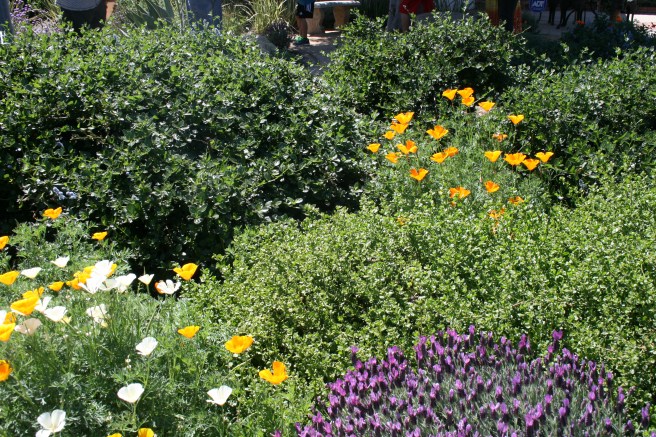
I’ve left this shot full-sized to make it easier to pick apart the elements. The large dark green mass beginning in the upper left is Ceanothusgriseus horizontalis ‘Yankee Point’, unfortunately not in bloom as some of the other varieties of ceanothus I saw on tour; moving clockwise you see a little knot of California poppies (Eschscholzia california); moving down from the poppies the mid-green mound is Baccharis pilularis ‘Pidgeon Point’, commonly called Pidgeon Point dwarf coyote bush; the lavender in the lower right is one of the non-native Spanish varieties and one of the deepest purple lavenders I have ever seen; rounding out the vignette is a mixture of orange, gold and white California poppies.
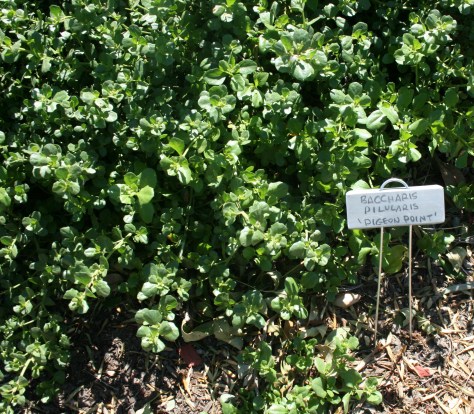
I saw ‘Pidgeon Point’ coyote bush in many gardens and have added it to my list to try to incorporate into my garden. It is evergreen, has remarkable climate and soil adaptability and, once established, requires only monthly watering at most. It looks to be a great low maintenance bank cover for sun. You can expect a 30″ high mound which will spread to 6 ft. or more. There is also a lower form called ‘Twin Peaks’ with smaller, darker leaves.
There are dozens of species of ceanothus, varying greatly in size, form and growth. Referred to in our state as the California lilac, they are prized for their blue flowers and glossy, dark green leaves. Most are evergreen and many are very frugal water users and particular about drainage. ‘Yankee Point’ ceanothus is one of the taller ground cover types and one that has a more refined look. Even though not in bloom yet in the Gerety garden, I can envision the show the broad masses will put on this summer.
This lovely front garden also boasts a mature cottonwood tree, a gorgeous stand of Echium, both pre-dating the 2014 garden installation. Additional plants seen in the above photo include Lymus condensatus ‘Canyon Prince’, a native grass commonly called Canyon Prince giant wild rye, Fremontodendron ‘Ken Taylor’ (flannel bush) whose golden flowers are just visible and Verbena lilacina ‘De La Mina’ whose lilac flowers echo the purple tones of the lavender. Not seen in the photos are several of the almost white leafed Conejo buckwheat I featured in the details of the Stonehurst arroyo stone cottage and new little leafed Palo Verde tree, Cercidium microphyllum, whichis not much more than a sprig at this point but will eventually provide the garden with a striking focal point.
My take away from these two Sherman Oaks gardens–thoughtful design of paths, rocks and planted areas using a variety of plant forms, leaf color and texture in repetitive masses can make a small garden with a big impact. Even though both of these garden spaces had the benefit of design professionals and only one is being maintained by the homeowner, they are both do-able efforts by the interested gardener and offer solid examples of good design.
COMING UP AND NOT TO BE MISSED: The Gottlieb Native Plant Garden–a garden with its own book and website!
OK. I have no idea but it did not take me long to make that observation. Also this year’s INS: the aforementioned buckwheat, sedge and other mixed grass meadows, river rocks and lots of places to sit and swing. On the way OUT: rigid formality, real lawn, synthetic lawn, tropicals. Let’s get going on the 2017 Theodore Payne Foundation Native Garden Tour!
THE LEAD OFF GARDEN–The Joyce garden in Granada Hills
Tucked into the curve of a cul-de-sac, this home has a front yard no bigger than a minute. A mature desert willow, Chilopsis linearis, anchors the entrance. Although not in bloom, the willow like leaves waved us in with an airy welcome.
Gardens on this tour must have at least 50% California natives. The Joyce front garden was well done with a mix of natives and a few nice roses. A narrow walkway led garden goers into a back garden that just could not be imagined. In contrast to the tiny front, the back is almost one quarter acre. Looking across a soft-textured slender sedge meadow (Carex pansa) which is surrounded by a variety of native habitat plants, your eye lands on the many mature evergreen, coniferous and deciduous trees, including the Tabebuiarosea pictured below, which screens the back of the property from a busy street. This garden is full of winding packed earth paths and includes a bioswale to capture runoff and prevent the patio areas from flooding.
Who would not want to take a rest in this inviting hammock? The homeowner has both dogs and grandchildren and told me that the meadow, which is irrigated using a Netafim drip irrigation system, stands up to both. The garden features many species of ceanothus and salvia, in addition to some other natives which were new to me. Here are a few of my favorites:
Calliandra eriophylla (fairy duster)Encelia farinosa (brittle bush or desert sunflower)Ceanothus ‘Concha’–more tolerant of heavy soils and moisture than most
The Joyce garden was well planned and well tended without the constraints of formality. Every area was child and pet friendly and I can really see a family using every part of the landscape everyday.
MOVING ON–The Wood garden in Sun Valley
This next garden took me to a unique part of the northeast San Fernando Valley called the Stonehurst Historic District (one of LA’s Historic Preservation Overlay Zones HPOZ). The Stonehurst neighborhood is comprised of 92 homes and boasts the highest concentration of homes in Los Angeles utilizing native river rock as a primary building material. Many of the homes were built between 1923 and 1925 by Dan Montelongo, a local artisan and mason, using stone selected from the nearby washes and foothills of the Tujunga Valley. This “Stonemason Vernacular” style is a derivative of Craftsman architecture and many of the homes are bungalows on large lots, often horse-keeping or animal-keeping properties.
The naturalistic Wood front garden complements the 1923 arroyo stone bungalow. The garden was redone in 2015 using selected native species to attract pollinators and promote biodiversity.
A large ornamental pomegranate shrub hugs the side of the home and provides shade for the courtyard behind the stone wall.
A meadow of custom grass seeds mixed by Theodore Payne and a small water feature provide calm counterpoints to tall spiky Cleveland sage (foreground, top photo) and other native perennials.
Salvia spathatica, hummingbird sage, provides a pop of pink among all the gray green foliage and the blues of the ceanothus and other sages.
The back of the property was not included in the 2015 native re-do but it is just too charming for you to miss, complete with the home’s original stone garage. The back garden has a 500 gallon cistern to hold rainwater for the drip irrigation system and a very large shade structure whose roof supports almost unseen solar panels.
Here are a few peeks…
The veggie garden with the garage in the background
The raccoon proofed chicken house
A great place for a picnic lunch
Nice uses of trellis work everywhere—doesn’t everything look fabulous against the river rock!
I ended up seeing this plant in a couple of gardens but this was the only one I saw still in bloom. You guessed it–it is a buckwheat! This is Eriogonum crocatum, common name Conejo or saffron buckwheat. This relatively rare perennial is endemic to the Conejo Valley in Ventura County where it grows in dry, rocky places. It will tolerate clay soil and takes full to partial sun. This one was fairly low and the little button heads are about the size of your little fingernail.
Before I move on to our next garden I want to share the photo below of the house across the street from the Wood garden.
This short retaining wall is made from a number of structures called gabions. A gabion is a cage or box filled with rocks or concrete. The word comes from the Italian word gabbione which means “big cage”. I have been seeing these in gardening magazines recently but they are certainly not common where I live. Over the course of this tour I would see several more, primarily used in place of non-permeable retaining walls.
NEXT UP–the Klemm garden in Shadow Hills
The highlight of this relaxed, low maintenance garden was the standout mixed green palette used on the home’s steeply sloped front yard. Three plants used in irregular masses covered the entire slope. The predominant species was, you guessed it, a buckwheat! This was my first introduction to Erigonum fasiculatum ‘Bruce Dickinson’, one of several cultivars of California buckwheat. Unfortunately, at this home I could not get close enough to get a detailed shot of ‘Bruce Dickinson’ but you’ll see a close up later on the tour. The foreground is massed with Rosmarinusofficinalis which had been neaten up recently enough to have pushed lots of gorgeous new growth. The last main player is Cistus salviifolius, commonly called sage leafed rockrose or Gallipoli rose. The rockrose is pictured below. These three wandered and wove in and out of each other providing a low water cover for a slope otherwise hard to irrigate.
This home also featured a native grass back meadow in place of lawn. In this case it was blue gramma, Bouteloua gracilis, and I did not find it as appealing as the sedge meadow.
I listened as the homeowner explained the process for getting it established to the point it would be child friendly–needing over a year without foot traffic–and promptly crossed it off any future meadow list!
Another memorable feature of the Klemm garden was a supreme Dendromecon hurdfordii, common name island bush poppy, another Channel Islands native. This one was easily 8 feet tall.
Pure sunshine!
THE LAST OF THE FIRST FOUR–the Jamison garden in Valley Glen
There was nothing not to love about this close to 100% native 5 yr. old front garden. It was the perfect inspiration for a gardener who needs to see that mature natives can look groomed while still let to achieve their natural shapes and sizes and who needs to see ways to offer subtle support to the floppers of the world. I spent a lot of time talking to these homeowners–the husband took several classes from Theodore Payne and those classes got him started and kept him going through the transformation from a house with a few shrubs and a lawn to the 1,800 sq. ft. burst of nature you see below.
Meet Matt and his dad who I met at this garden and then we tag teamed each other for several gardens after. Matt’s dad is his family’s garden guy and he and his son have been converting to natives for a couple of years. Matt was not so good with the names of things but he knows what he likes and together they are creating their little piece of paradise in this hot, dry valley!
Take note all you tall plant next to the driveway and sidewalk naysayers at how this homeowner offered support that blends in with the natural feel of the garden and set that support back 18″ or so to create a secondary planting area for smaller scale selections (and behind the split rail escapees.)
I could not even get out of the driveway before I was making plant notes and crouching down to snap shots of plant labels.
This little vignette sits right at the corner of the split fence next to the driveway. Though not in bloom, I had seen the taller purple stemmed plant at the TPF demonstration garden and learned it was Clarkia unguiculata, a reseeding wild flower commonly called elegant clarkia. I knew the name clarkia but was only familiar with the hybridized forms rather than the native species. The California poppy has also found a spot in this small patch of ground. The tall wild flower whose lavender flower can be seen at the top of the photo is Phaecelia tanecetifolia, also a prolific native reseeding annual and. Below you can see the flowers of the clarkia and phaecelia in more detail.
The desert marigold, Baileya multiradiata, also caught my eye. I am not normally drawn to yellow gold flowers but I loved the floppy form of this smallish native perennial.
Although not a great photo, you can see the homeowner who designed this garden below sitting in his Adirondack chair surveying his work, enjoying greeting visitors and offering plant ids and advice. Who would not like this peaceful view out their front door? He told me he and his wife sit in the shade of the crape myrtle frequently in the afternoons and even to watch the sun go down.
This home also has a beautiful small backyard with somewhat fewer native plants but clearly a garden area they nurture and use daily.
And, who could not love a native plant garden with a Little Free Library tucked into a corner where passers by can stop to admire nature at work, leave a book for the another to enjoy and pick up one to settle down with in your own hammock in the shade?
My takeaway on these first four–these are all regular gardeners with small to average sized homes on small to average sized lots. All had more conventional landscapes that have been converted, either in sections or as a whole, into predominately native plant gardens. Some, but not all, had varying amounts of professional design help. All maintain their own gardens, actively and hands-on. These were all ‘do-able’ landscapes and every one had ideas I could adapt to my own not native at all garden. A+ to all!!
I’ll try to post the last three Saturday gardens visits when I arrive home tonight. Now I am off on my Sunday route which will take me through Beachwood Canyon, Atwater Village, Silver Lake and down into Santa Monica. Then back north on the San Diego freeway for the long drive back to the Central Valley.
So I’m road tripping this weekend to the Theodore Payne Foundation Native Plant Garden Tour which has taken place in Los Angeles County annually since 2003. The 2017 tour features 13 gardens on Saturday, 16 gardens on Sunday, and an additional three which are open both days. AND the Foundation’s 22 acre site in Sun Valley offers demonstration gardens for viewing, a wild flower trail for hiking, and a California native plant retail nursery for filling up the available nooks and crannies in my car!
But first…who was Theodore Payne? A little research on the foundation’s website gave me a glimpse into the life of a man who was a 20th century pioneer in the native plant world. Born in rural England in 1872, Theodore was educated at Ackworth Academy, a Quaker boarding school which encouraged the study of nature. After his schooling, he was apprenticed to a leading English horticulturalist for thorough training in the nursery and seed business.
In 1893, the 21 year old Payne emigrated to the United States. His Ellis Island records list his profession as the “Seed Trade”. He first settled in Los Angeles, working on fruit ranches. Eventually he landed the job of head gardener at the ranch of Madame Modjeska in Santiago Canyon, Orange County. Three years later he returned to LA to work for the Germain Fruit and Seed Co. Theodore Payne purchased an existing nursery in Los Angeles and, in 1906, published his first catalog of seed offerings.
By 1915, Mr. Payne had developed an enduring interest in the development of gardens focusing exclusively on California native plants. The California Wild Garden was born on a 5 acre parcel granted by the LA Parks Commission. This garden contained 262 species of native trees, shrubs and wild flowers planted according to ecological areas centered around 5 native trees: sycamore, redwood, oak, giant sequoia, and Monterey and Torrey pines.
Through the 1920s and 30s, Mr. Payne provided ideas and plant materials for what we now know as the Santa Barbara Botanic Garden; assisted with the siting and design of the original Rancho Santa Ana Botanic Garden in Orange County and helped to relocate it to Claremont in 1951; created a native plant garden with 176 species at the California Institute of Technology and planted several hundred species of native plants in the areas of Descanso Gardens dedicated to California flora.
In 1960, the non-profit Theodore Payne Foundation for Wild Flowers & Native Plants was established to perpetuate California native flora. The foundation offers an extensive schedule of classes for all skill levels, school programs and field trips, an intern program, a great gift shop with reference books, tools and gifts and an extensive selection of seeds for wild flowers, grasses and perennials.
Before embarking on my ambitious Saturday route, hoping to see at least seven of today’s offerings, I took a turn around the Theodore Payne Foundation’s site in Sun Valley.
By the gift shop I spied a specimen of Lepechinia fragrens ‘El Tigre’, commonly called fragrant pitcher sage. I added this Channel Islands native to my garden last year and was rewarded to see one in a little more mature state–mine is rather floppy and I have been a bit concerned if that was to be expected. It seems so!
On the way to the retail nursery the demonstration gardens give you chance to see mature plants massed with good companions, giving you a heads up as to what those little sprigs in the cans will actually look like!
The amazing plant below is Salvia ‘Desperado’. It is a hybrid of white sage and purple sage and can grow to 8 feet in height. This clump was over my head! It is a little early for many of the sages to be in bloom but I did find one inflorescence which shows its purple-pink flower color.
Theodore Payne Foundation has declared 2017 ‘The Year of the Buckwheat’ and I saw the first of MANY buckwheat species on my stroll to the nursery.
With the charming name, St. Catherine’s Lace, Erigonum giganteum var. giganteum will sport large umbels of pinkish white flowers by summer. This is one of the largest buckwheat species and is native to the Channel Islands.
Really lovely to browse among the various sun and shade areas nestled in the backdrop of the native landscape. Although small in size compared to the chain garden centers, many genera represented and lots of knowledgeable staff were on hand to answer questions and identify plants which had popped up here and there outside the labelled areas.
On the go now to the first of my Saturday garden stops…map app in play and brochure in hand. I am going to divide the weekend’s gardens into several posts. First up will be the 4 northern most in San Fernando Valley and I will post that group tomorrow morning. Buckle up!!
It always seems to rain on the date slated for Clovis Botanical Garden’s annual fundraising event, the Spring Into Your Garden Festival. It has been a couple of years since I last attended the festival, a volunteer driven day which includes walking tours of the garden, children’s activities, speakers and a very nice plant sale focused on water-wise selections. I was really pleased to see the clouds clearing as I drove across town and even more excited to see all that the CBG has added since my last visit.
The Clovis Botanical Garden is a 3 acre water-wise demonstration garden composed of plants that thrive in the hot summers and cool winters of California’s Central Valley. Their mission statement reads: “To promote water conservation in the California Central Valley landscape through excellent gardens, exhibits and programs that educate and inspire the public.” The land is owned by the City of Clovis. The garden is sustained by the community through memberships, grants and donations and is maintained entirely by volunteers.
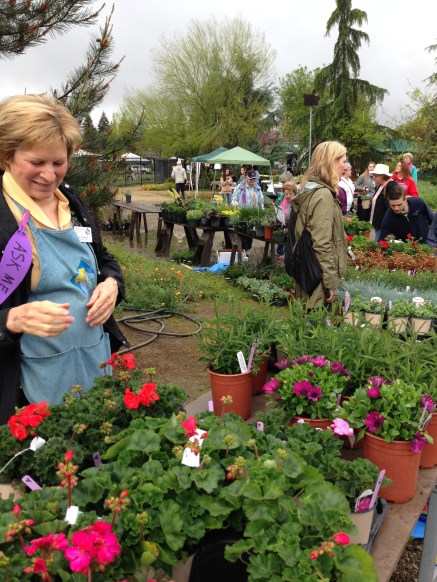
The plant sale is always popular and this year was no exception. Plants are provided by several local nurseries and the selections focus on natives and plants that have proven themselves to adapt and grow well in our low water, hot summer environment. Amazingly, I came home empty handed but I enjoyed seeing what my garden girls Rosemary and Donna were interested in as we browsed. The festival offers a plant sitting service to hold your selections while you enjoy the rest of the garden, enabling you to pick them up and pay on your way out!
Fresno County Master Gardeners and CBG volunteers were on hand to help with plant sale selections as well as answer festival goer’s plant and pest questions.
Today’s speakers greeted their guests in a recently built 1,500 square foot pavilion–a far cry from the folding chairs we sat in as we clutched our umbrellas just a couple of years ago. The garden’s newest addition is the Home Landscape Demonstration Garden. This area has four very small gardens vignettes: a low allergy garden, a condo garden with edible plants, a millennial garden relying on more rocks than plants and what the CBG has designated a traditional Valley landscape. This last one is more an example of what we should be doing, not necessarily what we traditionally have been doing! The vignette features plants requiring only moderate irrigation, a low flow irrigation system, no lawn in the front yard and synthetic lawn in the back yard. One feature in this area I especially appreciated was the signage pictured below, outlining the seven principles of Central Valley friendly landscape:
Conserve Water and Ensure Water Quality
Conserve Energy and Protect Air Quality
Nurture the Soil
Reduce Garden Waste
Practice Integrated Pest Management
Select Appropriate Plants
Create and Protect Wildlife Habitat
The plantings of the CBG are divided into a number of smaller areas, each with a narrow focus, and include a California native plant garden, a cactus and succulent garden, a Mediterranean garden and a garden featuring plants from South Africa and Chile.
One of the design aspects of this botanical garden that is so pleasing is the use of large numbers of specimens of the same plant grouped together, forming broad masses of consistent color and foliage form. We all know the landscape design principle of planting in groups of 3, 5 or 7 to provide calming repetition but I have never seen it used better than in this garden.
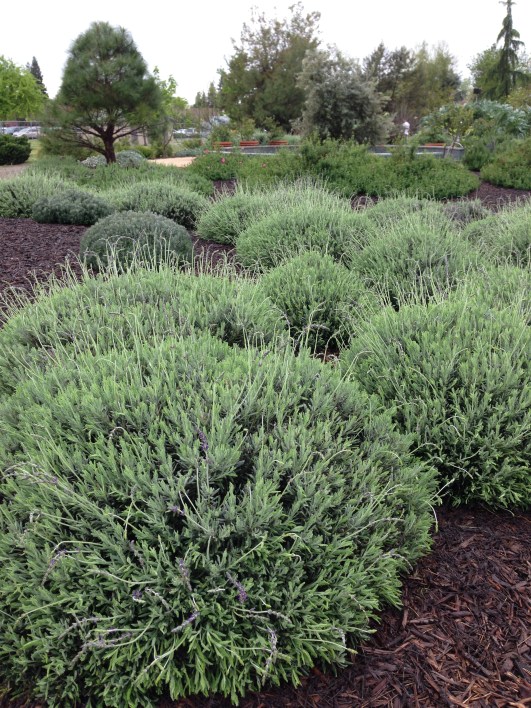
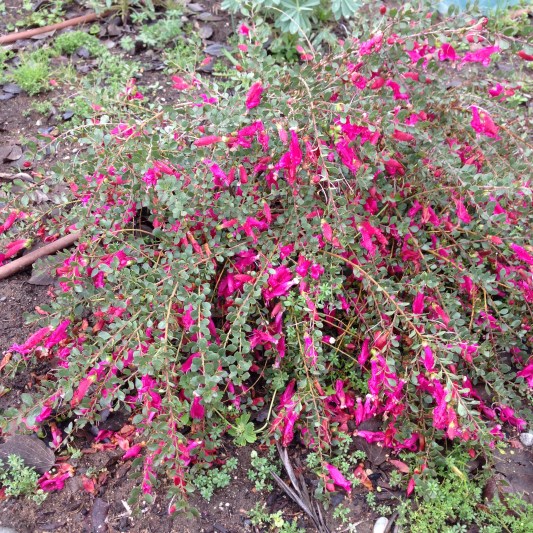
This broad bed is a veritable sea of Lavandula dentata. The backdrop for all this French lavender is a large grouping of rockrose which has just started to put on a few of its signature paper like fuchsia blooms.
Before we leave the Mediterranean area take a peek at small portion of the display of Cynara cardunculus, or artichoke thistle. These giant architectural plants stand at least 5 feet tall and are the focal point of a large bermed area planted in mostly silver grey plant selections. In the foreground you see Convolvulus cneorum, commonly called bush morning glory. This fast growing evergreen shrub forms a neat 2-3 ft mound and sports bright white simple funnel shaped flowers.
There are several large Torrey pines in the garden and the new growth just coming on was striking!
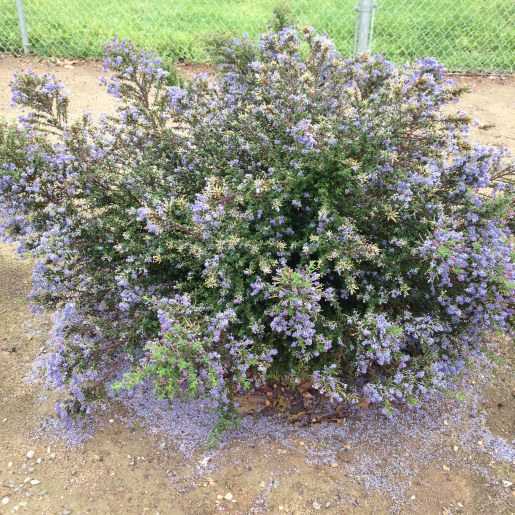
In the California native garden this wonderful Ceanothus ‘Dark Star’ was in full bloom.
Although it was a little past its prime bloom, I was drawn like a magnet to this stunning Silver Bush Lupine, Lupinus albifrons.
Both these native selections are negligible water users and prefer poor, rocky soil with excellent drainage. In these lean water years, residential gardeners may find more success in growing Ceanothus spp., the California lilac. Many of us have killed them with kindness in the form of water and fertilizer when trying to integrate them into traditional moderate water landscapes full of turf, roses and annuals!
It was pretty exciting to this Australian native, Eremophila maculata ‘Valentine’ in bloom. There are many species of this plant whose common name is the Emu bush and we are starting to seem them in the retail trade in areas of California trending toward low water landscapes. They are typically winter to early spring bloomers with flowers ranging from pink to red. This tough, mounding evergreen shrub will reach about 5′ X 5′ and is a good choice to pair with others that thrive with virtually no summer water after they are established.
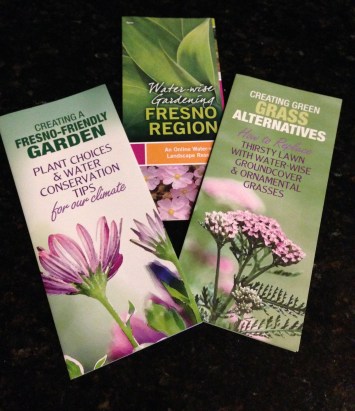
A coalition of local groups including the City of Fresno Water Conservation Program, the University of California Cooperative Extension and the Central Valley Friendly Landscape Committee were on hand with volunteers to answer questions and a great group of brochures to pick up for reference later–the Plant Choices & Water Conservation Tips is a great resource you can slip into your bag as you head out to look at water-wise choices at your favorite garden center.
This small but mighty garden is a welcome educational resource for gardeners looking for ideas specific to our region’s climate. You won’t see any hothouses full of exotic tropicals or collections of plants from cool alpine climes here! You will leave with practical, do-able and maintainable ideas you can adapt to your patch of paradise in the Central Valley.
NEXT UP: In a few days I am on the road to the Theodore Payne Foundation Native Plant Garden Tour in northern Los Angeles County. This is a two day event with 32 gardens, both public and private landscapes. If you’d like to learn more about the Foundation or the gardens on this year’s tour check it out on the web at http://www.theodorepayne.org
Early last summer I shared that we were embarking on several lawn removal projects. Because our mixed grass lawn (a euphemism for a jumble of lawns planted and repaired over the 17 year life of this home) leans heavily to common bermuda we had the lawn in areas we planned to renovate professionally chemically treated. Bermuda needs heat to break out of dormancy and the grass needs to be actively growing for the chemical treatment to be effective. We were well into July before any of the areas could be worked. In my August 15, 2016 post I shared photos of the two very small areas we had completed. I am pleased to say the little crape myrtle, Lagerstroemia ‘Natchez’, which looked like it had been involved in nuclear accident, has survived and, although this white flowering hybrid is still smaller than some of my husband’s walking sticks, it has just started to put on its new leaves. We underplanted it with a couple of six packs of one of my favorites, Convolvulus mauritanicus ‘Moroccan Blue’ and they are really coming on. I showed you this clear blue ground morning glory used as ground cover elsewhere in my garden in my April 12, 2016 post on ground covers. Here’s how it looks today:
This winter’s rain was plentiful enough that we have not used our irrigation system since November. As the year heats up I will evaluate the need for extra water to these new plantings and hopefully will be able to eliminate 2 of the 3 sprinkler heads.
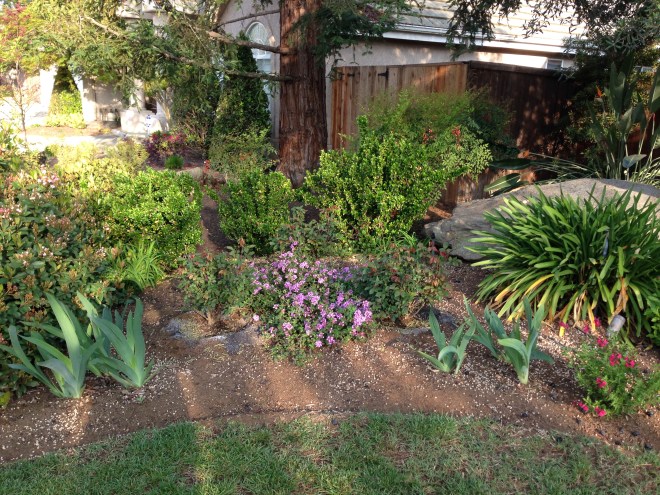
The second small area was basically a upside down U shaped extension of a lawn area that was always an issue to mow and continually dry as it sloped down and away from the rest of the lawn. The August picture showed the 3 Double Knock Out roses we used to fill the area–you could not even see the one itty bitty lavender Lantana montevidensis in the center! It has steadily filled the area since then and now forms a bright carpet which will provide a nice contrast to the dark pink blooms in a month or so. I had also added in some tall bearded iris divisions gleaned from other beds and their foliage is strong and proud! This newish bed, even though south facing, may be challenged with too much shade from mature trees in its vicinity but it is getting a good start. The three evergreen shrubs you see in the background are Euonymus japonicus ‘Green Spire’ planted about 5 years ago. This cultivar is one of the smaller euonymus varieties and will grow to a relatively narrow six foot high columnar form, forming a nice green backdrop that is pleasing on both sides from our property line.
You can see my spring efforts toward top dressing all my beds with new, rich and dark humus has not reached this side of the garden yet.
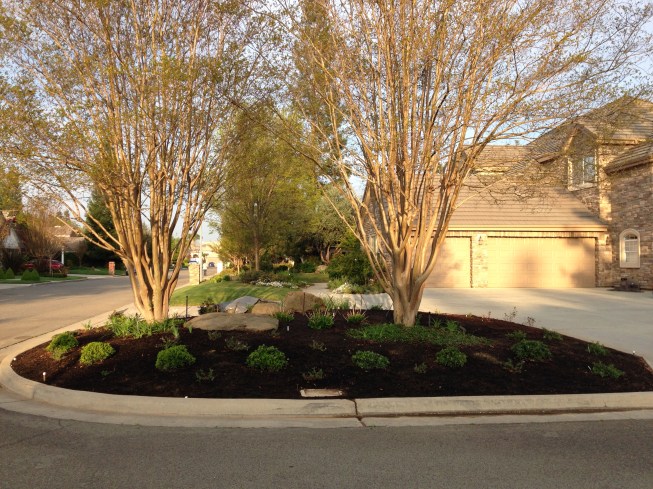
And now for the big reveal of what has seemed to the project with no end–what we call the driveway circle bed. Not really a circle, this bed is about 400 square feet and sits on the corner of our two driveways. I had to go way back into my digital photo files to find a pic of this bed about 6 months after we moved in.
The 3 foot tall boxwood hedges were a design element throughout the original landscape. Every one of the original beds had its own hedge separating it from the lawn areas. The interiors of most of the beds only occupants were China Doll roses. Many, many China Doll roses. The driveway bed was originally planted with three crape myrtles but only a stump of the west facing one remained in 2008. Over the last 8 years we have removed all but one of the hedges and now keep that one loosely trimmed (you can see it in the first picture of this post), rather than sheared. Over the years the roses became so shaded out that we had few, if any, blooms. I added perennials and annuals along the edges of the beds, including hundreds of bearded iris, but most simply failed to thrive after a while–lots of tree root competition, either total dry shade or screaming hot sun, and then they were the snails! The lawn thinned and suffered from all of the above and it became a logical, confined area from which the lawn could be removed. The optimum area to actively garden in this bed was the lawn area–leaving as much of the interior undisturbed for the trees. It all seemed so simple when I said it but turned out to be so much easier said than done!
The roots from the two mature and very large trees were everywhere and demanded very careful pick and shovel work to even remove what remained of the underground leftovers of the turf. My prime directive to my intrepid and pretty long suffering gardener’s strong man husband was that we save the crape myrtles at all costs! Even though they don’t bloom spectacularly well (I prefer not to severely prune them to stimulate new blooming wood) they provide us with screening from the street that could not be replaced in our lifetimes. We completed double digging and amending the narrow street curve side of the bed in late October, the southwestern facing section in January and finally the remaining northwestern areas a couple of weeks ago. As we went, we realigned the irrigation, hoping to end up eliminating an entire sprinkler line. I am sure the whole project was a true source of amusement to most of our neighbors, at least one of whom put in an entire new drought tolerant front landscape while we were still shoveling and wheelbarrowing.
The crape myrtle leaves are just peeking out and the entire bed has a fresh layer of humus. All looks very fresh in the early morning light!
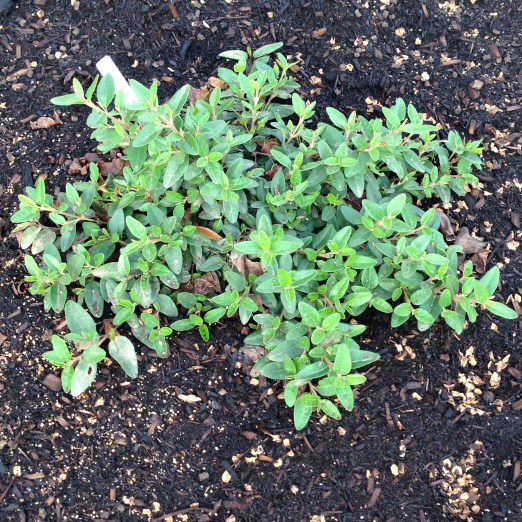
On the narrow east facing street side I kept the planting to a minimum adding only a curve of Pittosporum tobira ‘Wheeler’s Dwarf’ and small starts of the trailing lavender lantana that is so successful here seemingly regardless of heat or drought. This strip is ground zero for tree roots and the pittosporum is tolerant of competition. ‘Wheeler’s Dwarf’ was bred at the Wheeler Nursery in Macon, GA which was only a few miles from my home there. It has gained great favor as an evergreen shrub tolerant of many growing conditions with little care once established. They will form 2-3-ft. high ground hugging mounds not more than 4-5 ft. wide, perfectly filling this difficult area with year round green. the lantana will add a little color and substance while the pittosporum are small and repeats a color and form element used elsewhere in the front.
In previous seasons I had added daylily divisions and some ground cover starts of Vincaminor ‘Bowle’s Variety’. We left these, along with three Hydrangea macrophylla ‘Berlin’ intact. The vinca colonies are small but mighty hugging the bases of the trees and I tucked a few more in the bed’s shady interior. This evergreen spring blooming creeper is a cheerful lilac and sports a white rimmed eye.
The west facing section is in full sun virtually all day. I placed 5 Double Knock Out roses at the southwestern most corner, repeating the color vignette from the far side of the yard by underplanting them with the lavender lantana. Modern shrub roses are remarkably drought tolerant once they are established and the Knock Out series of roses has proven to be as tough as nails in my garden. Three Salvia greggii ‘Alba’ will provide a little white bloom relief from the bed’s predominantly lavender, purple and dark pink scheme. Several handfuls of daffodil bulbs got moved around in the digging–I like where this group landed! The foliage in the foreground are newly leafed out ground cover roses, Pink Splash Flower Carpet. I love striped roses and all the better if they are pink and white. As the bed curves to the northwest I planted another large grouping of salvia, my go-to Salvia ‘Mesa Azure’. There are five plants, placed on 3 foot centers. Planted from 4″ pots found last fall in a local nursery’s $1 pitiful plants section, they are so small they would not even show up in photos.
The shape and nature of the bed has opportunities for plantings all the way from full shade to full sun. The north curve gave me a chance to try something new. In my hunt for a 2-3 foot evergreen spreading shrub tolerant of shade but still having a bit of color I found Correa ‘Carmine Bells’. Commonly called Australian fuchsia, this delicate looking shrub needs good drainage and does well in poor or rocky soil. The winter blooming flowers are purported to be dainty little dark red bells which hang below the branches.
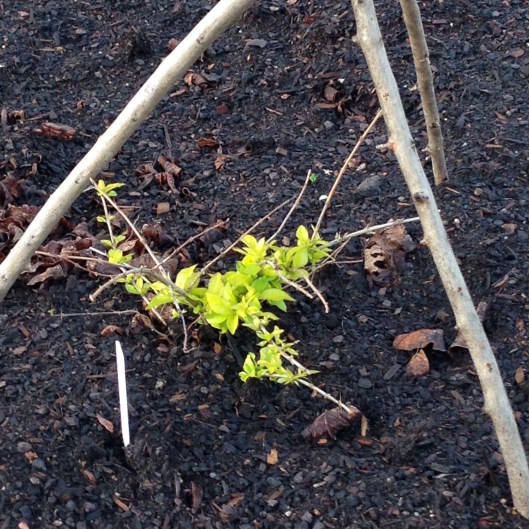
The center of the bed was a dilemma. It is quite a large area and its plantings would serve as the backdrop for everything planted around the perimeter. My first choice was Plumbago auriculata ‘Royal Cape’, the cape plumbago variety with the strongest blue flowers. This cultivar is a Monrovia grown selection and they tend to only offer them in a 5 gallon size. It would be very difficult to get a 5 gallon root ball in the center of the bed amongst the largest of the tree roots without damaging them. So without a plan B, I grabbed up several 4″ pots of Duranta erecta ‘Lime’ from the aforementioned $1 bargain bin. I have had one of these in a pot for years and its bright yellow green leaves practically glow when planted in concert with other darker green foliage. Duranta bear clusters of pale blue-violet flowers which are very attractive to butterflies. They can be a bit cold tender in my area but for a total $5 investment I just went for it. Not 3 weeks after I dug them in we had a really cold snap and all 5 little plant totally defoliated! You can see the one above has started to leaf out again. Four of the five look like they will survive–I used crape myrtle prunings to make little tripod protective structures for them so we wouldn’t step on the dead looking twigs through the winter.
I’ll give my initial plant choices a few more months to settle in before looking to add in additional plant material. I’ll mark my calendar for June to take a few more pictures so you can see how it is progressing!









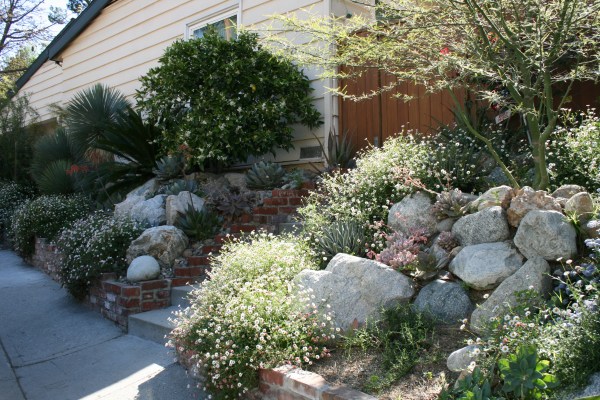
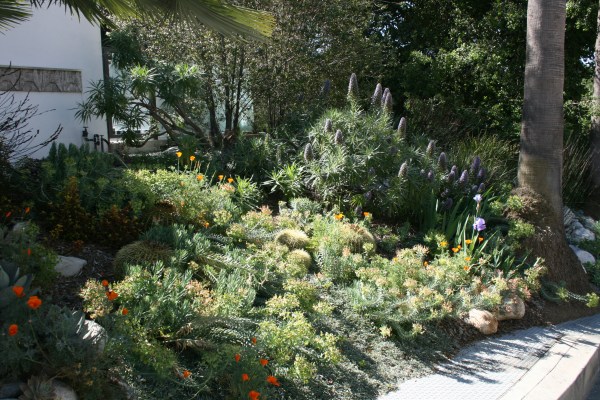
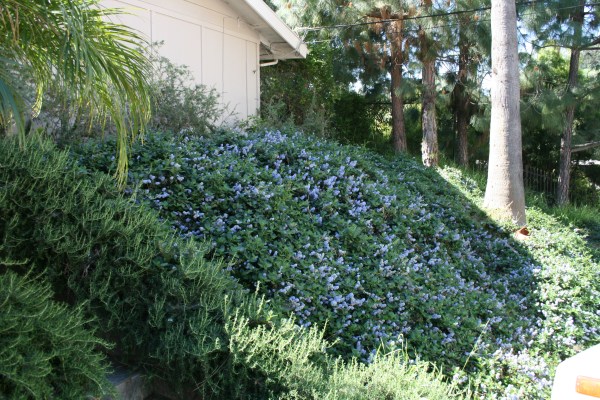


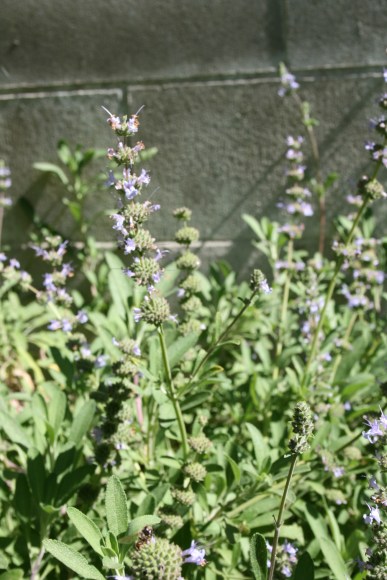
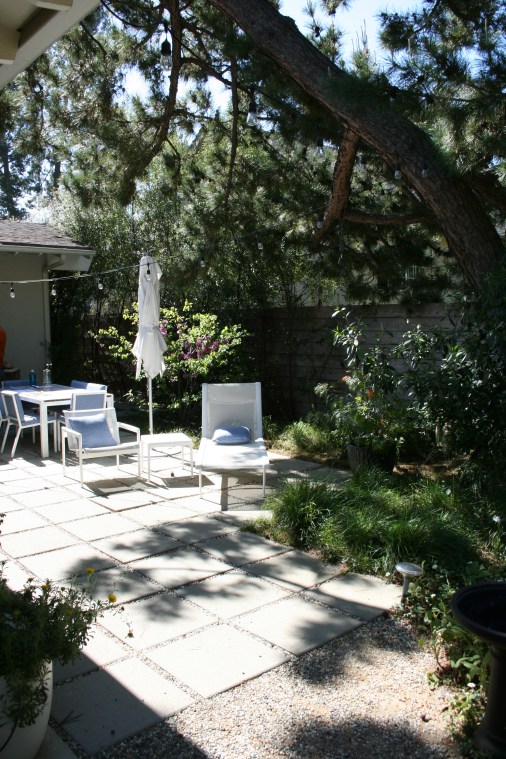



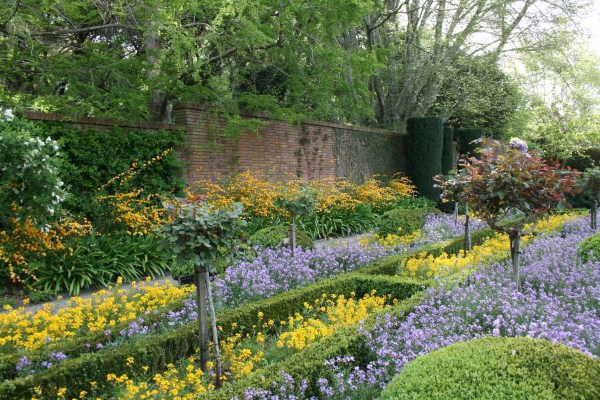











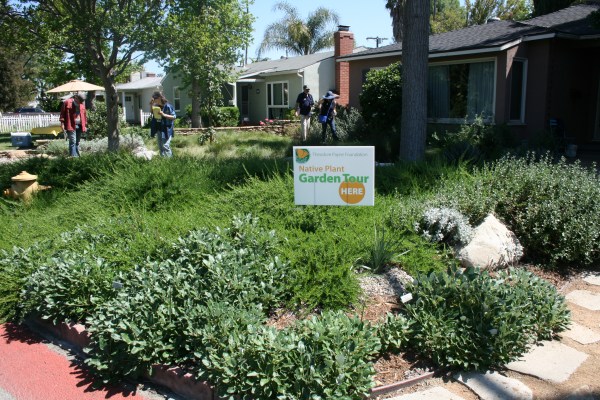


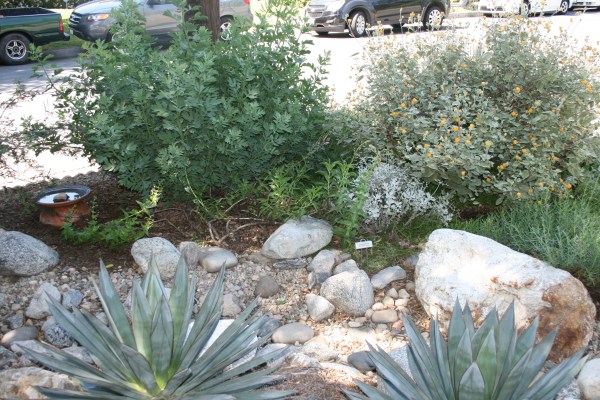

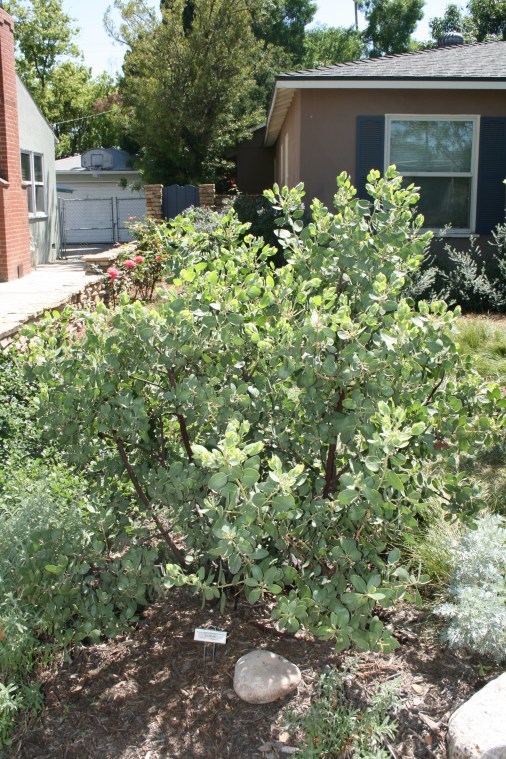

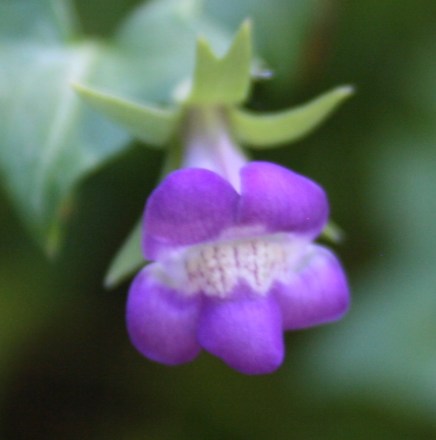

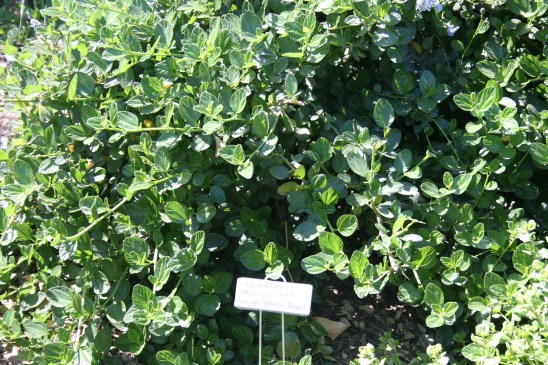
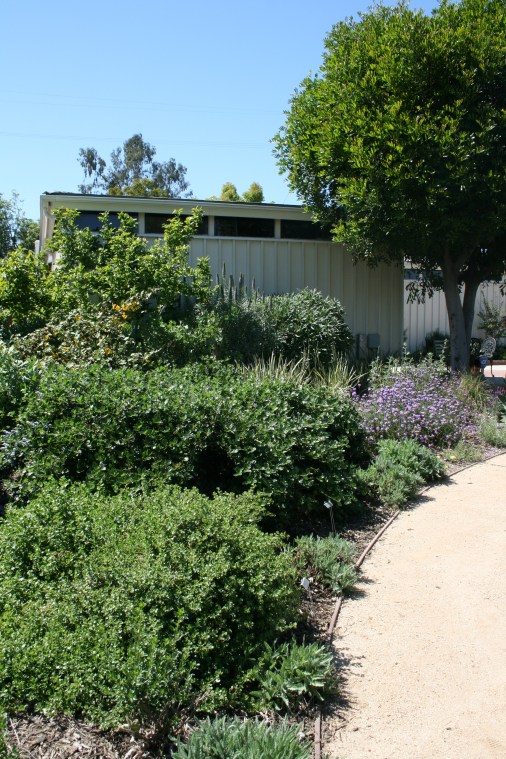


 Three plants used in irregular masses covered the entire slope. The predominant species was, you guessed it, a buckwheat! This was my first introduction to Erigonum fasiculatum ‘Bruce Dickinson’, one of several cultivars of California buckwheat. Unfortunately, at this home I could not get close enough to get a detailed shot of ‘Bruce Dickinson’ but you’ll see a close up later on the tour. The foreground is massed with Rosmarinus officinalis which had been neaten up recently enough to have pushed lots of gorgeous new growth. The last main player is Cistus salviifolius, commonly called sage leafed rockrose or Gallipoli rose. The rockrose is pictured below. These three wandered and wove in and out of each other providing a low water cover for a slope otherwise hard to irrigate.


 But first…who was Theodore Payne? A little research on the foundation’s website gave me a glimpse into the life of a man who was a 20th century pioneer in the native plant world. Born in rural England in 1872, Theodore was educated at Ackworth Academy, a Quaker boarding school which encouraged the study of nature. After his schooling, he was apprenticed to a leading English horticulturalist for thorough training in the nursery and seed business.










 Queen of the Dirt