The Garden Conservancy’s Open Days final California offerings for 2017 were three suburban gardens in San Jose, the heart of the Silicon Valley. The majority of the California Open Days occur in April and May and so I was surprised to see San Jose on the docket for September. Although the previews for these three gardens led me to feel they would not particularly fit my personal garden aesthetic they were intriguing enough to point me toward the freeway and in close enough proximity to each other to make it an easy trip. All three promised a mix of garden materials that would not be as summer weary as my those in my own garden!
THE GARDEN OF CEVAN FORRISTT
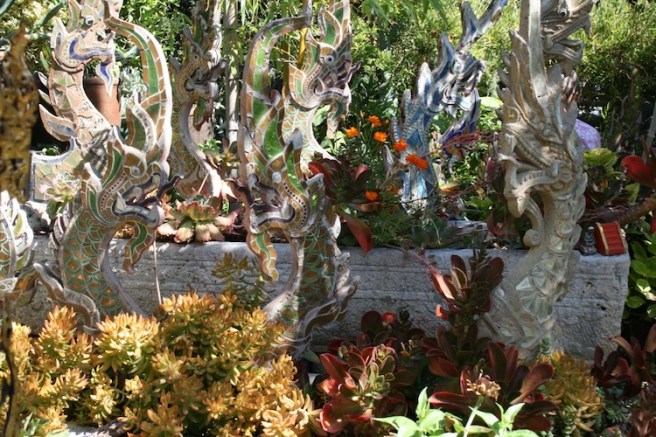
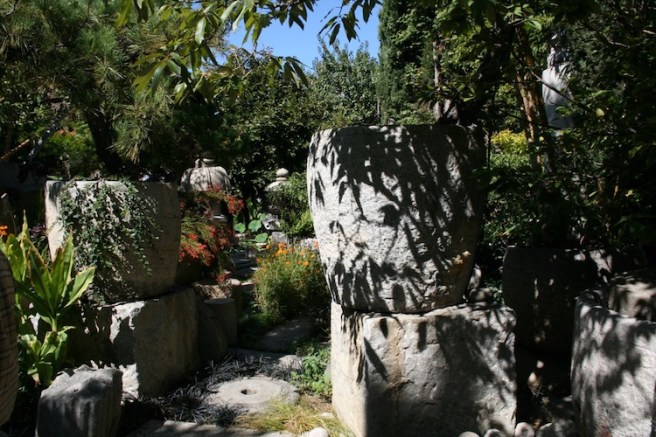
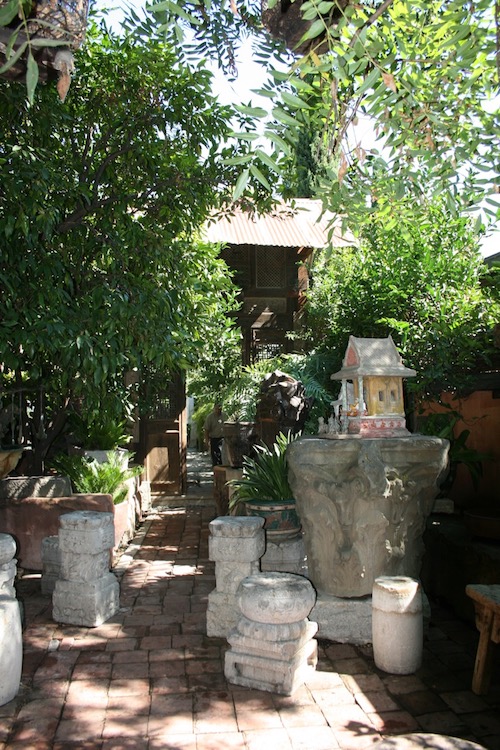
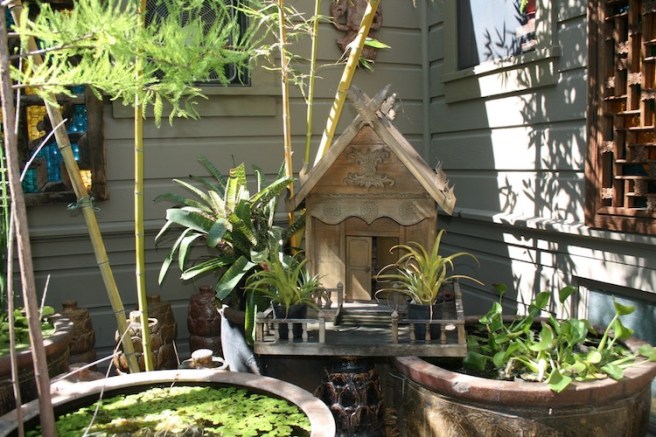
From street side it is immediately obvious that this garden is not just another neat suburban garden on a narrow street of bungalows of various ages and sizes. In fact, I am not even sure there is actually a house amongst the formidable walls, stones, urns and troughs. Cevan (pronounced Kevin) lives his garden design, embracing concepts and experiences gained from extensive Near and Far East travels and his background in stage set design. His highly stylized garden is probably not a garden suited for a young family or those of us who may need firmer footing but it clearly reflects his personality, playfulness and ‘more is more’ embrace of life.
The patinaed iron gates confirm his garden as his private sanctuary.
His mail is delivered in this unique repurposed copper box.
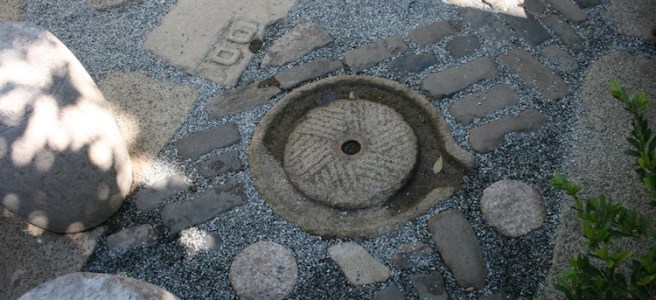
The front garden is a maze of narrow walkways, many with interesting stone accents.
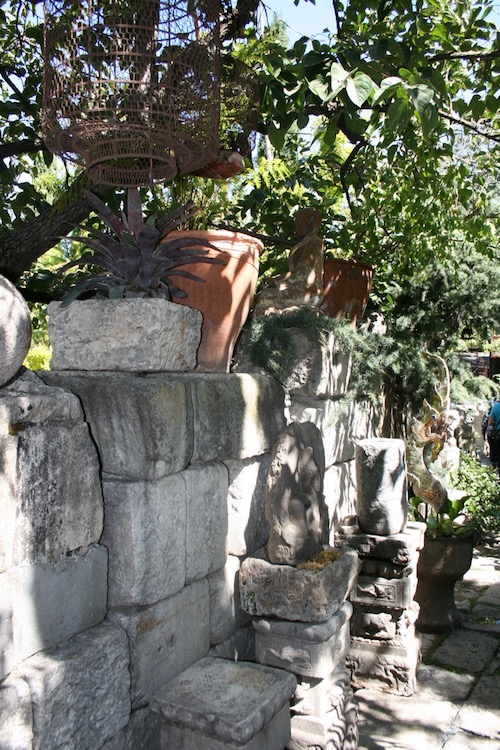
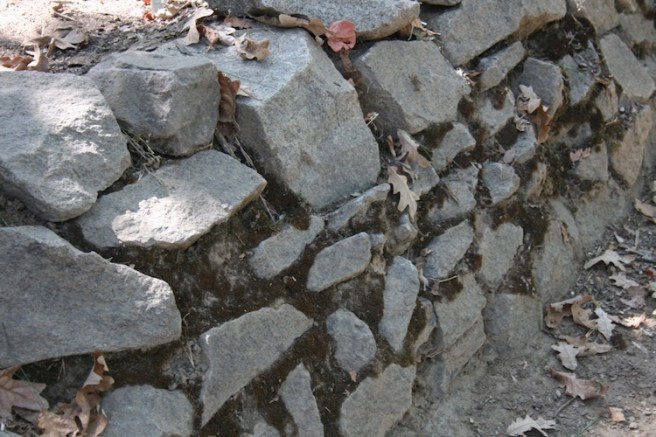
Fortress like stacked stone acts as walls for the paths. There is almost no place in the front garden where it is possible to back up to get a wide shot.
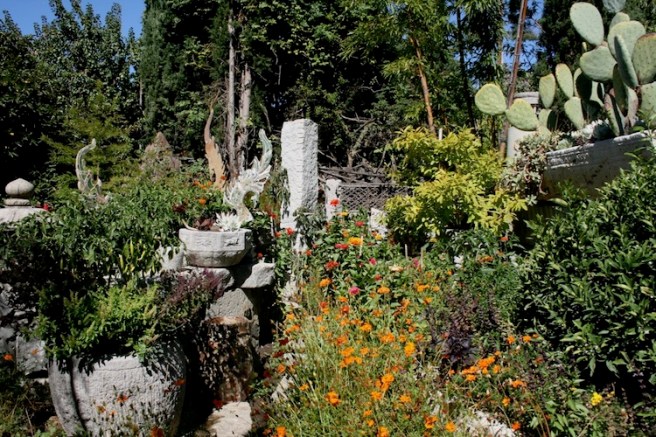
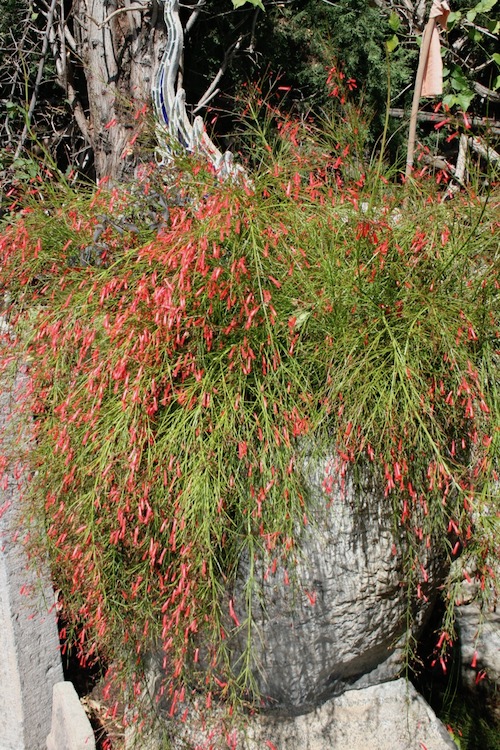
Succulents and perennials top walls and fill gigantic cement troughs. Much of the plant material is closer to eye level than the ground!
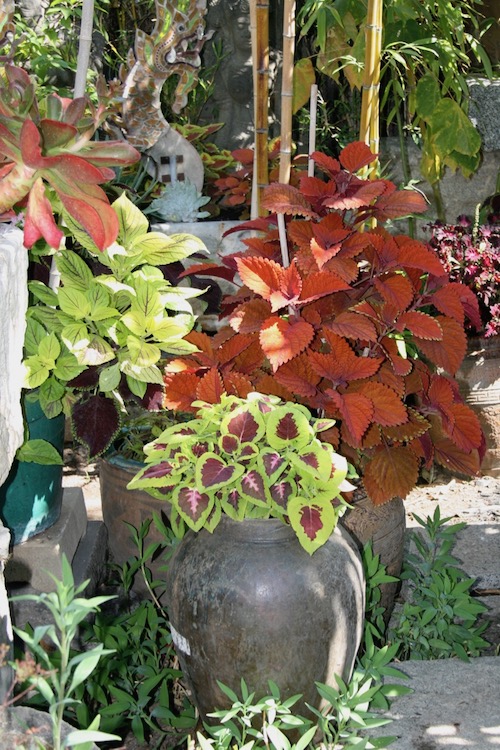
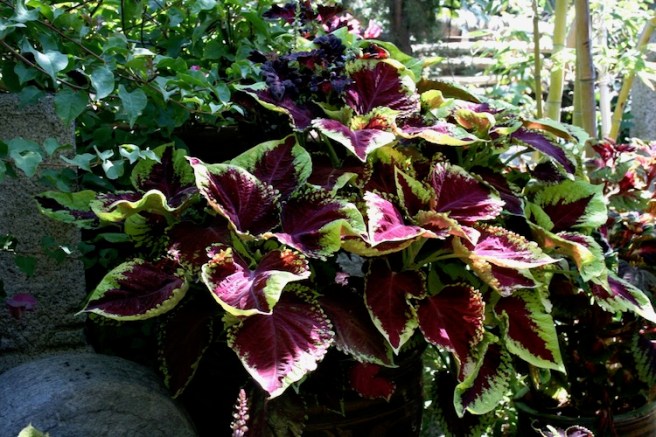
The garden has a wonderful assortment of Coleus, primarily in pots. A stone wall defines their own narrow garden room. It is hard to remember where I have gone left or right–there are vignettes, urns, statuary and decorative found objects at every turn.
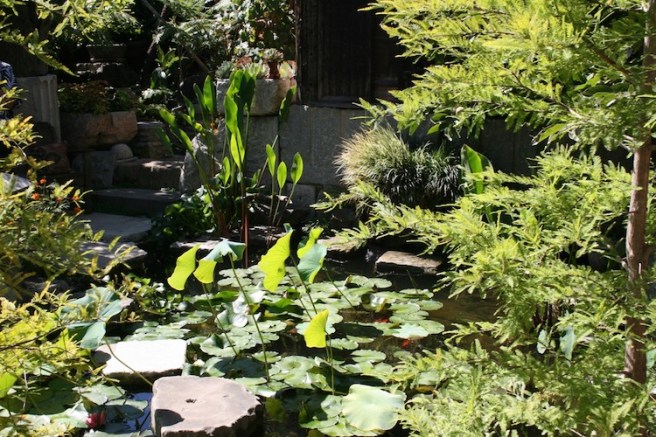
A cushioned stone bench provides a view of the peaceful koi pond. Above you see a young bald cypress planted directly in the pond. From the bench you get a narrow view of the Forristt home. Originally a modest Victorian cottage built from a kit around the turn of the century, it is clad on almost every surface with reclaimed materials and artifacts to disguise its nature and create the aura of an Asian dwelling.
Traversing the pond on raised concrete piers to yet new views of the garden I feel compelled to explain that I have now walked no more than 15 feet in from the from the entry gate–there is not a square foot unstructured or lying fallow.
In this very small space exist areas of full sun, dappled shade and complete shade. The perimeter of the garden, front and rear, has been planted with very tall screening plants and narrow trees, virtually eliminating any views outside the garden and reinforcing its air of mystery and privacy.
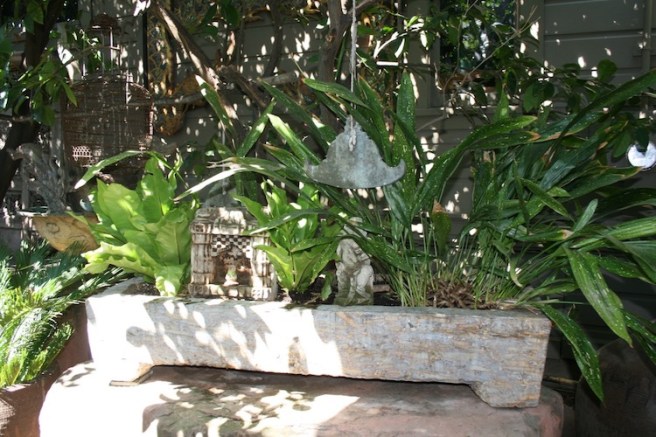
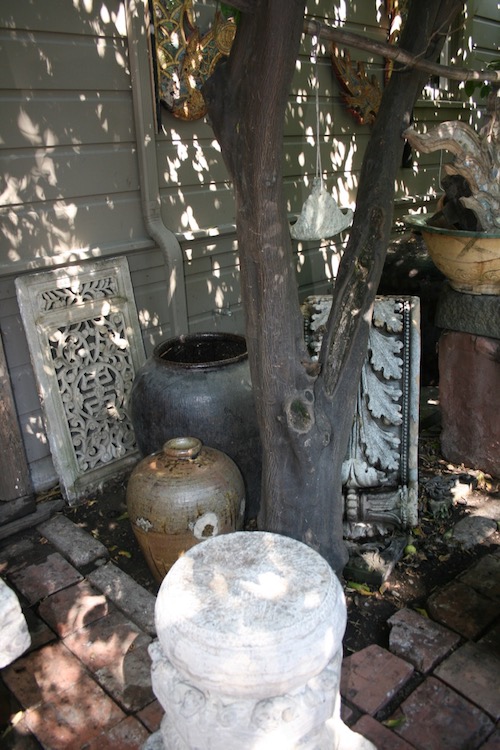
Stone, recycled and salvaged artifacts act as walls, pedestals and planters.
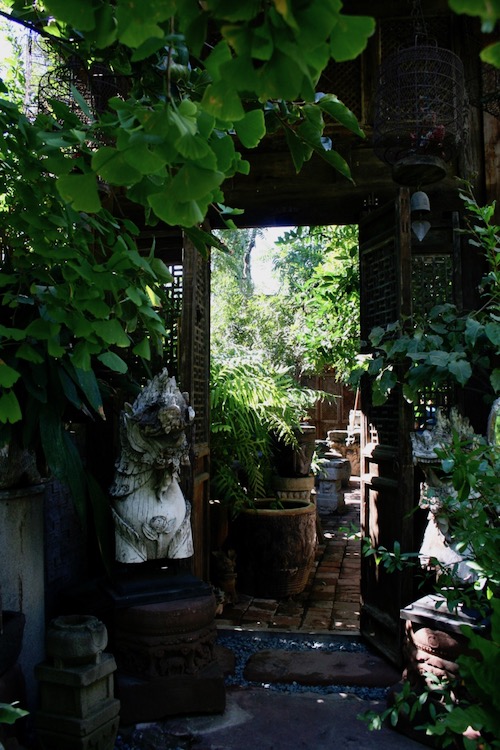
The well shaded rear garden gate offers additional layers of detail.
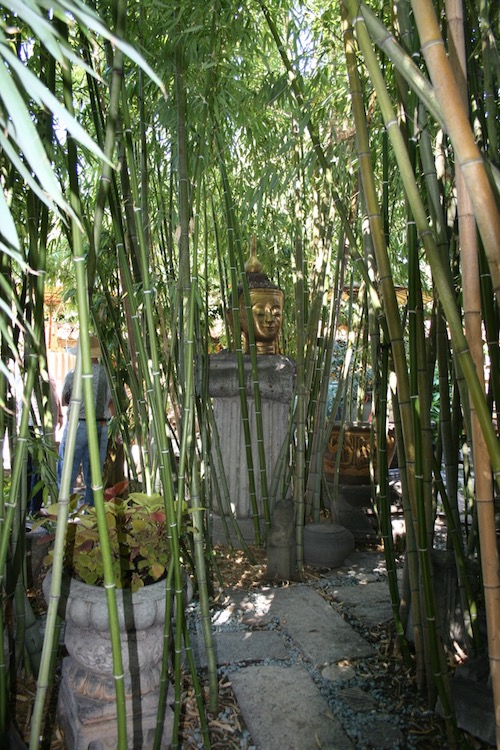
Very few of us would dare to nurture a towering stand of bamboo in our gardens–Cevan explained that this variety does not run aggressively.
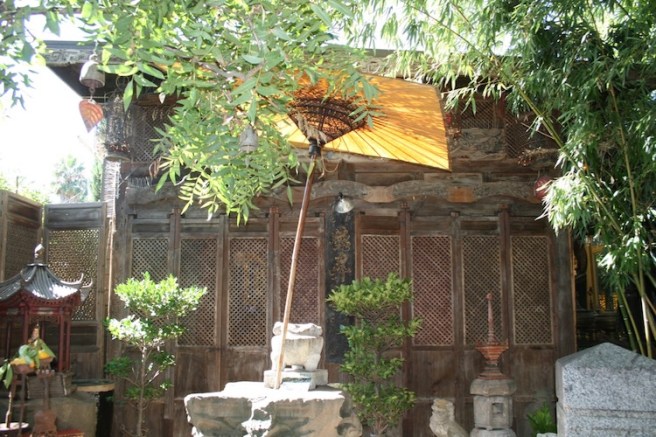
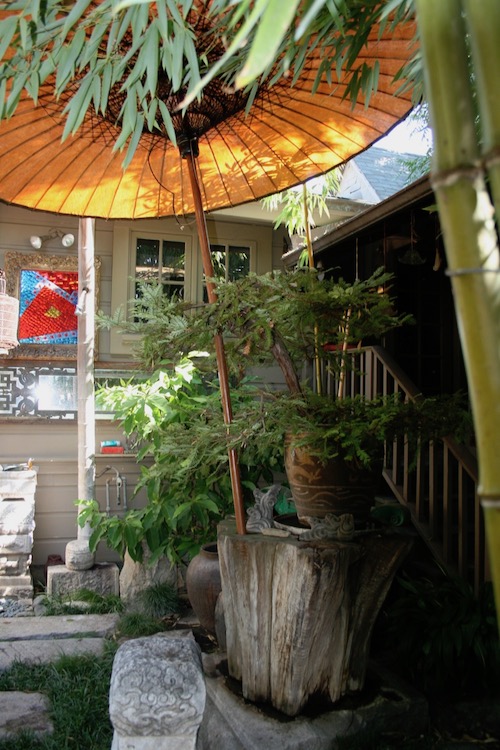
A number of colorful umbrellas offer high shade in the rear garden. Their poles are cleverly anchored in holes in large stones and in one case, a tree stump.
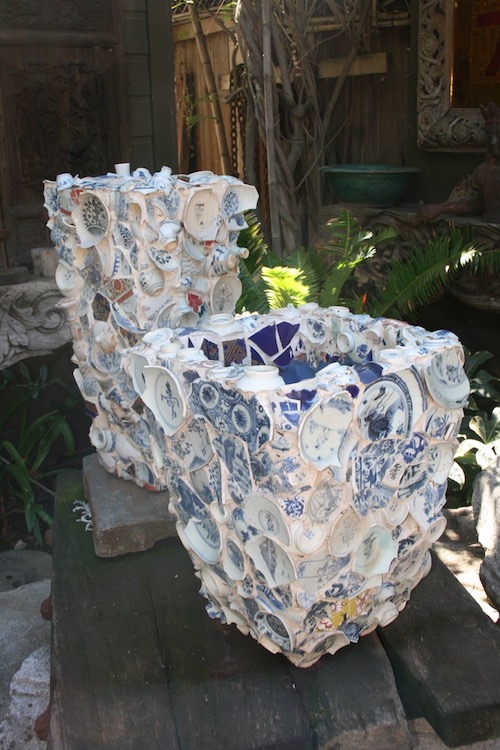
I loved these large urns tiled with broken blue and white china.
Ok–so this has really been a lot to take in! This very personal retreat like garden is not everyone’s cup of chai but there are strategies and elements here that when used on a less over the top scale will make a sanctuary space for anyone who embraces Asian design. If you would like to know more about Cevan Forristt Landscape Design and see additional photos (far better than mine) check out http://www.forristt.com or the write up in the book Private Gardens, pictured below.
In my next post I will take you to the Holden Garden which was designed by Cevan Forristt to meet the couple’s specific desires for an entertaining space inspired by global travel.
Long before I started blogging about gardens, my own and those of others, I visited public gardens in every city I found myself–I used to sit down with the local telephone book; now my iPad miraculously organizes all a city has to offer. A recent trip to Sacramento left me some open time and my tablet provided a few smaller garden suggestions that looked as though they might be a perfect fit for my limited touring time. The WPA Rock Garden’s story turned out to be much more a tale of what wasn’t there rather than what was.
The WPA Rock Garden is a scant one acre tucked between Fairytale Land and the Duck Pond north of the Sacramento Zoo in William Land Park. The Works Progress Administration was a Depression-Era work relief program put into place in 1935 by Franklin D. Roosevelt as part of his New Deal. The WPA put unemployed craftspeople to work on projects to improve communities all over the country–their efforts often recognizable by the use of indigenous building materials, commonly the local stone. The WPA Rock Garden was constructed in 1940 as a place of quiet respite within the park.
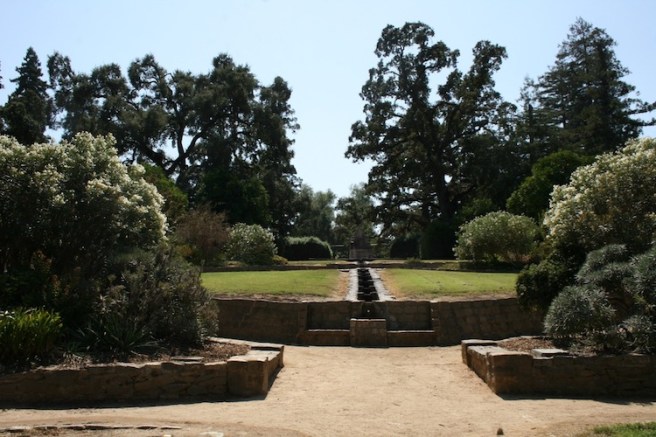
The first challenge was recognizing the garden–no signage was evident. I had seen photos of a lovely sign erected in the late 1990s but I clearly missed it. The meandering rock work, the signature of many WPA projects, was my only clue that I was in the right place. Not surprisingly, the garden was in poor condition at the end of a very hot and dry summer.
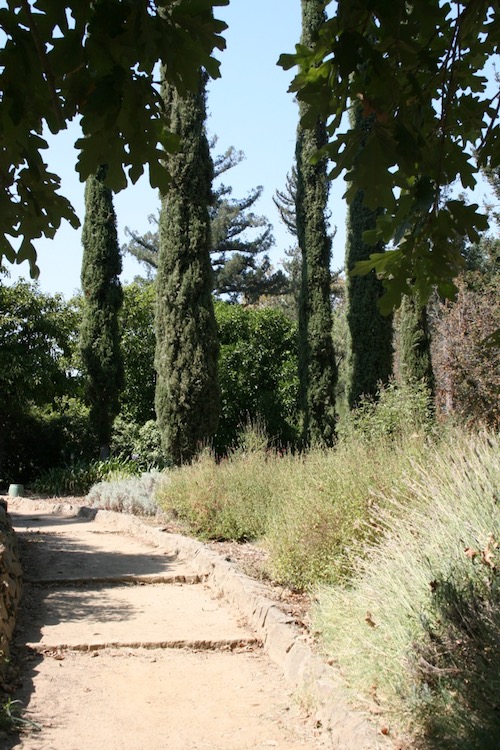
I found my way in via this path. The hillside gradually slopes up to the back of the zoo (chain link fence).
There was virtually no color to be found, even among the scruffy stands of native and non-native drought tolerant plantings. You see all of the color I saw except some white oleander just too high to photograph.
There were a number of bench areas to relax. I enjoyed a respite from the 95 degree heat on the shaded curved bench, closed my eyes and could envision what this garden could have been and still could be with its pleasing layout, meandering paths and multiple vistas.
Sort of by accident I found myself at what I think is intended to be the entrance to the garden.
A monument to Charles Swanston, one of the late 1800s pioneering businessman of Sacramento sits on a knoll to the back of this grassy area. I assume at some point water filled the pool at its base and then flowed down this rock raceway. Dry as a bone now, just like the rest of the garden.
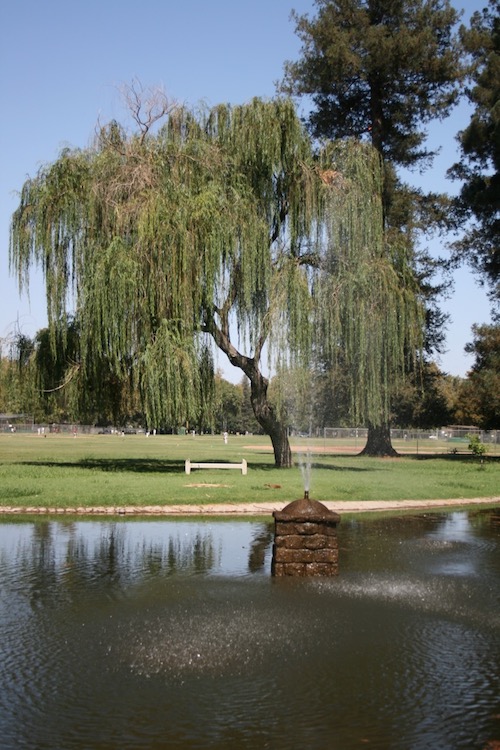
This cooling view is directly across the street from the garden and the memorial to Mr. Swanston–known to residents as the Duck Pond.
It was in my research into the Swanston monument that I was drawn into a more recent history of this once remarkable garden space. If you Google WPA Rock Garden and just look at the IMAGES you will see a garden that bears no resemblance to the garden I visited. Exuberant bursts of color pop from mixed evergreen and deciduous backdrops. Stands of herbaceous and woody perennials line the paths. Blooming vines scramble over the pergolas and children pose standing atop large rocks. Where was THIS garden–what happened here? Numerous newspaper articles, magazine articles and blog posts, mostly from the early 2000s to about 2012, extol the pleasures of this unique space. I even find a feature article filled with photos in Pacific Horticulture from April 2005–PH is pretty much the gold standard of horticulture publications for me. It was from these articles that I learned the real secret of the WPA Garden and her name is Daisy Mah.
Like many WPA era projects, the original garden declined once funds were depleted and the area remained neglected for decades. Horticulturalist Daisy Mah started her career with the Sacramento Department of Parks and Recreation in 1980 as the lead for the McKinley Park Rose Garden. After tiring of the monoculture of the rose garden she transferred to the William Land Park in 1988 and took the WPA Garden on as her own. At that time it was little more than an overgrown patch of ivy. Her first vision was that of a rock garden filled with alpine plants. The realities of Sacramento’s hot dry climate set in and she recognized that drought tolerant plants from the Mediterranean climates of the world would have a greater chance of success. This was pretty radical thinking in the late 80s and early 90s when public gardens (and many home gardeners) were all still living in a pretty starry eyed world of roses, hydrangeas and bedding plants—and we thought water was a never ending commodity. Over the ensuing 25 years Daisy Mah created and maintained the garden so beautifully represented in all those articles. In October 2013 Daisy Mah retired, moving on to travel and I am sure other garden pursuits. The last 4 years have not been good for many gardens in hot and dry California and public gardens in my state are under special scrutiny to be good stewards of resources. Daisy’s garden has surely suffered the loss of her passion, vision and daily ministrations.
Check out these two links for great photos of the WPA Rock Garden at its finest.
Exploring the history of Sacramento’s WPA Rock Garden has affirmed for me the importance of local gardeners taking on the advocacy role for their community garden sites–they are living symbols of our never ending efforts to surround ourselves with nature’s beauty. The WPA stone structures endure and offer a template from which a garden may rise again. We all need a little help sometime!
Filoli was eerily quiet as I arrived for my monthly class in this quintessential country estate of times gone by. The forecast was for a day in the low 70s which for me would be a relief from a summer with weeks on end of temps surpassing the 100 degree mark. Unlike the efforts of many home gardeners who are about ready to call it quits by this time of year, Filoli’s formal beds benefit from the June changeout of plant material from spring to summer (and staff to make it happen…I must have misplaced my own staff) and were bright, bold and thriving!
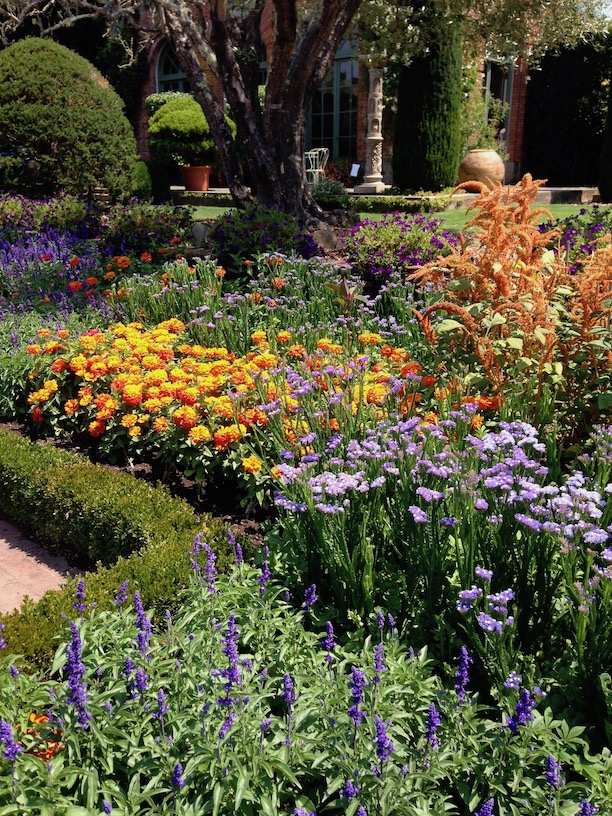
The play of the morning sun turns the sea of orange zinnias to gold! The bold color scheme of the Sunken Garden almost glows in full sun under blue skies.
The blue mealy cupped salvia and lavender statice, barely past seedling stage last month, have come into their own. All of the annual flowers seen here are started from seed and grown out in the estate greenhouses.
This butterscotch colored Amaranthus was interesting. Commonly called amaranth or love lies bleeding, there are many ornamental varieties as well as whole grain varieties used as a food crop. Most of the ornamental ones I have seen are in the red and burgundy tones–slipped my mind to ask our instructor, Mimi Clarke, later in the day for the cultivar name.
I also enjoyed seeing the pops of white along the northwest wall provided by really nice stands of Cleome. A taller variety, the flowers topped 5 feet. I am going to find a sunny spot in the back of one of my borders to sow a packet or two of these next spring.
The garden and gift shop area was dressed for late summer also. The plants for sale often mirror what is prominent in the garden at any given point–today was a bit of an exception with this nice display of succulents.
My usual route through the Walled Garden to my potting shed classroom allows me to check in on those disappointing begonias I noted last month. They have filled enough now to give me a grudging smile.
The less formal areas southeastern areas of the garden reflect more of the late summer doldrums all gardeners experience: perennials not quite fully cut back in hopes of encouraging an second flush of bloom, cutting garden annuals nearing the end of their prime time and roses looking like they have had a long, hot summer. Every month I find these areas to be a comfort. Even with a hard working staff there are always more maintenance tasks than time and hands to do them–just like my garden!
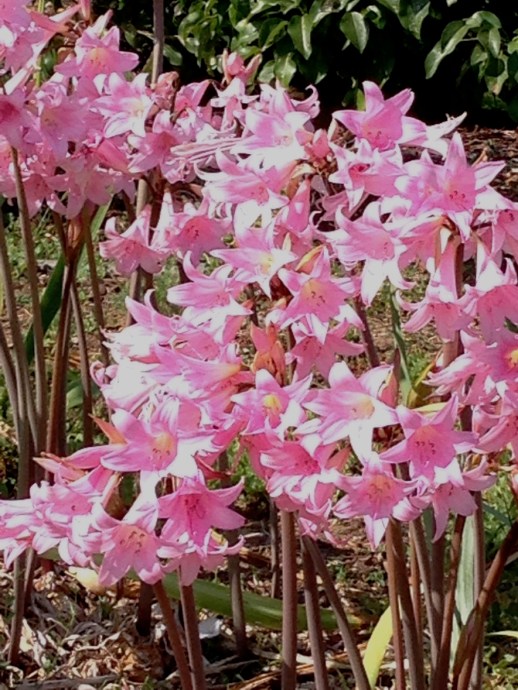
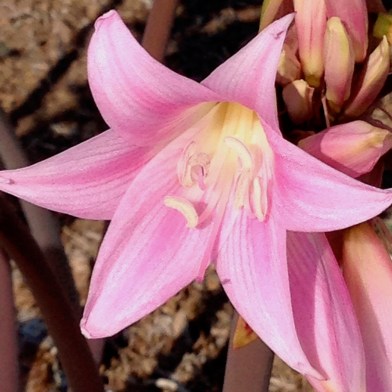
A highlight this month where the clumps of naked ladies blooming everywhere! The bulbs of Amaryllis belladonna and Lycoris squamigera both produce straplike leaves which die back in late spring, followed by long naked stalks topped with clear pink blooms.
I believe these to be the Amaryllis rather than the Lycoris due to the symmetry and more pointedness of the petals and the color of the stalks but I wouldn’t put money on it! They are in areas clearly visible from the paths but not close enough to examine on hands and knees without walking into the planted areas. Both plants are great naturalizers and resent being moved. They were very popular with 19th and 20th century gardeners and remain so today–although many folks who have them ‘inherit’ them with their property rather than having sought them out to add to the garden.
Propagation is today’s classroom and garden walk topic. As we had covered seed collecting earlier we would concentrate on asexual propagation today with our hands on focus being propagation by cuttings. The major methods of asexual propagation are cuttings, layering, division and budding/grafting. Propagation by cuttings involves rooting a severed piece of the parent plant; propagation by layering flip flops the process by rooting a part of the parent plant and then severing it. Propagation by division is accomplished by digging up the parent plant and separating it into several parts or separated off plantlets that have set down roots away from the parent plant; budding and grafting allow you to join two plants from different varieties. Excellent written material walking us through each of these propagation methods is included in our class notebooks–I have propagated by division countless times but have little experience with the other three techniques.
Mimi’s go-to advice of knowing your plant and using good references is especially apt as you try your hand at propagation. A plant’s basic genetic and structural properties can point you to the method and time at which it can be most successfully propagated. The fibrous crowns of daylilies are perfect to tease off new plants by division while a plant with a tap root like Queen Anne’s lace cannot be propagated in this fashion. Even the seasoned professional gardening staff at Filoli consult their reference materials to find out the specifics for the plant they seek to reproduce. One of her recommended text is the American Horticultural Society’s tome Plant Propagation which is well organized by plant and written at a practical level for a non-scientist–good step by step photos also.
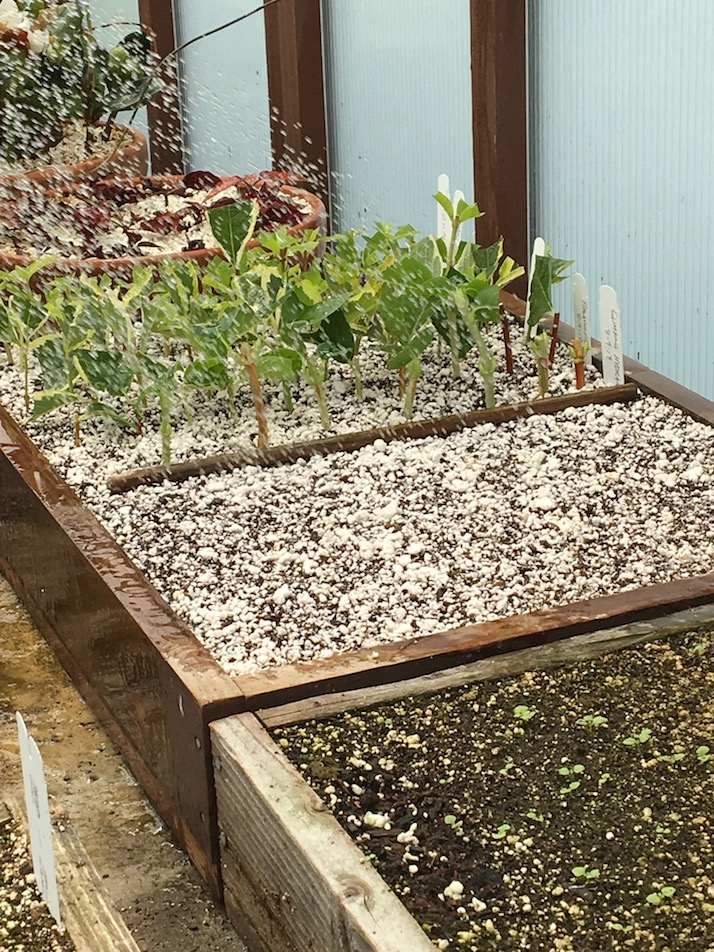
So today we will take a look at Filoli’s propagation set up, take some cuttings from the estate and prepare them just as the staff gardeners would. The hope is that they will be sufficiently rooted for us to pot them up to take home in September.
Before we head out into the garden we get a quick primer on rooting media and containers. Filoli gardeners construct propagation flats, sized perfectly to sit two deep on the tables in the propagation house (prop house), but any box that will provide suitable drainage can be adapted. The rooting media (soil) should be clean, porous enough for root aeration and drainage but also capable of water and nutrient retention. An easy mix to start with would be 50% peat moss and 50% perlite–dampened, mixed and pressed into your rooting container. Let’s head into the garden!
We stop outside the propagation house to see what is hanging out in the cold frames. Cuttings which have rooted well are potted up (usually to 4″ pots) and moved outside to acclimate. There are a number of cold frames throughout the ‘working’ areas of Filoli and at any given time they contain a mixture of potted up rooted cuttings, divisions and grown out plants waiting to be switched out in the display areas or bound for the retail shop.
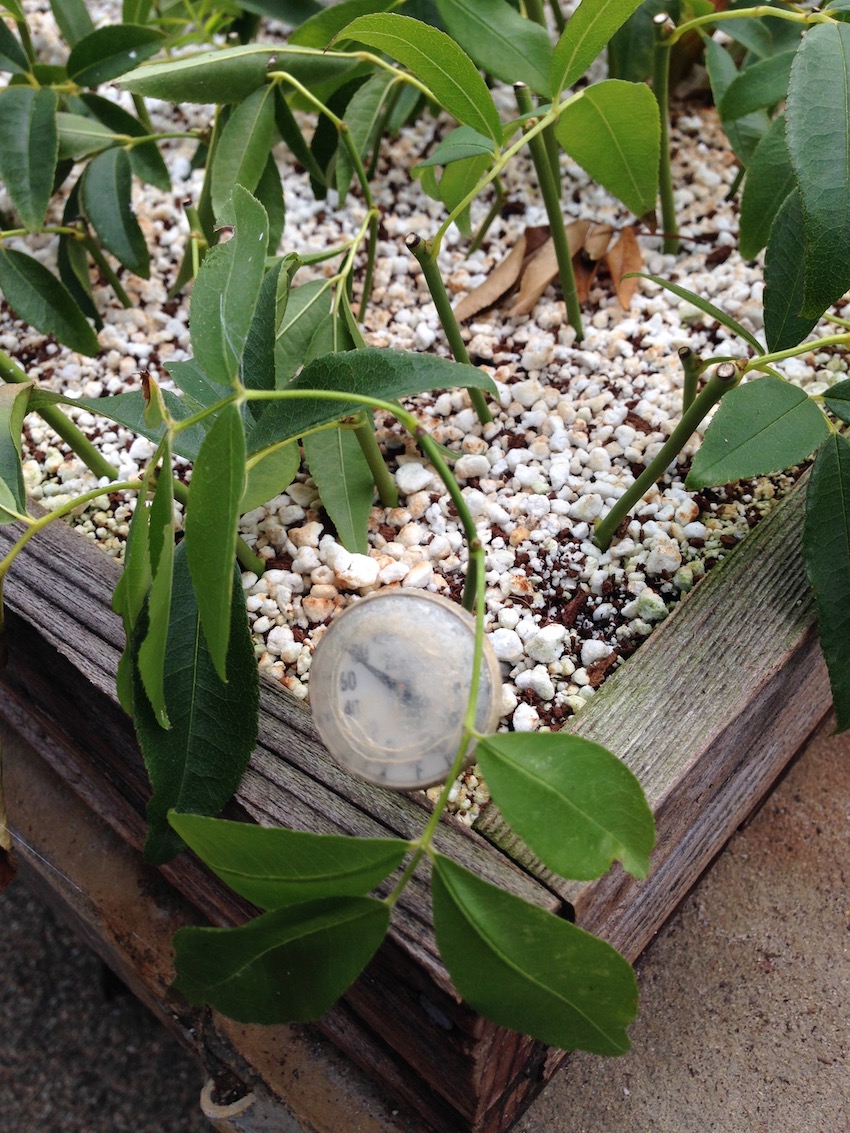
Inside the propagation house, pots and flats–check out Filoli’s perfectly sized wooden rooting boxes–are arranged on the concrete tables on either side of the structure. These tables are original to the prop house, which dates very early in the estate’s history. The tables provide bottom heat to the cuttings by means of a piped hot water system tucked up under the table top–also original and still working well. Overhead misters and fans provide the ongoing constant moisture needed for root development. Temperature of the rooting media is monitored by a thermometer in the box or pot and adjustments are made to the climate as needed. Everything is labeled with the plant name, date and often where the particular cuttings were taken in the garden.
Our next stop was one of the large greenhouses adjacent our classroom–this one houses many of the potted tropicals that rotate through the house and a host of succulents plus anything else that just needs a temporary home inside. We are catching this house at a time just past the last large annual changeout (June) and before flats are seeded in the fall with next year’s spring annuals. Mimi tells us that much of what we see today will have to be moved in a month or two out to house hundreds of flats of newly germinated annuals.
The greenhouse features a wide center walkway going from doors on either side. The perimeter window walls have permanently fitted table space. The double wide center table seems to only allow access from one long side and it initially appears very hard to reach anything more than an arm’s length away. I was fascinated to find that this very wide and long (maybe 30 feet long and 15 feet wide?) table sits on a system of galvanized pipes that allow it to be rolled from side to side with little more than one person’s effort–thus eliminating the need for a walkway on both sides and increasing the overall storage space.
Additional cold frames are found on both sides of this greenhouse. In the winter months they will be covered to prevent heat loss.
In the center of the above photo you can see pots of young Taxus baccata ‘Stricta’, the Irish yew, which is one of Filoli’s signature plants. Prominent in the original estate landscape, many of them on the grounds are decades old and there is a constant need for replacements. The original yews were started from cuttings taken from trees at Muckross, the Bourn family estate in Ireland. The cuttings were then planted at Mr. Bourn’s Empire Mine until Filoli was ready for landscaping. Every Irish yew replacement is grown from a cutting of one of the original plants.
We came upon this artful stack of wine boxes in the covered work area behind our classroom–looks like some quick minded gardener had snagged them to use as boxes for rooting cuttings and starting seeds. Some of my classmates opine that they were perfect in size and shape and muse about how they could explain to their spouse that they need to buy all their favorite wines by the case now so they could have these great boxes as a bonus! On to a lightening fast lunch so we can get back out in the garden to get our cuttings!
Mimi had planned for us to take cuttings from Weigela florida and Aloysia triphylla (lemon verbena), both robust deciduous woody shrubs that we had talked about on earlier garden walks. Special request cries arose for Philadelphus (mock orange), Hydrangea anomala petiolaris (climbing hydrangea), and a specific camellia. Clippers and brown paper bags for collecting in hand we’re off!
Everyone takes a turn at snipping, looking for supple disease free whips to harvest. On the left you see the brick wall of climbing hydrangea. Having done our research in the classroom on each of the proposed selections we had learned that this slow to establish but eventually very aggressive deciduous vine is best propagated in the spring when it is just beginning to produce new roots at the nodes to help it cling to its support (wall). Armed with the knowledge that the success rate for our late summer cuttings may not be high, we are still going to give it a try–I read recently a quote “If you are not killing plants you are not stretching yourself as a gardener.” So there. Now if I can only get the man I share a checkbook with to adopt that philosophy…
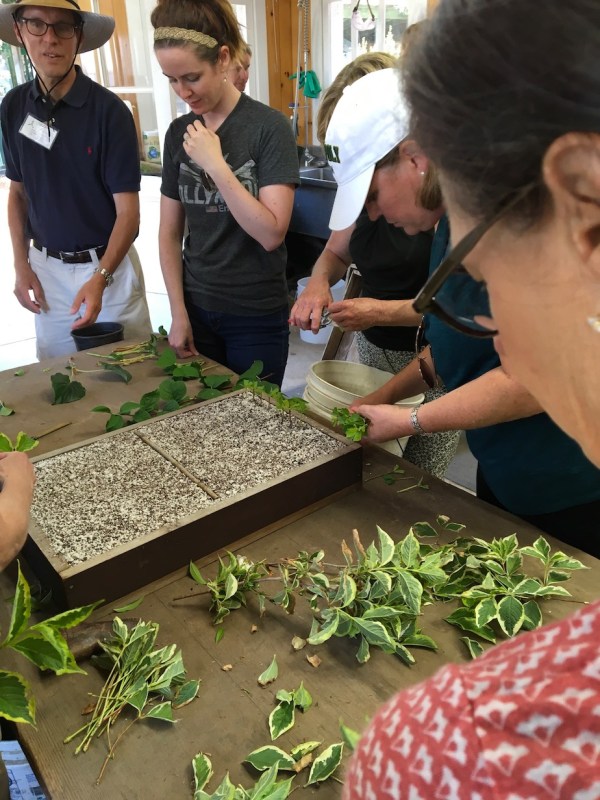
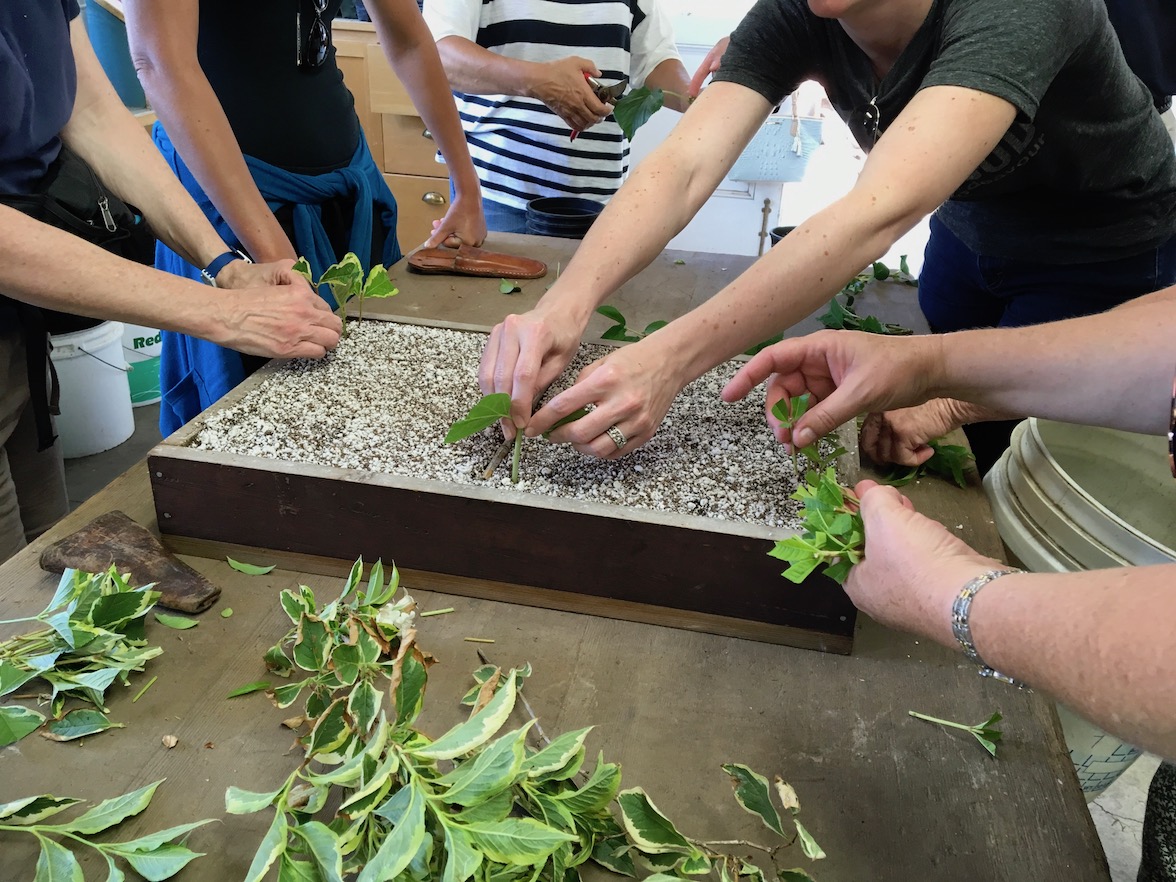
Back in the potting shed our booty is spread out by variety and we get a quick demo on where individual cuts should be made so that every cutting has a node which will be down in the rooting media and one exposed to the air which will produce new growth.
We divvy up into teams and to prep our plant’s cuttings and organize our rooting tray, keeping like cuttings together in tight rows. Labels are made and added to the tray at each point where the plant type changes. We are sharing our tray with the Saturday class it is amazing how many cuttings we got into our half. You can see above we originally started to fill the tray from both sides but ended up relocating them to our designated space. ‘Tray management’ may seem to be a facetious concept but it really critical in knowing what and when you’ve planted and keeping your propagation efforts organized. Just like so many things in life that you think you will remember exactly what and how you did something (on the day you actually did it)–the reality is that a week later it is all going to blur together!
Like a dozen proud parents we walk our tray to its place in the propagation house. Mimi Clarke gives it a gentle spray. If gardeners gazing with pride and love can make plants root these babies ought to be 2 feet high by next month!
The September meeting will be our last meeting of A Year in the Garden. We will close our time together talking about winding down the garden in fall. Our individual projects are due and we’ll have the opportunity to see what everyone else has done–no pressure here–and hopefully have well rooting cuttings to add to our own gardens as reminders of the time we have spent at Filoli.
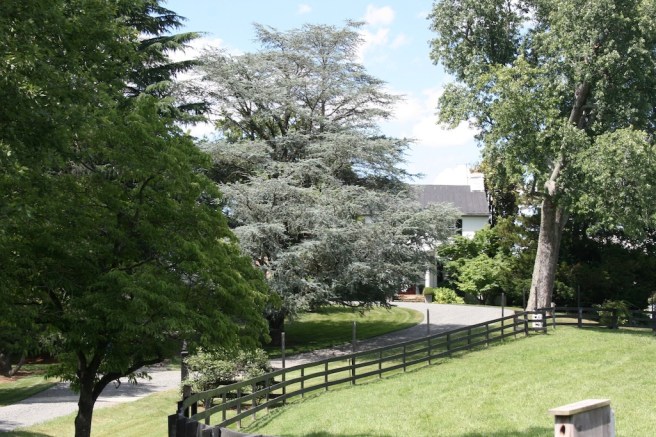
Virginia Gardener and her husband were married on their Middleburg estate shortly after purchasing the property in the 1970s. They share a passion for classic historic homes and the c. 1790 home on Seven Springs Farm met their hearts’ desires. Smack in the middle of Virginia horse country, the surrounding garden offers long views of rolling fields and distant hills.
Virginia’s property leads with her veggie garden and barn as any proper farm would. The plots for crops were not overly large but were chock full of really healthy looking produce, flowers and a bit of garden art here and there.
Virginia had walked down the driveway to welcome us. As we followed her back up toward the house it was hard not to be distracted by the views.
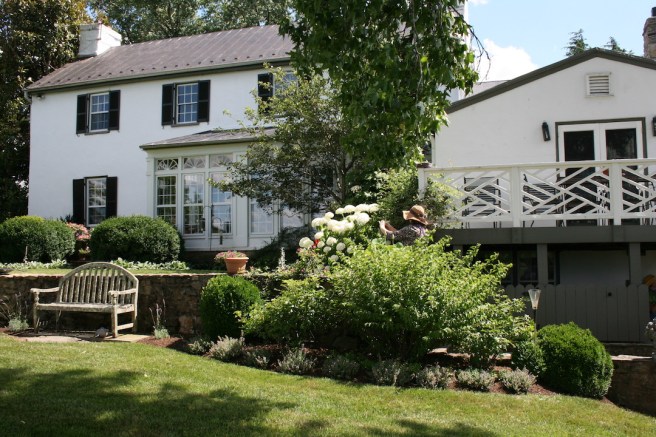
The gracious home comes into view. I am sure that 220+ years did not pass without changes to the house to meet the needs of the day but the home’s architecture remains marvelously cohesive.
The garden is divided into many distinct areas; both sides of the home feature a little more formality while the back has an open family friendly lawn.
As we rounded the home on the stone end we enter the herb garden near this charming small structure which I believe Virginia identified as the original spring house.
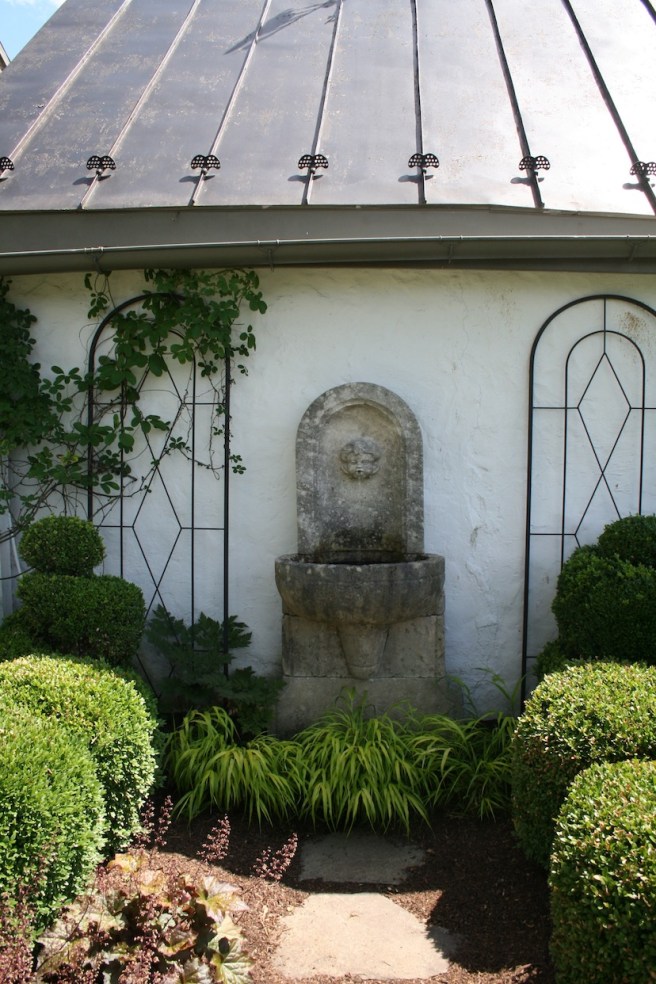
This vignette on the side of this rustic outbuilding features an ancient looking fountain framed by symmetrical boxwoods and iron trellises.
A classic sundial provides a centerpiece for the herb plantings
Meticulously maintained boxwood hedging of several heights separates the herb and secret garden from the broad expanse of the back lawn.
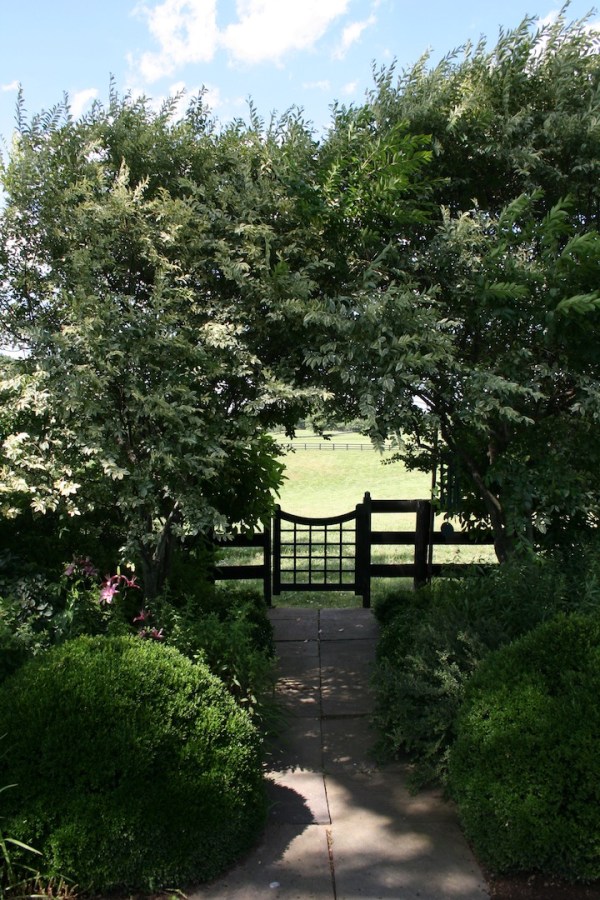
The perennial borders provide an area of transition from the lawn to the greater expanse of rolling grassland beyond the low rail fence. I loved that Virginia has provided numerous openings from the garden to the open fields, each one different and each one acting as the frame for a view worthy of a landscape painting.
No shortcut here but a lovely place to rest and enjoy the garden
Looking back at the home. The stone wall is a beautiful way to accomplish the elevation change and makes a nice background for the plantings. Classic boxwood define corners and walkways throughout the garden.
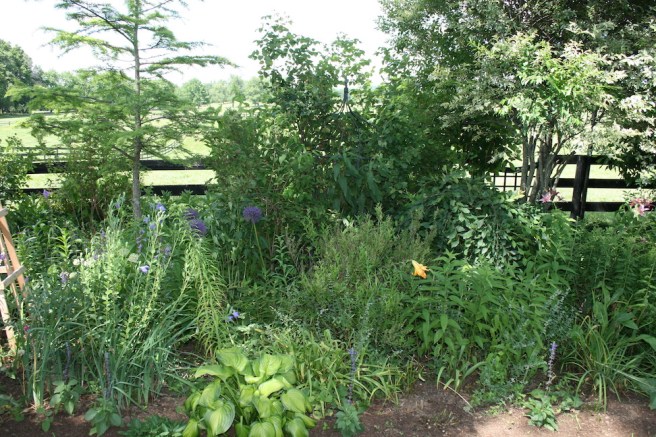
The perennial borders were not riots of color but had lots of variety so that there would always be something in bloom.
Deciduous and evergreen trees and shrubs, in addition to a variety of conifers, give the borders year round structure and interest, allowing the seasonal plants to wax and wane as they choose.
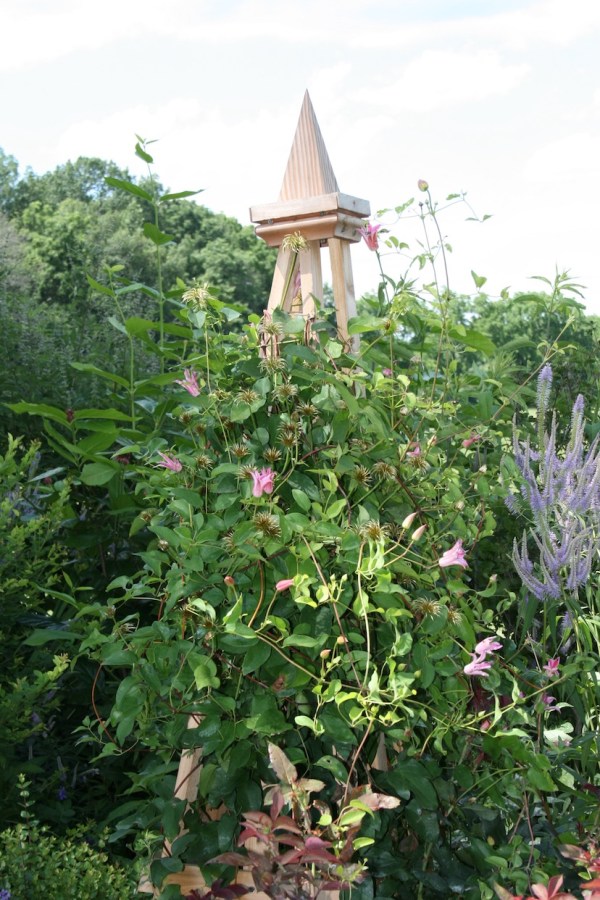
Wooden obelisks were staples of the border, offering vertical interest and a place for a variety of scrambling vines. Here you see one of the nodding bell shaped Clematis with blooms in all stages.
I would have been happy to sit on one of the gardens benches or up on the raised deck fitted for outdoor dining for the rest of the day enjoying this exquisite countryside.
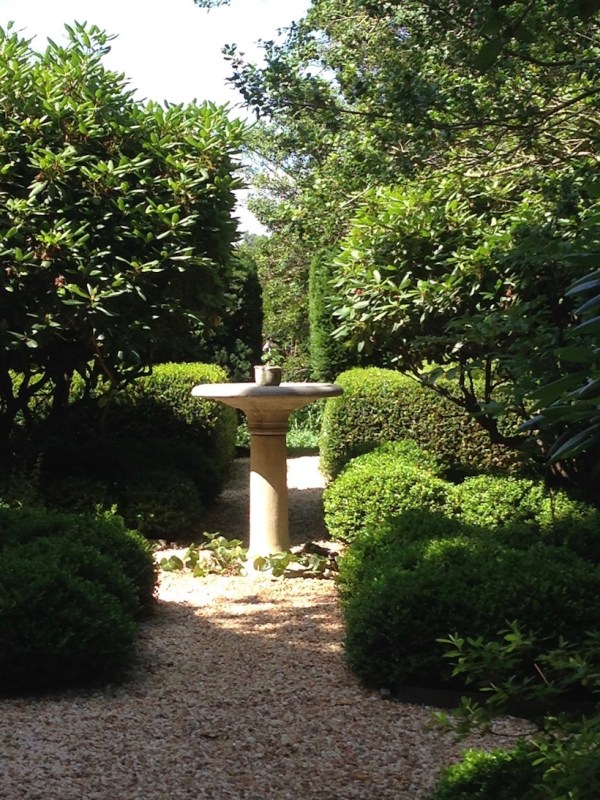
I want this birdbath!
Hands down this was my favorite place in Virginia’s garden. Another elevation change was accomplished with stone steps and this U shaped wall delineated a restful spot with a perfect view. Please take note of the bronze animal walking the back wall. I was not the only one who mistook it for coyote–several of us discussed it with interest for several minutes before a local took pity on us and identified it as a fox…you know, like in fox hunting…in horse country…duh.
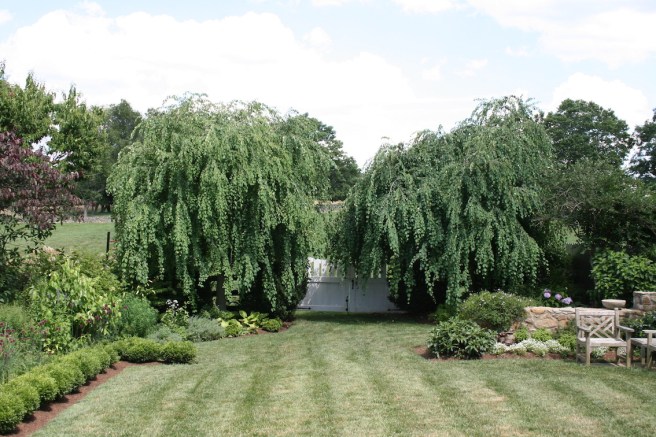
These beautiful weeping trees (maybe Katsura?) camouflaged a wide side gate.
One of many great garden art rabbits.
Yet another gorgeous framed view!
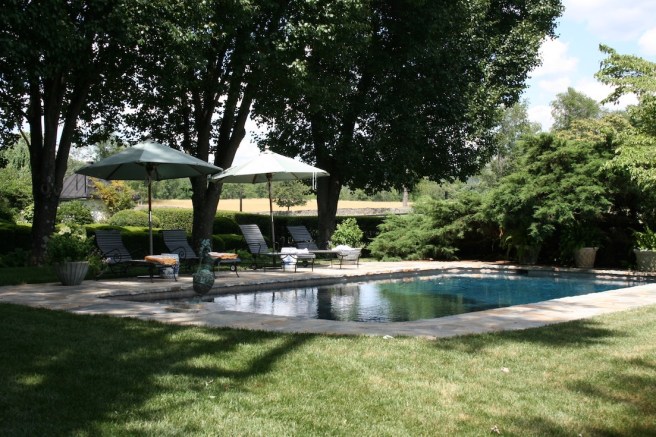
A formal boxwood garden takes you from the sunken stone area up toward the shady swimming pool. Symmetry and sight lines rule.
The back of this calming pond accommodates another elevation change.
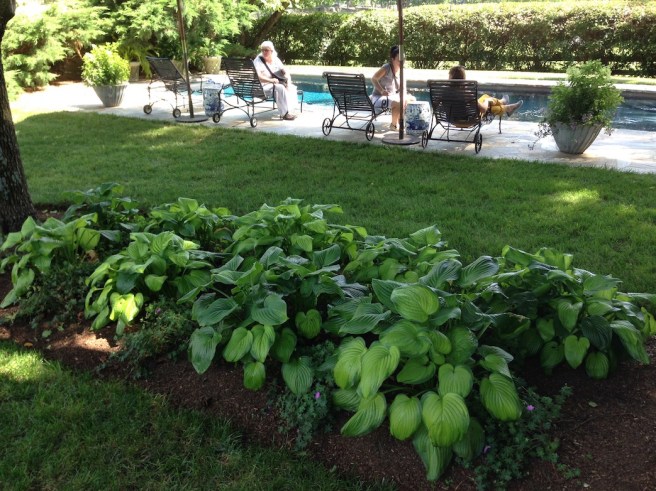
The faint limey green in these hosta leaves almost glows in this shady bed which delineates the boxwood garden from the pool area.
After several minutes rest in the shade by the pool and a glass of cold lemonade we weary garden bloggers bid good bye to Virginia Gardener and her Virginia garden. The distinct rooms of this garden estate have evolved over decades and speak to me of the cool mostly green gardens I remember so well from my years living in the Deep South. When you can achieve a beautiful garden that is also practical and looks good without spending every waking hour on maintenance, you have arrived!
Located at the foot of the United States Capitol, the United States Botanic Garden (USBG) was established by Congress in 1820. George Washington had a vision for a botanic garden which would demonstrate and promote the importance of plants to our young nation. Today, three garden spaces make up the USBG: the Conservatory, the National Garden and the adjacent Bertholdi Park. Approximately 65,000 plants are maintained for exhibition, study, conservation and exchange with other institutions.
The Terrace Garden entrance to the Conservatory offers a peek-a-boo view of the United States Capitol building.
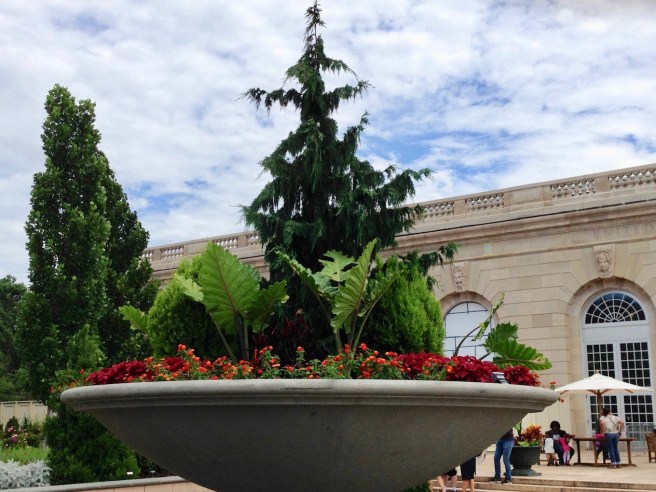
This gigantic shallow container, housing an interesting mix of tropicals and conifers, is the Terrace Garden’s focal point. The architectural conifer in the background bed appears to sprout from the super-scaled dish garden!
Although I am not a huge fan of the heavy humid air of indoor conservatories, my analysis of this day’s prevailing weather was that inside the big glass house could not be any worse so…
The Garden Court acts as an anteroom for the plant life of the Tropics. The mirror image shallow reflecting pools are beautiful and the aqua tile and sparking water offer visual relief from the sultry day.
That would the Tropics be without a massive Ficus aurea?
Additional collections from around the globe are housed in several auxiliary glasshouses that surround the two story main conservatory. I walked all over the world on these wide flagstone paths!
The National Garden, established in 2006, was originally conceived in the late 1980s to features roses which had been declared the national floral emblem in 1986. The concept was later broadened to include native Mid-Atlantic plants (dubbed the Regional Garden), pollinator attracting plants and a fountain celebrating the First Ladies.
The Rose Garden
The First Ladies Water Garden
Above and below–small sections of the Butterfly Garden. Many evergreens are incorporated here to maintain garden interest during the dormant season.
Views of the Regional Garden
As with many of the gardens I visited on and around the National Mall, this garden was being used for rest and respite by both adults and children. There were folks eating lunch, reading the daily paper and just absorbing the surrounding nature. Large enough to provide a bit of insulation from the hustle and bustle outside its fences but small enough to pop in on from the street without needing a map to find your way out.
A narrow strip of land between the Smithsonian Arts and Industries Building and the Hirshhorn Museum and Sculpture Garden, once designated in the master plan of the day as a future parking lot, is the site of the Mary Livingston Ripley Garden. Mrs. Livingston, who was the wife of the eighth Secretary of the Smithsonian Institution and the founder of the Women’s Committee of the Smithsonian Associates, was an accomplished plantswoman and envisioned the open space as a “fragrant garden”. In 1978 she persuaded the Women’s Committee to sign on in support of her garden concept and the space became reality in 1988. In the early years of the garden Euonymus was transplanted from her home in Litchfield, Connecticut to form the east wall espaliers. The garden is supported today with funds from another benefactor, Mrs. John C. Folger, who established an endowment in 1994 for the care of the garden with the hope that others would be inspired by her generosity and add to the funds, enabling the garden to be enjoyed by the public well into the future.
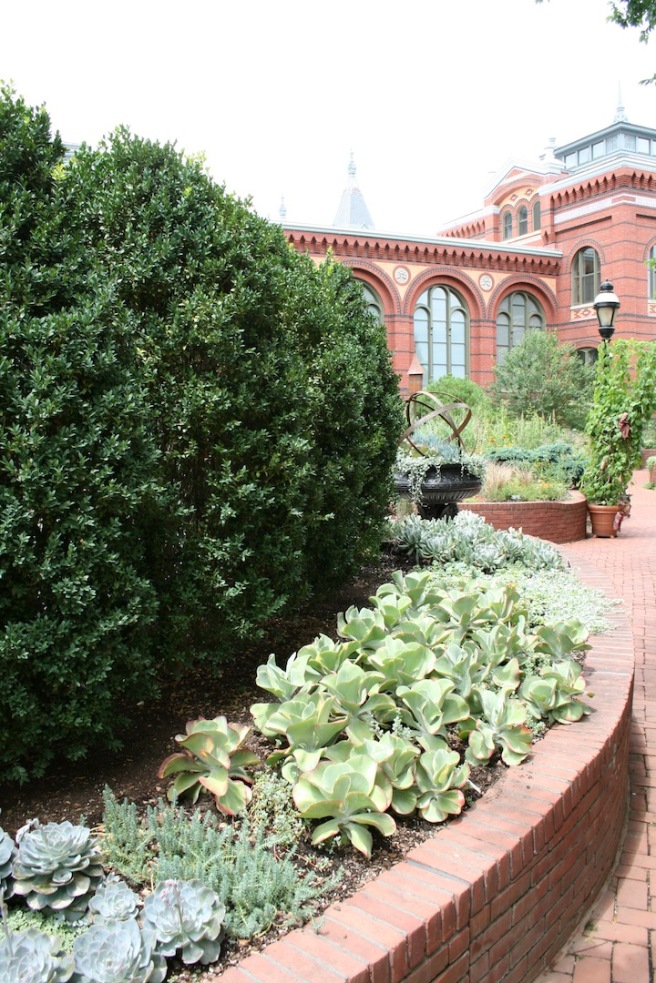
Washington, D.C. architect Hugh Newell Jacobsen set the stage for a still evolving collection of perennials, annuals and tropicals with his curvilinear brick walkway flanked by serpentine raised beds. His use of red brick echoes the surrounding buildings and grounds the long narrow garden.
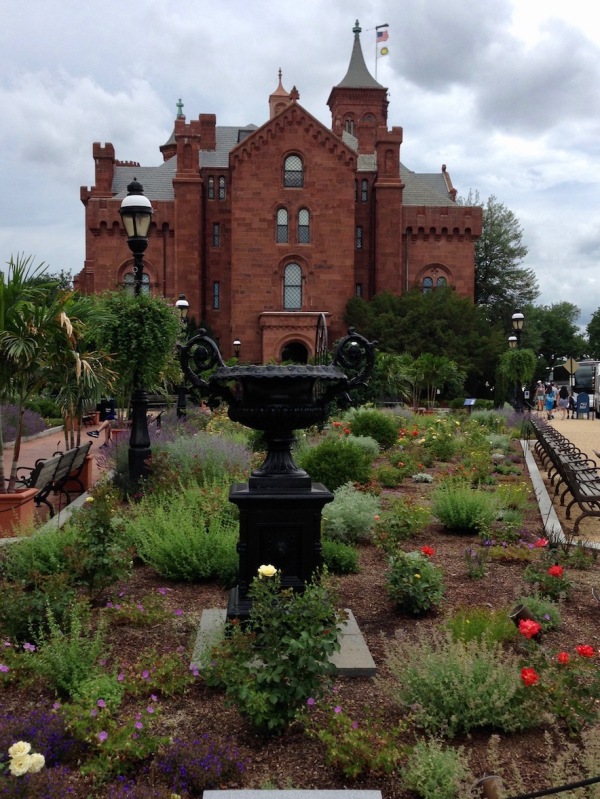
As you enter from the National Mall end of the Ripley Garden an airy courtyard, anchored by a large fountain, offers spots to sit in both sun and shade. As with all of the Smithsonian Gardens I visited, year round structure takes the form of groups of conifers and evergreen trees and shrubs. Current horticulturalist Janet Draper states her goal for the Ripley Garden is to expose visitors to as many different plants as possible and to “expand the plant palette.” With over 200 plant varieties represented, meticulously labeled and beautifully maintained she has certainly painted a garden picture which is both beautiful and educational.
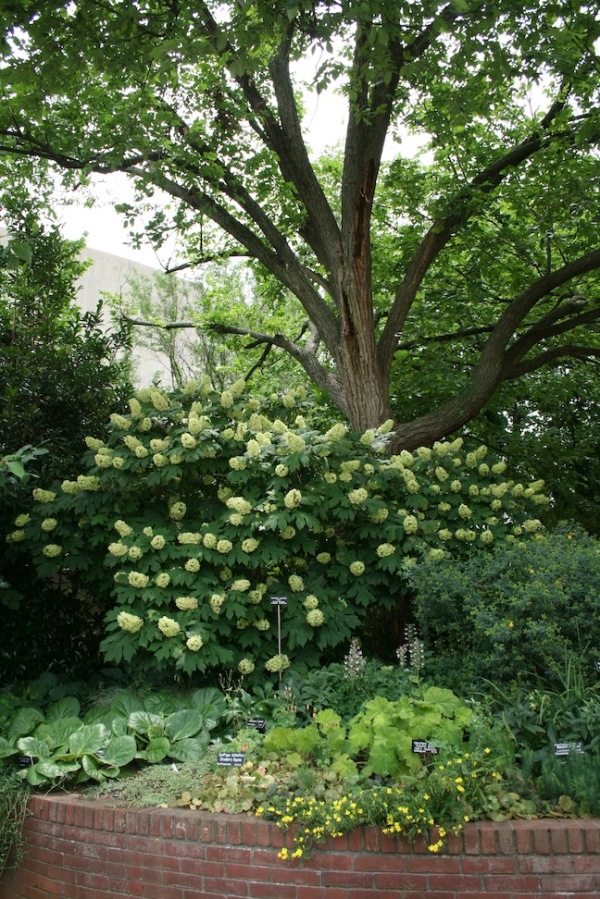
Hydrangea quercifolia ‘Alice’ reaches to the sky. Heuchera ‘Autumn Bride’, Acanthus mollis and Saxifragia stolonifera nestle at her feet.
Cistus x hybridus ‘McGuire’s Gold’ is a shining light in this plant grouping. I am going to check this one out for my garden! I love how this shrub acts as a prop for some very tall lilies planted behind it.
Here’s a great view of the winding chevron brick walkway which runs the entire length of the garden from the National Mall to Independence Avenue. What you can’t get a sense of is the undulation of the raised beds. At some points they are only a couple of bricks high as in this photo. At others they are raised waist high—they flow up and down so seamlessly it took me several looks to focus on the height difference.
There are blues and whites…
Chartreuses and limes…that’s Jasminum officinalis ‘Frojas’, common name Fiona sunrise jasmine on the far right.
Reds and grays–love the pop from these Caladium!
Really nicely done living wall. Smithsonian Gardens greenhouse staff design and execute all the hanging baskets and containers feature in the Ripley Garden. They also propagate the annuals and care for the tropicals and succulents out of season.
This interesting vine was new to me. Cissus discolor or rex begonia vine is being supported almost invisibly by a panel of fine chicken wire. A little research revealed that this species is a tropical and would generally be used as a houseplant in a cold winter area like Virginia. A great example of Janet’s goal to expose visitors to new and interesting plant material, in this case in non-traditional setting.
I have been seeing these ‘bug houses’ on Pinterest for awhile now but this is the only large one I have seen in person. Not willing to miss a teaching opportunity, this great sign gives garden visitors a heads up!
Hands down, the Mary Livingston Ripley Garden was my favorite of the 6 Smithsonian Gardens I saw. The original design of the curvy raised beds and brick walkways established a framework of open spaces to which structural and foundation plantings were added. Now mature, those plantings provide year round interest and a backdrop to showcase free flowing colonies of perennials, bulbs and their annual companions. This garden appealed to me as a plant collector and I am sure on every visit I would be able to see something either new to me or used in an inspiring grouping. The time and effort needed to maintain large expanses of turf or manicure bed-turf transitions can all be redirected toward creating interesting combinations of colors, textures and shapes in living plant tableaux.
Kuddos to Mrs. Livingston for pursuing her dream and creating this paradise which so easily could have become another parking lot.
2017 Capitol Region Garden Bloggers Fling participants had several hours to pick and choose among the 12 Smithsonian Gardens clustered on either side of the National Mall. I am sure Kathrine and Enid would be pleased to see the public garden spaces named for them and visited by thousands of garden and history lovers every year.
KATHRINE DULIN FOLGER ROSE GARDEN
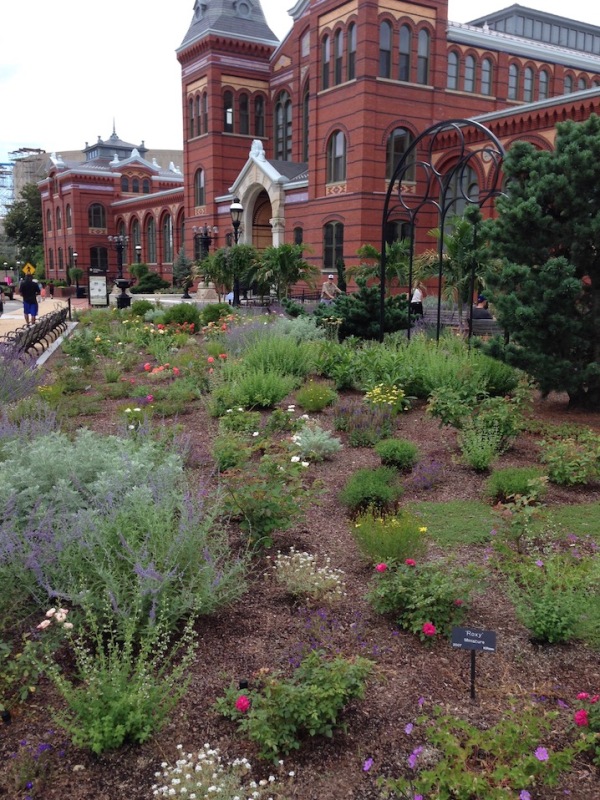
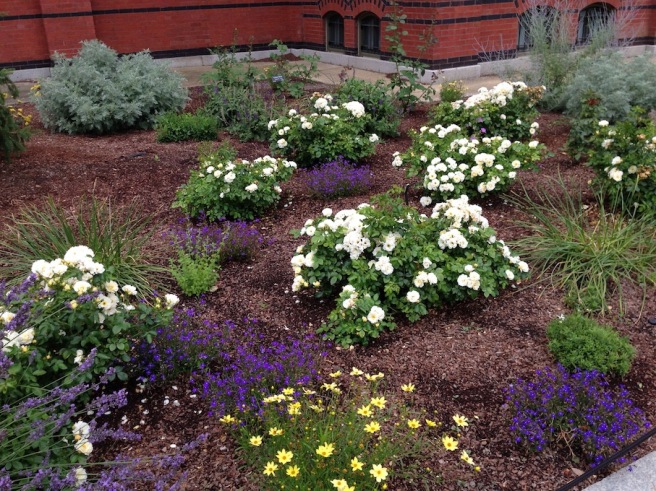
This garden is the centerpiece of the front of the Arts and Industries Building to the east of the Smithsonian Castle. The original garden was made possible by a donation from Mr. and Mrs. Lee M. Folger and the Folger Fund and was dedicated in 1998. The design called for a four season garden with specimen conifers and evergreens as anchors during winter months. Spring and summer would be dominated by an extensive collection of roses and their perennial companions. The 2016 redesign retained the four season focus and ground covers and additional perennials chosen for their ability to attract beneficial insects were added.
I will admit to some disappointment in this rose garden. All gardens have to be new at some point–I just happened to catch this one not even a full season after its renovation. Additionally, practicality has to reign sometime and the newly planted roses are almost all of the more modern shrub and drift types. This is perfectly understandable given that the Washington D.C. summer humidity inevitably fosters age-old rose issues such as powdery mildew and blackspot and these newer varieties are much more disease resistant. The newer landscape type roses also have less rigorous deadheading requirements and are probably better suited to public gardens than fussier varieties…oh well.
That being said, my nostalgia for the older, more classic multi-variety rose garden has not kept me from also going to the Knock-outs and Drifts in my own garden…
This urn along with an original 19th century three tiered fountain are part of the Smithsonian Gardens garden artifact collection.
Here’s our friend from Peace Tree Farms-Lavender ‘Phenomenal’. Lavenders are classic rose companions and this variety is used extensively in this garden. The ground cover Veronica ‘Georgia Blue’ (spring bloomer) will eventual spread to fill in around the lavender and other perennials.
Catmint (Nepeta), yarrow (Achillea) and the hardy Geranium ‘Rozanne’ hold promise as mounding ground covers.
I would love to check back in on this garden in two or three years after the mounding roses have matured and the perennials have taken hold. For now, Kathrine’s garden is new again with promises of what’s to come.
ENID A. HAUPT GARDEN
This 4.2 acre garden is actually a rooftop garden, sitting directly over the underground museum spaces of the National Museum of African American Art, S. Dillon Ripley Center, and Arthur M. Sackler Gallery. It can be reached from large gates on Independence Avenue, from entrances on either side of the Smithsonian Castle or by going out the Castle’s back door.
Philanthropist Enid Annenberg Haupt passionately supported the creation of public gardens and the preservation of horticultural institutions. Her three million dollar endowment made this garden possible as part of the redesigned of the Castle Quadrangle in 1987. The Smithsonian based Enid A. Haupt Fellowship in Horticulture is a much sought after academic opportunity.
The garden is actually composed of three separate gardens: the Parterre, the Moongate Garden Center and the Fountain Garden, each reflecting the adjacent architecture and the culture of the museums below.
As I entered the garden from the east side, the skies opened up and I sprinted to take shelter outside the African Art Museum. An inviting seating area complete with market umbrellas offered me a bit of protection from the shower and I got the opportunity to see several amazing potted plant specimens. The limited soil depth (remember we are standing on top of underground museums) and protection provided by the surrounding museums creates a microclimate milder than is typical of the region. I am reasonably sure none of these would be winter hardy if planted in the ground without shelter from the cold.
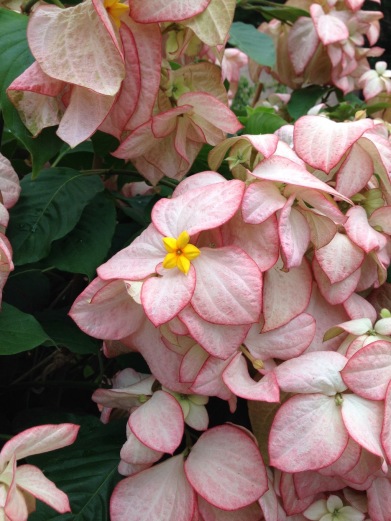
This gardenia was at least 12 feet tall and more than that wide!Look at the trunk on this angel’s trumpet.Mussaenda ‘Queen Sirikit’ –closeup of the bloom below
Just west of the museum’s entrance is the Fountain Garden, modeled after the Court of the Lions at Alhambra which is a 13th century Moorish palace and fortress in Granada, Spain.
At intervals throughout the gardens there are roof vents nestled among the foundation shrubbery, reminders of the museum activity below.
The Parterre is designed in classic Victorian style to complement the architecture of the Castle. Ornate iron borders harken to an earlier day when gardens full of fussy ornamentation and vast beds of stylized annuals were the mark of an affluent homeowner. Much of the Smithsonian’s collection of antique iron garden artifacts reside in the Haupt Garden.
A second brief shower drove me into the Castle for refuge and I never got to see the third garden highlight, the Moongate Garden Center. An interesting collection of potted specimens clustered at the buildings steps caught my attention-especially interesting was the unusual coloration on the conifer–maybe a pine?
I regret not taking time to read more about this garden before my visit. There was much to see and several interesting backstories that I missed because I did not do my research. When I return in a few years to check up on Kathrine’s roses and I will give Enid the time and attention she deserves!
And you will always count yourself as a winner! The last Friday of April on my calendar will always belong to the Gamble Garden Spring Tour in Palo Alto, CA and this year’s event was as inspiring and beautifully done as the many I have attended in the past.
I discovered the Elizabeth F. Gamble Garden and Historic Home not long after we returned to California and my husband was spending a lot of time in research discussions with a group of physicians at Stanford Medical Center. With several days and nights to fill every few weeks I explored much of Palo Alto and the South Bay Peninsula. Palo Alto’s climate is much more temperate than that of my Central Valley home and the city is home to innumerable beautiful private gardens as well as impeccably landscaped and maintained public spaces. It is also Sunset magazine country–until just last year the corporate headquarters, including both the test kitchens and test gardens, was just a stone’s throw away. For my Southern readers– Sunset is the west coast’s Southern Living!
Left to the City of Palo Alto upon the death of Miss Gamble in 1981, the property has been established as a privately funded non-profit foundation which is managed as a community resource. The Gamble Garden contains formal, woodland and demonstration gardens. It is the site for both adult and youth educational programs and a hotline/plant clinic operated by the Masters Gardeners of Santa Clara County. This amazing garden also partners with Children’s Librarians from the Palo Alto City Library in hosting monthly children’s story times.
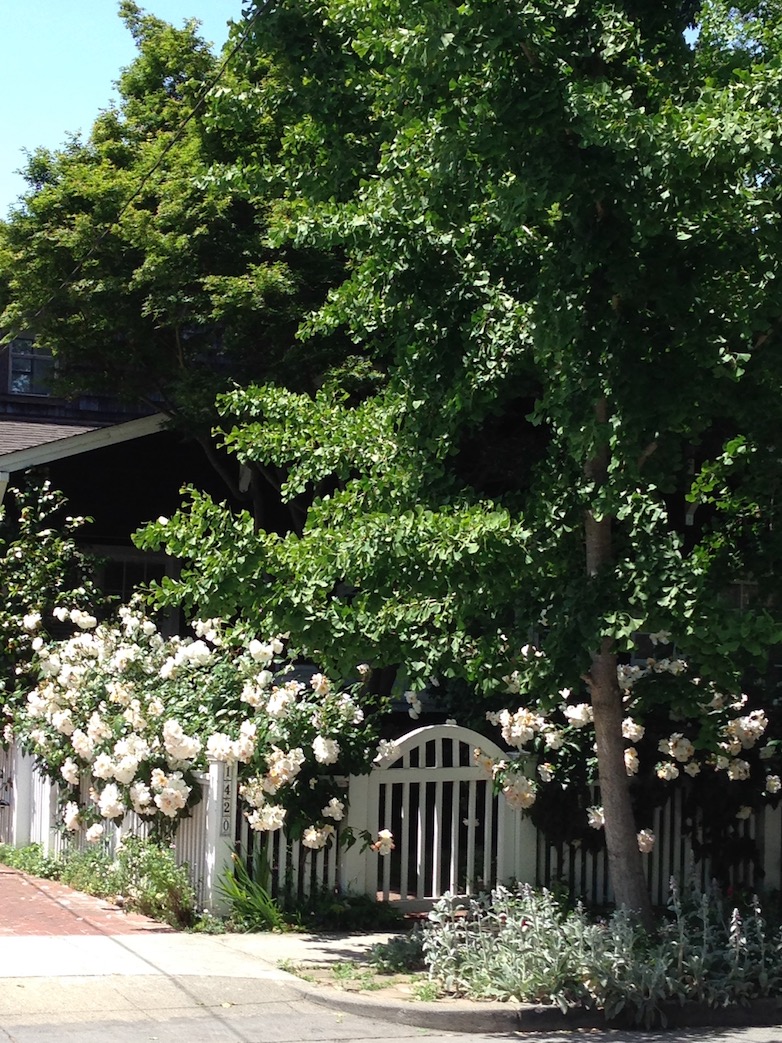
The 2016 Spring Tour included 5 private gardens, the Gamble Garden, a Marketplace and plant sale and much more. This year’s theme was “Gardens are for Living” and highlighted activity filled and family friendly outdoor spaces. One of the most appealing and rewarding characteristics of the homes chosen each year has been their ‘walk-ability’. This year three private homes plus the Gamble Garden were all within a 6-8 block radius. The Gamble Garden is in a jewel of a residential area with interesting homes of all shapes and sizes, many dating back to the 1920s. The neighborhood clearly values its outdoor spaces and is tremendously proud of the beautiful gardens on every street. It is a mecca for interesting fences, gates and garden art. So as you walk along with your tour booklet in hand, anticipating the next garden stop, you have the opportunity to see close-up all of the other homes and gardens along the way! It’s a time to take photos of plants or architectural details you admire, chat with your tour companions on a lovely spring day and meet and greet other folks doing exactly the same thing. My little group of four spent about a block chatting with a painter headed to a job site and also got a sneak peek at a monumental renovation as one of the construction bosses headed back to work in inside the gates. As our last two homes would take us to a different neighborhood requiring a new parking place there was the perfect opening for a little lunch on the way.
Garden tours are never optimal for taking wide view photos as the gardens are filled with visitors, many of whom are trying to do the same thing. Here are a few highlights for you to enjoy just as if you had been strolling along with us!
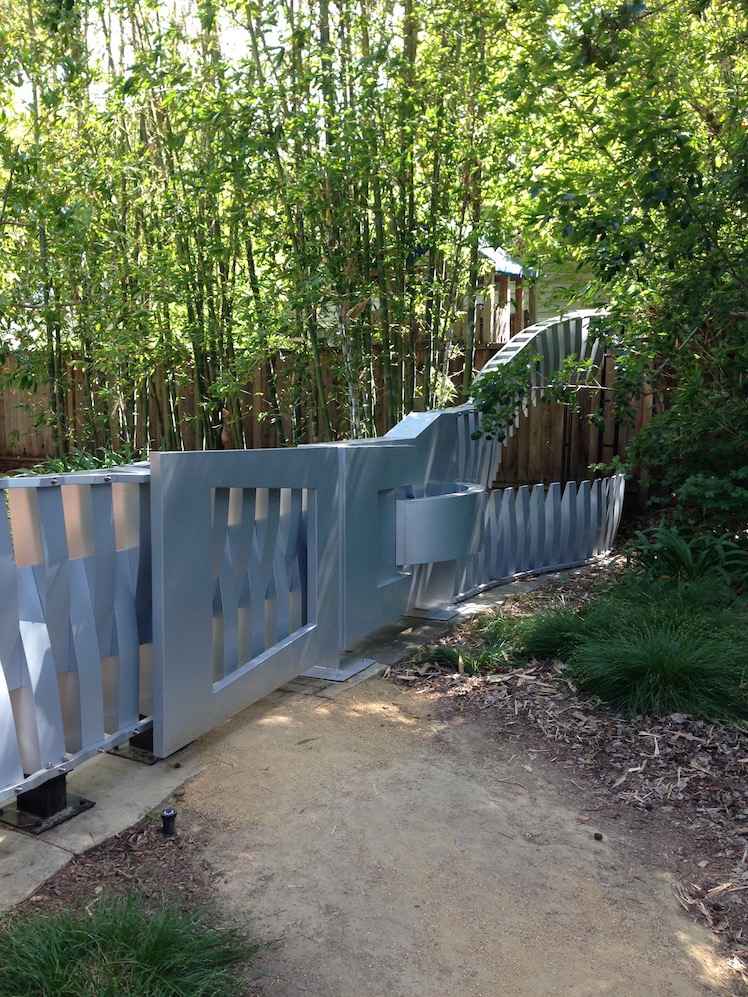
A single residence blends this very traditional arbor successfully with this unique sculptural fence and gate. This homeowner has developed a very personal garden space which includes a front yard labyrinth, many stone and metal sculptures, a diverse array of perennials and mature trees and an underground cistern which stores rainwater captured from the gutters. The zipper sculpture/fence was featured on HGTV in 2004—the tab on the zipper is the gate!
A narrow lot and side set front door makes the entrance to this lovely home’s back garden not much wider than a footpath. I was amazed when the vista widened to a beautiful and large open space which included a pool, small playhouse and many interesting plantings. The owners enjoy a serene outdoor eating area tucked up against the house where adults could mingle while the young ones have a spacious area to run and play. This gigantic bougainvillea climbing the front facade gives you a hint at the tropical flair throughout the property.
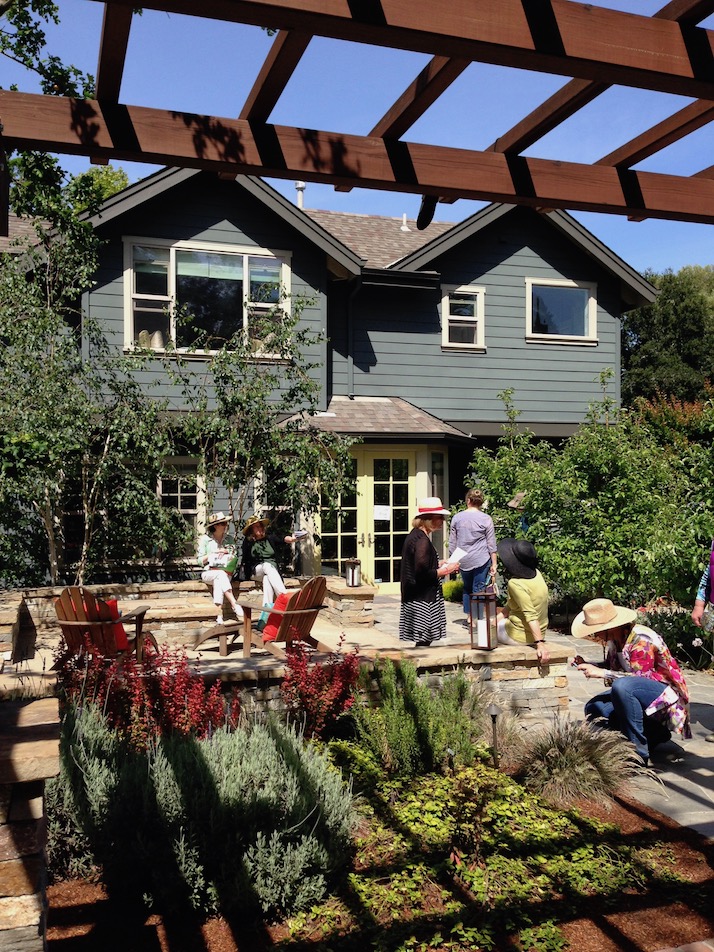
Ok, guys, are you listening out there? This landscape designer/homeowner redesigned his back garden as a series of rooms for year-round outdoor living as a Valentine’s Day gift for his wife. The spaces include an intimate fire pit close to the house, many stone sitting walls and a stunning kitchen flanked by a gracious dining area, both covered by a pergola. The view you see above left is from the dining area back toward the home. The homeowner chose many California natives and designed the landscape to provide food, flowers and shade. Loved this entire space!
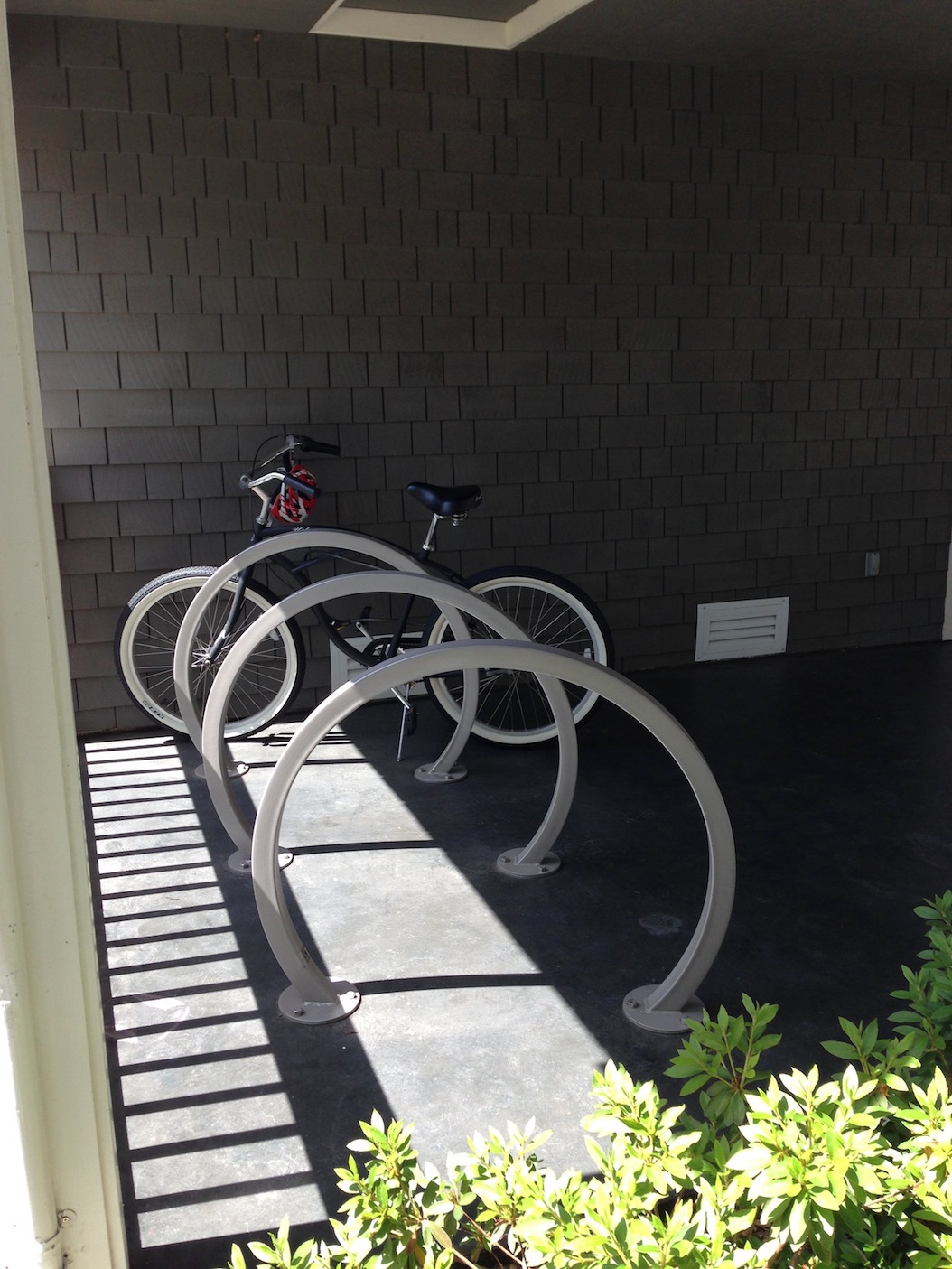
Traditional architectural elements in the garden echoed those found on this stunning gray shingled colonial home. Above you see the side yard transformed into a kitchen garden using raised beds and gravel pathways. The back garden featured an outdoor kitchen and play structure. I loved these very cool permanent bike racks placed just off the garage wall.
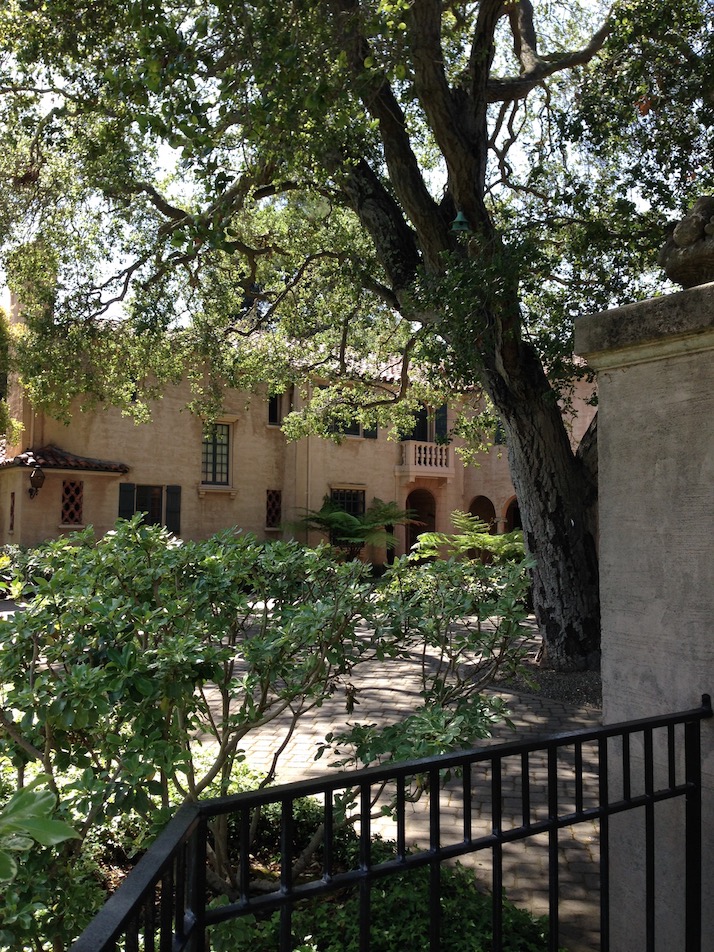
Now here are a few of the beautiful homes and garden elements we passed as we walked the tour route–I hope we will get to see some of these on future Gamble Garden Spring Tours!
Now that borders have been crossed and delayed luggage has been delivered there’s a bit of time to share with you my final FLOWER FRENZIED experience of this past week in Vancouver and Victoria, British Columbia.
With three very different garden adventures on my trip’s itinerary and no advance plan for the order in which I would do them, I now think their order was providential in giving me an interesting progression of the gardens’ purposes, design aesthetics and plant materials.
The UBC Botanical Garden, by its very nature of being university and research based, is very specimen centered. There is little to no disturbance to the naturally forested area in which the garden has been developed and plant colonies/collections are allowed to grow and fill areas relatively naturally. Even though not all plants are natives and there are several areas devoted to plants growing in special type of geography, i.e. the Alpine collection, the overall vibe is calming and very natural. Many visitors come daily to stroll, read or just relax. For me it was a close-up garden and I spent a lot on time on my knees examining individual specimens and exploring their leaf and flower characteristics.
The VanDusen Botanical Garden grew from a community’s desire to maintain open and public spaces within the confines of a busy metropolitan area. The founders saw an existing parcel of no longer used land as a perfect backdrop for building a botanical garden by adding not only shrub and perennial plantings but also many specimens and groupings of deciduous and evergreen trees. Structures, hardscape paths, water features and sculptures all provide focal points which both harmonize with and are in contrast to the planted areas. They also make the garden very sought after for private and public events, thus increasing its use by the city’s residents. This garden offered me many opportunities to view and photograph a variety of plant combinations, both color and texture, and take some of these companion ideas home to try out on a smaller scale.
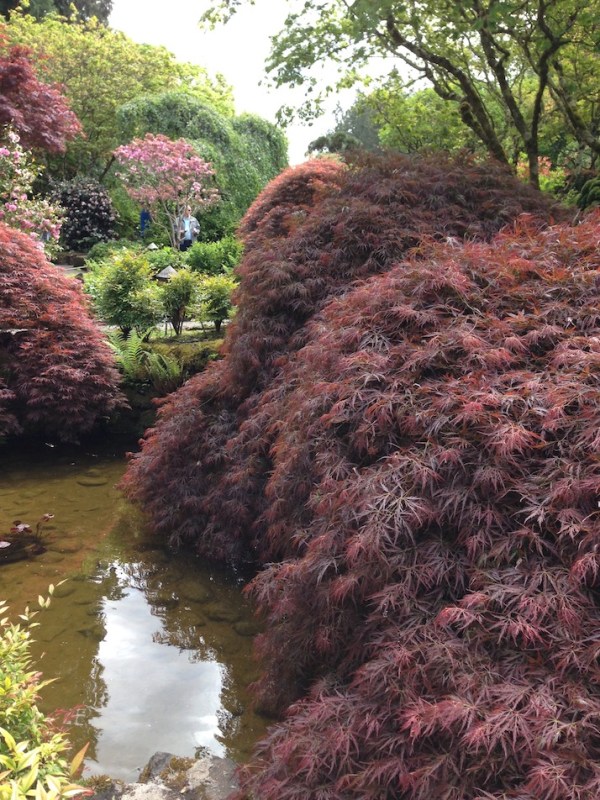
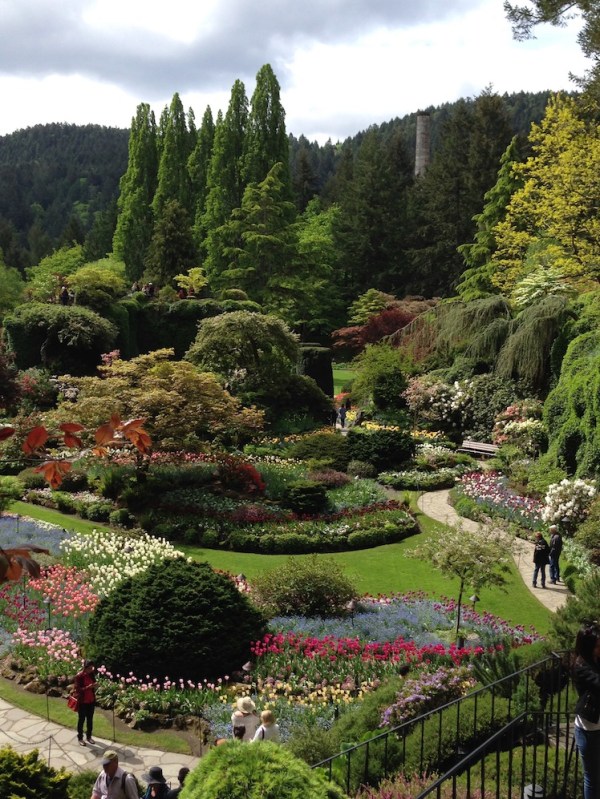
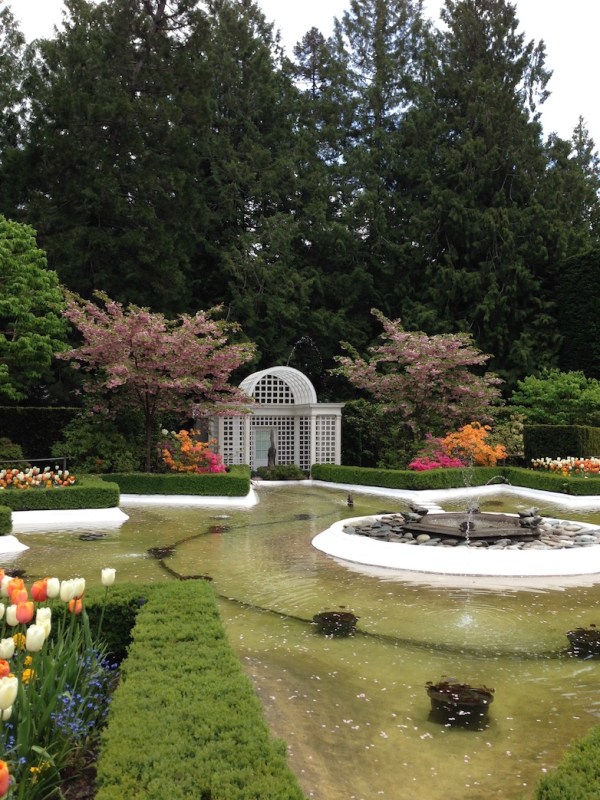
My final garden stop was the awe inspiring Butchart Gardens in Victoria, on Vancouver Island. Dave took time off from his conference to join me and after being the lucky last car on the ferry and enjoying the beautiful vistas as we cruised the bay, we found ourselves driving through rolling farmlands to see one woman’s backyard garden. Jennie Butchart’s vision for a way to use a played out limestone pit and block the view of her husband Robert’s cement plant has evolved over many decades to be an attraction of almost Disney-esque proportions, minus the costumed characters and rides. The Butchart home was built in 1904 on 120 acres at the base of the Saanich Peninsula near the limestone quarry used in Mr. Butchart’s cement production. Jennie built her first formal garden, the Japanese Garden, a few years later with the help of a famous garden designer from Yokohama, Japan. The Butchart Sunken Garden was developed in the old quarry between 1909 and 1921 and Mrs. Butchart continued to add themed gardens, totally 55 acres, until the late 1920s. In 2004, the Gardens were designated a Canadian National Historic Site. These beautifully executed and maintained gardens for me were definitely long view gardens and, to that end, I offer you a few long vistas of Jennie’s dream.
Japanese GardenSunken GardenLooking up the side of the Sunken Garden wallItalian Garden
The Butchart Garden has been blooming for over 100 years and is still family owned and managed. Although it is manicured and maintained on a grand scale, there were still many “take aways” that could be executed on a much smaller scale in my own garden. Clearly, I will have to increase the line item for tulips in my garden budget by about $100,000! Having said that, I just can’t resist closing with the photos below.
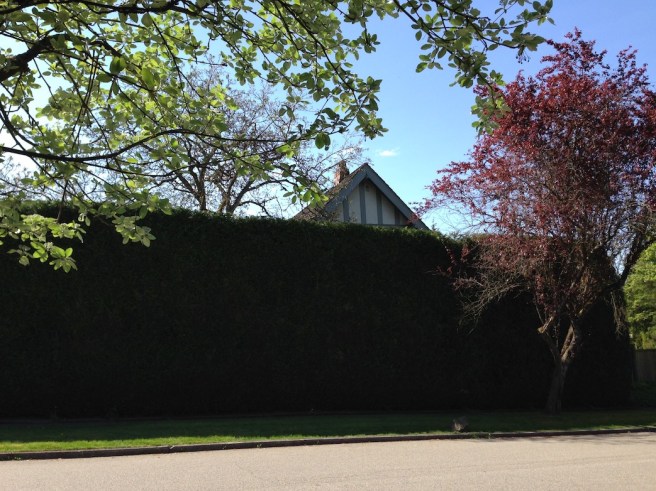
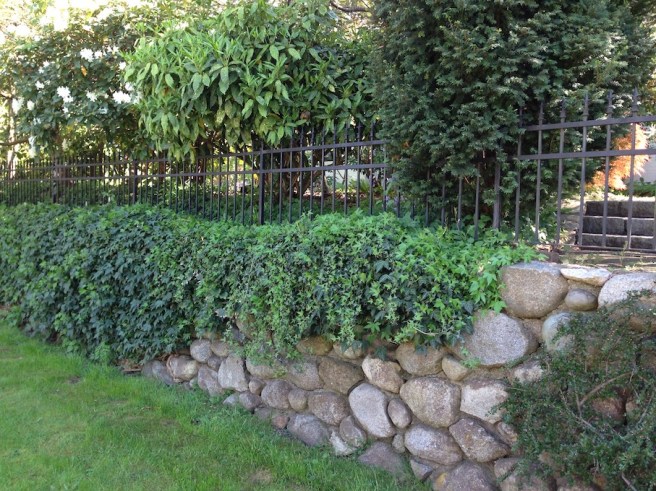
One of my favorite things to do in any city I visit is wander around the residential neighborhoods looking at both the local architecture and landscape. I had anticipated a sort of British version of upscale Seattle vibe here in Vancouver and from what I can actually see I was pretty close. My walks to and from bus stops and gardens or shops have been concentrated in the older, definitely upscale areas of the city whose residential histories range from the very late 1880s up to about the 1920s or 1930s. There are many older, very large timber and stucco homes under renovation. I am sure they were and still are beautiful if I could actually SEE them! Vancouver is a city with the “H” factor—just about every home, from petite to palatial has a HEDGE shielding its view of the street activity and my view of it. I’ve complied a few of my favorite “H” looks to share with you from my feet on the street time the last two days.
Classic cottage behind classic hedgeProbably a really big mansion behind a really tall hedge New house with a hedge in the makingVery small car in danger of being swallowed by very large hedgeSeriously gorgeous relaxed hedge of Japanese maples, rhododendrons and mixed evergreensNot sure how these folks even got into this neighborhood–they must not be from ’round here but I loved being able to see their pretty house and landscapingHedge behind a great rock wall with a nice iron fence to bootWould have killed to see this home with the great copper domeThirty foot high loosely trimmed hedge cozies up to its 20 foot high uptight neighbor–maybe they are sipping margaritas on one side and prune juice on the other…You know I have ever so many more pics from this walking tours of hedges in Vancouver but I’ll close on a serious note with this stunning mixed conifer and evergreen hedge highlighted by a lovely entry arbor covered with vines–beautiful home, beautiful hedge



















































 A narrow strip of land between the Smithsonian Arts and Industries Building and the Hirshhorn Museum and Sculpture Garden, once designated in the master plan of the day as a future parking lot, is the site of the Mary Livingston Ripley Garden. Mrs. Livingston, who was the wife of the eighth Secretary of the Smithsonian Institution and the founder of the Women’s Committee of the Smithsonian Associates, was an accomplished plantswoman and envisioned the open space as a “fragrant garden”. In 1978 she persuaded the Women’s Committee to sign on in support of her garden concept and the space became reality in 1988. In the early years of the garden Euonymus was transplanted from her home in Litchfield, Connecticut to form the east wall espaliers. The garden is supported today with funds from another benefactor, Mrs. John C. Folger, who established an endowment in 1994 for the care of the garden with the hope that others would be inspired by her generosity and add to the funds, enabling the garden to be enjoyed by the public well into the future.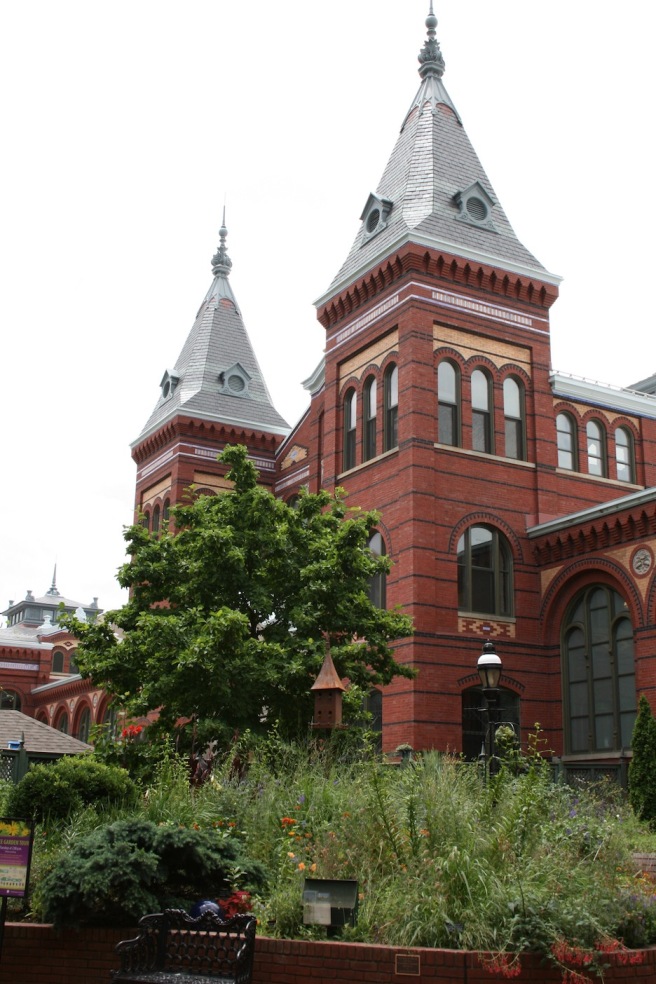




 This interesting vine was new to me. Cissus discolor or rex begonia vine is being supported almost invisibly by a panel of fine chicken wire. A little research revealed that this species is a tropical and would generally be used as a houseplant in a cold winter area like Virginia. A great example of Janet’s goal to expose visitors to new and interesting plant material, in this case in non-traditional setting.




















 Queen of the Dirt