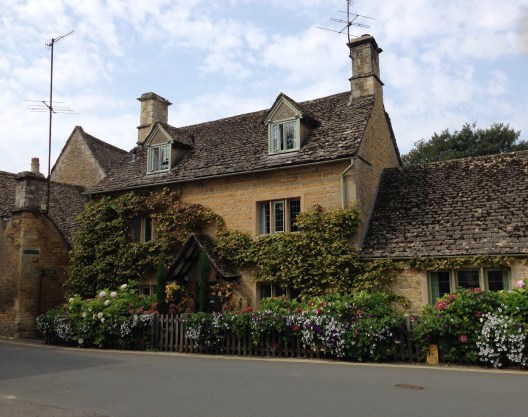
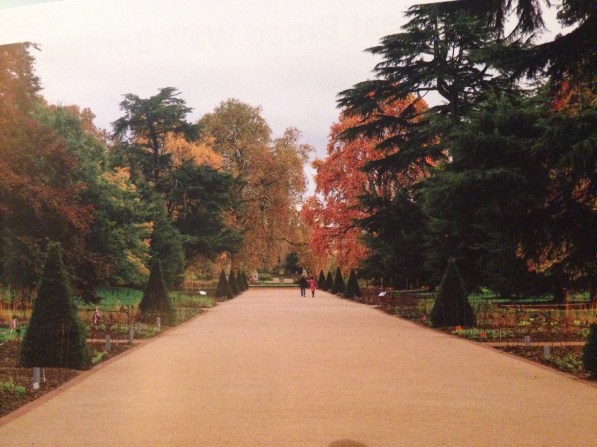
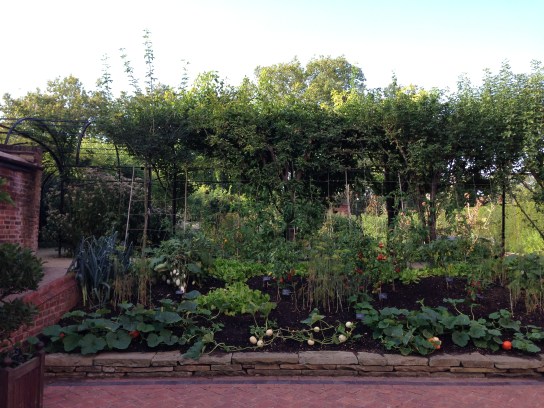
Now this is storybook England…

Today’s itinerary included a tour of three Cotswold villages followed by Anne Hathaway’s Cottage and the Birthplace of William Shakespeare, both in Stratford-upon-Avon. If the post seems to be getting too long I’ll do a separate post for Anne and Bill.

Traveling northwest of London into the countryside we immediately encounter thick, wet fog. David, our tour guide tells us this is not uncommon and that the only thing about English weather that you can count on is that you can’t count on it at all. David uses this time to give us a little history of the region we will see. The Cotswolds is a region of rolling hills and villages, often called the most picturesque in England. It encompasses 6 counties with numerous villages and hamlets filled with stone houses (many with stone roofs also) built from the locally quarried white limestone. The stone has turned a honey gold with age and the cottages looked as though they have strayed into the 21st century from another era.

The word ‘cotswold’ comes from two medieval words: ‘cot’ meaning a sheep enclosure and ‘wold’ meaning hill. During the 1500s wool production was the backbone of the economy. The British Isles has more than 50 types of sheep broadly divided into mountain sheep and lowland sheep. The mountain sheep are found in Scotland, Ireland and Wales and tend to have good lean meat but poor quality wool as they are athletically built for mountain life but tend to get pretty scruffed up in the process.  David tells us that the lowland sheep found in England, having no mountains to climb, are downright lazy and thus produce fatty poorer quality meat.  Their coats do benefit from the laid back lifestyle however and in the 1100s-1500s they produced the finest wool in Europe.  The wool was shorn and sent to Flanders where it was woven into cloth. Today the economy of this region is based on agriculture with 80% of the land being farmland. Crops include wheat, barley and rapeseed from which canola oil is produced.

Our first stop is the village of Burford known as the ‘Gateway to the Cotswolds’. Its name is derived from the Old English ‘Burh’ meaning a group of houses and ‘ford’ meaning the ability to cross a river, in this case the River Windrush, without a bridge. Burford has  about 2,000 residents and only one main road. Three eras of cottages can be seen here: Tudor from the 1400-1500s, identified by their black painted oak trusswork and white painted plaster; those built after the Tudor period but before 1700 are identified by windows which are set on the same plane as the walls and those built after 1700 have windows set back 4-5″ from the walls. I was a little disappointed to see very few gardens here and David affirmed that this area is not known for its gardens. Here’s what we saw on Buford’s main street!

img_4546
Parthenocissus of some type turning a brilliant red for Fall

The collection of finely made wooden handled brushes in this shop’s window made me want to buy one of every kind–they were works of art masquerading as cleaning tools!

Here’s that Tudor architecture David told us about–notice we are on a hill.

I still have several handled baskets like these from the time my parents lived in Wembley in the early 1950s.

Our bus was parked in front of the Burford Priory in a car park area that has existed for many years off the main road. Our guide relayed that the priory property had been purchased as a country house by Elizabeth Murdoch (daughter of Rupert Murdoch) and she has been attempting since then to have the bus parking removed! Apparently walls don’t make good neighbors…

img_4567
Burford Priory

Onward to our next Cotswold stop–the village of Bibury which lies on both banks of the River Coln, a Thames tributary. This village dates to 1130 and is the scene of the accidental discovery of a Roman villa in 1880. The village has only about 40 homes and businesses, two of which are hotels.
img_4575

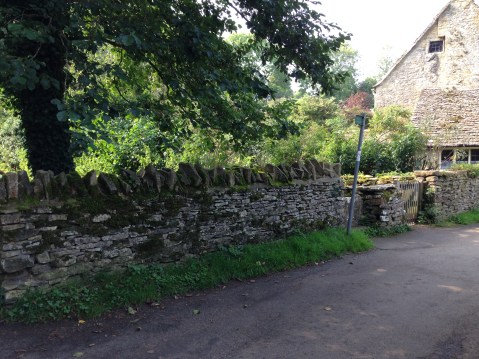
Dry stacked stone walls like the above are found all over the Cotswold region and there are many beautiful examples in Bibury.

img_4573
Arlington Row Cottages

The picturesque Arlington Row cottages above were built in 1380 as a monastic wool store.  In the 17th century they were converted into a row of cottages for weavers producing cloth for the Arlington Mill on the River Coln. These cottages are depicted on the inside cover of all UK passports and are a nationally notable architectural conservation area.

img_4594

The Arlington Mill still stands on the river but is now a private residence.

The Bibury Trout Farm has lovely gardens, much of which are right along the river to be enjoyed by all. The Swan Hotel also sits on the shallow river’s bank allowing visitors to stroll anywhere in the village within 5 minutes or so. Bibury is perhaps the most beautiful village I have seen in all my European travels.

After a rich ice cream cone from a local vendor we are back aboard our coach heading down NARROW country roads toward our last Cotswold District stop–a village called Bourton-on-the-Water. This village’s name comes from the Saxon ‘burgh’ meaning fort and ‘ton’ meaning village. Evidence has been found of an earlier Bronze Age settlement which may account for the name. The water in this case being the River Windrush. This village seems almost a metropolis compared to the previous two! Burton-on-the-Water is the civil parish for the county of Gloucestershire and has about 3,200 residents. This charming village is known for High Street. Long wide greens flank the shallow River Windrush which lies right next to the street in the heart of the village with businesses and shops on both sides. Families with toddlers and uniformed school children play and rest on these lawns with a few brave little ones wading in the river. Our guide David told us that on the hottest days residents are known to play football in the river which is now no more than ankle high. Clearly a vacation destination for Brits and foreigners alike there are many guest cottages and small restaurants with outdoor seating. We have time to wander on our off this main thoroughfare and it is just as charming at every turn.  Take a look!

Five low, arched stone bridges cross the River Windrush allowing residents and visitors to access both sides of the villages main street.


img_4609

There is no shortage of honey colored stone in Bourton-on-the-Water! Even the new additions needed such as the dry stacked wall leading away from the village center to an unseen parking area has been made to blend in with the ancient structures. Narrow lanes and cottages small and large beckon you to stay awhile–I could certainly spend a few idyllic weeks in any of these three Cotswold villages with a bag full of books or a basket of appliqué and never get tired of the beautiful views, cool clean air and very hospitable townspeople.

I will leave Mr. and Mrs. Shakespeare for a short post tomorrow. You are free to go about your day as usual while planning your Cotswolds adventure in your mind’s eye…

Kew #2…

With my head still buzzing I quick step back to the Victoria Gate to meet my guide Jane for the tour of the Great Broad Walk Borders, just reopened this summer after a 3 year renovation project.  To get both history and perspective of the borders, at 1,050 ft. long purported to be the longest double herbaceous perennial border in the world, Jane starts our tour at the Palm House.

img_4385
Palm House with Parterre Garden in front

Standing on the steps of this immense glasshouse Jane told us the origins of Kew can be traced to the merging of the royal estates of Richmond and Kew in 1772 and that until 1840 is was primarily a pleasure garden for the royals. In that year Queen Victoria agreed for the park to be taken over by the state and be opened to the public. William Hooker was appointed as director with the mandate to develop Kew for public use. By 1844 the arboretum had become overcrowded and landscape architect William Nesfield was commissioned to redesign the landscape. The Palm House was to be the focal point of the gardens with vistas radiating from it and a parterre to be built between the house and the existing pond. The basic structure of his redesign still exists today.

The Parterre Garden spans the length of the Palm House and is planted twice annually. Nesfield’s redesign of the formal gardens coincided with the time Victorians were in love with elaborate displays of bedding plants and the Parterre was considered to be such a display for those who did not have the resources for their own. The word parterre means ‘on the ground’, these gardens being meant to be viewed from above. I am holding the photo on the left in my arsenal for whenever Dave gets really cranky about garden maintenance–I will tell him that he is a lucky man as he could be trimming the grass around all THESE elaborate beds by hand!

As we move away from the Palm House toward The Great Board Walk Borders a question is asked about how the tropicals were kept warm in the glasshouse in the 1800s. Jane points out a tall brick tower far across the pond (really a lake) and relays that a tunnel was built from the tower to the ground beneath the glasshouse where the coal fired boilers were located. The tunnel acted as a passageway for coal to be delivered and as a flue to carry the smoke underground and out through the tower acting as a chimney.

The brick tower is highly decorative. The right side photo was taken from about 20 feet in front of the chimney–an amazing distance away from the glasshouse across the pond!

As The Great Broad Walk Borders were designed to be a grand processional to the Palm House from the historical main entrance at the Elizabeth gate our group swings wide through the surrounding trees to reach the top of the border and make our approach as if we were visitors to the gardens in the 1800s. This gives Jane an opportunity to tell us that the border was originally rhododendron and small seasonal plants in kidney shaped beds with a backdrop of Deodar Cedar (Cedrus deodara) trees. The Deodors gradually died out (only 3 remain) as they were just not suited to the English climate and were replaced with American Tulip trees in the 1930s. All but two of those trees were lost, along with over 1,000 others, in a huge storm in 1987. In 2000 the avenue of cedars was restored, this time using Atlas Cedar (Cedrus atlantica), which is more drought tolerant. Various border planting schemes had been tried in the late 20th century but none had achieved the desired effect. In 2013 the current design was finalized and the restoration project begun.

The Broad Walk path is 26 feet wide. A series of 8 circles, bisected by the path are joined to form one continuous planting area down each side of the Broad Walk. The shape is like a bean pod and inspired by the largest seed pod in the legume family, Entada giga, commonly know as the Sea Bean. Each circle bed has a different theme and all are planted with a variety of herbaceous perennials. Topiary yew trees (Taxus baccata) were included along each side to emphasize the perspective as you look down the path from either side and to bring some formal evergreen structure to the borders.

img_4704

This photo from the Broad Walk guide was taken in autumn 2015 after the yews were planted but before the perennials had established and gives you an idea of the perspective the designer was seeking to establish.

As we neared the top of the Broad Walk my guide pointed out two trees of interest, neither of which photographed really well but I want to share them with you even if you have to use your imagination a bit:

This Japanese Pagoda tree (Styphnolobium japonicum) dates to 1760 around the time the Pagoda folly was added to the gardens. It has grown in a horizontal fashion and has been propped up by various methods for more than a hundred years–can you see the brick support in the picture on the right? That one was added in the 1840s. The supports at the top end are steel and much more recent. It is fenced now for its preservation and protection.

The Weeping Birch in this photo is a single tree, planted in 1846, rather than the colony of trees it appears to be. The tree’s graceful branches cover the ground of an area over 100 feet across. In the photo on the right I am standing under the tree near its main trunk and you can clearly see that it is now being supported with steel beams to relieve the tree of the weight of its many branches. It is underplanted with thousands of shade loving bluebells and must be quite a sight in the spring.

Let’s take a walk down The Great Broad Walk Border! The first and largest of the circles is planted with long swathes of colorful CULTIVARS that have been well-proven as garden worthy plants. It is a nod to botanists and hybridizers whose goal was to bring easy to grow and care for plants offering bold blooms, forms or scents.

Left: Aster ‘King George’ in the foreground, Kniphofia ‘Tawny King’ just behind then Rudbeckia  fulgida var. deamii and Euphorbia palustris

Right: Penstemon ‘Firebird’ in the foreground, Geranium ‘Orion’ and many more

The next circle is planted with members of the MINT family (Lamiaceae), such as sage (Salvia), lavender and catmint (Nepeta). Many contain essential oils that give them aromatic foliage, and also have medicinal and culinary uses.

Left: Agastache ‘Firebird’ in the foreground, Salvia ‘Maroon’ and Perovskia ‘Blue Spire’ in the background

Right: Salvia ‘Serenade’

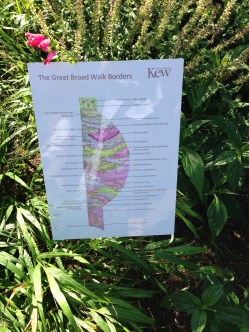
Just a note about plant identification–Kew has not marked individual plants in these borders. Instead they have colorful identification guide plaques for each section like the one below.  Unfortunately they picture the bed vertically rather than having the photo run the same way as the bed and so I found them really hard to read.  I did my best to get the right names for you!

img_4429

Members of the DAISY (Compositae) family fill the next circle. This family has over 25,000 species and includes asters, daisies, sunflowers and more.

Left: Helenium ‘Loydser Wieck’ in the foreground, Aster x frikartii ‘Monch’

Right:  Eurybia divaricate (White wood aster) cloaks a young climbing rose

Take a look at the finials which top the climbing rose support whose base you see in the above right photo. Their cedar cone shape plays homage to the original avenue of cedars planted along the walk.

img_4418

The fourth circle is devoted to plants classified as MONOCOTYLEDONS, or monocots. Research at Kew on monocots, whose seeds germinate with only one seed leaf is wide ranging. Daylilies (Hemerocallis), Crocosmias and many summer flowering perennials fall into this group.

Left: Alstroemeria ‘Indian Summer’   Right: Echinacea ‘White Swan’

Circles 5, 6, and 7 highlight different plant characteristics. PLANT LIFE CYCLES are the focus of circle 5 which features a variety of annuals, perennials and biennials.

img_4426

BEE FRIENDLY specimens fill circle six.

Circle seven features flowers with varying types of SEED DISPERSAL mechanisms. Finally,  in the last circle, in the SHADE on the only two remaining American Tulip Trees are plants that are tolerant of lower light levels such as ferns, anemones and hellebores.

We’ve come to the end of The Great Broad Walk Borders all too soon for me. There is so much more to see here at Kew Gardens and it deserves another day I just don’t have! I’ll leave with with these vignettes from around the grounds.

NEXT UP: The Cotswolds and Stratford-upon-Avon

Queuing for Kew…

Just to set the record straight…there was no queue. I just could not resist the fun title. On the topic of titles let’s this garden’s right straight off. My visit was to Royal Botanic Gardens, Kew. Dave left early for his meeting venue and I followed shortly heading to the London Underground. Kew is quite far out from the Central London area, requiring a line change and a total travel time of about 45 minutes. The last few stops are above ground with simple station platforms reminiscent of a bygone era. When you alight at Kew Station you have clearly left the hustle and bustle of the city and entered a quaint English village  like those we have all seen on PBS and BBC for years. It was very much a sigh of relief for me after several days on the run, trying to figure out how to get where we wanted to go and not get run over by a bus or taxi in the process!

img_4370
Kew Station

A brief walk takes me to the Victoria Gate of this world class botanic garden. This 326 acre park offers more attractions and highlights than anyone can cover in a single day. After consulting with a docent I decide to buy a ticket for the Kew Explorer, a hop-on, hop-off land train which circles the garden and offers me a solution for seeing some of the more outlying areas without my legs falling off and sort of get a peek at everything before I commit my brief time here to any specific part of the garden.

I was able to get a sense of the Woodland Glade, Holly Walk, Berberis (Barberry) Dell, Redwood Grove, Conservation Area, Oak Collection and Rhododendron Dell while on the train and did not feel the need to explore them on foot. These are all very large scale plantings and were better viewed from a distance, freeing up more time to focus on other garden areas.

I hopped off to spend a bit of time at the Japanese Gateway and Pagoda. The Pagoda, one of many follies in the garden, was completed in 1762 at the height of the 18th century craze for Chinoiserie. The ten story octagonal structure has lost its elaborate detail after so many years and is undergoing a two year restoration project. Its neighbor, the Gateway of the Imperial Messenger, is a 4/5th replica of the Gate of Nishi Hongan-ji in Kyoto, Japan. The gate was created for the Japanese-British Exhibition held in London in 1910, then dismantled and reconstructed near the Pagoda in 1911. A small Garden of Peace offers an area of tranquil respite and completes the Japanese landscape.

My next stop was Kew Palace to see the Queen’s Garden and the Royal Kitchens. The Queen’s Garden sits between the palace and the banks of the River Thames. However they are fully walled and you do not even recognize that the river is there until you view the formal garden from the Palace’s upstairs windows. The house started its life as the home of a Flemish merchant. It was purchased by King George II for Queen Caroline and their children in the late 1700s and will always be associated with the illness of their son, George III. The Kitchen Gardens bear witness to the never-ending search for a cure for his ‘madness’ with all manner of medicinal plants being grown in addition to the edibles for family meals.

img_4474
Queen’s Garden

Leafy allees lead to the Kitchen Gardens, also formally laid out with a center axis. The garden’s medicinal plants are well labeled, including information about the ills for which each plant was believed to have curative powers. The source of George’s supposed madness remains elusive.

img_4484
Edibles are planted closest to the entrance to the kitchens

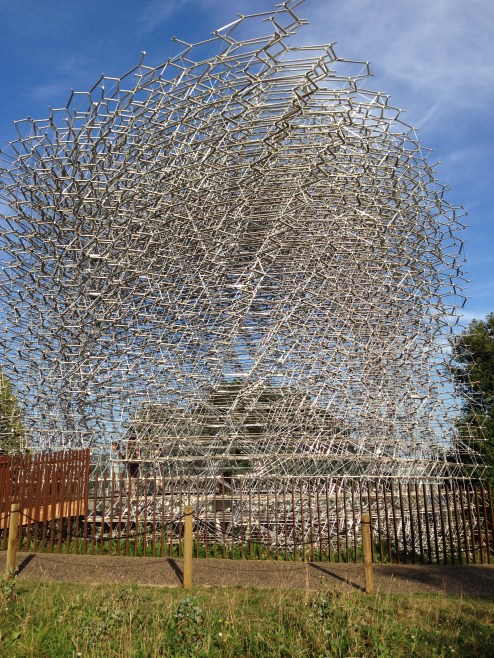
I had signed up for a 2 pm tour of the newly completed Great Broad Walk Borders and had just enough time for one more hop-off the Explorer, this time at another new must-see at Kew-The Hive. Artist Wolfgang Buttress was commissioned by the UK Government to create this multi-sensory installation which formed the centerpiece of the UK Pavilion at the 2015 Milan Expo. The structure rises to almost 65 ft. and highlights the importance of pollinators to the world’s future food security. The Hive allows visitors to step inside the life of bees in hopes of inspiring us all to join in the battle to save the bees.

img_4510
The Hive

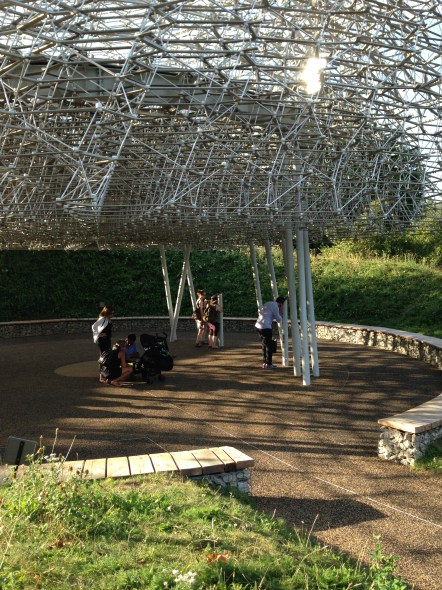
The research of Dr. Martin Bencsik (Nottingham-Trent University) on bee vibration and communication patterns inspired the artist to create the structure which stands in stark contrast to the many centuries-old buildings at Kew. You enter The Hive from a circular path set into a wildflower meadow. The installation is made from thousands of pieces of aluminum which create a lattice effect.  It is fitted with 1,000 LED lights that glow and fade as a unique soundtrack hums and buzzes around you. The lights are in fact responding to the real-time activity of bees in a beehive located near the Orangery in another part of the park. Vibration sensors called accelerometers have been place within the beehive The sound and light intensity within The Hive changes as the energy levels in the real beehive ebb and flow.  It is a surreal experience to stand inside the hive and experience the life and energy of bees. The Hive’s honeycomb structure weighs 40 tons yet seems light as air.

To stand inside with the floor almost disappearing below you and the hive rising high and open to the sky above is an experience not to be missed. To add to the experience, bone conductors have been installed in the space beneath The Hive. These convert the sound into vibrations which, when touched with the wood stick provided, travel directly to your skull, and represent the secrets of bee communication through vibrations.

img_4515
Feeling the bees’  vibrations through bone conduction

Kew’s Year of the Bee offers many Hive activities and educational opportunities to learn about Britain’s bees and the plight of bees worldwide, how to be bee friendly, the power of pollination and creating wildflower meadows.  There has even been a special opportunity to experience The Hive at dusk–so sorry I missed that!

NEXT UP: KEW #2 The Great Broad Walk Borders, a little Kew history and MORE!

More of London’s (and my) past…

We started our day by spending a few hours in the British Museum so Dave could commune with the ancient Egyptians for a bit. Our hotel is only two blocks from the museum’s gate so it was an easy journey on a day forecasted to be unseasonably warm for London in mid-September. Not so much a gardener’s dream but pretty impressive nonetheless.

Our plan was to next travel to the Tower of London on the city bus–new territory for us as we have only ridden the Underground (tube) until now.  We made a small walking detour in search of a small garden behind St. Giles Church called the Phoenix Garden. I discovered this garden listed on the website TimeOut London in an article called Secret Gardens of London. Described as a small walled garden reached by walking down an almost hidden alley beside the church it was a bit challenging to find! Unfortunately a sign posted told us it was closed starting just the day before for some hardscape restoration and the addition of a new, larger and more easily seen entrance. Drat!

Back on track for the Tower we took 2 buses as the day warmed considerably. My desire to see this piece of England’s history stemmed primarily from a 1954 photo I have of my older sister and I holding hands with one of the Tower’s guards. That’s me on the left!

img_4214

We took the tour which was lead by a Yeoman Warder (often called a Beefeater), saw the Crown Jewels and walked the walls of the Medieval Palace. I then approached one of the Yeoman Warders and showed him my photo. I learned several things–the first being that my mother incorrectly identified the Yeoman in the picture as a Yeoman of the Guard when he was actually a Yeoman Warder like the gentleman I was speaking with.  A Yeoman Warder is a full-time  job working only at the Tower. There are only 37 Yeoman Warders at any time and they must have 22 years distinguished English military service and have achieved a certain rank to be considered. They are part of the Queen’s bodyguard service. A Yeoman of the Guard is only called to service a few times a year for ceremonial purposes.

The Yeoman Warder I was speaking with immediately noticed something unusual about the uniform in the photo and asked if he could show my photo to the Yeoman Warder Archivist, David Coleman. I agreed and he was called. Mr. Coleman was very excited about the photo, asking for permission to copy it.  He told me that the uniform was from a period for which they have almost no photographic record. He pointed out that the crown on the uniform was still the King’s Crown but the letters below E II R are that of Queen Elizabeth. When the Queen was crowned a new style/shape of crown was designed for the uniforms (see the difference in the photo below.) My parents had arrived in England only a few months before Elizabeth’s coronation in June 1953. Mr. Coleman surmised that probably due to post WWII financial restraints only the letters were changed from G R (for King George) to E II R for Elizabeth with the old crown remaining until until it was financially feasible to replace. He shared that he was developing a project on the Yeoman Warders of the post WWII era and thought my photo could be an addition to that documentation. What fun! And really not a shrub or flower in sight!

img_4355

Here a just a few other photos from our Tower experience.  The first was taken in about the same spot as the one from 1954. You can see in the first two the interesting juxtaposition of the centuries old Tower architecture with the modern glass building. The final two smaller photos are of the Tower Bridge which crosses the River Thames just to the east of the Tower walls.

img_4345

img_4346

Oh, by the way…later the BBC News told us the day had been the highest temperature day in September in over 100 years–I guess we brought that Central California heat with us as a gift.!

NEXT UP: QUEUING FOR KEW…

Stepping into England’s story…

Not every sight we take in on this London adventure will have a landscape rich with Penelope Hobhouse cottage beds or trees and houses hundreds of years old–not sure why but it seems my husband has a few venues he wishes to see in his few free days before work calls him back.

We board our bus (called a coach on this side of the pond) early in the cool morning air for the 2-1/2 hour ride to the English Heritage site of Stonehenge. It seems to take remarkably long to get from our central London hotel to the point where the city meets the countryside. From there it is open road with only broad, flat fields to the right and left. Rolled hay, sheep and cattle dot the fields which are so green they almost look painted.

Stonehenge, also a Unesco World Heritage site, is an ancient temple aligned on the movements of the sun.  The stones were raised 4,500 years ago by sophisticated prehistoric people. I was amazed to learn that archeologists believe that there is just as much stone deep in the ground as we see above ground and that much of the site remains unexamined for burial remains.

There is a pathway to follow all the way around the stones and an excellent audio guide giving you historical and cultural information at designated spots. Access to the site is somewhat controlled by holding back groups to not overcrowd the perimeter at any one time. Visitors are remarkably quiet and respectful as they view the stones. The stones and their story inspire quiet reflection and awe at the feat it was to get them there. The gray sky and strong breezes intensify the spiritual nature of the site.

English Heritage and the National Trust’s (managing the surrounding landscape) restoration and transformation of the site from earlier ‘improvements’ return a sense of context and dignity to this marvel of human endeavor, leaving Stonehenge surrounded only by grass and reunited with its ancient temple approach called the Avenue.

Note to my fellow Fresno gardeners–I can’t help but believe that if we had these marvelous stones in our midst that we might lay them on their sides, bring in a mature olive tree to plant behind them and just scrape the ground around them raw with a hula hoe.  What do you think?

The pharmacist and the physic…

Less than 24 hours after our plane touched down at Heathrow we are visiting our first true London garden–not quite a record for me in a foreign country, but close.  I just could not see enough of the Buckingham Palace garden to call it a true visit.  Dave and I walked the 1.7 miles from Queen E.’s turf to take in the beauty of London’s oldest botanic garden, the Chelsea Physic Garden. While the green stuff is more my passion than that of my pharmacist husband he could not help but admit he was intrigued with the history and purpose of this 4 acre walled garden which was establish in 1673.

The Worshipful Societies of Apothecaries purchased this plot of land on the River Thames for the purpose of training apprentices in the identification and use of medicinal plants. It would also serve as the base for their extensive livery services which moved goods up and down the Thames. The proximity to the river allowed the Apothecaries to moor their barges, collect plants in the surrounding areas and take advantage of the river’s warm currents which contributed to the location having a very favorable microclimate for growing a wide variety of useful plants. The establishment of the garden also allowed plants from other parts of the world to be introduced to Great Britain through the garden’s Apothecaries. In the 1700s the garden’s establishment of a global seed exchange system called Index Seminum solidified its international reputation. This seed exchange still exists today!

In 1680, a physician trainee named Hans Sloane apprenticed at the Chelsea Physic Garden and would eventually play a pivotal role in the life of the garden. As other transportation forms emerged and the monopoly of the barge livery service declined, business slowed and the Apothecaries were no longer financially solvent. Hans Sloane, now a successful physician, purchased the 4 acres and the surrounding land, called Chelsea Manor. Dr. Sloane then leased back the garden area to the Apothecaries in perpetuity for the sum of 5 pounds per year. This business arrangement remains intact–the non-profit organization called Chelsea Physic Garden pays 5 pounds per year to the descendants of Dr. Sloane and the garden has flourished for 300 years as London has developed around it. It remains a hidden gem behind brick and stone walls and serves not only as an educational resource but also as a place of respite from a bustling city.

Our docent, Zoe, started our tour in the shadow of this statue of Dr. Hans Sloane which stands in the garden’s axis. We found that we were the only visitors in our group who were not residents of Great Britain!

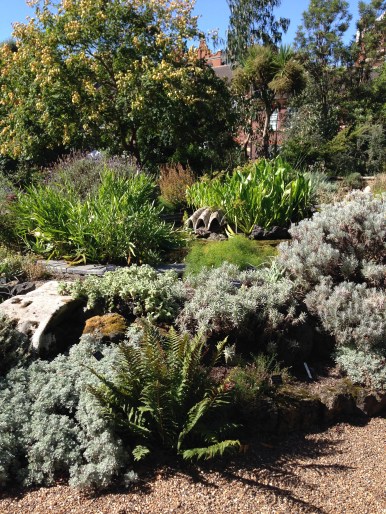
There are multiple sections of the garden and the contents of each is organized differently.  For example, in one section of small formal beds each represents a different part of the world and its medicinal plants as they were known in the 1600 and 1700s. The star of this area as you see below is an interesting built up rock garden, some rocks having come from the Tower of London and others from distant Polynesian volcanic islands. This area had been spruced up a bit in Victorian times with the addition of a pond water feature accented by a giant clamshell–the vignette tips its hat to the plant crazed late 1800s when British adventurers traveled the world procuring specimen plants to add to both public and private collections.

img_4246
The Pond Rockery

Also of note tucked in a corner of the Garden of Medicinal Plants is the largest outdoor fruiting olive tree in England and the world’s most northerly outdoor grapefruit tree–both of which thrive in the garden’s warm microclimate.

img_4258
Not such a big deal to a sunny California girl but a pretty big deal in cool, moist England!

The Garden of Medicinal Plants features formally ordered small beds highlighting plants deemed to cure various ills–many of which were the precursors to modern medicines. This area was especially interesting to Dave and by the time we were halfway through Zoe was looking to him for interesting information to add to her talking points.  Each small bed featured an exhibit citing the general medical arena in which the plants were thought to be useful and historical information of how those plants, in fact, do yield curative substances used today.  I am not sure you can read the titles on these but they are ENT & Lung Diseases, Analgesics &  Anesthetics and Oncology.

The Poisonous Plants Bed featuring a huge Castor Bean lurks behind the Medicinals. Behind the skull and crossbones section I saw the Abhorrent Arbour vining up on the side  of the Glasshouses (what Americans call greenhouses.) As its name suggests, vines with nose wrinkling qualities entwine the structure. Zoe noted that most plant material is left to its natural life cycle in the garden as the medicinal capabilities may be found in the roots, stems, leaves, seeds or mature pod casings at various points of development.

We wandered through the Atlantic Islands Border, featuring many rare and endangered plants of the Canary and Madeira Islands and Crete and the Garden of Useful Plants in which we saw plants grown for their fibers or other parts used in making needed household goods.

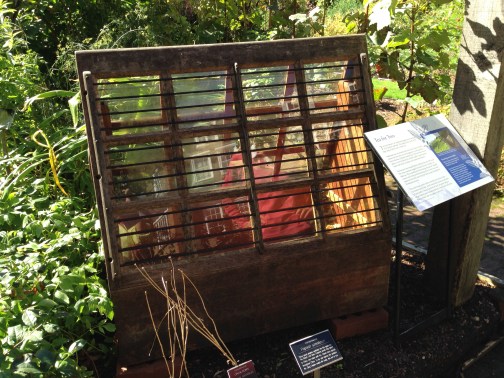
The Historical Walk introduced us to several people whose contributions to the world of botany and association with this garden are noteworthy.  I was especially interested in the story of Robert Fortune who was the garden’s curator when he left in 1848 on a trip to China.  He traveled on behalf of the East India Trading Company to collect tea plants for cultivation in the northern hills of India, then a British colony. He also perfected the Wardian Case which was a sort of mini greenhouse designed to transport seedlings successfully in the holds of great sailing ships through voyages many months or even years in length.

img_4275
Wardian Case

This intensively cultivated 4 acres also includes a World Woodland Garden, a Garden of Edible Plants, Sweet Pea Avenue, a Fernery (unfortunately closed for renovation) and many other delights. They offer lectures and classes throughout the year along with Family Days focused on child friendly activities. On our Sunday afternoon visit the lawn area bordering the cafe was full of families still dressed in their church clothes with “packed lunches”, blankets, books and bubble wands.

Our tour ended at a pair of gypsy style caravans used in educational programs.  The one pictured below features the life and pursuits of Dr. Sloane, the garden’s benefactor. The other, unfortunately in too much shade to photograph well, introduces the work of Dr. Carl Linnaeus, the Swedish botanist, physician and zoologist who formalized the modern system of binomial nomenclature. I was humbled to know that I have been writing scientific plant names improperly all my life. I learned that in the two name system of genus first, then species, the genus and species are always either in italics or underlined, the genus is always capitalized and the species is not. I stand corrected and will endeavor to do better!

img_4283
Learning about Dr. Hans Sloane

I’ll close this post with a few more photos of this lovely not quite secret garden. As always, there is never enough room to share every photo. I hope you’ll enjoy those I have selected and give a thought, if ever in London, to step away from the glitz and glamour of Kensington and Kew to see this tiny tribute to Great Britain’s contribution to the botanic world.


Wanted: stone cottage with a modest backyard…

Here is my first of several posts from gardens afar! Dave and I are in London for a bit over a week’s time. In a couple of days he will be off to attend his conference and I will, alas, STILL be on vacation.  After a stressful hiccup with our hotel arrangements we focused on  seeing the sights, deciding we could always sleep on any one of many very lovely park benches if need be.

We rode the London Underground from our temporary housing in Kensington to the Green Park station on our way to see what the other Queen has been doing in her house and garden.  Green Park is a lovely tree shaded city park with a well worn path leading right to her front gate. Even at 9 am the park had a number of family groups with their blankets spread out enjoying the start of a beautiful sunny day.

Clearly Queen E. was not expecting us as she had decamped to her summer residence in Balmoral, Scotland.  Luckily for us her absence from the palace during August and September each year gives the rest of us a chance to peek into the royal life.  Our tour was to include the Buckingham Palace State Rooms and a special exhibit called Fashioning a Reign: 90 Years of Style from the Queen’s Wardrobe. Although her interior decor is bit heavy on the gilding for my personal tastes, I can’t fault her taste in art and furnishings.  Great area rugs and lovely upholstery throughout! The exhibit of her clothing, which included a generations old christening gown (the one worn by the most recent royal baby), her wedding gown, coronation gown, and selection of special outfits from each decade since the 1920s, was captivating. Especially fun was the millinery collection featuring favorite looks over the years and introducing us to the designers who have served her under what are called Royal Warrants–in other words, hatmakers to the Queen. So sorry, Buckingham Palace allows no photography inside.

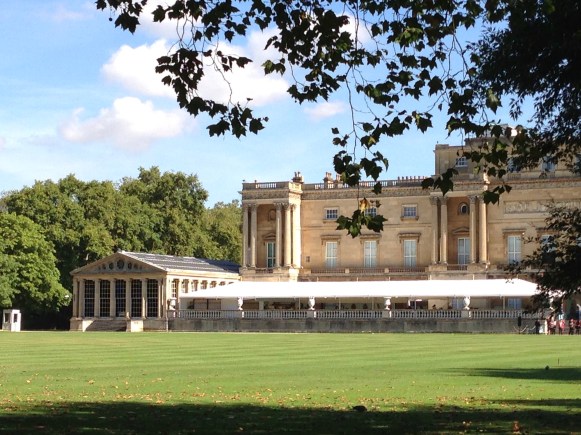
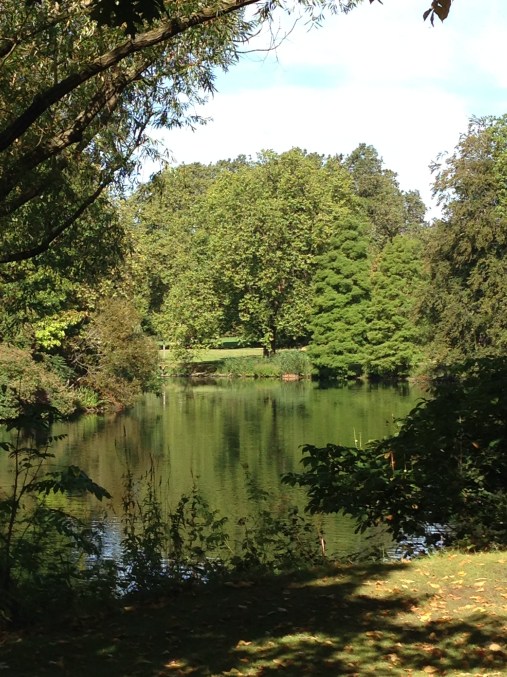
I was disappointed to learn that the Garden Highlights tours sell out within days of the new season’s ticket availability.  I did learn that Queen Elizabeth hosts over 8,000 of her countrymen/women at a series of garden parties each year in her 40 acre backyard. The Buckingham Palace gardens were not open to the public until 2008 when the August and September tours were initiated to raise funds for their upkeep. The gardens include a lake, a helicopter landing area and over 350 species of flora. The State Room tour ends in the the Bow Room which overlooks the broad back lawns so we did get a few glimpses of the south side of the garden as we exited. Have a look:

img_4219
Looking back as we were walking down the south side exit
img_4220
Small view of the 3 acre lake–a serene spot
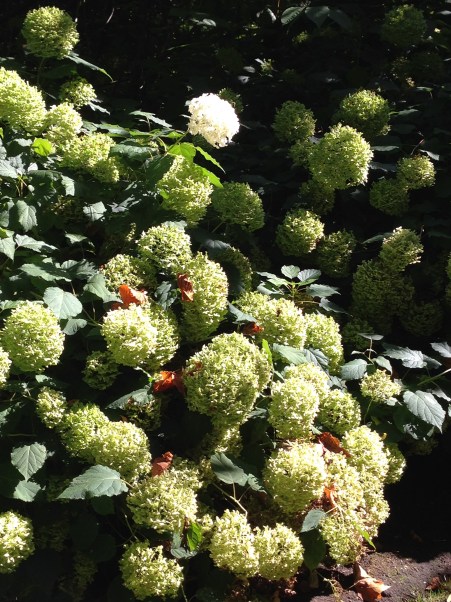
img_4222
Wide swathes of ten foot tall Oak Leafed Hydrangeas
img_4236
Gigantic mop-head Hydrangeas finishing their summer

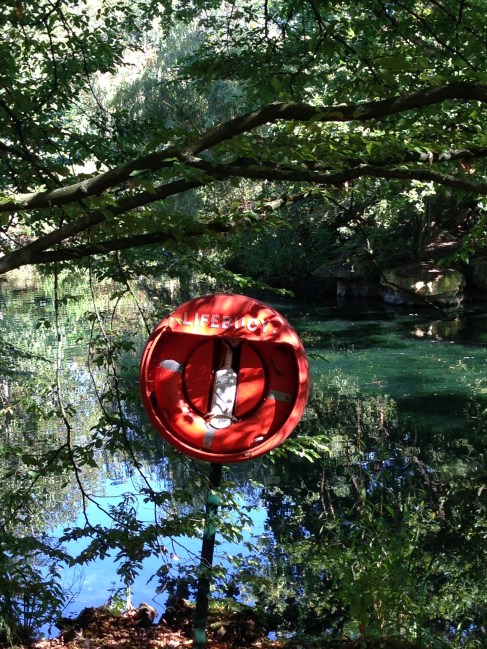
Can’t help but think the huge colonies of anemones and ferns were just a teaser as to what the larger herbaceous borders would look like.  I’ll leave you with this last photo–maybe a glimpse into a side of Queen E. we just don’t hear about.  This was taken on the edge of the lake which is quite close to the path leading to the exit.

img_4227
How do I get an invitation to one of these garden parties?

NEXT UP: The Pharmacist and the Physic

A tale of two plumbagos…

Let’s just get this out of the way before you think to make the observation–it is just a coincidence that the subjects of today’s post both have blue flowers! Most west coast gardeners are very familiar with the sprawling shrub commonly called Cape Plumbago, botanical name Plumbago auriculata or Plumbago capensis depending on your reference material. It is a staple of freeway landscaping in Southern California where the temperate climate encourages it to bloom year round.  Far fewer gardeners have made friends with its cousin Ceratostigma plumbaginoides, commonly called Dwarf Plumbago. Here’s a peek at both!

CAPE PLUMBAGO

IMG_4200

IMG_4206

Cape plumbago comes to us by way of South Africa and has earned its place in the record books as a workhorse shrub which is not too fussy about its conditions.  My south Orange County, CA garden had several hundred feet of very steeply sloped  ground, much of which was planted in this beautiful shrub. A single plant will grow into a loose mound 6 feet tall and 8-10′ wide making it a good choice to cover large banks or open areas.  If you need to keep it more under control just prune it back a bit in late winter.  I have room in my Central Valley garden for only the single plant you see in the photo.  It performs beautifully and fulfills the thankless function of covering a good bit of ground in the foreground of an established olive tree–ground which is almost untillable and an area of intense competition for water. Cape plumbago will be evergreen in areas of little frost.  True to its South African origins, frost will burn new growth and reduce your plant to a blackened mess but the shrub generally has good prospects for a spring recovery.  Cold tolerance is not a sure thing below USDA Zone 7 or 8. Recently I learned that seedlings of this plant vary widely in the intensity of the blue phlox type flowers. Mine is a very pale blue.  If you want to be sure of a more sky blue try to either purchase one of the named varieties such as ‘Imperial Blue’ or choose your plant when it is in bloom.

DWARF PLUMBAGO

IMG_4208

IMG_4207

You simply cannot find many plants bearing blue flowers as intense as those Ceratostigma plumbaginoides sports. This shrubby wirey-stemmed ground cover is treated as a perennial in most areas.  In my garden it breaks dormancy very late (June) and requires a long growing season to come into bloom, usually in late summer when the cool blue is a welcome sight in an otherwise parched landscape. Dwarf plumbago spreads by underground stems and it is purported to grow rapidly and widely in loose soil.  My colonies are a bit more restrained perhaps due to limited water and more compact soil than it prefers.  The fresh green foliage carpets (maybe more like an throw rug than a carpet!) areas beneath a grouping of miniature roses and a few clumps of under-performing daylilies. By the time the blooms are at their peak the foliage will be starting to redden for fall, providing additional contrast. In my garden the foliage dies back for the winter.  When late spring arrives I shear anything remaining above ground to stimulate the new bright green growth.

Temperate winter gardeners like myself have a tendency to dismiss deciduous plant material.  Because our landscapes do not spend the cold months buried under ice, snow or slush we seem to believe we are entitled to gardens that are green and blooming all the time, thus we gravitate toward evergreen trees and shrubs and ground covers (not to mention winter ryegrass and the flats of winter annuals!)  Because we don’t put our gardens to bed for the winter in the same way that many midwest and northeast gardeners do we also do not get to experience the thrill of the first crocus peeking up through the snow and many other early spring delights.  I can’t help but feel that the deciduous nature of the dwarf plumbago has been the deciding factor in its underuse in mild winter gardens.

I challenge you to expand your garden’s horizon with one new deciduous perennial, ground cover or shrub this fall–maybe the dwarf plumbago is the one for you! Dig it in, kiss it goodbye for the winter and wait for the rewards of spring.

Are you in the zone?

Picking plants whose intrinsic biological and cultural needs fall within the parameters of the soil and climate in which you hope them to thrive is perhaps the most basic gardening principle. The question “Will this grow in my zone?” seems as though it should be one with a yes or no answer. Nothing is ever that easy–not even understanding what your ‘zone’ is and what information that zone number is conveying.  There are several references  available to gardeners which tell us what zone we garden in.  Let’s look at a few of them:

USDA PLANT HARDINESS ZONE MAP

Nine times out of ten the zone number you see on plant tags and labels is the UDSA Plant Hardiness Zone.

A collaboration of climatologists, meteorologists and horticultural experts produced a lovely full color map first published in 1960 and updated in 1990. The USDA zone reference leaped forward to the digital age in 2012 with an additional update. There are no print maps produced of the 2012 update–you can access and download the maps from the USDA website http://www.planthardiness.ars.usda.gov or just type your zip code in the window provided on the site and you will be rewarded with your zone number.

But what does this magic number tell you?  The USDAPHZ (yes, they actually refer to it that way now on the website) is a scale which shows the average annual minimum winter temperature, divided into 10-degree F zones, during a 30 year historical period.  Each 10-degree slice has an “a” and a “b” part so the USDA Zones and corresponding temperatures start at 1a (coldest winter) and rise in 5 degree F increments to 13b (warmest winter). For example my zip code 93711 is in Zone 9b with average annual minimum winter temps of 25-30 degrees Fahrenheit.  Typically a plant label or description will state a range of zones or use the wording ‘hardy to zone__’ indicating the lowest zone number recommended for the plant. For gardeners in cold weather winter parts of the country this zone number is critical in determining whether a plant will “winter over” or be lost to temperatures simply too cold for the plant’s cultural requirements. Bear in mind that past weather records are not a guarantee of future weather. Additionally, all gardens have a variety of microclimates within them–valleys or low spots where cool air collects, warm pockets created by the reflection of the sun off concrete or blacktop, etc. The number is never a substitute for your experience and that of fellow gardeners in your area.  It is simply a place to start.

For those of us in areas characterized by milder winters and screaming hot summers the  USDAPHZ leaves us in a quandary.  If my plant choice is burned to a dry husk or wilted down to a barely recognizable lump by September it really is of no benefit to me to know  if it will winter over!  The need for a scale to identify heat tolerance easily must have inspired the creation of this next zone map.

AMERICAN HORTICULTURAL SOCIETY HEAT ZONE MAP

Cold is not the only factor which determines whether what you plant will survive and thrive in your garden.  Heat was finally given its due with the creation of this 12 zone map.  The zone number indicates the average number of days each year that a region experiences “heat days”–temperatures over 86 degrees F. The AHS designates this as the temperature point at which plants start to suffer physiological damage from heat. The zones range from Zone 1 (less than one heat day per year) to Zone 12 (more than 210 heat days). My garden is in AHS Heat Zone 9 which equates to 121-150 days annually exceeding 86 degrees F. When a label or reference lists the recommended zones they are listed from high (hottest) to low (coolest).

IMG_4193

The above label is a perfect example that the zones, whether hardiness to cold or heat tolerance, are only a starting point for your selections.  The ‘Blue Waterfall’ campanula’s hardiness number tells me that my winters are plenty warm in  USDA Zone 9 as this plant can tolerate winters in zones well below mine but I am pushing beyond the recommended AHS Heat Zone by a couple of notches. My colonies of ‘Blue Waterfall’ are sited in early morning sun only and get adequate water and have been very successful. I suspect  that if they were planted in anything close to the full sun they can take in cooler zones and they would be toast!

As recently as a few years ago the AHS website had a zip code zone finder tool similar to that of the USDA website.  This has disappeared from their site and other sites which formerly had links to it.  I suspect that AHS would like you to purchase their map.  The Society has also classified more than 2000 plants by AHS Heat Zones and offers that information in a reference manual called AHS Great Plants Guide. Their website, http://www.ahs.org, is packed with lots of gardening basics/resources and you can purchase both the book and the map online.

The excitement of having heat tolerance classifications for plants and a nifty full color  map to find our zone is dampened in that relatively few plant growers or garden centers mark their stock with the AHS Heat Zone. AHS is promoting a label format that will offer both cold hardiness, heat tolerance and a classification such as annual or perennial but until industry takes up the cause it is all just information under wraps unless you purchase the reference material and carry it around with you as you shop!

REGIONAL GARDEN GUIDE CLIMATE ZONES

Lifestyle, garden and travel gurus Sunset Publishing and Southern Living Inc. both have book format regional garden guides covering the geographical areas of their circulation focus.

The Sunset Western Garden Book began as a plant selection guide published in 1935.  In 1954 the first Sunset Climate Zone maps appeared, dividing its focus area into 13 climate zones.  Sunset refined and expanded the maps in 1995 delineating 33 climate zones covering 13 western states and a small part of Canada.  The Western Garden Book has been the “go-to” resource for practical gardening information and plant selection for generations of western gardeners.

When I moved to Georgia in 1995, my So Cal girls gave me a subscription to Southern Living and a copy of The Southern Living Garden Book to get me started in my new home. Amazing, this garden reference not only covers areas typically thought of as the South but also Kansas, Missouri, Illinois, Ohio, Pennsylvania, New Jersey, Maryland and Delaware.  Everyone must love New Mexico as both books lay claim to this state.  I feel badly for the gardeners in the Dakotas, Iowa, the Great Lakes states (2 Ms, 1W and New York) and all those little Eastern seaboard states past New York that they don’t have a publishing conglomerate looking out for them! The Southern Living Garden Book divides its domain into 5 zones: Upper, Middle, Lower, Coastal and Tropical, each followed by the word SOUTH.  Well, it is their book after all!

Both these stellar regional garden guides espouse that factors well beyond heat and cold ultimately affect the success or failure of your plant selections. Sunset lists latitude, elevation, ocean influence, continental air influence, mountains, hills, valleys, microclimates and soil as components unique to any geographic region that would make it a welcoming home for a plant with specific botanical needs. Southern Living emphasizes that the relatively short, but sometimes frigid, winters combined with hot and humid summers presenting unique challenges across its southern (and semi-southern) readers gardens.

Each of these guides presents detailed climate information zone by zone and not only gives you a number you can use for reference in identifying plant material’s suitability but also lots of general climatology and geophysical data that is really pretty interesting reading. My Georgia garden was in the Lower South zone which is described as “a region of short winters, early  February springs and hot, sticky, often dry and seemingly endless summers with nighttime temperatures usually no lower than the mid-70s.” My California Central Valley garden is in Sunset Zone 8, characterized as a cold-air basin with a long  constantly sunny growing season, high summer daytime temperatures and piercing cold winter north winds.  We sit right on the edge of Sunset Zone 9–the primary difference being that Zone 9 is a thermal belt sit at the base of foothills whose cold air can flow right into my Zone 8. There goes my opportunity to grow citrus commercially…

If you were to look at the USDA hardiness of my Zone 8a Georgia garden and Zone 9b California garden they look pretty similar, just as my AHS Heat Zone 8 Georgia garden cozies right up against my California garden’s AHS Heat Zone 9.  In fact, due to gargantuan differences in humidity, rainfall and soil types these two gardens are very different from each other.  The  additional factors used by these two regional gardening guides lead me to rely far more on their zone structure than looking at raw numbers of heat and cold only.

It is not totally uncommon to see the Sunset Climate Zones listed on plant tags for things that are grown in California–especially now that Sunset has partnered with growers to market the Sunset Western Garden Plant Collection.

You may also see plants tagged with any combination of the different zone numbers–USDA + AHS Heat Zone as it visible in the ‘Blue Waterfall’ tag above, USDA + Sunset or AHS Heat Zone + Sunset. Hopefully, the tag will tell you what reference is being used not just give you a number! Here’s a test for you below:

IMG_4189

You have a number range but whose zones are those?  This has to be a Sunset Climate Zone   indication because none of the other scales in use now have numbers as high a 24!

Are you ZONED OUT yet? The takeaway here is that we have all kinds of resources to help us plan our gardens using plants which have the greatest possibility of thriving in the setting we provide.  Use these resources with the foreknowledge that a zone is not a guarantee. Arm yourself with information, revel in your successes and tell those dead ones  that there are more just like them where they came from.

Xerihysteria!

Although the Central Valley of California has long been known as a region of no summer rainfall, the past several years’ lackluster winter rains and even more critical,  very low winter snow packs in the Sierras, has heightened our water awareness, both residential and agricultural, and is moving us to take seriously the need for less thirsty landscapes. Gardeners in my valley have been living a fool’s dream for many years.  We live in an area which receives less than 13″ average annual rainfall, with half of that being concentrated in the months of January, February and March.  We have built our dream gardens in a veritable desert with relatively cheap and available water–at least available in our minds. I can remember my mother talking about city outdoor watering restrictions as far back as 20 years ago. I have not an ounce of the requisite science to tell you why things NOW have gotten to critical mass–I just know that seems to be our current state.  My city limits outdoor watering to 2 days per week during very specific hours, other cities in my valley have total outdoor watering bans. Water rates are still reasonable compared to some other localities but increases are inevitably, on the horizon.   New homes now offer synthetic lawns or very limited square footage of lawn.  Cities are offering monetary incentives to remove turf and replant those areas with drought tolerant plants, mulch and rocks.  We are bombarded from all sides to move into the arena of low water landscapes.

I have long held some gardening principles which dance around the edges of water conservation;

I keep my more delicate and thirsty plant materials clustered close to the house where it is easy to give them a bucket or two of water if needed.

IMG_3790

I recognize the benefit of creating shade, both with trees and structures.

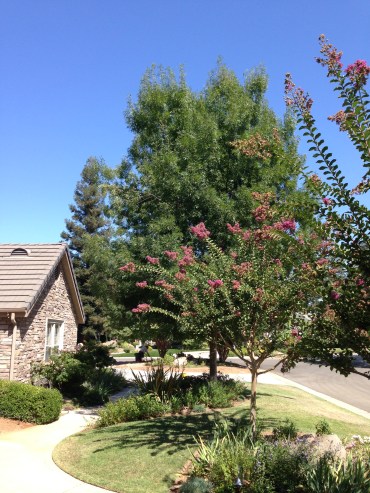
The Raywood Ash below, planted from a 15 gallon can in 2010, is large enough now to cast some very nice pools of shade on plants which would normally be brutalized by the sun all day due to their south and west exposures.  The two crape myrtles, formerly pruned to their knobby knees in search of increased bloom, are now pruned lightly after their first flush of flowers and a bit more in January with an eye toward developing a nicely branched small canopy (yes, this does decrease bloom to an extent.)

IMG_4181

We added trellis-work to our backyard pavilion to grow Eden climbing roses. The trellis, long since planted, provides needed support for the roses and some sun protection for the plants added below. Eventually the massed roses will increase that protection.  The back of the pavilion receives the shade benefit of the foliage from 3 mature Bradford pear trees.

IMG_0186

We work really hard to provide optimum growing conditions by double digging for new beds, amending our soil and adding compost to our beds yearly.  Yes, that is me behind the jack hammer!

IMG00191-20120508-1020

I try to focus on plants suited for our hot  and dry conditions. Plants native to Mediterranean areas and the American plains are good candidates.

On the not so successful side…we have found it a challenge to even condsider converting to drip.  We have an about 1/2 acre and 14 lines totals. As we have enlarged beds and eliminated small amounts of turf over the last 8 years our lawn and bed lines overlap each other in some parts of the garden and we lack good coverage in others.  We are just not willing to incur the expense or do the work to entirely replace our automatic sprinkler system. An even  greater challenge is my unwillingness to become an ornamental grass and rock girl.  I love my roses and much of my existing evergreen shrubbery. I have found most mature plant material to be more adaptable to reduced irrigation than we give it credit for. I have all ready rid myself of things I did not want in my garden and so now I’ll have to find a way to add in moderately waterwise plants which will not be too out of sync with the look I want and I level of care I am willing to give.

Our 2016 waterwise initiative has been to reduce the amount of turf the front garden.  Living on a corner lots results in a lot more front yard than is easily cared for.  We targeted 4 areas for turf removal-2 small and 2 large.  While our front lawn is of the Heinz 57 variety, the bulk of it is common bermudagrass. Permanent elimination of bermudagrass pretty much requires a chemical component.  I expect that when the permafrost starts to melt in those northern reaches the scientists will find viable roots from bermudagrass and when they go out for lunch they will return to a fully established lawn! As such, we needed to wait for the bermuda to break dormancy in order for the herbicide to be fully taken down into the roots.  Our weed control expert treated the areas in June and all was looking pretty bad within a couple of weeks.  Meanwhile I got a bit impatient and we actually dug out one of the small areas (about 25 square feet) before the grass was fully dead.  That area is pictured below.  It has been replanted with 3 Knock-Out roses which I have found to be very unfussy about water after their first year. The roses are underplanted with a single purple trailing lantana to act as a gound cover. We did reconfigure the existing sprinklers to provide enough water for the roses to establish and then 2 of the 3 heads will be capped off.  These plants look remarkably well considering our hot July and only about 5 minutes of water twice a week!

Looking for that feeling of satisfaction from actually completing something (you know like when you pay off the smallest of your credit cards so that it is gone then move on to the next smallest rather than putting all your money on the huge balance but still getting that bill, now a wee bit smaller, next month) we moved on to the second of the small sections.  All of you who have been to my home will recognize this stupid little piece of stand alone turf right by my front step.  With the backdrop of a well established and very healthy 3 foot high boxwood hedge this little 3/4 moon shaped area has the potential to be a showy little seasonally planted little bed.  I am just not sure I really want to go there!  We dug out the dead grass–much easier to dig the roots than when they were only half dead as in the first area–and my husband  exposed and temporarily capped off the sprinkler lines.  The bed was then double dug to a depth of about 18″, the soil being amended as it was returned to the bed. I added a 15 gallon ‘Natchez’ crape myrtle.  My heart’s desire was a pale pink blossomed tree to complement the stone and my purple front doors, rather than the white flowers of ‘Natchez’, but the small planting area with sidewalk on one side dictated a smaller cultivar.  In true garden ninja fashion I dug this tree in on a day when the temperature topped 109.  The tree responded by dropping every one of its leaves but you can see some new foliage emerging after about 10 days.  Hope springs eternal in the garden world! The jury is still out on what will go below the tree. This small area had 3 existing sprinkler heads which we changed from lawn pop ups to risers. We left the three for now and will evaluate the removal of 2 as time goes on.

IMG_4178

After these two smaller areas exposed the ins and outs of doing a good job removing turf and preparing these heavily compacted areas for replanting, my shovel loving-rototiller disparaging husband may be wavering on some mechanical aid for the two larger sections to come.

The driveway circle area has an irregular strip of turf about 6 feet wide and 60 feet long if you stretched it out in a line.  He has exposed the sprinkler heads and capped them off in preparation for the big dig. The strip of lawn on the side of the house starts out quite wide at the driveway edge then narrows to about 5 feet wide.  It extends about 80 feet beyond this large blue juniper.  I’ll keep you posted on our progress!

“Let’s just get rid of the lawn.” rolled off my tongue in last March. Easier said than done.  Especially if you want the greatest possibility for successful new plantings.  Two other gardening friends are working through this process as we are.  The questions and concerns seem endless.  How do I blend these new beds (with hopefully waterwise plantings) with my old beds to create consistency and rythym?  I see great new plants at the garden center that supposedly need no summer water–how can I integrate those in areas having some sprinkler coverage? How do I keep the mulch from washing off my raised areas? I see lots of ideas in magazines and books. Why can’t I find those plants in my retail nurseries?  We definitely have more questions and answers!