Gather in the garden…

This was a most appropriate theme for the Gamble Garden Spring Tour, held yearly to benefit the Elizabeth F. Gamble Garden in Palo Alto, CA! It was a beautiful spring day as my three garden road trip girls and I strolled the five private gardens and the grounds of Miss Gamble’s 1902 home. This beautiful historic property is open to the public daily and exists solely on gifts and membership, receiving no funds from the city, state or other government entity. A small staff and large cadre of volunteers work diligently to keep the garden in peak form for the enjoyment of all. You can find out more about the Gamble Garden and all they have to offer at http://www.gamble.org or check them out on Facebook, Instagram or Pinterest.

The Gamble Garden is only a short walk to the Stanford campus and sits on a major road flanked by vibrant residential neighborhoods. Every year I have attended this exceptional tour I leave with the same two lasting impressions: what a diverse architectural and horticultural heritage the neighborhoods represent and how welcoming everyone I encounter is as I walk from garden to garden. 2017 was no exception. It is clear that the neighborhoods embrace and appreciate the Garden in their midst.

Even though only 5 gardens are officially on the tour the walkability of the event gives garden oglers the chance to see many more. I will include pics of my favorites in between the garden descriptions noting them as ON THE WAY.

As our drive was uneventful we arrive about 10 minutes before the gardens opened and decided to walk to the farthest from our parking spot and then work our way back, giving us a chance to see these:

ON THE WAY
GG17walk2
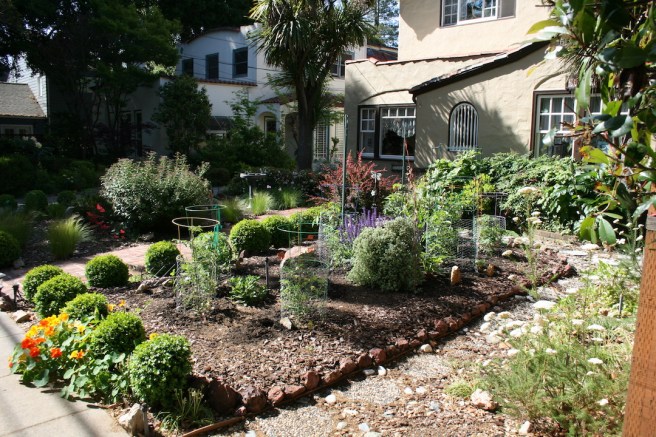
Best front yard veggie garden ever
GG17walk1
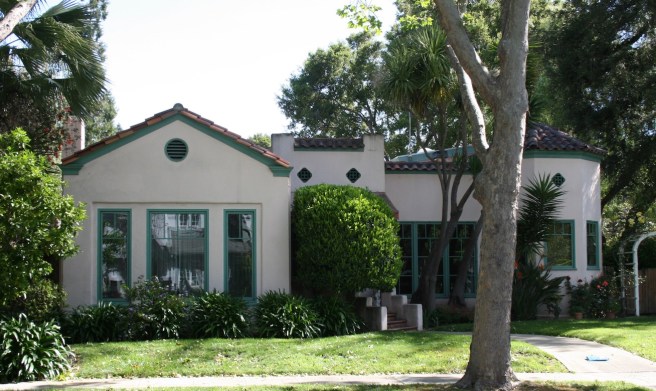
One of many Spanish bungalows with interesting architectural details

SANTA RITA AVENUE

GG17SantaRita10

The approach to this garden tells you right up front that there will be a lot to see here! I’ll take help from anyone out there to identify these stately trees bearing huge coral pink inflorescences. As I saw them street side in several places I am sure they are not uncommon to the South Bay area but I could not find anyone who knew even their common name. The detailed stone columns, fence and gate were representative of the attention to detail through the garden.
GG17SantaRita2

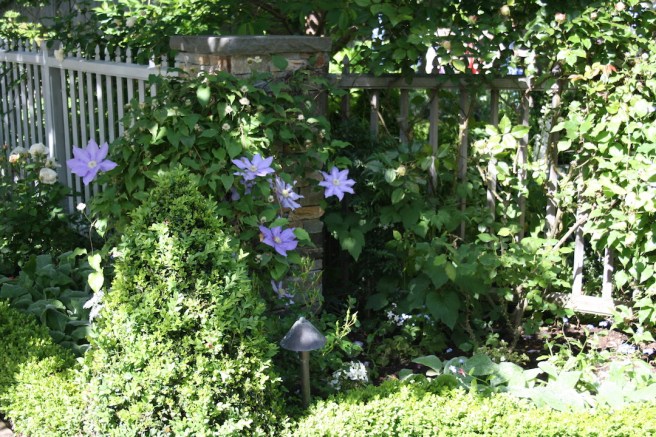
The charming entrance led us to a diminutive formal front garden. Low boxwood hedging with taller elements at the corners provides year around structure within which seasonal plant materials are featured. The beds are awash with the soft pastels of roses, delphiniums, clematis, gaura and nicotiana. Lush roses climb every available support!

Even the property line fencing was treated as a design element with Ficus benjamina in training along wires highlighting the fence’s cross pieces.
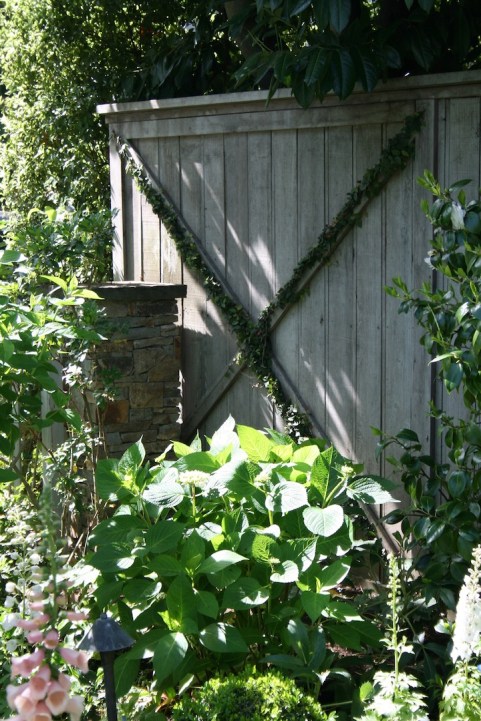
GG17SantaRita4

The subtlety of this garden’s palette gives the overall impression of a green and white garden–really reminiscent of many Southern formal gardens.

A narrow side path led us into the expansive back garden which offers multiple areas to relax, entertain and dine.
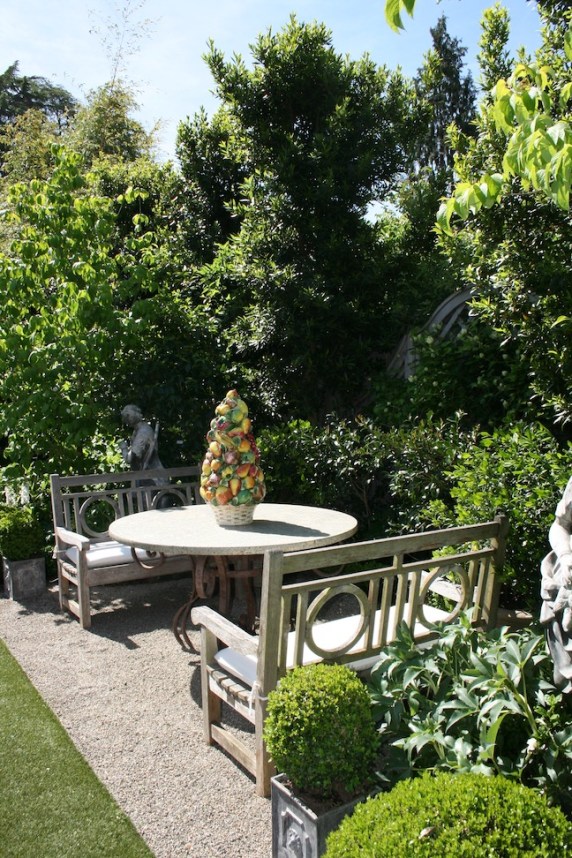
GG17SantaRita9

The garden’s designer, Katsy Swan, softened a very long garage wall by adding a pergola covered with the muted colors of Sally Holmes and Alfred Carriere roses. Little Gem magnolias add height, flanking another spot to relax.
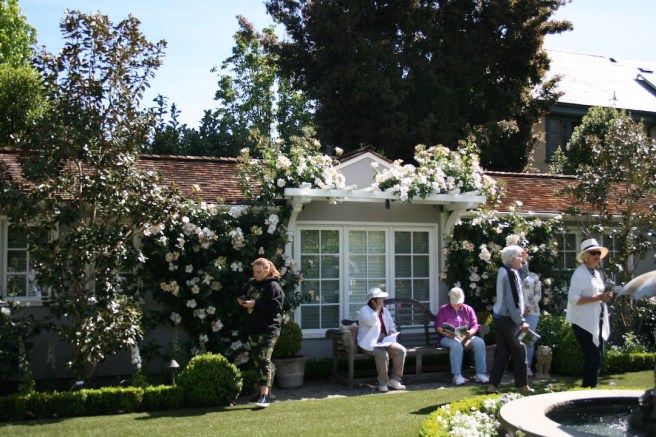
GG17SantaRita7

More climbing roses smother a nicely detailed pergola that anchors a corner of the home’s back patio and provides an affirmation of the garden’s aesthetic as you exit through it to the driveway.
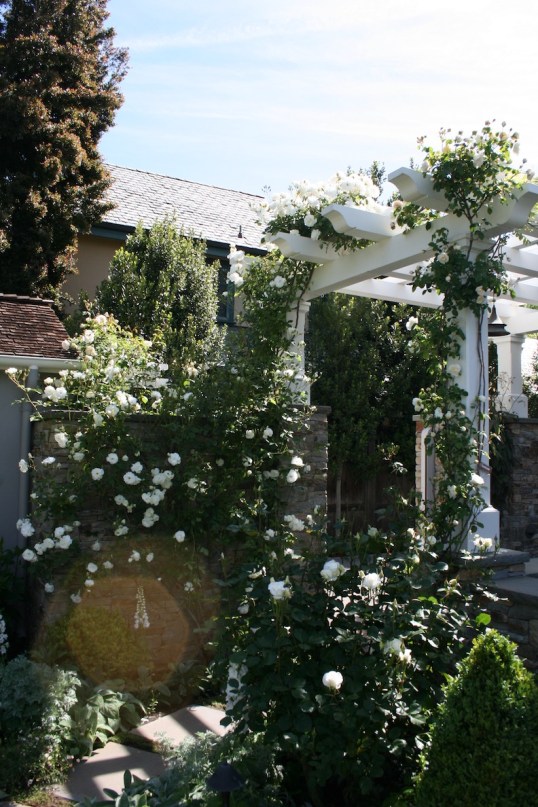
GG17SantaRita6

My take away from the Santa Rita Avenue garden–the use of consistent plant materials front and back to establish a year around green infrastructure allows you to play with your bed’s contents to your heart’s desire and gives the garden interest in every season. Pay as much attention to the details as you do to the big picture!

SANTA RITA AVENUE BONUS GARDEN

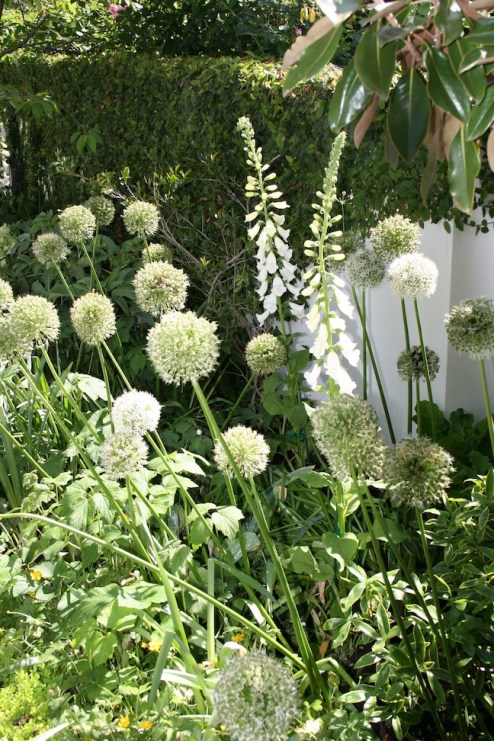
The walled garden of the home directly across the street was created by the same designer and the owners were gracious enough to allow tour goers to walk through their beautiful landscape. The continuity of plant material throughout was very pleasing. This garden also had a well thought out green infrastructure around which a succession of seasonal bloom evolved. The palette was muted and very pleasing with the creamy stucco of the home.

GG17SRbonus1

GG17SRbonus2

The street side of the wall sported predominantly green and white plants. I loved the interplay of the alliums with their round heads and the spiky foxgloves.

GG17SRbonus5

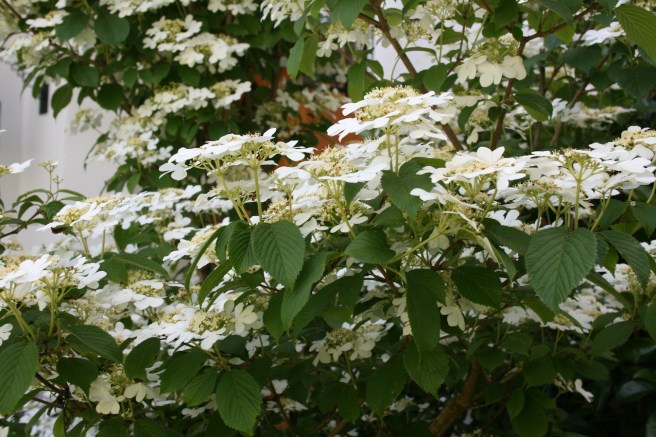
The front porch was flanked by these gorgeous Viburnum plicatum tomentosum ‘Mariesii’ ,whose natural form creates this layered look. Background right you see Magnolia ‘Little Gem’. Foreground shaped boxwood and some left n a rounder, more natural form and a hydrangea yet to bloom. Take a look at the viburnum’s bloom in more detail below.
GG17SRbonus6

This tree was a single specimen anchoring the home’s corner as you exited the walled garden onto the driveway. The flowers look similar to a dogwood but the foliage seems wrong to me–I am really not sure. I took several photos of the bloom in various stages and will check it out with my Filoli teacher later this week. Thoughts anyone?

GG17SRbonus8

My take away from this bonus garden–you cannot go wrong with green and white!

ON THE WAY
GG17walk4
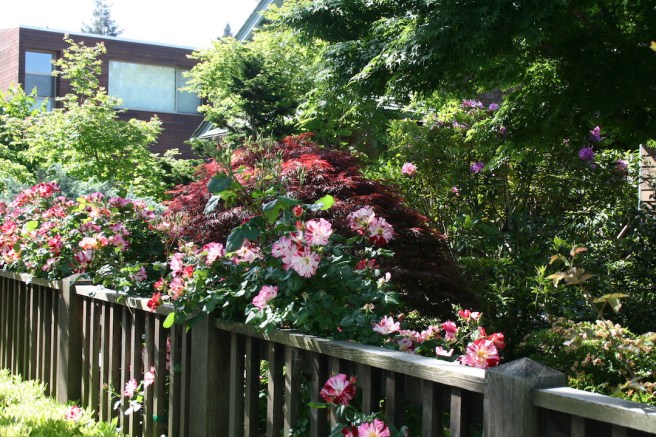
A lot going on but it all worked together–great bold fence
GG17walk6
Beautiful entrance

TENNYSON AVENUE

This formal garden was inspired by Colonial Williamsburg and includes traditional Southern elements throughout. The small front formal garden is a study in green and white and so heavily shaded by mature crape myrtle trees that it was a challenge to photograph.

GG17 Tennyson1

The VERY narrow side path leading to the back garden was full of interesting plants including Hydrangea petiolaris (climbing hydrangea) rambling up the chimney. Enclosure was provided by ivy carefully trained on a wood and wire structure and there were eye catching elements all along the walk.

The back garden entrance took us through a formal boxwood parterre of Japanese boxwood with English boxwood corner elements. The boxwood were quite tall and enclosed beds of Iceberg roses and camellias. While I liked the concept of this formal area leading you to the more open lawn area I found the paths to be uncomfortably narrow and imagined that pruning the roses closely surrounded by thigh high boxwood would be a challenge!

GG17Tennyson3

I can totally see myself sitting on this petite patio enjoying the summer afternoon as the scent of the wisteria envelopes me!

My take away from the Tennyson Avenue garden–think twice about scale and always allow enough room to move around your garden so you and your visitors can enjoy every element.

ON THE WAY

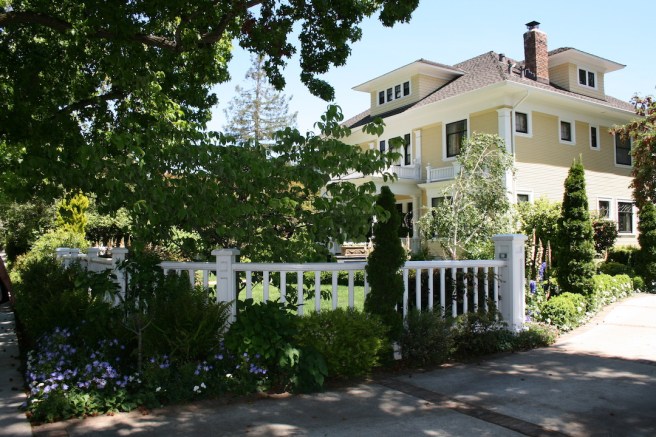
Who doesn’t look a great looking gable? I know there must have been an incredible garden behind this beautiful gabled gate.
GG17walk12
Not enough words to describe this lovely home and garden

CASTILLEJA AVENUE

GG17Castilleja1

GG17Castilleja2

Fun and flowers characterize this 1926 Spanish bungalow. The front lawn has been replaced with a Mediterranean feel paver sidewalk and an interesting collection of perennials and small scale shrubs. An sculptured olive tree anchors the corner and along the walk you will find Geranium ‘Rozanne’, echinacea, penstemon, euphorbia and Shasta daisy. Behind the violet flowers of ‘Rozanne’ you can see an young ‘Wonderful’ pomegranate which provides both flowers and fruit.
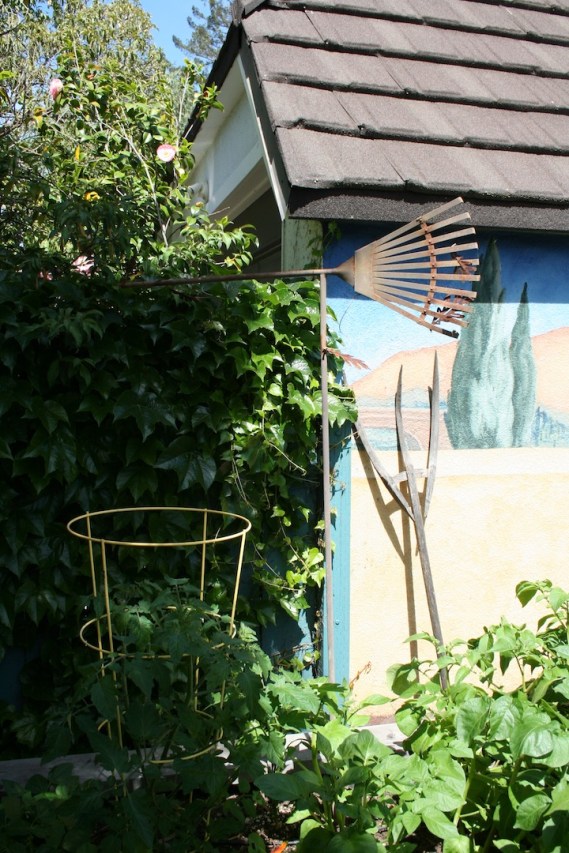
GG17Castilleja5

The tiny back garden had a wide variety of plants, large and small, and lots of found and upcycled garden art. I love this weather vane made from a garden rake!

My take away from the Castilleja Avenue garden–it’s your garden so have a good time with it! While I love the cool serenity of the green and white gardens with touches of muted pastels, this garden probably suits my plant collector style more.

ON THE WAY

GG17walk11
This ultra modern home provides contrast and diversity–the minimal landscape is perfectly suited


GG17walk10
Beautiful details on a compact facade

MELVILLE AVENUE

So many interesting thing to tell about this home and garden. Melville Avenue is part of the Professorville Historic District, one of four historic districts in Palo Alto. The homes in this district were built by Stanford faculty starting in the 1890s on lots which were originally part of Leyland Stanford’s farm. You can find out more about this unique district on the Palo Alto Stanford Heritage webpage http://www.pasthistoric.org. This stately Victorian was purchased by the current owners in 2011 and was moved 100 feet forward in an extensive remodel to provide space for more back gardens, a guesthouse and a pool.

GG17Melville5

There are both formal and informal spaces, private and public spaces. The formal areas are characterized by classic bluestone paths and boxwood hedges. A working area for potting up and storage is adjacent to an area devoted to the family chickens. Raised beds and espaliered fruit trees are tended by the owner’s daughter. As you leave these service areas you pass this unique espaliered ginkgo.

GG17Melville4

As you emerge from the path into the more open space of the back yard, the sense of enclosure and borrowed landscape is tremendous. Groupings of mature conifers, evergreens and hardwoods form a backdrop for the new guesthouse and pool.
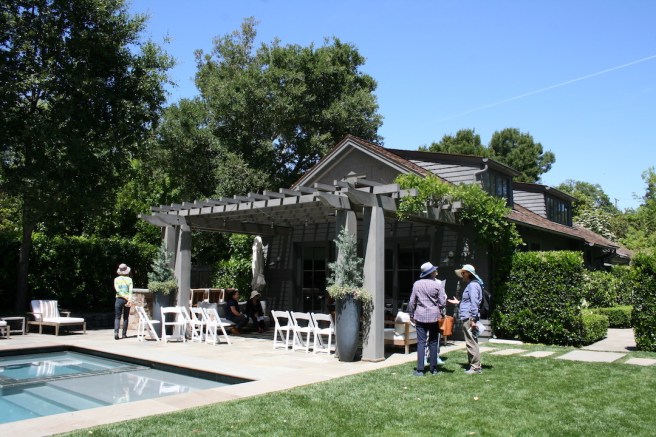
GG17Melville1

The deep side beds which flow the entire depth of the lot are massed with mature trees and large scale shrubs. This is not a garden packed with color but it a very livable garden for both adults and children and a garden that would not have to be meticulously tended everyday to retain its naturalized beauty.

GG17Melville 7

Extensive patio space at the home’s rear (right off the kitchen) is clearly the heart of this yard and is a fabulous entertaining space for family and friends–great wedding location, too!

GG17Melville6

Everywhere you look there are places to gather in this garden! I could sit on this side front porch all day long and just let the world pass by.
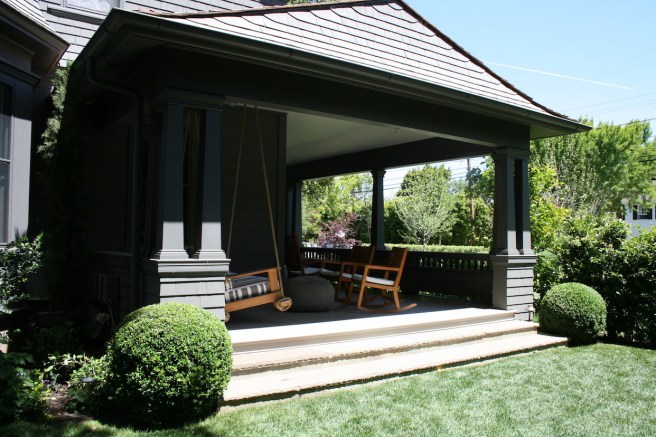
GG17Melville2

My take away from the Melville Avenue garden–use a large garden space to suit your own needs incorporating features for both children and adults. Keep it simple by layering masses of large scale evergreen and deciduous shrubs. Not all gardens have to overflow with color. Even though very large, I would call this the most low maintenance garden seen today.

ON THE WAY
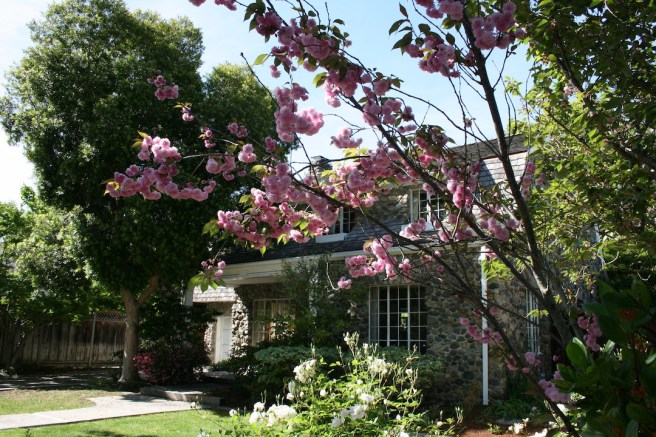
GG17walk3
Gambrel roofed stone cottage–one of several still blooming cherry trees we saw today

COLERIDGE AVENUE

These homeowners have spent 40 years getting their estate garden just right. A series of four garden rooms, each unique in feel, take you all the way around the home.
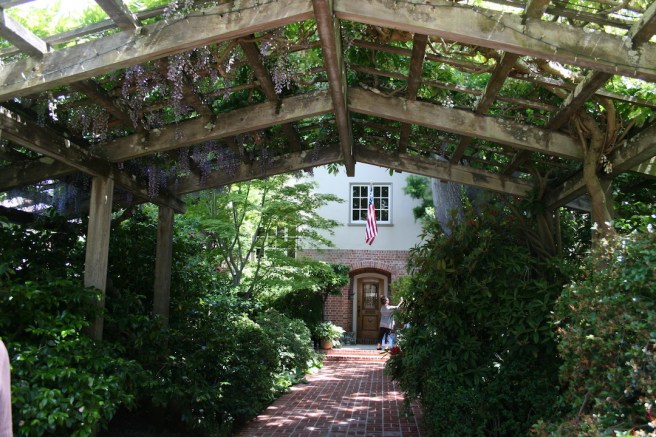
GG17Coleridge1

The completely walled garden is entered under this very large scale wisteria covered arbor. The arbor’s shape is repeated in smaller scale in other parts of the garden. The brick front walk is lined with 80 year old rhododendrons, towering camellias and mature azaleas.
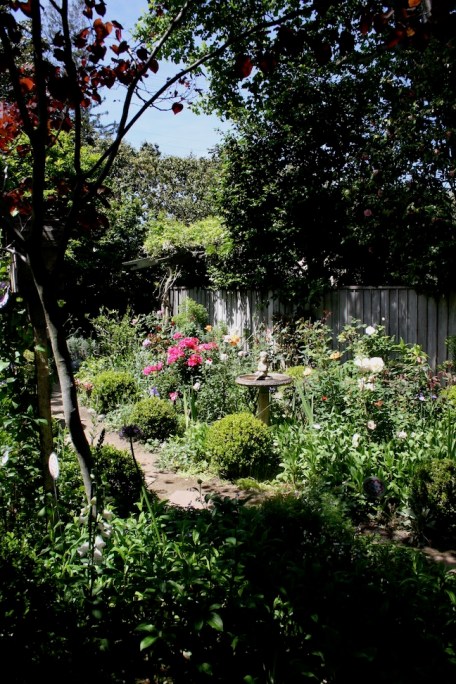
GG17Coleridge2

A quick right turn at the front door brings us to the first garden room, an English style garden with a profusion of flowers inside boxwood borders. A red leafed Forest Pansy redbud offers dappled shade and roses climb all the walls. Each season will bring new blooms to life and this area is used extensively for cutting.

GG17Coleridge3
Rose ‘Polka’

A short walk on the side path ends in a secluded terrace which the family uses for casual dining.  A marvelous sense of enclosure is created by layers of mature trees on both sides of the back property line.
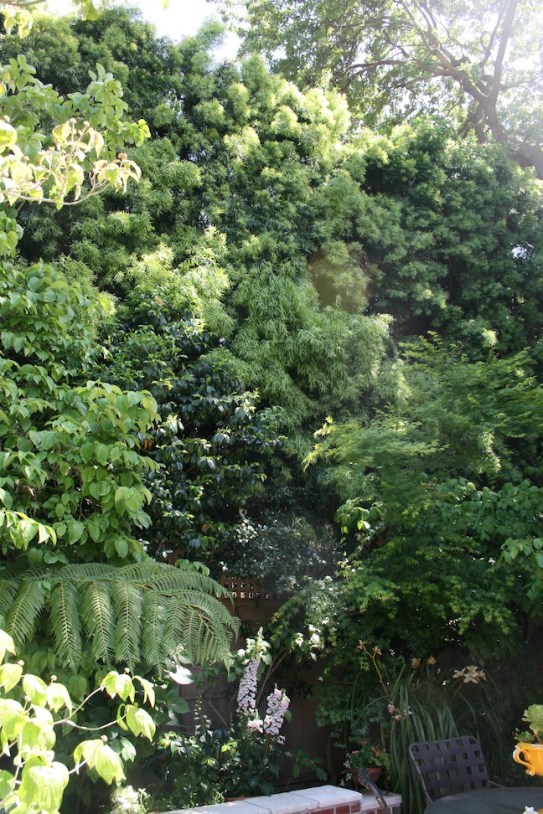
GG17Coleridge8

A  Pieris japonica over 15 tall drips with white blooms and there is a small koi pond.

The third garden room sits behind the garage which is more charming than many English cottages! The grassy area is shaded by dogwoods and Japanese maples. A prized tri-color beech, Fagus ‘Tri-color’, was the inspiration for the redesign of this area. You can see its foliage in the upper right of the photo.
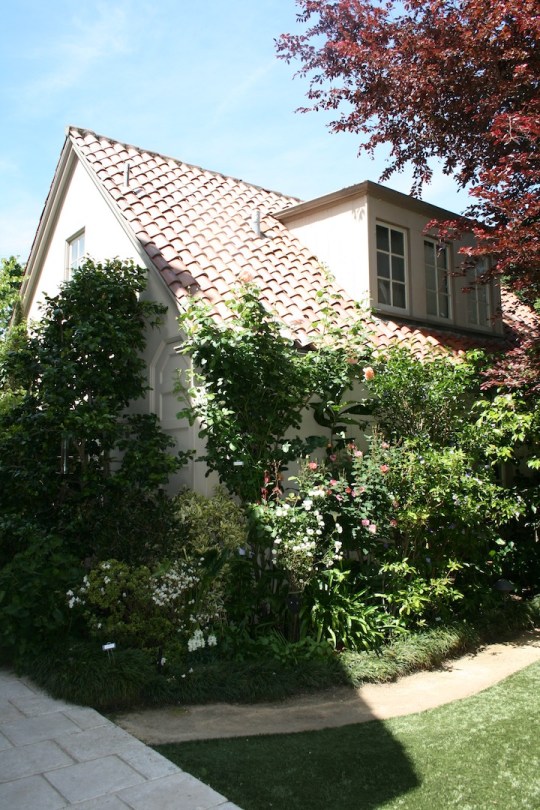
GG17Coleridge6

Rounding the garage (which is equally wonderful from the new viewpoint) we enter the pool garden which was formerly an orchard. I realize that having made a full circle, we are actually now back in the front yard! This perfect sunny pool spot with narrow perimeter beds and a single original grapefruit tree can be seen from the home’s French doors. An amazing bright yellow vine covered by bees masses one section of wall.

New to me–the tag reads Macfadyena unguis-cati, common names cat’s claw and yellow trumpet vine. This climber can reach 25-40 feet quickly by hooked, clawlike, forked tendrils. The Sunset Western Garden Book calls it a good choice for erosion control on slopes as it puts down roots wherever stems touch the ground.

My take away from the Coleridge Avenue garden–think out of the box and use all your garden space as private space. A walled garden offers you the opportunity to put your pool where the spot is sunniest–in this case, the front yard!

Whew! I am walked out–how about you? It’s a great time to call your friends and set a date to gather in your garden, big or small, formal or informal, perfectly designed and maintained or in need of a bit of TLC. Gardens are for sharing.

Iris on parade…

Bearded irises are among the choicest perennials for borders and cutting. Although only one of hundreds of species in the genus Iris, they are perhaps the most widely grown and certainly the most widely recognized. Amongst the rhizomatous irises, the tall bearded irises have routinely stolen the stage from their shorter or beardless cousins. More than 100 years of breeding has produced all manner of colors, ruffles and fragrance.

Bearded irises are best planted mid-summer to fall (for bloom the next year) in soil with good drainage. They will adapt to a variety of soils from sandy to clay if the drainage is adequate. I commonly plant groups of three rhizomes. Because the growth is from one end of the rhizome, plant two parallel to each other about 12″ apart with non growth end facing you. Then add a a third to make a triangle with its growth end facing the first two. That last rhizome’s growth will fill in the space giving you a nice clump. Plant the rhizomes root side down with the top barely at the soil’s surface–do not bury! Iris will benefit from a light application of bone meal, superphosphate or any 6-10-10 fertilizer about a month before bloom and again a month after. Plan to divide every 3 or 4 years. Your iris will tell you when they are too crowded with smaller and fewer blooms. In my climate I trim the bloom stalks back after the flowers are finished but wait to trim the foliage back to about 6″ in the late fall.

Mild winters and early springs here in Central California result in iris blooming far earlier than the printed catalog material indicates. My iris start in late February and are virtually done (except for a few rebloomers) by late May. In other zones, iris may not even start blooming until mine are almost finished!

Here are a few blooming now in my garden. IMG_2024If you have been reading Queen of the Dirt from the beginning you’ll recognize ‘Night Ruler’ as the iris that started my fascination with plants I used to think were too old fashioned and ordinary for me. I saw this one in bloom when I lived in Georgia and thought it was pretty spectacular. Although it never flourished in my Macon garden, I dug a few rhizomes up when I moved and found it likes California’s dry heat. The 3 rhizomes grew to about a 3 foot diameter colony after only a couple of years and they bloomed prolifically. The growth of an ash tree eventually totally shaded out the colony and after several years of decline I dug, divided and replanted the healthy rhizomes to sunnier areas in both my front and back gardens. ‘Night Ruler’ returns to the throne!
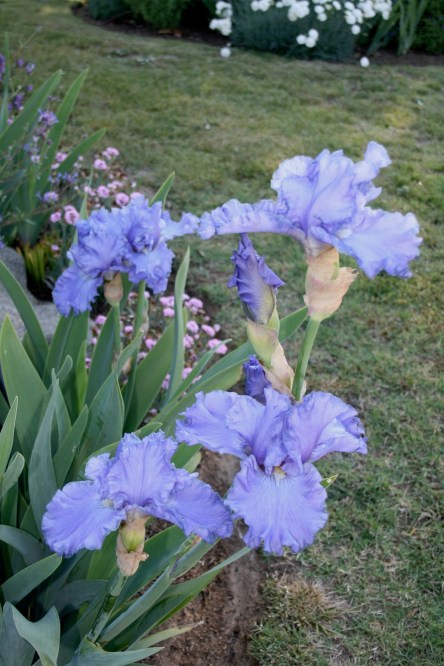
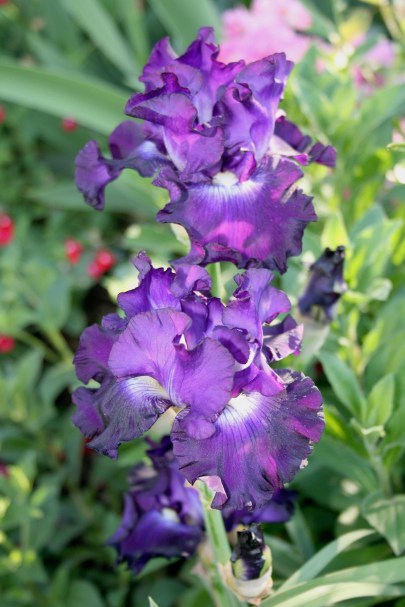
Because the development of high shade is a focus for many Central Valley gardeners, a natural consequence is the reduction of full sun for those plants needing it. Almost all of my original iris plantings have been moved at least once as various trees matured. The lawn area we call the driveway circle had 8 different iris cultivars in its interior bed. The crape myrtles had almost doubled in size since the iris were planted in 2009 and all these colonies had been in decline for a couple of years. In our recent lawn removal and replanting project in this area I dug all the iris up and potted up the best of the rhizomes for replanting this fall. The seemingly constant moving around of iris due to division or the need for a sunnier site has resulted in some cultivar name confusion for me. I keep really good records of what is planted where but my map now looks like a jigsaw puzzle with arrows, rhizomes names and numbers pointing everywhere!

Another iris whose original site proved problematic is Iris ‘Riverboat Blues’. Vigorous perennials ended up covering these rhizomes every year with foliage and they just never did much. Last fall I dug the few viable rhizomes and moved them to a sunnier, less competitive site and ‘Riverboat Blues’ has rewarded me with multiple bloom stalks and dozens of huge sapphire flowers.

IMG_2043

IMG_2044

This is a tall selection which can sometimes need staking with the weight of triple socketed buds and 8-9 flowers per stalk.

IMG_2042

Small but mighty Iris ‘Full Impact’ lives up to its name. This dark blue-violet bicolor is beautifully ruffled , has glacial white markings and a  white beard. The beard is the group of fuzzy hairs at the top of the lower three petals of the flower. These three petals are called the falls. ‘Full Impact’ will open 3 flowers at one time, producing a very full and rounded look. I have groups of these 30″ tall stunners on either side of my front walk, blooming amid a lot of pink and lavender perennials and roses and they never disappoint. Although these colonies have multiplied and been divided several times they seem to snap back a little faster than some of the taller selections. AND they are a favored by regular hummingbirds!

Who doesn’t love a plicata? So you say “Just what is a plicata?” In iris terms, a plicata is a flower which has a  stippled or stitched margin color on white.

On the left is Iris ‘Loop the Loop’–a huge selection almost 4′ tall in bloom. IMG00158-20120423-1420In a previous post you saw this photo of a large group of ‘Loop the Loop’ exploding in bloom. This one too has now been divided a good bit and I have smaller colonies in several garden spots. I let the original planting go too long before the first dividing was done and I saw first hand what happens–I think I only had 3 stalks in 2014 compared to over 40 when the photo on the right was taken. Above right is Iris ‘Got the Melody’. The white on this cultivar is much muddier than on ‘Loop the Loop’ so they would not be attractive planted in proximity of one another. This double and triple socketed stem yields 10-12 buds per stalk and is tall enough to stand above its neighbors.
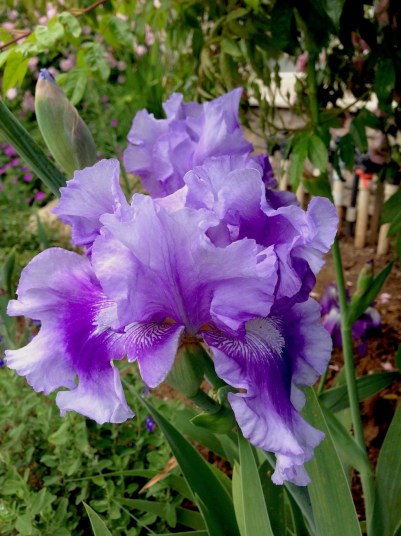
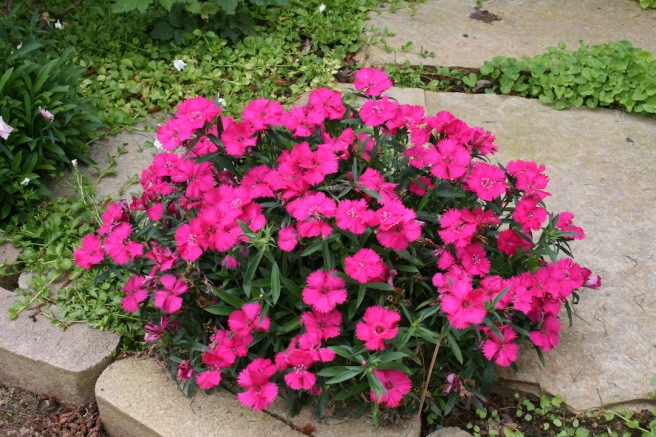
I’ll close with with the splendid lavender bloom of Iris ‘No Count Blues’. The eye-catching falls are overlaid with a darker purple and it bears a yellow throat. Amazing, don’t you think?

IMG_2661

Iris are the perfect pass a long plants. Even in  barely adequate conditions they will multiply rapidly, giving you many to share with family and friends. I kind of like knowing that someone I care for has a little piece of my garden to enjoy every day.

In the pinks…

Blooms of the genus Dianthus are perhaps some of the most widely known flowers to both gardeners and non-gardeners alike. While the family has over 300 species and many hybrids a much smaller number are commonly offered by retail sources for the home garden. The genus contains annuals, biennials and perennials however, many are treated as annuals regardless of their botanical nature. Dianthus of all sorts are classic cottage garden flowers whose foliage forms grey-blue or grey-green mats with the flower stems rising in early spring. They are commonly called pinks by UK gardeners but almost always referred to by their genus name in the US.

Dianthus barbatus or sweet william is a staple of our spring gardens. Although biennials, sweet williams are often treated as annuals in California and replaced from 6 packs each year. I cut mine back every year after they go to seed and accept with grace whatever hangs on til the next year. Once the biennial/seed cycle is established I pretty much always have some in the foliage only state and others bloom ready. There are tons of named hybrids, so many so that they often are not even marked with their variety but only bear a color designation.

IMG_2037

IMG_2036

I am sure these are very familiar to everyone! I place them to serve as low edging material in the very front of my beds. They come as go as they please so every few years I may add in another 6 pack or two.

A few years ago I started buying every different dianthus species I came across just to see how the ones less familiar to me could be used in my beds. These included named varieties of Dianthus deltoides (maiden pink), Dianthus gratianopolitanus (cheddar pink) and Dianthus caryophyllus (carnation or clove pink.) For the most part they have stayed in the front of the borders and beds and they have been carefree with the exception of an occasional hard cut back to stimulate new foliage.

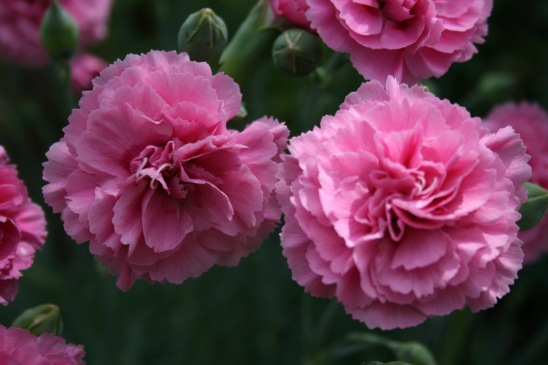
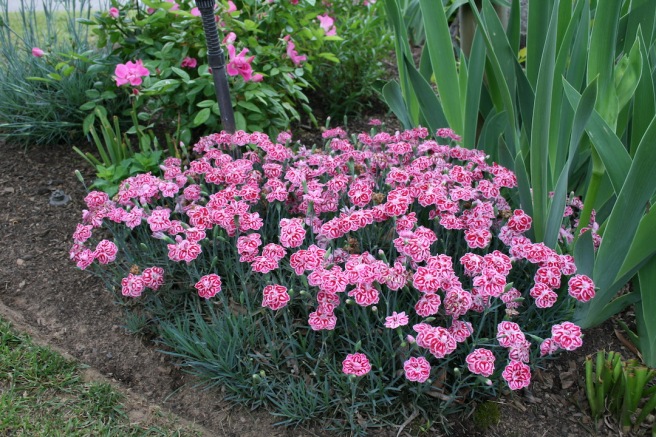
Two of my favorite clove pink selections are from the Devon Cottage Series of Dianthus caryophyllus bred by Whetman Pinks of the United Kingdom. After a few years in the ground they have formed nice big clumps of foliage with lots of flowers. This series is a great cutting selection and if they have any fault, it is that they are floppers once the flowers open. Even though the flowers are only about 12-14″ tall my plants end up with alot of props! As the common name suggests, the flowers have a wonderful clove scent.

IMG_2013

This is Devon Cottage ‘Fancy Knickers’. You can see that the size in bloom rivals the erect foliage of the iris they neighbor. This clump is about 18″ in diameter.

IMG_2014

The bloom is bright white with just a hint of a pinky red eye. Every stem has multiple buds which bloom in succession. Deadheading is a must to keep the bloom vigorous and the plants neat looking–I find this to be true of all dianthus.
I also love the clear pink Devon Cottage ‘Rosy Cheeks’. In the ground a few less years, the overall plant size is smaller but the blooms still hover at the foot tall mark.

IMG_5748

IMG_2031

Another Whetman Pinks hybrid which has done well in my garden is Dianthus ‘Starburst’, sometimes labeled Dianthus ‘Clavel’s Starburst’. A smaller, tighter foliage mat and correspondingly small, shorter flowers of raspberry, pink and white grace this early bloomer.

IMG_2011

IMG_2012

Here are a few others blooming now!

TPFNPGT Sunday, one garden unifies two homes…

ANOTHER NEIGHBORHOOD, ANOTHER HILL–the Stirton garden in Silver Lake

A very narrow and winding lane took me to my next Theodore Payne Foundation 2017 Native Plant Garden Tour garden. This street is unusual because in its original state every lot had two homes on it. On one side of the street the lots are at street level and on the other they are mountain goat territory. Of course the next tour garden was on the mountain goat side!

IMG_1761

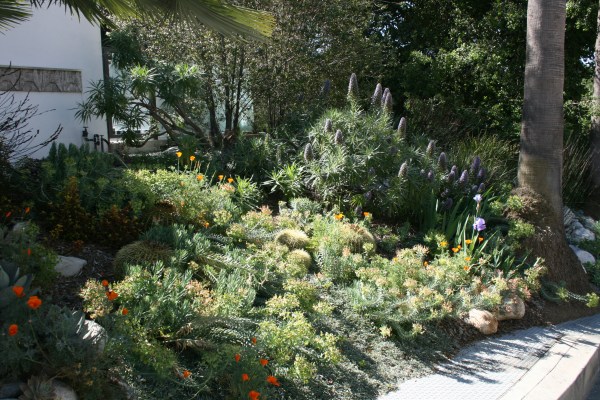
This is the lower part of the front slope which is held back from the side walk with a block retaining wall. This is one of only a few homes I saw which had what we always referred to as a “parking strip” between the city street and sidewalk. This parking strip was chock full of reseeding wild flowers and water wise shrubs, including several varieties of ceanothus and buckwheat. A very prominent player was the annual Lupinus succulentis, California native arroyo lupine.

IMG_1763

Even where not in bloom this reseeder’s lush green foliage fills the need for an erosion control ground cover. I was especially interested because this is not traditionally a drought tolerant plant. Although somewhat adaptable it generally requires ample water. This entire slope is hand watered so the homeowner has the opportunity to give the lupine extra water without jeopardizing the plantings which resent wet feet, i.e., ceanothus.

In that first photo you saw one of the two small homes on the property in its original state. It is now used as a rental. The homeowner has extensively remodeled the other home to sleek modernity and you would never believe they were once twins.

IMG_1766

Looking up from the street you get just a peek of the clean lines and industrial materials used in the remodeled unit occupied by the property owner! The stairs leading to the homes sit pretty much in the middle and although both homes have small back gardens (only about 6 feet of flat area, then steep slope up), the front garden takes up most of the property. At various point on the concrete steps there are opportunities to step to the side and into terraced areas.

There was so much to look at–7 species of buckwheat (Erigonum), 4 species of manzanita (Arctostaphylos), 5 kinds of salvia, 3 cultivars of Mimulus (monkey flower). Oh my!

IMG_1768

This healthy stand of Trichostema lanatum, common name woolly blue curls, was a testament to the care this gardener takes with his water. If there ever was a zero water/perfect drainage plant once established, this is it. The wide range of water requirements for these hillside plantings simply could not be met with a one size fits all irrigation scheme. Bravo to a man and his garden hose!

IMG_1777

Many of the native landscapes lean heavily to the purple, blue and orange palette. This bright pink island mallow, Lavatera assurgentiflora, is native to California’s Channel Islands and grows quickly to a 12 ft. erect shrub with maple like leaves.

As this garden was a designated rest stop we had the opportunity to step into the more modern bungalow and take in the view this gardener enjoys every morning when he has his coffee on the balcony! Having once struggled with a garden which had several steep hillsides and not experienced success even close to this—I tip my broad brimmed gardening hat to this labor of love.

IMG_1773

My take away on this Silver Lake hillside garden–not all natives are drought tolerant and not all low water users are natives. Mixing in natives and non-natives with high moisture requirements is do-able if you can commit to hand watering them. Cohesive landscape design can unite even the most diverse architecture!

LAST STOP ON THE TPFNPGT 2017 will be a tiny cottage garden in Jefferson, only a few hundred feet from I-10. I saw 19 of the 32 gardens on this year’s tour and will have given you a peek at 13. Time for us all to move on to new adventures. In less than a week I will head north for the Gamble Garden 2017 Gather in the Garden tour and in 2 weeks I’ll be back in SoCal for the Mary Lou Heard tour and Garden Conservancy’s Los Angeles Open Day.

P.S. I am experimenting with the resolution on my photos to try to free up additional space  in my WordPress media library. Let me know if you feel the quality of the photos had diminished to the point that it is not good for you. Thanks!!

Hello ‘Little Rev’…


IMG_5730

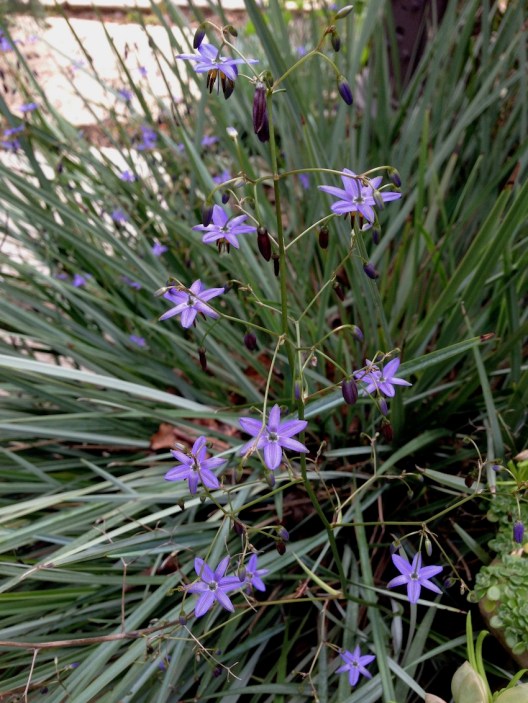
The genus Dianella, also called flax lily, are interesting architectural plants originating in Australia and Tasmania. The upright habit and grasslike strappy leaves of Dianella revoluta ‘Little Rev’ and its cousin Dianella caerulea make them especially suited to modern drought tolerant gardens. ‘Little Rev’ is a bit smaller than other selections and will reach 18″ in full sun and 24″ in partial shade as mine is planted. The 3/4″ sparse star- shaped blue flowers are followed by metallic blue berries. We have been inundated with ornamental grasses and grasslike plants in the last few years and most seem pretty scruffy to me in a traditional mixed border. ‘Little Rev’ is well-behaved in the ground or containers, requires little to no care and looks attractive year around. Put this one on your garden center shopping list!

TPFNPGT Sunday, a new neighborhood…

The gardens of the Theodore Payne Foundation 2017 Native Plant Garden Tour have opened my eyes to new groups of plants to explore. My challenge will be to do the research on their adaptability to a colder winter and how to integrate the ones I like best into all ready established garden areas. I’ve pick just a few more to share in this post and one more and then we can move on to other topics and tours!

A GARDEN IN TOTAL HARMONY WITH ITS HOME–the Kramer garden in Atwater Village

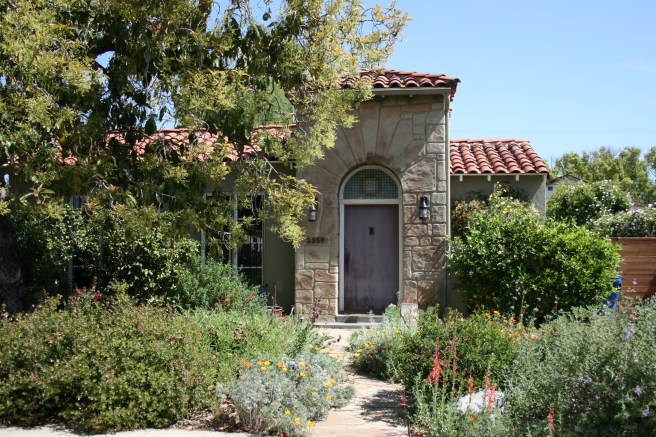
California native gardens are designed to complement many home styles from starkly modern to Craftsman post and beam but no architectural style seems to be as well suited as the quintessential Spanish bungalow.

IMG_1721

This homeowner redesigned her back garden using many natives in 2010. The front garden was installed in 2013 and mixes meadow and coastal sage scrub elements with some carefully designed topographical changes, adding lots of interest to a small and originally flat lot. The large mounding plant front and left is a nice stand of Salvia clevelandii  ‘Allen Chickering’.

IMG_1722

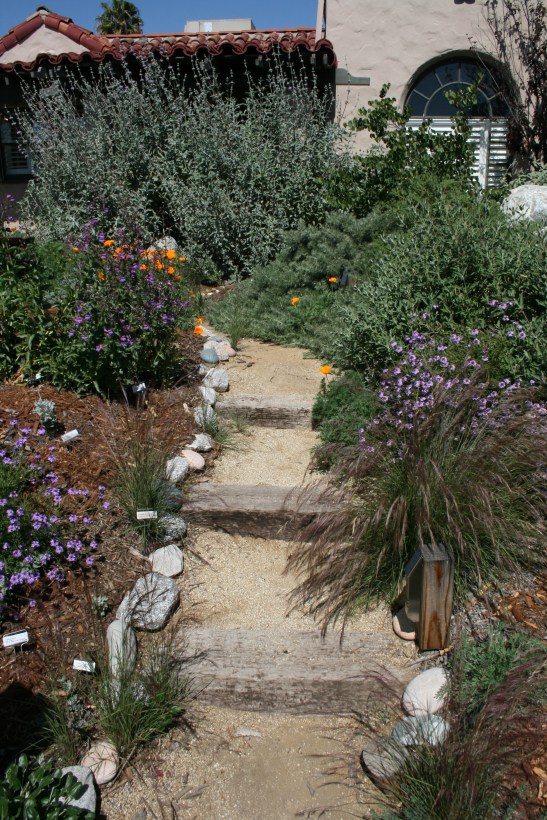
This railroad tie and compacted earth walkway leads you up and through the garden in a meandering fashion allowing you to see a wide variety of color, texture and form on the relatively short walk to the front porch. The grasses left and right are Aristida purpurea, common name purple three-awn. The lavender pops on either side are Verbena lilacina ‘De La Mina’. The darker purple mound to the right of the path is Penstemon spectabilis var. spectabilis or royal penstemon.

IMG_1734

As the narrow path takes you to the porch steps by way of the small driveway you pass the phenomenal salvia which is almost as tall as the home’s roofline (look at the previous photo for a better perspective). The plant is marked Salvia ‘Vicki Romo’ but the Theodore Payne docent on site believed it was mismarked and actually was Salvia ‘Desperado’. My references list ‘Vicki Romo’ at a compact 3 ft. and this whopper is at least 10 feet tall.  Another interesting specimen is the Artemisia californica ‘Canyon Gray’ seen in the front left and again just behind the clump of orange poppies on the right. The grayish foliage provided a pleasing midpoint between the greens and the grayish white foliage of many of the garden’s selections. This artemisia is finely textured and very soft to the touch. I saw this in others gardens later in the day in large mounds 4-6 ft. wide. As with all artemisias, good drainage in a must. Repeated in this garden were many of what I now know are staples in the Southern California native garden: dwarf coyote bush ‘Pigeon Point’, red-flowered buckwheat (foreground above) and saffron or Conejo buckwheat.

The Kramer home has a deceptively large back garden–probably 3 times the depth of the front. The narrow, deep lot lends itself perfectly to a series of garden rooms. This is clearly the homeowner’s garden playground with a less restrained palette and lots of variety, including some of the finds you just pick up and dig in because you thought they looked interesting!

IMG_1738

IMG_1744
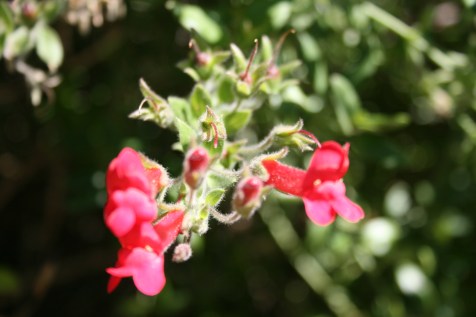
Galvezia speciosa–showy island snapdragon


MATURE TREES AND WOODLAND SHADE–the Miller-Coon garden in Atwater Village

Just a short ride passing through the “village” part of this community led me to another wide flat street of small, neat homes. Parking was at a premium and I ended up about 2 blocks from the next tour garden. The short walk yielded several great yards so just imagine you are walking down the street with me and take a look!

IMG_1758

fullsizeoutput_9d1

IMG_1749

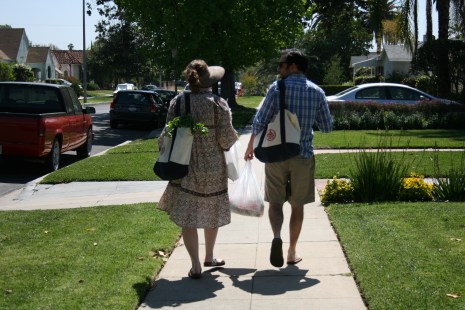
A side note–as I got out of my car I fell in step behind this couple walking home from their grocery trip to the little village area about 3 blocks away. They had their bags and their Starbucks cups in hand and were strolling home on a great day to be outside. The couple turned into their driveway just across the street from the garden which was my goal and I was momentarily jealous of the walkable, small city within a big city lifestyle they were obviously enjoying!

IMG_1748

The Miller-Coon garden has been on tour every year since 2003. It is somewhat more relaxed and relies heavily on a mix of mature trees and shrubs and lots of reseeding annual wild flowers.

IMG_1755

It is a diminutive front garden dominated by a large Torrey pine and 6 different native oak  species. In this photo you see the pine in the background, our native redbud, Cercis occidentalis, and one of several species of manzanita on the property. The violet blooms in the foreground are elegant clarkia (Clarkia unguiculata) which returns each year from seed.

My take away from the Atwater Village gardens–you can pack a lot of gifts in very small packages! Although both of these streets are definitely in the “flatlands”, you don’t always have to play the hand you are dealt. Both homeowners added dimension, interest and additional planting space to their gardens by altering their topography with very gentle mounds and curves.

NEXT UP–I travel to a unique neighborhood in Silver Lake where the historical standard is to have two homes on a single lot.


Spring is here…

Although I still have several more gardens to share with you from my recent visit to Southern California on the Theodore Payne Foundation Native Plant Garden Tour and given that I have two more big garden tours coming up in the next two or three weeks, I thought I hit pause on other folks’ gardens and let you see that I DO actually garden.

IMG_1999

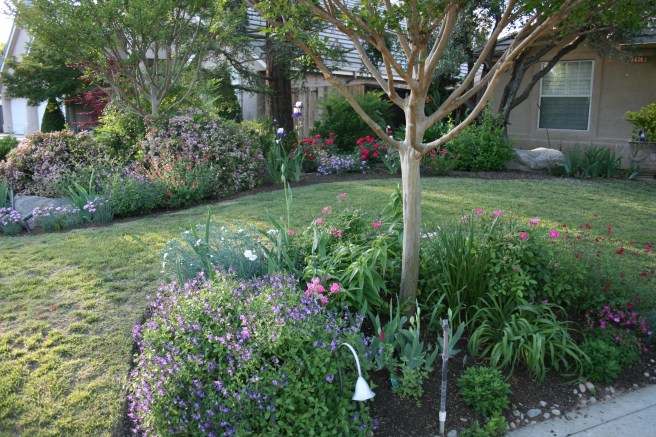
We have had an abnormally wet spring and everything in the front garden has benefited from the extra water. At mid-April, to not have turned on the irrigation systems by now is phenomenal. Last year I added pops of rosy red in the form of the Double Knock-Out  roses and a few of the perennial salvias–you can see the Salvia ‘Killer Cranberry’ in the mid righthand side of the photo. I think they really wake up the predominantly purple, lavender, pink scheme and will provide strength when the paler colors wash out in the heat of the summer. The earliest of the iris are blooming with others ready to come on. The perennial dianthus I have been adding over the last few years are nice big blue green clumps this year with the first few pink or white flowers open.

IMG_2000

This foundation bed by one of the front sidewalks is looking especially good! The pair of tree roses (‘Renae’) has exploded into bloom. Geranium ‘Tiny Monster’ and Salvia fruticosa add a little violet and blue relief from all the pink. I featured this salvia in a post last spring when I added it to the bed. I love the blue gray foliage against all the other clearer greens. It has tripled in size from last year and is covered in blooms. The ‘Pink Dancer’ Indian hawthorn (lower left) has finally come into its own after several years of very few  flowers. I told you that 2017 was going to be the best garden year ever!

IMG_1980

TPFNPGT Sunday, fresh legs and new batteries…

Here we go again! My schedule for the second day of the Theodore Payne Foundation 2017 Native Plant Garden Tour is ambitious so I do my eating and driving on my own time and arrive and my first garden of the day just at the 10 am opening bell.

A CHALLENGING HILLSIDE–the Rice-Siwolop garden in Beachwood Canyon

This recently renovated Mid-Century Modern home had perhaps the smallest front yard I have ever seen!

This massive 7 ft. retaining wall rose from the narrow public sidewalk to enable these gardeners to have a small strip of level ground which you see in the photo below. This very narrow bed, anchored by the broken concrete walkway, was planted in California fuchsia (Epilobium ‘Silver Select’) and Silver Carpet aster (Corethrogyne filaginifolia  ‘Silver Carpet’). And yes…those are the tops of the car parked on the street that you can see in that photo! The similarly narrow bed to the left of the steep steps held other silver green and gray native plantings and the superb non-native specimens of Euphorbia bourgeana  and  Agave parryi in the center photo.

IMG_1676

So I am thinking–having spent more time locking up the car than I did in this garden that I will be way ahead on my schedule! The next garden is about 100 yds. uphill on the same street and as I pass by the street level garage I see the back yard is open also. An extremely narrow sidewalk flanked by the house on one side and another very high retaining wall on the uphill side leads to a funky two level wood staircase which takes me up into the back garden.

IMG_1685

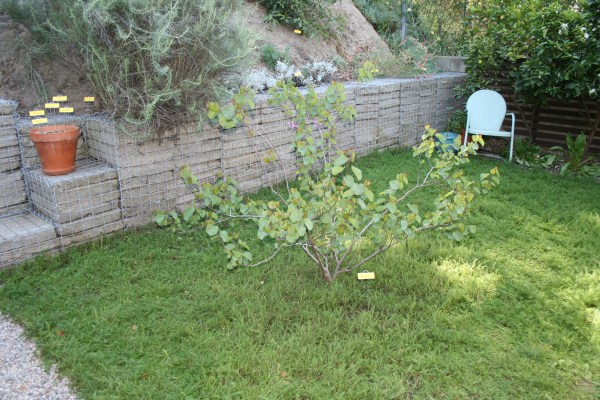
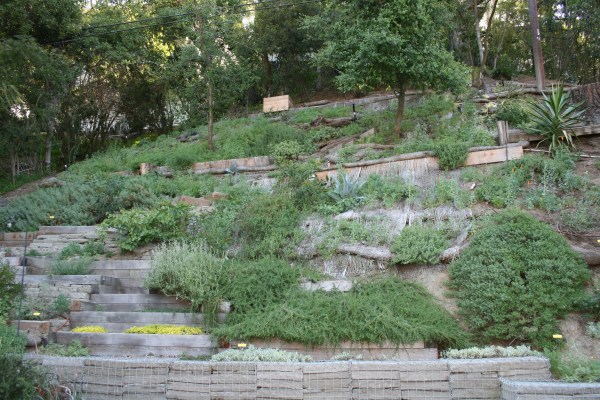
Holy slope! The back yard melds a wild and untamed slope with the man made elements required to make it accessible. The hillside is stabilized by a gabion wall, hemp and wattle erosion netting and large drifts of native plants.

IMG_1682

The gabion, which you can see at the bottom of the photo, has its own story. Neither side of this lot has enough room for any mechanical digging apparatus access to this back slope. The terraces on the hillside were hand dug and the dirt hand carried down to the very narrow flatland. It was then screened and mixed with cement for stability and formed into the square blocks which fill the wire cages to form the gabion running the width of the yard. So…the slope is actually retaining itself!

IMG_1683

Thoughtful placement of the timbers forms a set of steps which allow access to the upper levels for planting and maintenance. Natives anchoring the hillside included my new favorite Erigonum fasciculatum (California buckwheat), Pigeon Point dwarf coyote bush, Hearst’s ceanothus, Salvia leucophylla (purple sage), several types of manzanita and in summer, a wide variety of reseeding annual wild flowers.

IMG_1691

A small lawn of common yarrow (Achillea millefolium) is home to  native redbud, Cercis occidentalis, and offers a soft contrast to the more industrial feel of the hardscape. This property was truly an example of taking what you have and adapting your garden style to fit the site. Bravo!

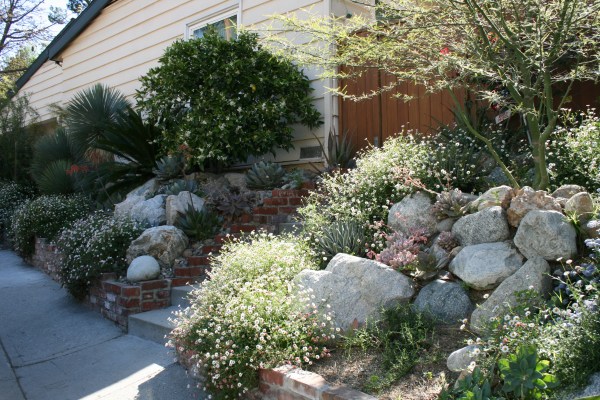
As I walked up the hill to my second garden I passed several really well done landscapes, all using their steeply sloped lots to best advantage. Take a look…

IMG_1705

IMG_1700

IMG_1704

ALMOST TO THE HOLLYWOOD SIGN–the Kohler-Koch garden

Another Mid-Century Modern, another orange door! A standout feature of this front garden was the immense stand of lavender which occupied almost half of the slope. The combination of the lavender and the succulents seemed a bit of a disconnect for me up close but when you stood back and took in the home’s landscape in the context of the hillside it sort of worked itself out.

IMG_1707

The back garden was planted in 2013 and offers a laid back style with naturalized scenery year round-interest. The homeowner reports lots of wildlife from the surrounding hills.

IMG_1710

There is definitely a sunny side and a shady side to this back garden. This beautiful Palo Verde (Cercidium) tree anchors the sunny corner. You can get just a peek at the river rock wash descending the hill. The bed area behind the retaining wall incorporates additional drainage mechanics to direct water rushing off the slope in a rainstorm.

IMG_1712

The Salvia sonomensis was a bee magnet and I think its season is just getting started. More creeping and mat forming than upright this species spreads to about 4 ft. wide and needs exceptional drainage, preferring gritty soil.

IMG_1714

A mature pine provides a shaded spot just outside the home’s kitchen. Just as in the previous garden, the flat area is quite narrow but used really well, offering places to eat outside, rest and read a book or just observe the nature surrounding you.

My takeaway from the Beachwood Canyon gardens–steep slopes front and back presented challenges for these gardeners. A combination of good planning, thoughtful use of a variety of hardscape options and erosion control deep rooting plantings can tame the wild while preserving the expansive views offered by slopes on small lots.

NEXT UP–heading to Atwater Village

A Year in the Garden…Filoli in April

What a difference a month makes! The potted daffodils have been retired, the tulips are waning and the gardens at Filoli have burst into bloom. Especially light traffic allowed me to arrive with almost an hour to walk the gardens before I needed to be in my potting shed classroom. As Filoli was not yet open for day visitors, I was fortunate to have the opportunity to revisit a few plants which were not quite out in March and take photos in a virtually empty garden.

Of course, my first stop was the courtyard now dripping in wisteria. Different varieties were in different stages from just barely in bud to full bloom–both purple and white. The smell was heavenly! This first one drapes the door of the gift shop and is Wisteria floribunda ‘Violacea plena’.

IMG_1878

IMG_1876

It is a beautiful double with shadings from light to dark purple. The white silky wisteria, Wisteria brachybotris ‘Shira Kapitan’, was just getting started.

IMG_1866

The grouping of Wisteria brachybotris ‘Murisaki Kapitan’, yellow Lady Banks roses and weeping cherry was stunning. The wisteria bloom detail below reveals that the flowers in each amethyst inflorescence has a spot of yellow, tying in perfectly with the rose clusters.

IMG_1871

fullsizeoutput_9cf

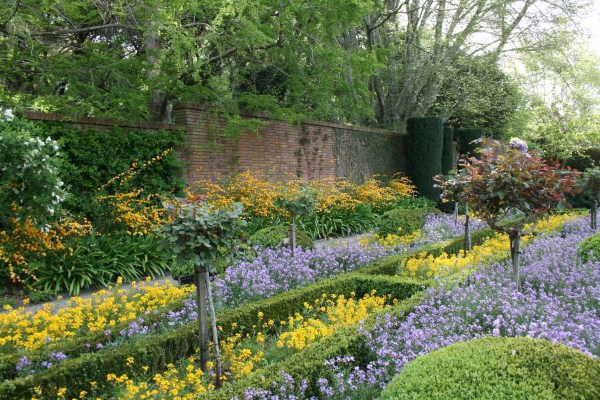
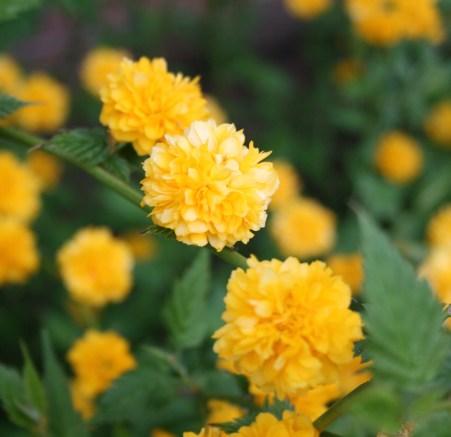
With time running short I cut through the walled garden to make my way to the greenhouse area. Along the way I saw not only another gorgeous wisteria but also a grouping of Kerria japonica ‘Pleniflora’ making a bright statement against the red brick wall of the garden.

IMG_1902

IMG_1895

Kerria is a deciduous shrub with an open arching form. It can grow quite large with a spread of 8 ft. and a height of 6 ft. Its position as the backdrop for a stand of agapanthus gives it room enough to spread out as the season progresses. As the flowers do not stand up well to strong sunlight, the somewhat shaded area will help the kerria blooms hold their color.

fullsizeoutput_9c9

Soil Management was our morning topic. Instructor Mimi Clarke reviewed the four key components of soil composition: mineral soil, organic matter, water and air and we learned the terms needed to understand and discuss soil: soil profile, soil texture, soil structure and soil reaction. The takeaway here was that virtually none of us are blessed with the loamy soil (40% sand, 40% silt and 20% clay) perfect for most plants. While we cannot change our soil’s texture we can change its structure with the addition of organic matter and thus improve conditions gradually over time. No magic bullet, no specific formula and definitely not overnight. We discussed the differences between and the merits of compost and mulch. We finished the morning with a discussion of both organic and synthetic fertilizers. This unit in our notebooks has some great reference material including an overview of the various types of organic fertilizers available and how they are best used and a scaled down home gardener batch recipe for Filoli’s potting soil. Thank you, Mimi!

The focus of our afternoon garden walk was Landscape Perennial and Annual ID. Just as she had for our Tree and Shrub ID walk, Mimi provided a reference sheet for each of  the selections on our list. So great to be able to walk, look, listen and take photos knowing you have all the hard facts all ready on paper to refer back to rather than trying to write down the details as you go along. While there was masses of blooming material on our walk, many of the plants we were focused on were not yet blooming–running a little late this year. As on our previous walks, our group is very enthusiastic and tends to slow Mimi up on her walk schedule. But, no matter, we always have next month to revisit anything we missed!

Most of the perennials and annuals on our list were very familiar to me and so I tended not to photograph them, especially if they were still only foliage. Take a look at a few interesting plants that caught my eye as we rambled:

IMG_1884

Choysia ternata or Mexican orange is an evergreen shrub with glossy dark green leaves and covered in clusters of small fragrant white flowers in late winter and early spring. Although I had read about this shrub I had never actually seen one. It was beautiful and the scent of orange blossom was heady. Reference material indicates that this shrub is fast growing and can reach 6-8 ft. The several I saw were more in the 3ft. range but looked quite mature so they may have been a more compact cultivars rather than the species. Below you see detail of both buds and blooms.

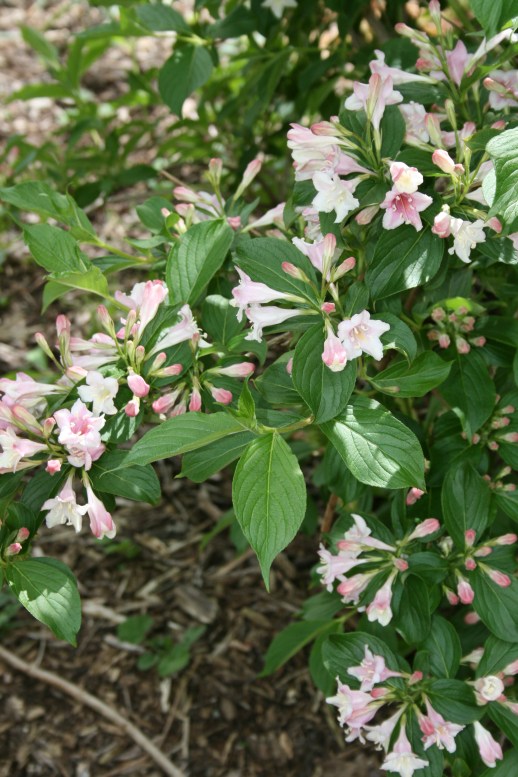
Weigela florida is a large deciduous shrub with long arching branches that almost reach the ground. This shrub was quite common in Georgia but I think many California gardeners in very temperate zones are not as drawn to deciduous shrubbery when there is so much available that gives year round green plus seasonal flowers. Weigela is not especially interesting after it finishes its bloom period and can get pretty rangy. They definitely benefit from yearly pruning of the oldest stems to the ground to increase production of dense new growth and blooms the next year.

IMG_1934

IMG_1936

There are a number of named cultivars and hybrids with flowers ranging from white to deep pink and foliage varying from bright green to burgundy. The plants I saw were quite young, very open and loose.

Yet another deciduous shrub I don’t often see in Valley gardens is Deutzia gracilis, or slender deutzia. As with the weigela, deutzia are not especially attractive when not in bloom and probably best used in a mixed shrub border where they can blend in with other foliage when they are not flowering. Although somewhat smaller and more fine textured than the weigela, deutzia also has slender arching stems and benefits from cutting back the wood that has all ready flowered severely to outward facing side branches.

IMG_1938

fullsizeoutput_9c7

These three shrubs are all best in full sun to partial shade in really hot climates and need regular water.

One of the annuals highlighted on our walk was Viola cornuta ‘Jersey Jem’, as seen below.

fullsizeoutput_9d0

This little tufted pansy was bred by Filoli staff and it not available commercially. Every year the gardeners collect the seed from the violas as they wane and then use that to raise seedlings to plant the following year. Although these plants will be removed in another month or so as Filoli resets their display beds to summer, with a shaded spot, regular pinching and deadheading they could last well into summer in a home garden. Lucky US–next month as part of our Seed Collecting unit we will get to harvest ‘Jersey Jem’ seed to take home for our own gardens!

We also made a return trip to the Camperdown elm I shared with you in my February post. The bare branches are just starting to leaf out in a few places and the tree was covered with pale green seeds which, from a distance, made the elm look as though it were flowering.

fullsizeoutput_9ce

IMG_1950

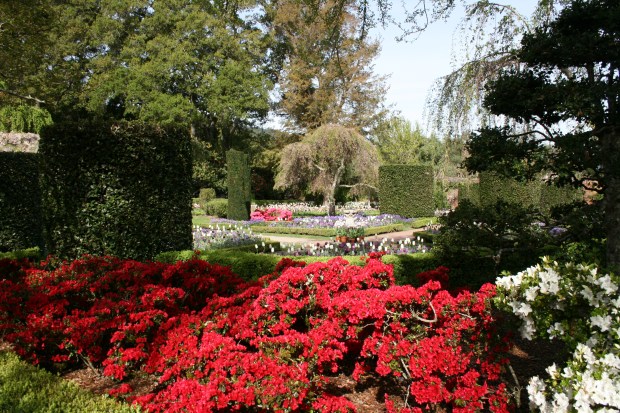
Filoli is a garden of long views. They have been ever-changing over the three months of class so far. It is difficult to narrow my favorites down to a few from this trip. Take a look.

IMG_1901

IMG_1906

IMG_1917

IMG_1891

IMG_1892

And the short views are just as impressive!

IMG_1910

Looking forward to good gardening days ahead for us all and many more great road trip gardens to share with you!

TPFNPGT Saturday, ending the day at the Gottlieb garden…

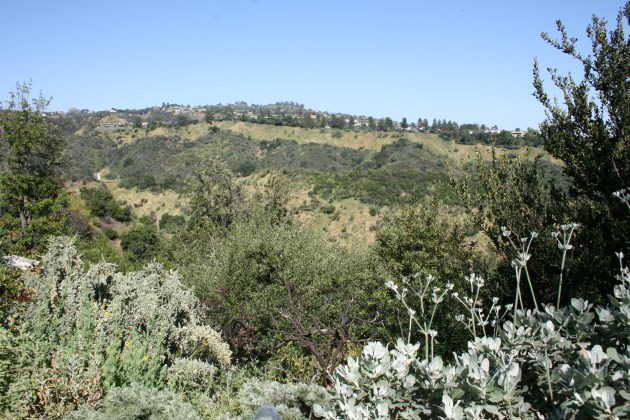
After viewing six lovely gardens in the San Fernando Valley, I climbed up Benedict Canyon Drive on a veritable Mr. Toad’s Wild Ride to drop down on the other side into the LA Basin. I continue to be amazed that after, all the years I lived in Southern California, this was my first trip through the hills NOT driving on a freeway! Only minutes from the glitz of Rodeo Drive a man made (woman made?) urban oasis overlooks Laurel Canyon and offers a  place of respite for the owners, Dan and Susan Gottlieb, and the flora and fauna they nurture.

This one acre steeply sloped site has been in the making for over 25 years. When Dan first showed Susan the home, she was distressed that the ivy covered slopes provided no habitat for the birds–and so the labor of creating this environmentally sensitive and sustainable chaparral woodland began. The garden is a National Wildlife Federation-certified Backyard Wildlife Habitat and a Xerces Society-designated Pollinator Habitat.

Dan and Susan are environmental philanthropists and photographers. Susan pursues her passion for conservation not only with this native garden but also by serving on the President’s Advisory Council for the National Wildlife Federation and in her work with both the Theodore Payne Native Plant Foundation and UCLA’s Institute of the Environment and Sustainability, among other organizations. The Gottliebs own G2 Gallery, a wildlife and nature photography gallery in Venice, CA which donates all proceeds of sales to environmental causes.

After seeing the garden on in 2003 on the first Theodore Payne Native Plant Garden Tour,  Huell Howser, the late KCET television personality and host of “California Green”, devoted an entire episode to Susan’s conservation work. The garden has its own website http://www.thegottliebnativegarden.com where you can find a host of photographs, plant and wildlife lists and a great Wildlife Journal whose posts give you a look at what the Gottliebs see on a daily basis in their garden.

Now for the bad news–I was not very far into this fascinating ecosystem when my camera let me know my last CF card was full. Having little battery left on my phone, I have only limited photos of this great garden. So I’ll show you what I have and if I’ve left you hungry for more, hop on over to the garden’s website. Or go to http://www.theodorepayne.org and click on the 2017 tour information for photos and plant lists of ALL this year’s gardens.

Most of the homes on this street have minimal front yards. A shady courtyard leads you to the Gottlieb’s front door. A special treat for garden visitors was that this garden was accessed through the home. Dan and Susan have a wide variety of art in many different forms, both inside and outside. As you approach the large glass doors opening to the patio, the views capture you.

IMG_1670

IMG_1671

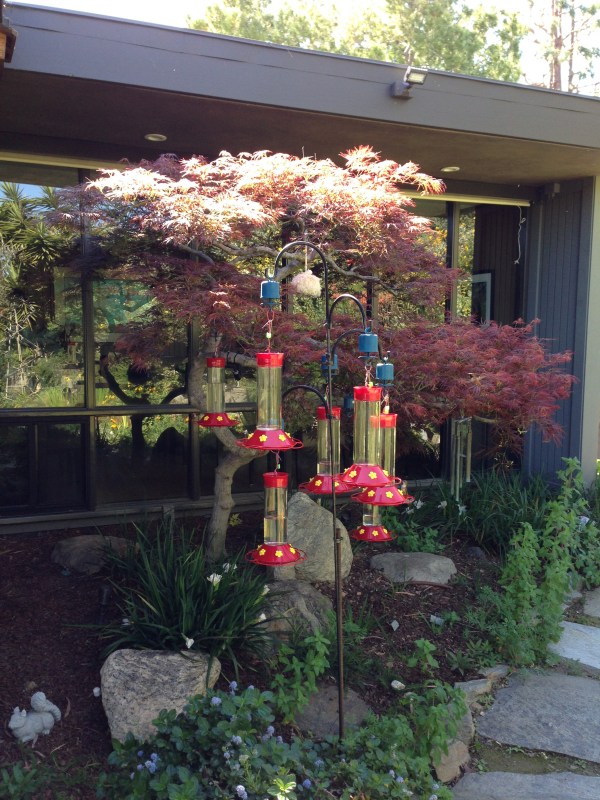
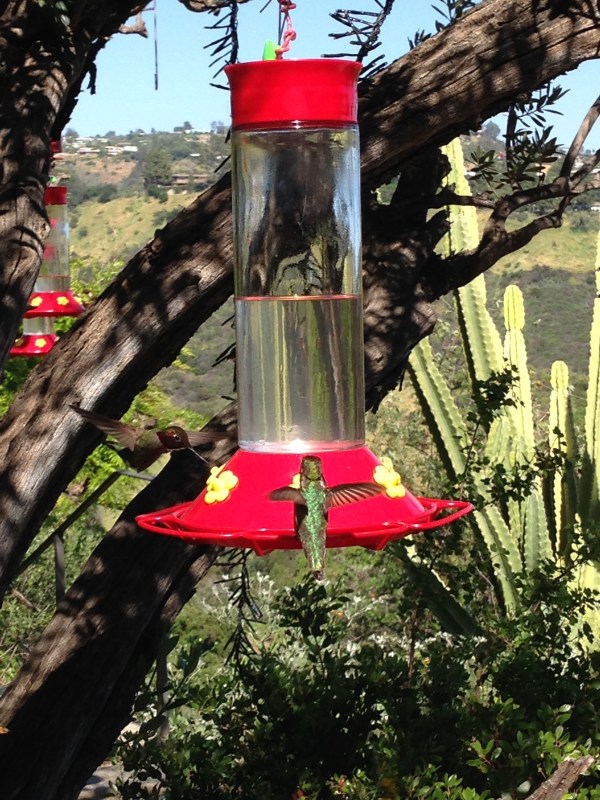
Both Dan and Susan have a special affinity for hummingbirds and, although I did not count them, they must have over 30 feeders just on the patio area. There were literally hundreds of hummers hovering around feeders grouped in clusters and hanging on shepherds hooks.

IMG_5647

IMG_5652

The Gottlieb home is on a very steep street and thus they have a significant slope retained by a block wall on their uphill side.  Here you see a small section of the slope where water runs down the slope into a calm little stream bordered by colorful sun loving natives.

IMG_5645

The Erigonum fasciculatum that I have seen in so many of this day’s gardens shines here as a slope cover draping down to camouflage the utilitarian block wall.

IMG_5646

All of the planted areas are exuberant and filled with such variety I could not hope to even give you a partial list. What struck me about this long and very steep slope was how restful all that variety was even though the palette tended more to the lighter, more yellow green than to the darker greens.

The Gottliebs have designed an interesting solution to allowing their cats to have time outside without putting them in the position of being either predator or prey. Wire mesh tunnels run from cat doors in the side of the home to a number of points on the slope- sort of like an elevated train track for the kitties.

IMG_5663

 Succulents play a role in the patio area and especially liked this cheerful collection!

IMG_1669

The patio and its compact surrounding beds and beautiful pool are only a small fraction of the garden property. Dan and Susan Gottlieb have made their steep slope down into the canyon accessible with a series of wooden walkways. On tour day groups of people wander up and down the slope stopping to admire the variety of form and texture making notes about plant combinations. Susan drifts among her guests answering questions and pointing out plants of special note. Although I walked the entire slope, my camera had already failed me so I have nothing to share save my impression of what a stunning habitat the Gottliebs have created, with the intent of returning the landscape to what it might have been before we all came in digging and building.

fullsizeoutput_9c4

This lovely new book tells the story of the garden and features Susan’s photography. The book is also packed with interesting topics, in prose and pictures, including an introduction to P22, the bachelor mountain lion who lives in the Griffith Park area; LA Bird Day; a short list of reasons to “go native”; native alternatives to invasive species and profiles of many Southern California and national organizations dedicated to environmental causes. All proceeds for the sale of the book go to environmental causes.

My takeaway from the Gottlieb garden–I will attend this tour next year just to have another opportunity to spend time in the beautiful habitat they have created and graciously share with others interested in biodiversity, native plants and water conservation. It will be my FIRST garden of the day, not the LAST, and I will come prepared with extra batteries, CF cards for the camera and fresh legs to explore the slope into the canyon more fully.

NEXT UP–I’ll check in on Filoli in April and next week I’ll share the TPFNPGT Sunday gardens.