Golf course to garden…

Another day…another botanical garden.  I set out on the #10 Granville bus bright and early heading ‘uptown’ for the VanDusen Botanical Garden.  The UBC Botanical Garden I visited yesterday was somewhat remote from the hustle and bustle of town and, while having much diversity in plant life,  was very much focused on preserving the natural forested area and ecosystem.  I imagine it to be the epicenter of botany research and educational opportunities for both the university students and the community at large.  I admit to having expected to see many more of plants I have always associated with the Pacific Northwest such as hosta, oak leaf hydrangea, deciduous azaleas and dogwood and left having not really made the distinction between what has always grown in this geography and what modern gardeners have filled their landscape with for enough years that I just thought it was from here!  In contrast, VanDusen Botanical Garden is a much more structured and managed horticultural display with flowers, shrubs and trees from all over the world and presented in collections and plantings that are thought out far more carefully than Mother Nature ever would.  And it is smack in the middle of town, surrounded on all sides by homes and businesses.  It is equally as breathtaking as the UBC garden, just in a different way!

The 55 acre garden was part of an original 6,000 acre 1885 land grant from the Province of British Columbia to the Canadian Railroad system and made as an inducement to extend the railroad to Vancouver.  In the early 1900s a small portion of the land was developed as an exclusive residential area known as Shaughnessy.  A golf course was built as part of this development.  Years passed and although the area prospered with many beautiful,  large residences being built and still occupied,  the golf course was eventually abandoned.  In the late 1960s the desire to preserve the golf course land as public space with an eye toward a botanical garden, the Vancouver Foundation was formed.  The 55 acres was purchased and management of the project was placed in the hands of the Vancouver Board of Parks and Recreation.  The Garden was named after philanthropist J. W. VanDusen, then President of the Foundation and donor of 1/3 of the funds needed for the land purchase.  There are 46 plant collections and the areas are linked together in compatible landscape groupings.  The Garden also has a full schedule of adult and youth educational programs and offers professional development for teachers.  Add to that a beautiful gallery with rotating displays of botanical art, a wonderful library, a gift shop and great little lunch place!  Of special note is the new Visitor’s Center opened in 2011.  Its design, inspired by organic forms such as an orchid leaf, presents a harmonious balance between architecture and landscape.  It is also a “green” building which uses less energy, water and natural resources while producing less waste and creating a healthier indoor environment. Below you see an image of the Visitor’s Center and its unique door handles which appear to be made of branches of the Henry Lauder Walkingstick tree.

 Continuing on to the beautiful vista of Livingstone Lake and the  Cascadia Garden.

This wonderful conifer is espaliered over a structure about 30 feet in length and provides a shady entrance to the restaurant.

IMG_2922


The Children’s Garden is home to several playful topiary critters–this one in its infancy.
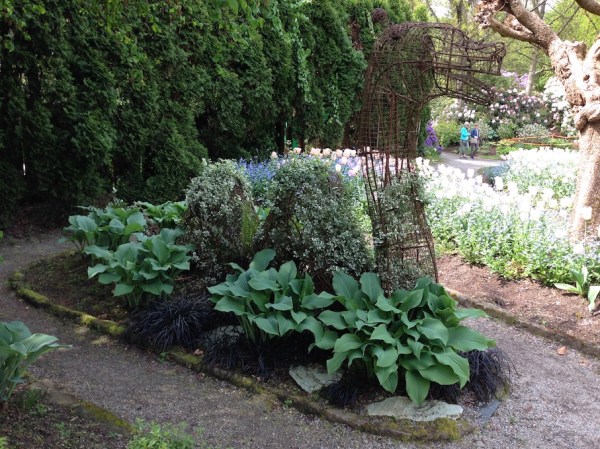
Children's Garden sea serpent topiary

Photography nor words can do this vista of tulips and forget-me-nots justice as we pass through a formal garden area toward the Rhododendron Walk!

IMG_2923

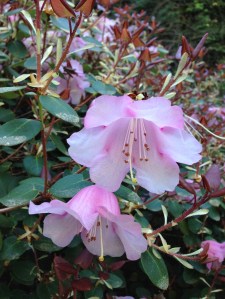
The Rhododendron Walk pairs the many species of this glorious shrub with companion shrubs, perennials, bulbs and ground covers. The walk has over 600 species and an even greater number of hybrids.  The Walk is generally at its peak in May but an unusually early and warm spring made this beautiful show just for me!

The Rhody Walk and several other areas in the Garden filled my giant hosta wishes.

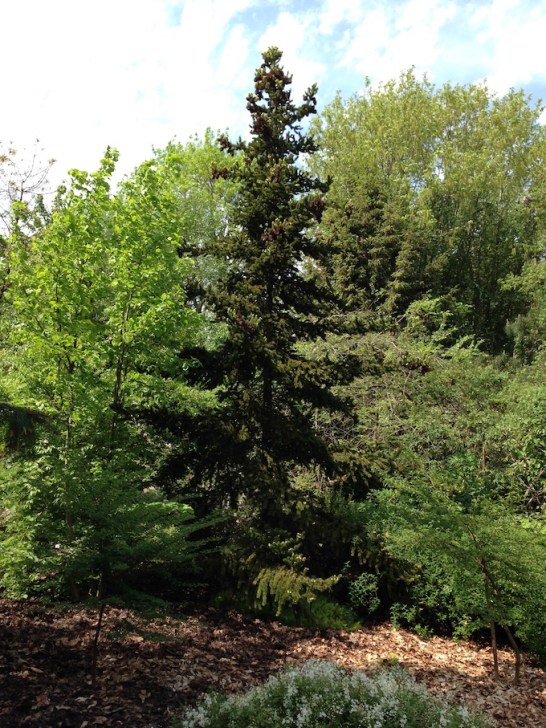
I was in awe of the variety of trees, both deciduous, evergreen and conifers, that can be found amongst the various collections.  The Pacific Northwest has one of world’s greatest coniferous forests as here they are predominant over deciduous trees because their evergreen needles enable them to continue photosynthesis when deciduous trees are dormant.

IMG_3002

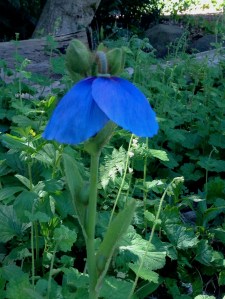
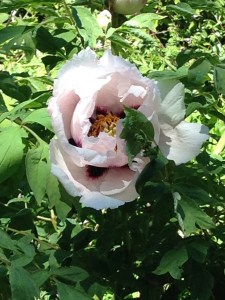
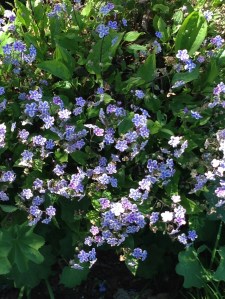
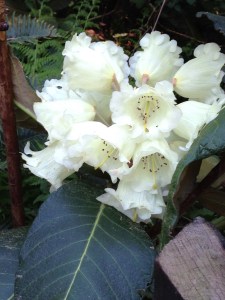
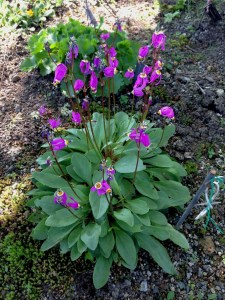
So many photos left to choose from—here are a few more favorites plants that I was thrilled to see thriving in large colonies with amiable companions and a few that I have never even seen in person before.

If you click anywhere in the photos, you will be able to roll the cursor over the individual photos and see a caption with the plant’s common name. Let me know if this doesn’t work for you…first time trying this.

It was clear to me that this beautiful garden is not only a destination for travelers like me but also is a source of respite and relaxation for Vancouver natives.  In my wanderings I passed many groups of two or three folks just strolling and chatting, a lot of moms and grandparents with strollers,  artists sketching and photographers snapping away.  Vancouver residents are truly blessed to have this oasis of green (and every other color) right in their backyards.

Will close with this moment understood by gardeners everywhere……………………………
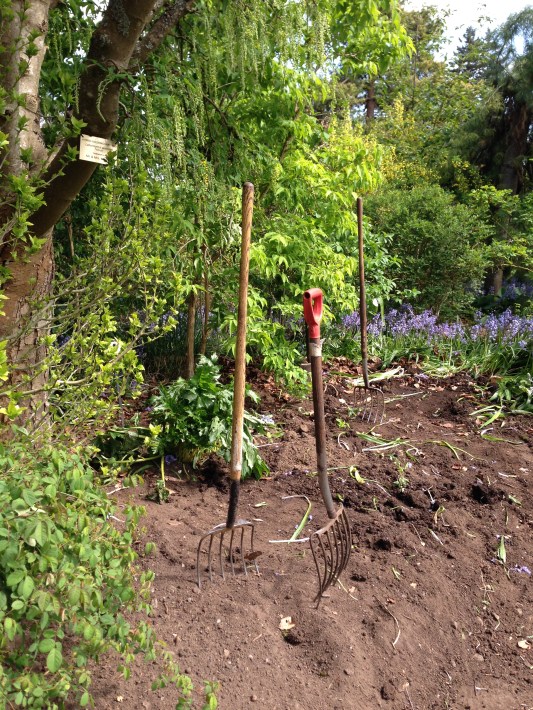
IMG_3139

Spectacular by nature…

Hello, gardening friends!  I am spending a few days in beautiful Vancouver BC, Canada and what a post card worthy city it is.  It seems as though I can see either the water or the mountains from everywhere I go and from many places–BOTH.  I did not even have to go outside my hotel room to encounter my first garden experience.  From my room on the nineteenth floor of the Pan Pacific Hotel I have a perfect view of the largest “green roof” in North America.  The roof sits atop the Vancouver Convention Center West Building and is home to not only diverse plant life but also over 600 honeybees!

IMG_2743

My first port of call was the University of British Columbia Botanical Garden.  I opted for a city bus ride rather than driving and got to see a lot of Vancouver, from the busy downtown to beautiful homes on large suburban lots.  The UBC Botanical Garden is made up of a number of garden areas including the Alpine Garden,  BC Native Garden, Carolinian Forest,  and the phenomenal Asian Garden.  Not to be missed is the Greenheart Canopy Walkway and that is where I started my adventure.  As I was a tour group of one I got special attention from my guide,  JoAnn.  The Canopy Walkway is an aerial trail system which allows you to journey through the upper parts of the forest canopy by navigating 10 suspended walkways  or bridges which connect 8 platforms.  Most platforms are about 50 feet above the forest floor–one has a secondary spiral staircase leading to a 70 foot high viewing deck.  The Greenheart Company specializes in nature based walkways and eco-attractions and has built canopy walkways in Central and South America and Africa.  The design and engineering of these canopy walkways does not damage the trees or the delicate surrounding ecosystem as the platforms and walkways are hung from the trees using a cable tension system.  No nails or bolts!  As I am not great with either heights or motion the tour was not without anxiety for me but we took it slowly and I am so glad I pushed myself.  Definitely no ziplines on my bucket list! At each platform JoAnn pointed out trees of note and shared with me how various plant materials were used by the people of the First Nations (Native Americans, only Canadian.)  Really an awesome experience.

IMG_2749

After communing with those 100 year old trees up close and very personally I returned to the earth to spend the balance of my afternoon wandering through the various gardens in awe of the huge rhododendrons, fields of various ferns and many species of plant life I know only from pictures in books.  Although the garden’s inhabitants are well marked often the markers were too far off the paths for me to see so a few of the gorgeous specimens I photographed will probably remain nameless.  Here are some highlights–how many can you name?

Getting your little ones on a schedule…

Having a weekend free of commitments and significantly hotter days forecasted for next week I set about to do the first deadheading of a couple of groups of roses.  No plan to shop, eat out or even take a road trip—no better way to spend a weekend than deadheading roses.  Is that a commentary on my life, or what?

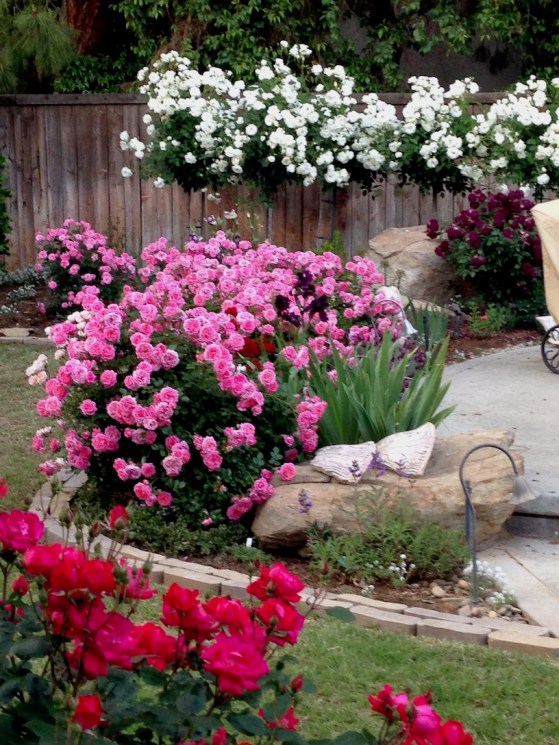
When we bought our home in 2008 it was 8 years old and most of garden beds appeared to have the original landscaping from 2000, the year the house was built.  Knowing I would change a lot of it I spent our first 6 months surveying what we had and how it performed.  I probably should have taken a year but the 6 months put me into March and how could I resist a new gardening year?  Clear winners of the “what stays and what goes” conversation were several groupings of pink and red miniature roses.  Their companions, orange in color, lost the toss.  Doing some research on these little beauties at a local nursery, Gazebo Gardens,  they were identified as Sunblaze miniatures, Sunblaze Pink and Sunblaze Red from Star Roses.  I also learned that the Sunblaze Pink was no longer being grown, having been replace by a new and apparently improved pink called Sunblaze Sweet.  After a short but intense period of mourning at not being able to obtain additional plants identical to my pink miniatures I simply rearranged what I had and moved forward.  I have the pink and red alternating in areas of 2 beds and they have performed magnificently for the last 7 years.

I have developed a deadheading regimen for the Sunblaze Pink roses that gives me 6 or more blooming periods, each lasting about 8 weeks.  With a little variation here and there for weather (hot) and water (very little) they respond with clockwork precision.  A little disclaimer here—I am not a rosarian or in any way educated about roses, except what I have read and gleaned from others.  I was a Master Gardener when I lived in Georgia but as roses are very challenging in that humidity and fungus ridden garden environment we got very few calls needing help with them.  I can only share what has worked for me, in my garden with these particular roses.

In my Central Valley of California we routinely strip the flowers and foliage off our roses mid November in an attempt to force them into dormancy and get them ready for annual pruning.  I prune all my roses about mid January. In many places this would be considered very early but if we have a mild winter and an early spring you could be looking at new growth on plants you have not even gotten the clippers to yet.  The Sunblaze Pink responds to this hard prune by popping out new growth within a few weeks depending on the weather.  Dependably I have buds, and then the first open flowers, by the third week in February. Below you’ll see one of the beds photographed about mid March.

IMG_2624

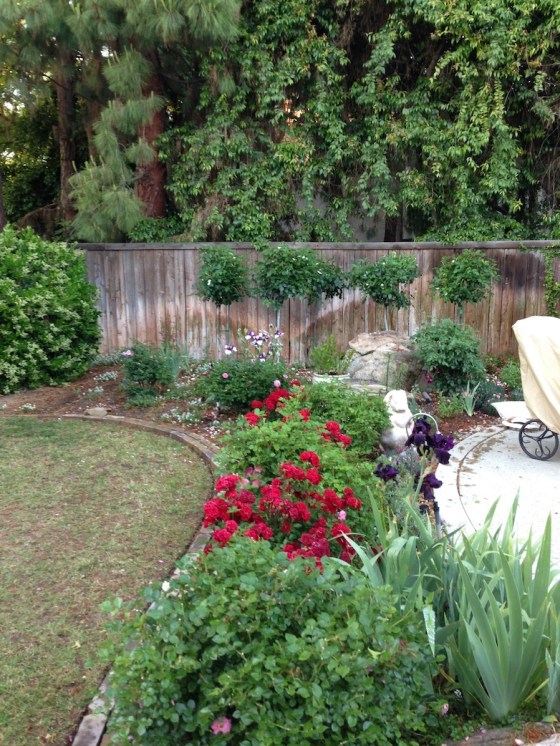
You can see here that the Sunblaze Red are naturally smaller than the Sunblaze Pink but they both look lovely in combination with the dark purple iris and the smaller lavender. In the next photo you can see the roses have reached their bloom cycle peak.  This photo was taken on April 7th.

4-16-16 Pre-pruning

I tend to deadhead quite aggressively and, according to some of my gardening gals, a bit too early in the cycle.  I find that if I wait til all the roses on any given plant are spent I’ll be looking at cutting back around new growth or life will just get in the way and things won’t get deadheaded at all. The photo below was taken this morning and it a good representation of the point at which I go looking for my clippers—noting that I am about 7 weeks past the emergence of the spring growth.

Flower staus pre-pruning

I have spent flowers, flowers in their prime and even some buds.  They all have to go!!  It takes a great leap of faith to cut off perfectly good flowers but you are just that much closer to the next bloom cycle. To cut these to bring inside for a vases or a bouquet you would have to pick through all the dead ones to get anything decent anyway.  Also lessening the flower murder stress is that our first bloom cycle is in prime time for the hoplia beetle.  These miserable critters use the blooms on white and light colored flowers as their own personal love shacks.  They emerged from the soil about mid March, fly up to and mate in the flowers all the while munching on the flower’s petals to keep their strength up.  Then the female lays her eggs in the soil where they overwinter as larvae.  If you look closely in the above picture’s upper right you can see one of these bugs sticking out–they are often mistaken for Japanese Beetles.  They are most effectively controlled by handpicking and squashing–yuck.  I have enough yuck in my yard stomping snails–do I really need this?  The good news is that they will be gone by the second bloom cycle!

So I have spent about 3 hours with my clippers on a total of 8 Sunblaze Pink roses.  I think this is a good trade for the promise of the next bloom cycle. Typically these bushes rest for about 2 weeks and then start pushing out new growth.  In 6 weeks I will have a clean new flush of blooms to enjoy for a couple of months.  Then I’ll just do it all over again! By the way, the 5 Iceberg tree roses you see in the background of these pictures got their first trim back today also and will follow much the same cycle as the Sunblaze Pink. Interestingly enough, the Sunblaze Red are exceptional ‘self cleaners’. Their flowers dry and drop very cleanly on their own, they will rest then come back into bloom without any human intervention almost on the same schedule as their neighbors.  Isn’t nature wonderful?

4-16-16 first deadhead back

So here you can see the fruits of today’s labor.  The second bed containing these same roses looks much the same.  Put your timers on and I’ll give you a heads up when we have flowers again.

Covering a little ground…

To a gardener a good ground cover is a lot like a stand out sauce is to a cook—it can go along way toward deflecting attention from any mistakes you made on the main course!  Ground covers will wind their way through your other plantings unifying diverse colors and forms. They can provide erosion control, take the place of lawn in areas where lawn will not thrive or is not needed for foot traffic, and cover the feet of plants whose growth habit tends to leave them a bit bare below the knees.

Ground covers come in all shapes and sizes, foliage textures and colors. Many, although not all, have colorful flowers desirable for your garden in their own right. Some are clumping while some spread by underground runners. They could be evergreen or all but disappear in the winter’s cold to come roaring back with the rest of your perennials in the spring. In large scale planting areas you may even opt for masses of closely planted shrubs, such as abelia, juniper or rosemary to fulfill the ground cover function.  More and more roses are being bred specifically to stay fairly low and plant en masse with little of the traditional rose care being critical for successful blooming. While we often think of vines as being plants we use to cover trellises or other structures to add vertical interest, many vines do admirably well finding their way on the ground to fill in large areas—ivy and star jasmine are perfect examples of vines used as ground covers.

When choosing plants to act in the ground cover role you must still look at sun/shade, soil and water requirements.  This can seem complicated if you are trying to fill an area which may go from sun to shade or have a soggy spot in it.  My experience is that whatever you pick will grow to the breadth of its comfort zone and you’ll see soon enough that the uncovered areas need an alternate pick.  I have an area in a north facing shade bed filled with Anenome ‘Honore Joubert’, a lovely and fairly invasive perennial which needs afternoon shade in my area.  As the bed edges forward and abruptly loses the shade of the house, thus falling into the direct southern sun—-the anemone stops!

A couple of my favorite ground covers have been pictured in previous posts: Geranium ‘Tiny Monster’ and  Dianthus ‘Firewitch’. Here are a few more:

Veronica ‘Waterperry Blue’ is a lovely little 4-6″ high trailer which blooms early in the spring.  Very polite, tolerant of both sun and shade and and providing a lovely contrast in my garden when planted under pink and red Sunblaze miniature roses.

IMG_2603

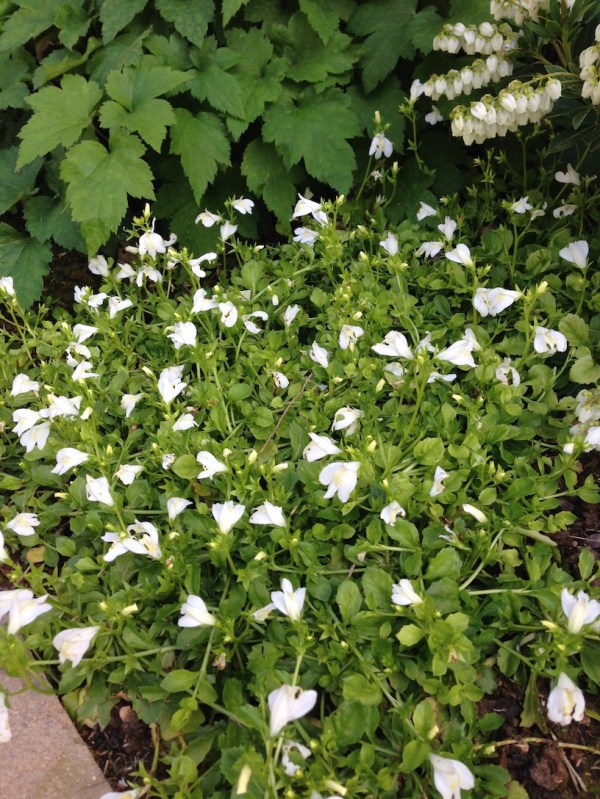
Mazus repens ‘Alba’ is another little clumper-trailer.  This one brightens up my shade bed bordering my back patio.  It required a good bit of neatening up early this spring but by May or so it will have filled back in.  Yet another spring bloomer with almost chartreuse foliage.

IMG_2605

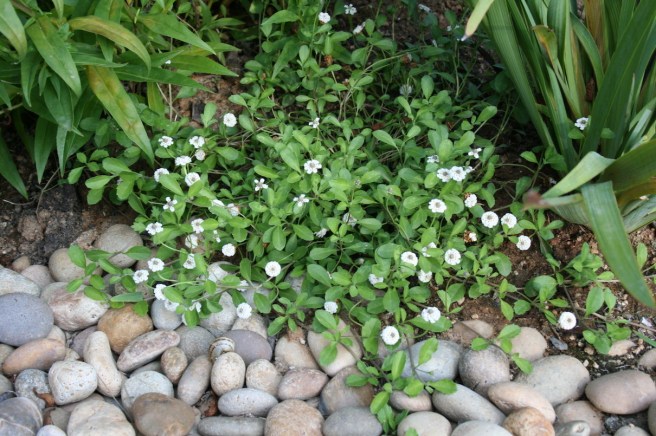
This one is a little more unfamiliar and hard to find.  You might find it labeled Phyla nodiflora or Lippia repens.  Its claim to fame is the ability to withstand foot traffic and can be a lawn substitute for smaller areas.  It can even be mowed and bounce back pretty quickly!  The flowers are reputed to appear spring through fall but in my garden I have only spring bloom.  I does form a very tight mat of both above ground stems and underground roots and can be hard to eradicate if you find you don’t love it.  This photo is of my original 4″ pot purchased 2 seasons ago.  It now fills the entire area of the rose bed it is in–about a 10 ft diameter circle boundaried by pool deck and grass.

Mystery groundcover from Plant Depot 5-13

Hellebores may not be considered traditional ground covers but they are indispensable if you want to fill the areas beneath high branching hardwoods and conifers.  They are naturally understory plants, unbothered by root competition and flourish in the forest floor environment created from leaf and needle drop.  They are commonly called Lenten Rose or Christmas Rose depending on the species.  While they bloom in the fall through late winter, their strong, leathery, dark green foliage persists throughout the year.  In masses they make a statement even when not in bloom. Hellebores are prolific reseeders and if left in place will form huge colonies of new seedlings. The only downside I have ever seen was that the seedlings take several years to reach blooming size—this surely accounts for their relative pricey-ness in the retail nursery market.  The seedling’s bloom color is not necessarily true to the parent plant and there is much variation from white to cream to pink.  The plant pictured is 9 years old and was originally a seedling from the garden of my dear friend, Mary Sims, in Macon, GA.  There is intensive breeding going on the the hellebore world and you can find many new named varieties and color variations in specialty plant catalogs.

IMG00001-20110304-0834

Also a little non traditional but very effective in large swathes are Daylilies (Hemerocallis.)  These clumping beauties provide clear green foliage most of the year (depending on variety and where you live) and offer more color and form variety than almost any other plant group except possibly roses. Go for at least 3 plants of each variety and lay them out blending your colors as you fill your bed.  You cannot go wrong!  For a feast of offerings try Oakes Daylily Farm in Knoxville, TN. Their catalog is extensive and the many plants I have ordered from them have been in excellent condition with large healthy scapes ready to go in the ground.

Barbara Mitchell daylilies 6-05

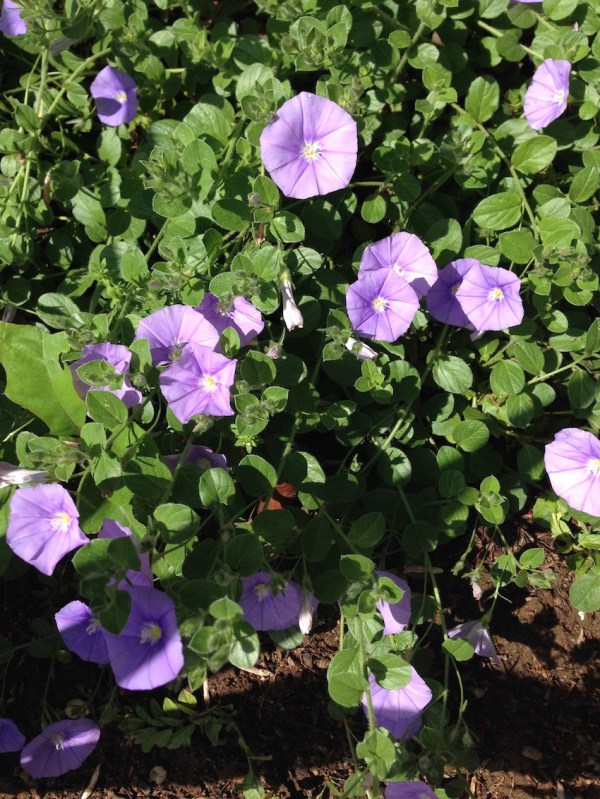
My last offering for today takes us back into the more traditional ground cover world.  I first saw this plant in action in a lovely sun filled space in one of the gardens on the Gamble Garden tour in Palo Alto, CA and I was instantly a fan. While their weather is more temperate than where I live, the plant was a foot high mound about 3 feet in diameter out in the very hot sun without any protection. It almost glowed! This is Convolvulus mauritanicus ‘Morrocan Blue’  and is commonly called ground morning glory.  What a charmer it is.  I established it just last spring in a very hot, dry area of my side yard that gets little to no attention and it has really made quite a show as the “skirt” for some lovely, very tall white bearded iris.

Convolvolus mauritanica 4-16

There are so many more to share with you I’ll need a “part deux” ground cover post.  We have not even talked about the campanulas, lantanas, or verbenas! Until next we garden together…

Social climbers…

There are not enough weekends in April and May to be able to take in the many wonderful garden tours available to us!  I starting doing garden tours in earnest when I first moved to the South in the late 1990s.  The expansive gardens filled with wide swaths of flowering shrubs and bulbs were just so different from the beautiful but smaller and more detailed gardens commonly on tour in Southern California.  At one point I found myself trying to figure out how I could be in Georgia, South Carolina AND Alabama all on the same weekend.  They were all just too good to miss.  Adding to that space aged travel dilemma was my desire to hold on to my favorite California garden events too!

On one of my trips back to Southern California to attend the Mary Lou Heard Memorial Garden Tour I came face to face with the climbing rose which sparked my desire to have these beauties in my garden.  In this case it was a magnificent ‘Berries and Cream’ climber in the front yard of a small and tidy home in Fountain Valley.  There are few plants that can snarl garden tour foot traffic as surely as a climber massing over trelliswork 8 feet high and 10 feet wide and in full bloom.  Gardeners with yards large and small, from all walks of life, stop to chat about the beauty of a robust climbing rose.  As an aside to this climbing rose story let me encourage you to check out this wonderful tour which is held yearly, usually on the first weekend in May, and was started in memory of the owner of an iconic cottage garden nursery and shop in Huntington Beach, CA.  The tour encompasses 30+ gardens across Orange County and the funds raised from tour-goer’s donations is earmarked for the Sheepfold, a shelter for women in crisis and children.  See their website heardsgardentour.com for the details of this year’s event.

So roses, climbing or not, were a challenge for me in humid Central Georgia.  My few attempts were less than successful in a land where black spot and other fungal diseases reign supreme.  Returning to hot, dry Central California opened new opportunities to check “climbing rose” off my garden bucket list.  Roses are much beloved in my city and many varieties are available starting in January.  Roses can be seen in their glory from March through November.  We are a bit challenged by our often mild winters and you have to force yourself out into your garden in late November or early December to cut off perfectly good flowers and strip still green foliage to force your plants into dormancy to prepare them for full on pruning in late January.

Having solved the humidity/disease challenge by moving 3000 miles west I now had a more formidable challenge to surmount.  By their nature climbing roses need structure–trellis work, a pergola, fences to scramble on to mention a few possiblities.  It is sort of a “if you build it, they will grow” kind of thing!  My husband is very supportive of most of my garden dreams and plans until they involve construction or worse yet–letting something grow up the side of the house or attached to a fence.  This probably results from an ill fated episode in our first garden together when I planted creeping fig and encouraged it to grow up the side of the house, resulting in a close relationship with the gentlemen who you hire to re-spray the stucco and pay by the square foot.

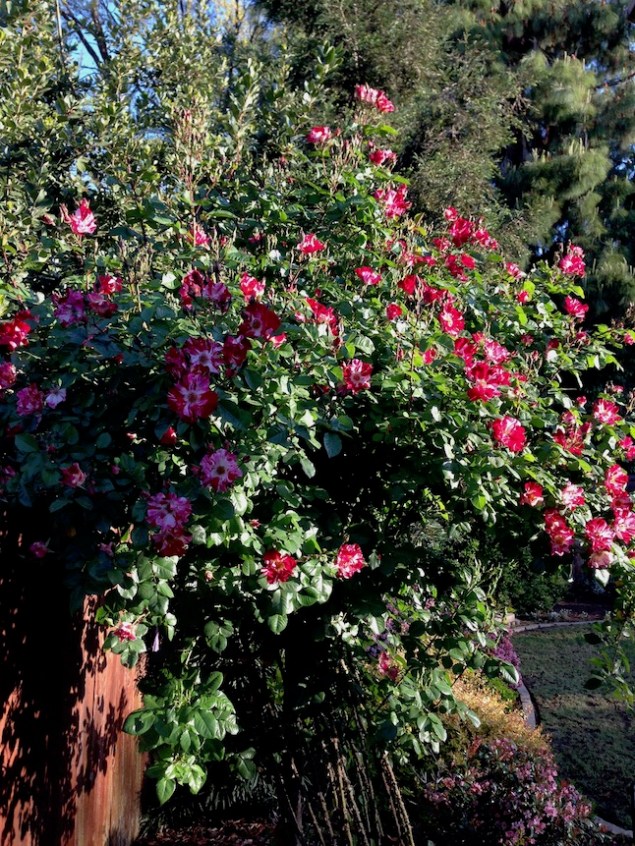
The death of a large Photinia fraseri on our west fence line presented a wonderful opportunity.  My husband cut back all the small branches, leaving the trunk and larger branch structure in place and I went to my local rose gurus, Gazebo Gardens, to purchase my first climbing rose.  Notice that I did not say that I researched varieties, lengths of canes, blah, blah, blah.  Just went right out and bought one I liked—a floribunda climber named ‘Fourth of July’.  Had I done the research we might have left even the small branch structure intact on my tree trunk trellis as this magnificent rose’s climbing canes can surpass 12′!

Climbing Rose Fourth of July

‘Fourth of July’ is now entering its 4th bloom season and it requires me to stand on the top step of an 8 foot ladder to do the pruning and cleanup work in January. What you are seeing below is just the top or head of the upward trained climbing canes—there is another 5 feet below where the canes are tied to the dead tree trunk!

IMG_2615


Good thing I started with a robust and very forgiving climber!  I have since added two more selections to my garden and learned that there is way more nuance and sophistication to these gems than I realized.  My next selection was destined for a more traditional metal trellis easily seen from our back patio.  I now realized there could be much variation in the natural growing length of the canes by variety and specifically chose one whose canes were in the 8 foot range so it would not overwhelm my support.  This sparkling lovely is called ‘Morning Magic’ and comes from the breeders who gave us the Knockout Roses.  It is a delightful shell pink and almost seems to shimmer in the early morning sun.


My rose expert friends tell me I need a good bit of corrective pruning in my attempts to cover my framework well but I am not unhappy with my efforts so far—this is the 3rd year in the ground for this magical rose.

The last climber I bring you is ‘Eden’.  We built the pavilion you see in the photo under the blog title in 2011.  It provides us with an additional shady spot for entertaining and we often eat in the pavilion on summer evenings. Feeling it needed some ‘softening’  we added the painted trellis work in the fall of 2013. The trellis has 6 uprights, four of which are planted with ‘Eden’.  Fearing a rose might overwhelm the space which functions as the main entrance those two uprights are planted with Lavender Trumpet vine—-this vine is known to be a slow starter but it has definitely underwhelmed me.  Moving the rose canes toward the top horizontal crosspieces has been quite challenging with lots of tying and tweaking.  At the beginning of its 3rd year I have only one cane up on the horizontal  and I have found identifying the climbing canes to be more than problematic for my novice pruning skills.  I will persevere in hopes of seeing a bride and groom standing under a glorious profusion of roses in a couple of more years!! Are you reading this, Joshua?

Climbing Rose Eden Spring 2014
First year in the ground

IMG_2610

IMG_2612
Where we are today!

Go, ahead! Become a social climber.  You will be rewarded with almost endless beauty.  Happy planting from my yard to yours!

Oh, to be first on her list…

In contrast to my relaxed, cottagey, only the strong survive gardening style my record keeping style is copious, tedious, highly organized and never ending.  I tend to keep detailed records of everything, not just what I have planted or what has bloomed when but of items purchased, warranties starting and ending, bills paid, gifts given, clothes worn where, etc., etc., etc.  All these records, of course, are kept in subject specific and color coded notebooks in my studio. I have Daytimer calendars back to the late 1970’s so just in case I need to know where I was on December 2, 1991 or September 18, 2002 I can access that information at a moment’s notice.  You know how the prosecutor on TV crime dramas always asks the witness where he was on .a certain date and time? I am amazed they can answer because without my calendar I can’t tell you where I was yesterday.   I think you get the picture.  Those of you reading my posts who actually know me absolutely get the picture.

One of my record keeping efforts that actually brings me some joy and reflection every spring is the list I keep of the first blooms to appear among a variety of groups of plants.  I note the dates and the general growing conditions and take a few photos.  Here are a few of my firsts for 2016.  I will note we did have a wetter than normal winter and have had some earlier than is typical warm weather.  Both of these have contributed to things blooming a bit earlier and a bit more robustly than I have recorded in the last few years.


Rose Singing the BluesCamellia jaqponica

Floribunda Rose ‘Singing the Blues’ is consistently an early bloomer in my garden.  I have 3 bushes and two of them sit in a narrow strip of ground bordered by house on one side and driveway on the other, receiving lots of reflected heat.  It is a bit more lavender and a bit less pink in natural light than it is in the photo.  This rose is fabulously fragrant and produces many large clusters of flowers continuously until early winter.  This rose is very disease resistant and has stunning dark green sturdy foliage.  It is an A+ in my book!

Dianthus ‘Firewitch’ sports masses of face up neonDianthus 'Firewitch' pink blooms over a neat mound of blue grey foliage.  This a a new take on the very old fashioned group of flowers called Cheddar Pinks—a staple of every cottage garden.  ‘Fire- witch’ is a perfect edging plant, remaining neatly in its boundaries.  Like all perennial dianthus, a light shearing  of the faded blooms will produce a new flush of flowers.  It blooms off and on all summer for me and is the plant to which I credit my obsession with all things dianthus.
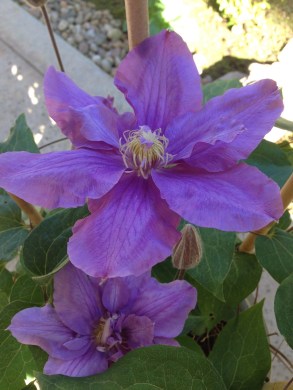
Clematis 'Vyvyan Pennell'

I so hate to show you a clematis whose variety I cannot definitively name—it was marked as ‘Vyvyan Pennell’ but that cultivar has double flowers so it could not be correct.  Its fully 7″ across flowers are gorgeous by any name!  It has been in this pot for about 6 years and will fully cover the 36″ supports by early summer.  Even though clematis are full sun plants I give this one a bit of patio protection in our hottest months to reduce the chance of it drying out if we are away for several days.

The bearded iris first bloomers were a trifecta this year!  I have over 60 iris varieties and they range from very early bloomers to very late bloomers.  Left to right the 2016 firsts are:

                         ‘Laura Buelow’                    ‘Night Ruler’                 ‘Over Alaska’

A special “first” award goes to the hosta pictured below.  My love affair with hostas has spanned many years and two gardens where my attempts to grow them have been thwarted by one critter or another.  I grow several varieties now but they are most successful for me protected in pots.

Hosta


I am calling this one the ‘FIRST HOSTA (NOT IN A POT) TO HAVE THIS MANY LEAVES BEFORE IT IS EATEN TO THE GROUND BY SNAILS’…how’s that for a unique cultivar?

A tiny monster any girl can love…

I have long had a love affair with geraniums–true or hardy geraniums to distinguish the group from their cousins, pelargoniums (often called zonal geraniums.)  I am usually in the throes of a love affair with one plant or another and spend my garden center time searching out every different one to add to the garden.  In future posts you’ll no doubt hear about my current obsession with all the wonderful new perennial dianthus, or my first glimpses at the diversity in the large plant family called campanula which sent me up and down the highways hunting down every one in the Central Valley, or the lavender years, or, or, or…I first drank the kool-aid with Geranium incanum in the eighties when we had a difficult front slope in southern CA to fill with things that were easy care and would take up a fair amount of space.  At that time there were not many varieties of these hard working gems in most local nurseries or garden stores even though there are over 300 species and many, many cultivars and hybrids in the world.

Most true geraniums, often called cranesbill, are easy care; not too fussy about soil and rarely bothered by insects or disease.  Although they are often tagged as full sun, in my hot, dry climate most benefit from some afternoon shade.  Let’s face it—most everything here, including me, could benefit from some afternoon shade!  I have about a dozen different kinds between my front and back beds but few are in bloom yet.  I do shear back the foliage for our cold winter and the new foliage is just now popping out.  Later in the spring I’ll  dedicate a post to them as they come into their prime.

On the other hand, G. ‘Tiny Monster’ has been up and running since mid January and will bloom continuously until I cut it back in self defense in late November or early December. It is a garden workhorse for me.  The  source of all the ‘Tiny Monster’ clumps in my garden (and in several fellow gardeners’ yards) was a 4″ plant found almost two years ago at the fabulous Plant Depot in San Juan Capistrano, CA.  I always stop in when I am visiting my SoCal girlfriends and never leave the OC without back of the Volvo wagon full of great finds.  Lots and lots of 4″ pots so you can try a lot of new things without breaking the bank.

I popped my little discovery in the ground under one of a pair of ‘Renae’ cascading tree roses hoping to give it a little protection from the southern exposure.  It quickly grew to a clump about 18″ high and 4 feet across.  Like many of the true geraniums it will attach to the soil at points away from the original crown.  These babies can then be detached from the runner, dug up and transplanted.  ‘Tiny Monster’ has proven itself as a reliable mounding ground cover in the hottest, driest conditions imaginable.  You can see the original clump in the photo below—this is a south facing bed with brutal summer sun.  I have transplanted clumps to a dry little sloping area behind the pool which is also south facing AND gets the western sun to boot.  Never wilts, never dries out, always blooms.  If I let it, it will scramble over its neighbors but is easily controlled with 5 minutes and a pair of hand clippers.  The magenta flowers are cheerful and the charming lacy, cut leaves look airy and cool.  For me, this tiny monster can hang out in my garden any time!

Hello, dainty little bells

We returned home from a few days at our mountain cabin to find many new wonders coming alive in the garden.  Soon my central valley will be in the throes of its hot, dry summer when I swear I can see the heat move in waves before my eyes and it’s everyone into the pool on a daily basis. I appreciate every little minute of springlike weather when things start to wake up from their winter’s sleep and stretch their arms out for another year.

A couple of years ago I added a shade bed adjacent to my north facing back patio.  The area had formerly been lawn and the shade from the house had made it a spectacularly unsuccessful lawn.  Shade tolerant grass varieties were not the answer–as soon as you passed the line of demarcation shaded by the house you were in hot, dry country.  The result was a lovely curvy bed about 25 feet long but only about 4 feet at its widest.

IMG_2540In this photo you can actually see the “line in the sand” drawn by the sun and the shade.  As the sun moves to its summer position it does encroach somewhat more into the bed (enough to have a couple of miniature roses at the eastern end) but for most of the year the meandering little bed remains a haven for shade and moisture loving perennials including hosta, Maidenhair ferns, hellebores, pulmonarias, tiarellas, calla lilies, true geraniums and bellflowers.  The bed is anchored by two standard gardenias, a couple of Pieris japonica ‘Prelude ‘ and several small hydrangeas Pink Elf®.  It is also home to every snail and slug within a five mile radius—sometimes it seems as though you just can’t win!!

One of my favorite inhabitants in this shady little village is a colony of Solomon’s seal (Polygonatum odoratum var. pluriflorum ‘variegata’)  That’s a pretty big name for this dainty perennial whose 14″-18″ arching stems sport dangling creamy white bells in early spring.  Solomon’s seal is a relative of the Lily-of-the Valley and actually a member of the same family as asparagus.  Its delicate leaves are edged in white and large colonies result from the spread of its creeping rootstock.  It is easy to pull up if it wanders too far but really, who would want to? If you live in cooler areas the leaves will develop a lovely yellow color before dying back for the winter.  In my very hot summer climate it can look pretty ragged by fall but always comes back just as hopeful the next spring.  There are several interesting explanations for the plant’s name.  One is that its roots bear depressions that resemble royal seals–another that pieces of the root when cut  look like Hebrew symbols. Below you’ll see the Soloman’s seal and a few of its shady neighbors!

Soloman’s friends bottom row left to right: Hellebore ‘Queen’s Double’, Brunnera macrophylla and Pulmonary ‘Tivoli Fountain’


Reminders of my life in the south…

Although the quintessential Queen of Blooms, Camellia japonica, is grown all over the world, it will always speak to me of the South.  Having lived for many years in an historic neighborhood in Macon, Georgia, which was covered in camellias, azaleas, dogwoods and hydrangeas, I will always associate the camellia with the laid back elegance and style of the deep South.  Leaving that garden paradise in 2008 to return to the hot, dry Central Valley of California required a major adjustment in expectations to successfully grow many of the acid and moisture loving plants I had come to rely on not only for a graceful landscape but also for a ready source of cut flowers.  In my zone 9 garden camellias fare best with morning sun and afternoon shade.  The scorching afternoon summer sun punishes the foliage so badly that by the time it cools off and the plants start to come into bloom in late fall and early winter they still show the effects of the summer stress.  We have fairly alkaline soil and are in an area with a lot of petal blight, a fungal disease which causes buds and flowers to prematurely brown and drop.  Many camellia lovers have persevered here in spite of the challenges and there are some lovely large plants around town which have flourished with just the right exposure, protection and care.

My garden has very few spots offering the coveted morning sun/afternoon shade combination so we just had to make do.  I have a number of large camellias in pots on my north facing covered patio—-a location made in heaven for them.  Too many more and I won’t be able to get out the door.  Over our first few years here I planted a variety of camellias against the fence on the west side of our house.  This is the “service” side of our property but it is a joy to see the blooms from the windows in our bedrooms and bath rooms.  Just about the middle April  we suspend panels of shade cloth from the fascia to the top of the fence behind the plants to give them relief from the summer sun.  The shade cloth panels usually come down around Halloween.  Although intended for the plants, the panels provide the extra service to us of protecting those rooms from the western sun and make it possible to actually have the shutters open on summer afternoons!

As they will be done blooming soon I took a few shots of some of my favorite varieties of this magnificent flower to share with you—Enjoy!


Clockwise starting from upper left: ‘Grand Prix’ (6″ across!!), ‘Sue Kendall’, ‘Jordan’s Pride’, ‘Nuccio’s Bella Rossa’, ‘Nuccio’s Gem’

Just now digging in…

Hello, Gardening Friends!

I am embarking on this adventure to replace the Friday Plant of the Week emails going out to many of my gardening friends.  Having shared the gardening world with wonderful people from California to Georgia and back again it is rewarding to pass on your successes, failures, new finds and old favorites–not only with the gardeners in whose dirt I have been  knee deep but with some new friends I might meet along the way.

I am still figuring out how this world of cyber sharing works so be patient with me regarding the look of the blog and whatever technical errors I will surely make along the way!!

I am a life long lover of all things GARDEN.  High on my plant list are iris, hellebores, roses and just about all perennials.  I am less enamored of managing grass which is a good thing given the drought stricken status of my home state of California.  No longer a veggie girl as my husband’s family keeps us in more fruit and veg than we can consume.  I definitely have a garden–with all its ups and downs– not a landscape.  I look forward to sharing it with you!