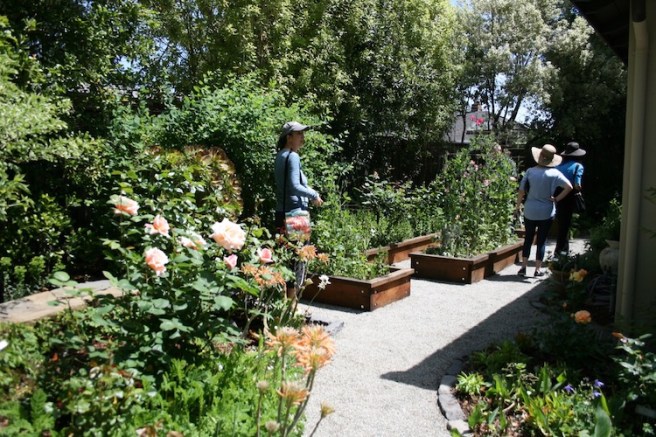
LA cruising…terrific terraces

It’s Garden Conservancy Open Days time again! If you’ve not read any of my previous Open Days posts (I’ll add their links at the end of this first 2019 post) let me tell you a bit about the program. Open Days is a nationwide community of gardeners with a passion for teaching and inspiring each other. Since 1995 Open Days has welcomed more than a million visitors to noteworthy private gardens in 41 states, all under the umbrella of the non-profit Garden Conservancy’s mission “to save and share outstanding American gardens for the education and inspiration of the public.”

As a Garden Conservancy member I receive a directory each spring listing, state by state, the gardens and landscapes included in the year’s Open Days offering. As a rule, the California gardens are amongst the earliest of the season although in the last few years a Bay Area day has been scheduled in the fall. Some years I barely have received my directory before I have to get on the road to see as many as I can fit in my schedule. All of the information is also available on the Garden Conservancy’s website http://www.gardenconservancy.org/opendays along with more details about their Garden Extras and Digging Deeper events and their local partners. The directory itself is great resource and I keep mine from year to year.

California’s first Open Days event took place this past weekend and showcased five gardens in the Hancock Park and Windsor Square neighborhoods of Los Angeles. The drive from my San Joaquin Valley home requires a crack of dawn departure to ensure I am ready and waiting at the garden I have designated as first on my route to ensure that I get to see them all by 4 pm closing. This year’s Los Angeles selections are all quite close to each other so there is at least a possibility of finding time for lunch. My husband has opted in so I might even catch a nap on the way down. The morning air was cool and crisp as we navigated off a busy urban street to a small neighborhood where most of the homes were shaded by the canopies of mature trees. I think it’s going to be a great day!

THE MEADOW LANE GARDEN IN HANCOCK PARK

GC LA meadow 1

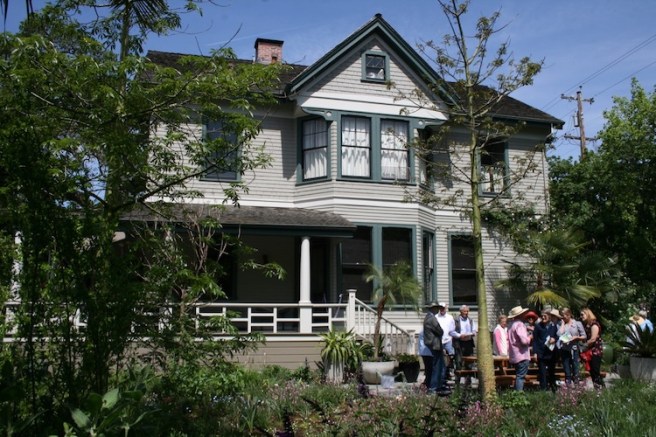
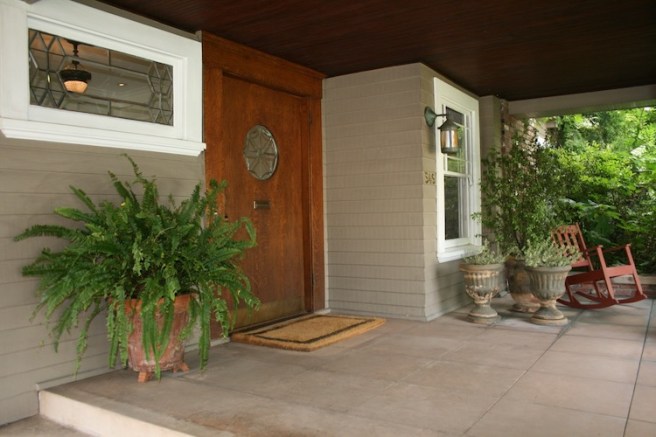
This 1907 painted shingle historic home sits a stone’s throw away from very busy Wilshire Avenue but feels as it it is miles away. The front garden is simple and snuggled up against the large covered porch draped in wisteria.
GC LA meadow 21

This front door and the entrance to the back garden are reached via the motor court which is shade by this magnificent eucalyptus tree.

GC LA meadow 22

I’ll take any corrections on the tree identification–my guess is based on the smooth slightly mottled bark. I simply could not back out into the street far enough to capture the actual height of this tree which offered shade to a large part of the home’s facade.
GC LA meadow 2

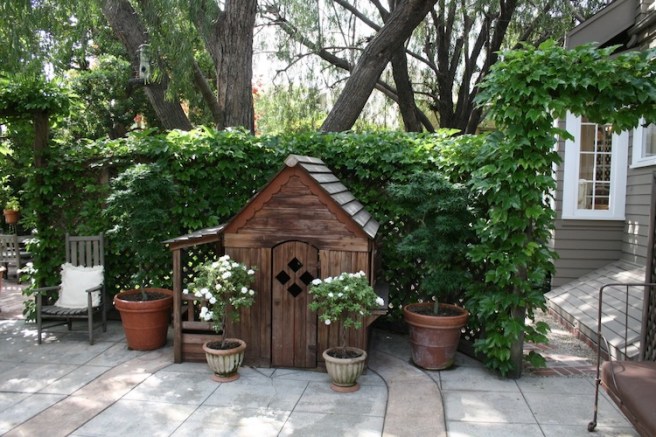
A petite, wooden playhouse sits just outside the back garden’s vine covered entrance, along with a few pots and an old-fashioned rocking chair.
GC LA meadow 3

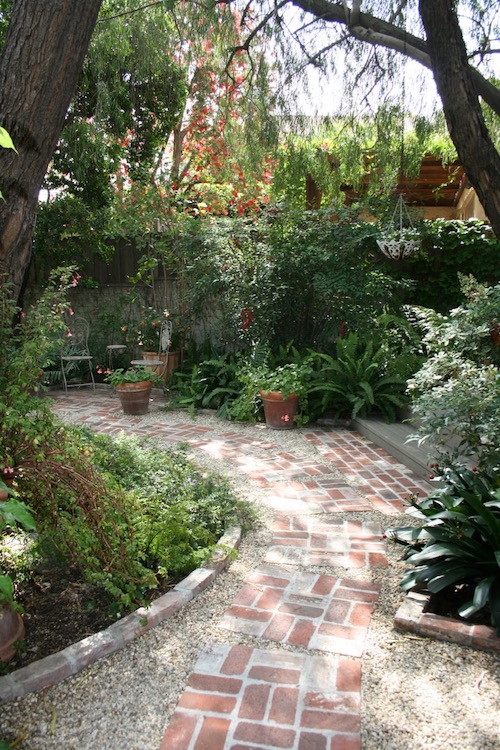
The garden is very narrow and falls off to the back in a steep slope which has been extensively terraced to offer level ground at several elevations as you descend. The brick path leading you into the garden is set in gravel and curves around another huge tree. You are seeing the full width of the garden at this point.
GC LA meadow 4

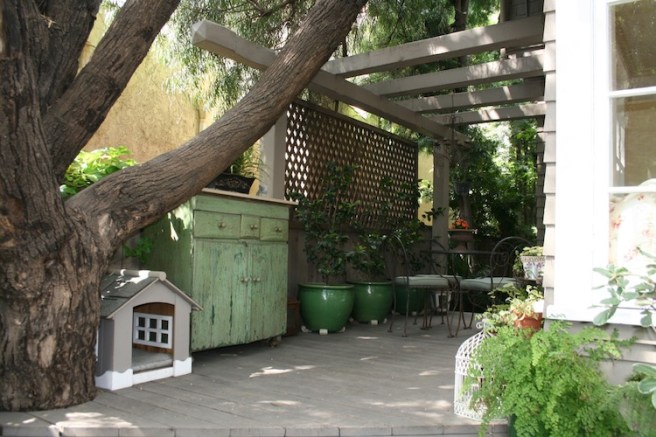
A couple of steps up to the house level reveals a wooden deck (again built around another very large tree) with a casual dining area screened from the neighbors yard with trellis and lattice work.
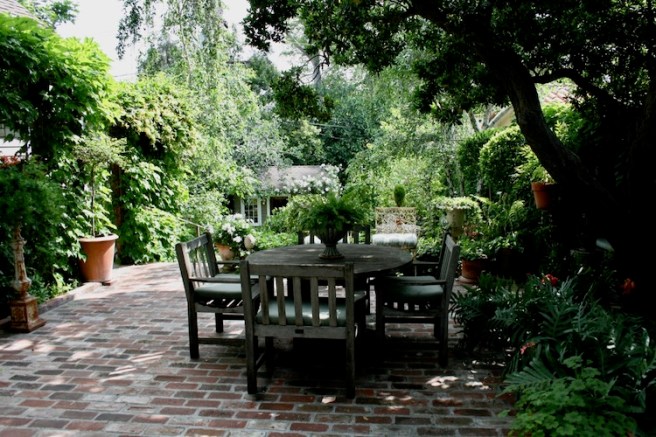
GC LA meadow 5

The brick path opens into a small terrace of the same material with a shaded dining area. I have purposefully not adjusted the exposure on any of these photos to give the a true sense of the intimacy and sense of enclosure these very large trees offer in this long narrow garden. The masses of greenery, both in the ground and potted, effectively disguise how close the property line fencing is to this cozy space.
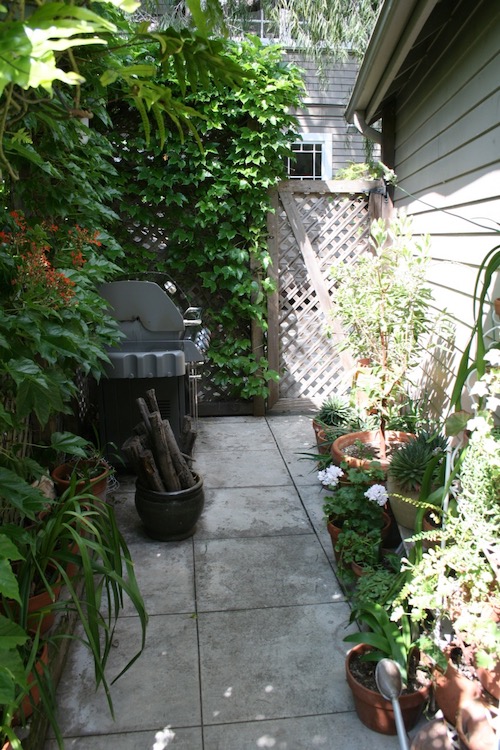
GC LA meadow 9

A small utility space is hidden between the garage and a foliage covered lattice screen which is also seen in the far right of the photo just before this one–again an indication of the garden’s size.

GC LA meadow 7

The ornate iron chairs on the right mark the end of the brick terrace level but the slope down is again camouflaged by the abundance of plant material in the ground and in pots.

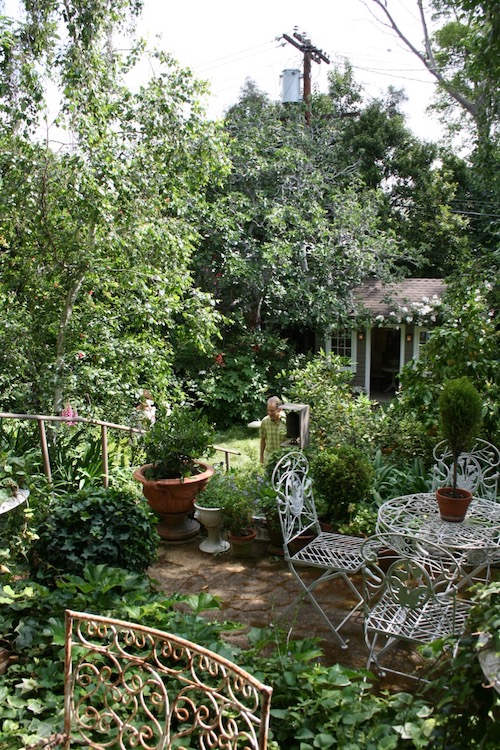
Looking down into the lowest part of the garden from the brick terrace.

GC LA meadow 24

The staircase railing disappears into the vines draping it.
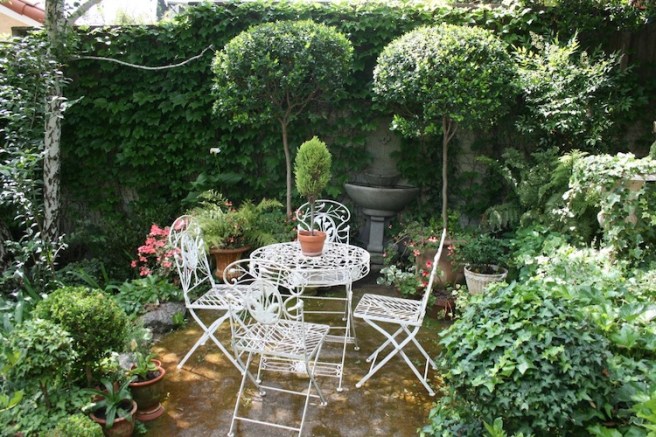
GC LA meadow 10

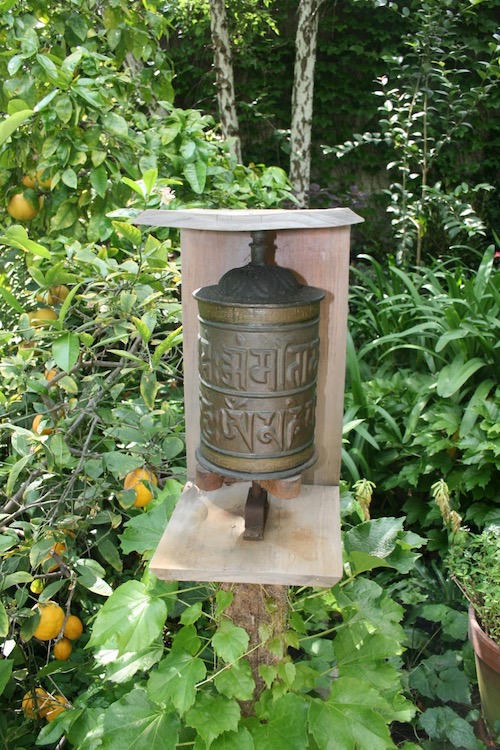
A few steps down the wooden staircase offers another level to sit and enjoy the garden from a slightly different vantage point. A small fountain gurgles in the background and pops of color  stand out amongst the primarily green landscape.
GC LA meadow 11

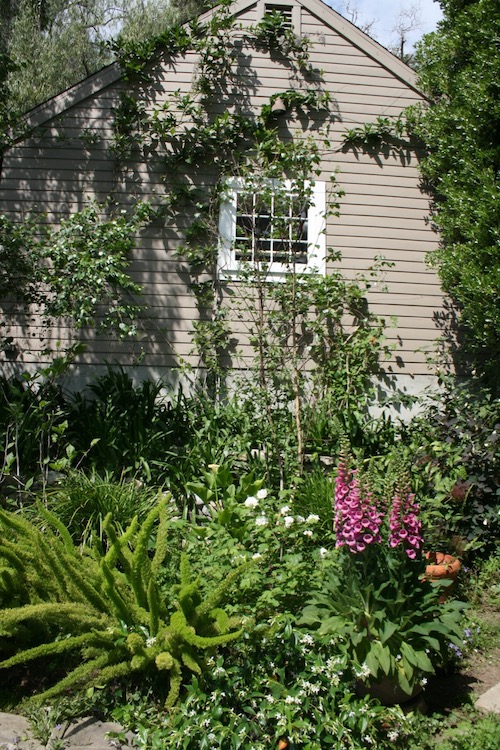
Seen as you descend the steps into the meadow part of the garden at its lowest level.
GC LA meadow 14

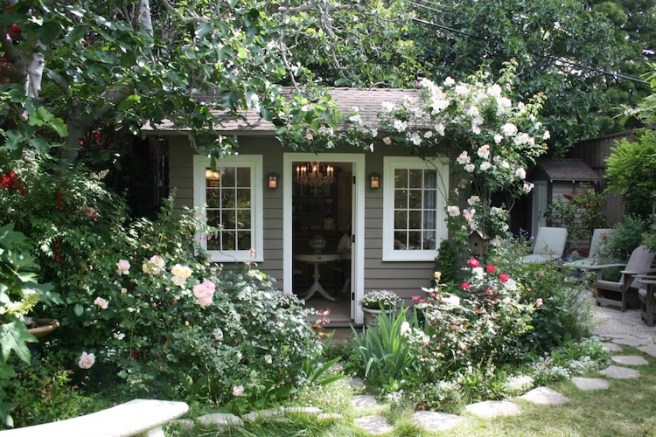
Looking back uphill from the small Carex meadow to the back of the garage. Not easily visible are the several extra terraces created by piles stone and broken concrete which step the plantings up giving them more depth.
GC LA meadow 12

The Carex meadow acts as a wee front garden for this petite rose covered cottage furnished as a sitting room.

GC LA meadow 16

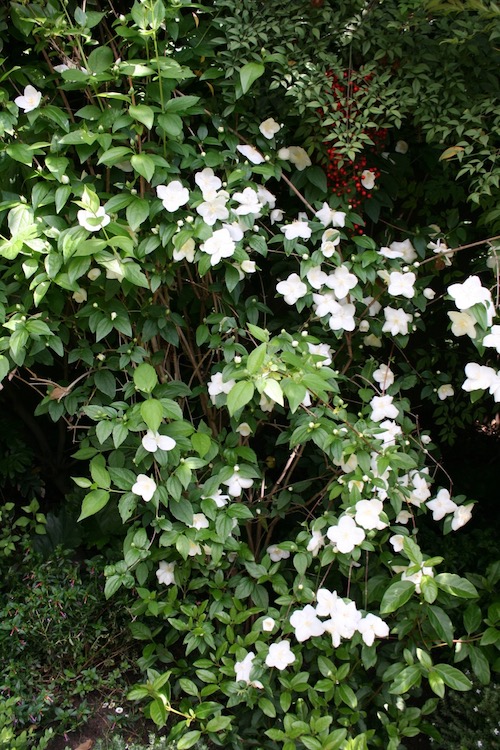
A massive and gnarled bearing fig tree towers above the cottage with closely planted perennials and shrubs beneath its canopy.
GC LA meadow 15

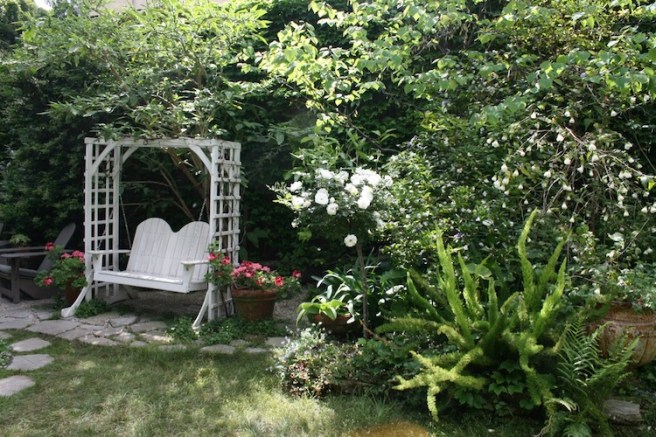
A Philadelphus, or mock orange, covered with sweetly scented white blooms lights up the shade created by the fig.
GC LA meadow 13

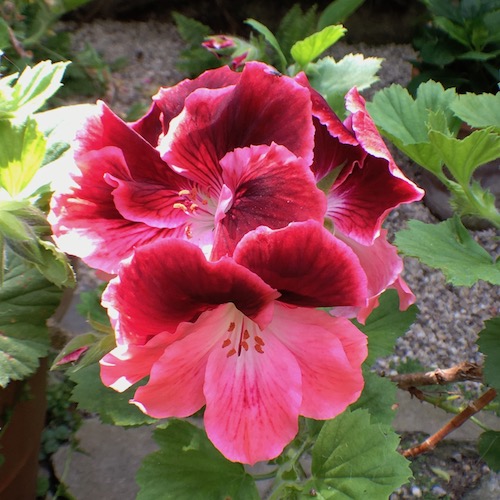
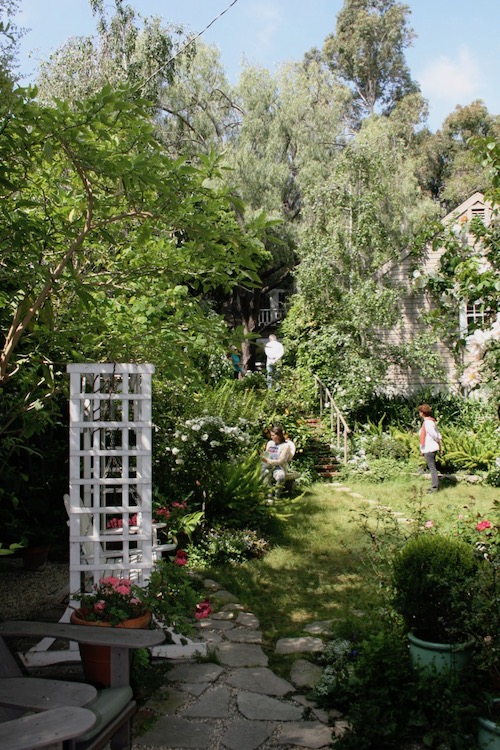
The stone path through the meadow offers a shady swinging spot and a bit of bright potted color.
GC LA meadow 25

GC LA meadow 18

Looking back up towards the house which is totally hidden by the tree cover. On the right is the back of the garage.
GC LA meadow 19

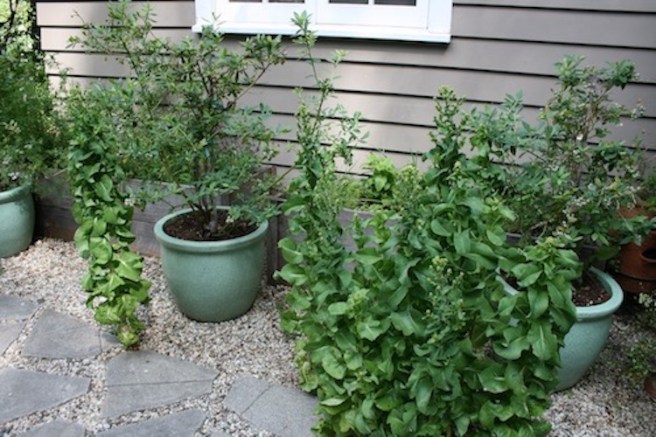
A spot of bright sun across from the swing is the perfect place for a few veggies, in this case blueberries and brussels sprouts.

GC LA meadow 17

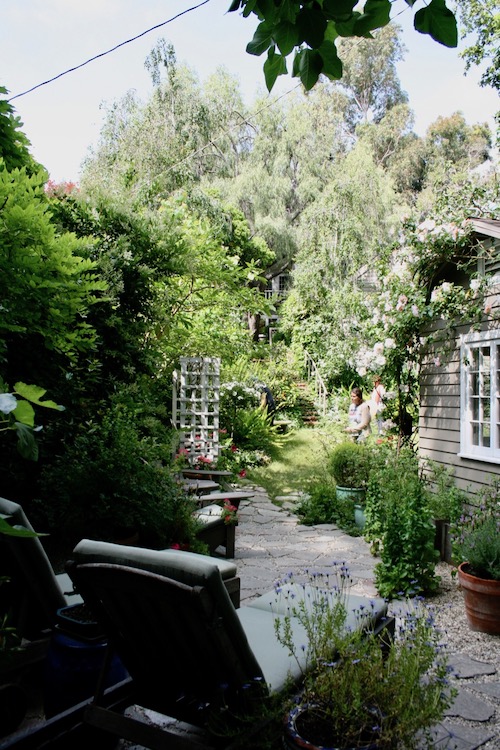
A couple of cushioned Adirondack chairs stand at the ready for anyone who is just tired out after making the descent!
GC LA meadow 20

View from the furthest point of the garden back uphill to the tree canopy. This charming garden warmed my heart with the attention to detail and its frowsy country charm. It is clear evidence of homeowners who not only love but also live in their garden. I think the basic geography of this lot would have scared off many of us as being just too much to deal with but these homeowners have created a garden with classic, yet casual style, using the elevation challenges to their advantage in creating very useable space.

Previous Garden Conservancy Open Days gardens can be seen in these posts: A little Mendocino madness…Mendocino madness…#2Mendocino madness #3…More Mendocino madness…#4Mendocino madness #5 at last…LA dreaming…Tech meets (very little) turf…Tech meets (very little) turf #2…

This year’s Los Angeles gardens are deserving of individual posts so next up will be THE RHEINSTEIN GARDEN IN HANCOCK PARK.

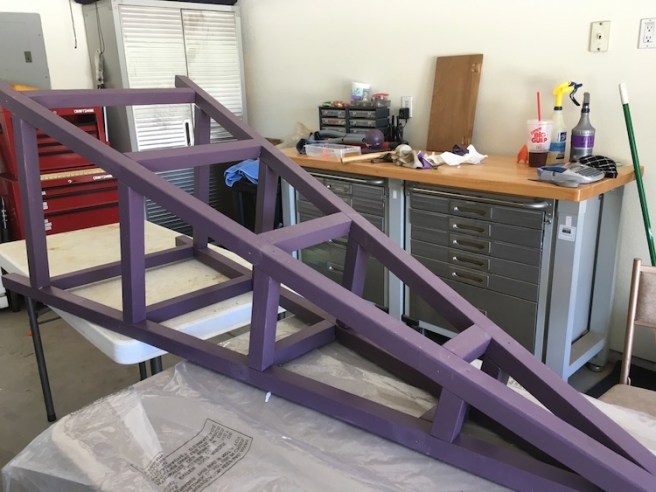


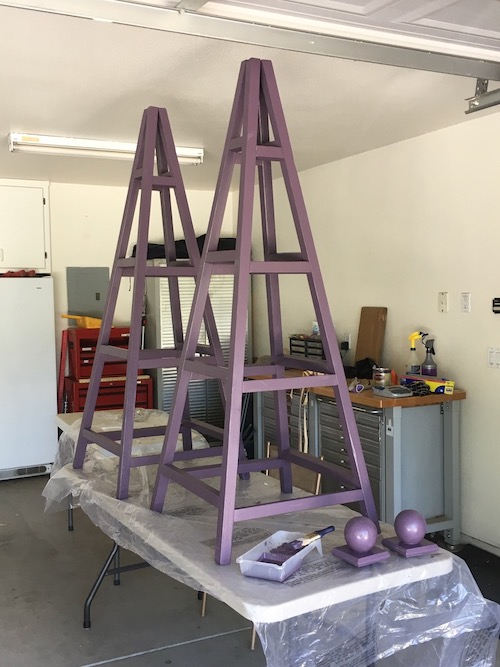
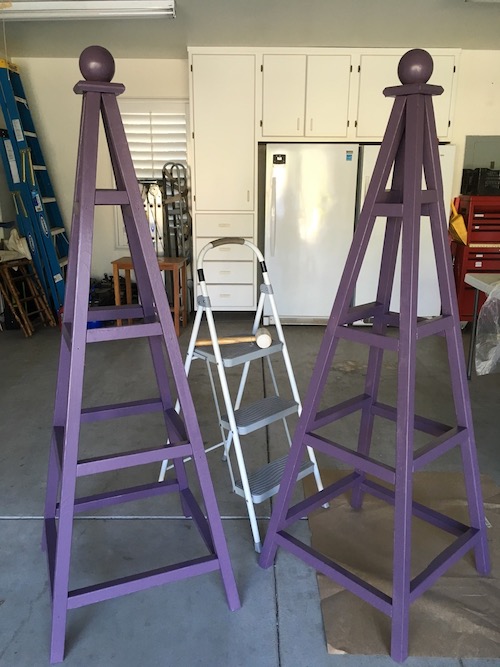
Les deux tuteurs sont finis!

This gardening girl is happy to have this project finished–even happier to have the boxes of parts off the floor of my quilting studio.
If you missed my recent post Tuteur-ial…, check it out to see the first few steps of this DIY project. Back from my travels for a few days I get back to it.
tuteur 10

In the first project post I stopped short of adding the final side having run out of energy, daylight and time.

2 tuteurs 2

My trusty rubber mallet tapped that final side on each tuteur.

2 tuteurs 3

Did a little paint touch up here and there in preparation to tap on the ball finials.

2 tuteurs 1

At 72″ tall I need a step stool for that final construction step.

2 tuteurs 4

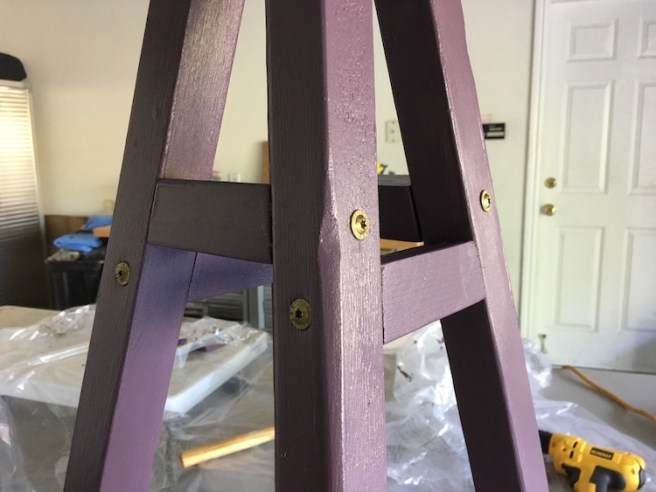
Every dowel held joint got a 3″ long screw for stability.

2 tuteurs 5

Each tuteur required thirty-two screws–plus 4 in each finial base. The instructions caution against over-tightening these screws and I am proud to report the drill only got away from me twice out of 72 screws total. For now I have decided to forego adding the slender upright extra bar on each side. I think the look is a little more contemporary without them.

2 tuteurs 6

Et Voila! In place flanking currently unplanted hayrack window boxes, the tuteurs help to carry the purple front door and trellis work theme to somewhat colorless area adjacent to the driveway. The awning over my studio windows is actually a small stripe containing beiges, browns and the purple, although the purple doesn’t leap out–they painted wood certainly draws the eye! The last step is the selection of a climber or tow that can co-exist. Full sun,  adequate water and hopefully evergreen. Any thoughts?

There are lots of examples and instructions to build various styles of tuteurs or obelisks on the web. Lacking the tools and skill to do a lot of accurate lumber cutting I went with a kit with all the hard tasks accomplished by someone who knows what they’re doing. Had it not been for my desire to paint the wood I could have assembled both in the matter of several hours. Thank you, Mr. deJong of Woodbrute Designs in British Columbia for your great directions and all parts included.


Digging Deeper with Keeyla Meadows at Urban Adamah…

The last day of my long Bay Area weekend was devoted to a Garden Conservancy Digging Deeper program at Berkeley community farm Urban Adamah.

Adamah 1

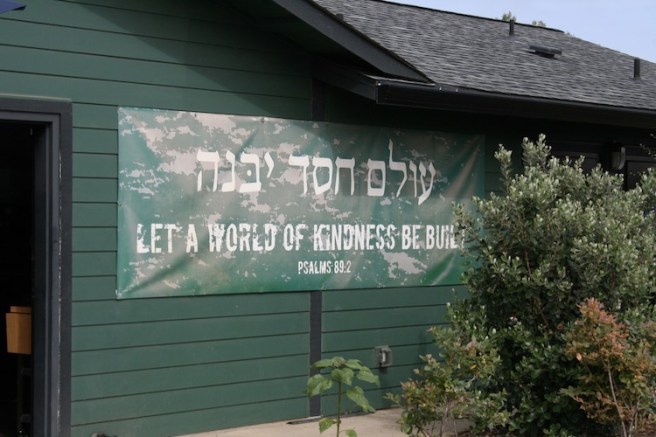
Urban Adamah was founded in 2010 by Adam Berman as the first urban Jewish community farm in the United States.  The farm’s seeds are rooted in a Connecticut farm-based residential leadership program. Adam envisioned an urban farm that would provide a fellowship program, offer Jewish agriculturally based experiential programs for youth and families, and contribute to food security in the East Bay. The farm moved in 2016 to its permanent home near Codornices Creek in Northwest Berkeley after  five years in a temporary location. The word adamah in Biblical Hebrew means ground or earth.

Adamah 13

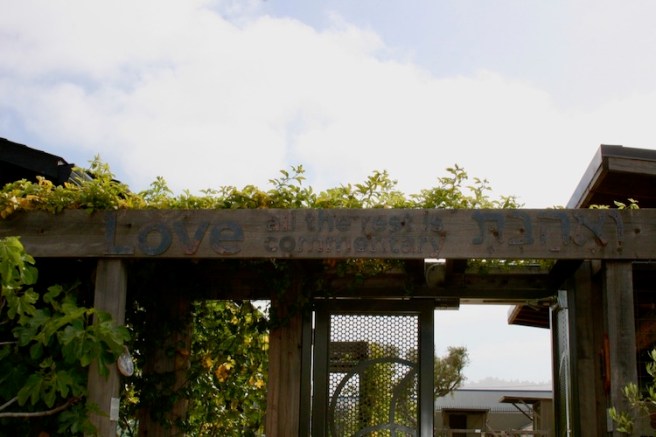
A little hard to decipher as the metal sign over the entrance has aged–it reads “Love…all the rest is commentary”.

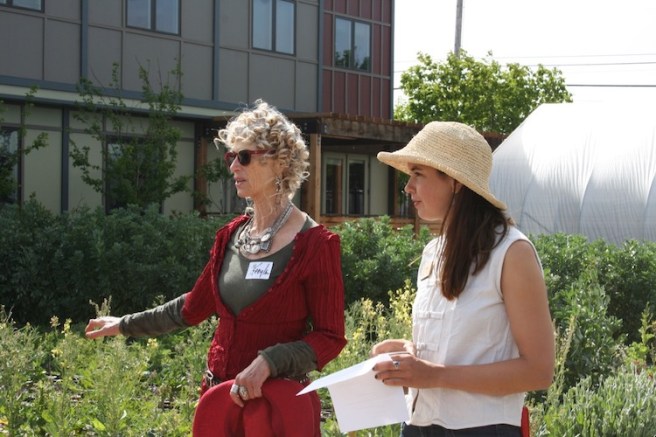
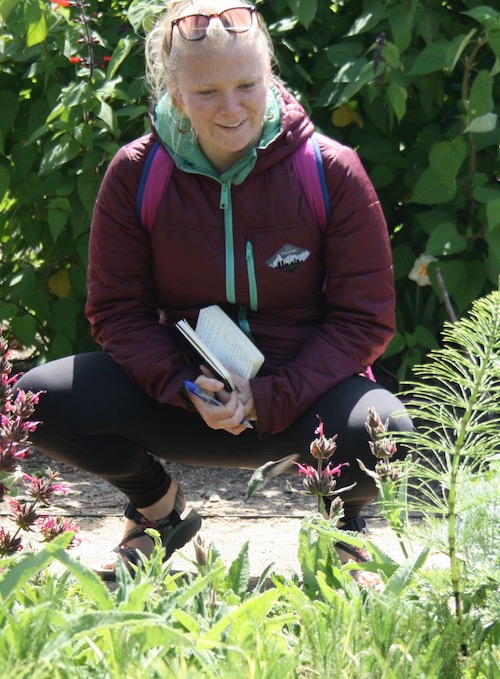
Berkeley artist and landscape designer Keeyla Meadows was brought in to design a city required swale when the 2.2 acre parcel was a blank slate. She went on to design the Pollinator Garden, the Children’s Garden and work with staff as other parts of the garden have been developed. Keeyla (on the left below) and Emily, the Urban Adamah Landscape Coordinator were our guides.

Adamah 20

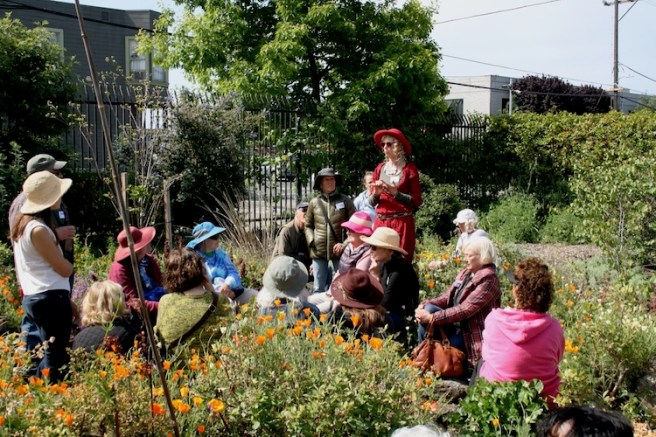
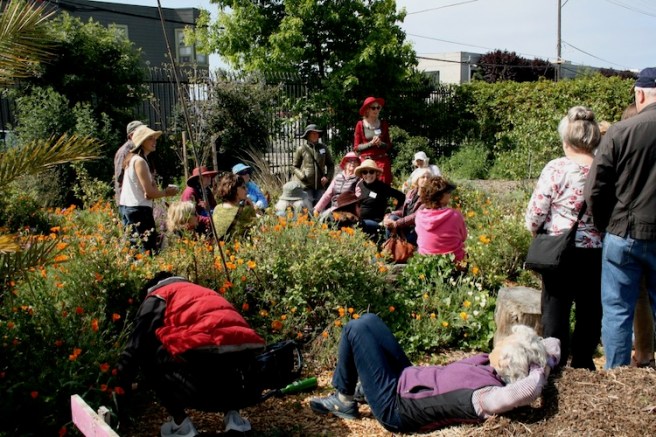
We gathered in the center of a large circular planting bed to learn a bit about the farm’s history and philosophy. The core tenants of Urban Adamah are stated in this Mission Statement: “Urban Adamah seeks to build a more loving, just and sustainable world. We ground and connect people-to themselves, to others, and to the natural world. We do this by providing farm based, community building experiences that integrate Jewish tradition, mindfulness, sustainable agriculture and social action.”

Adamah 21
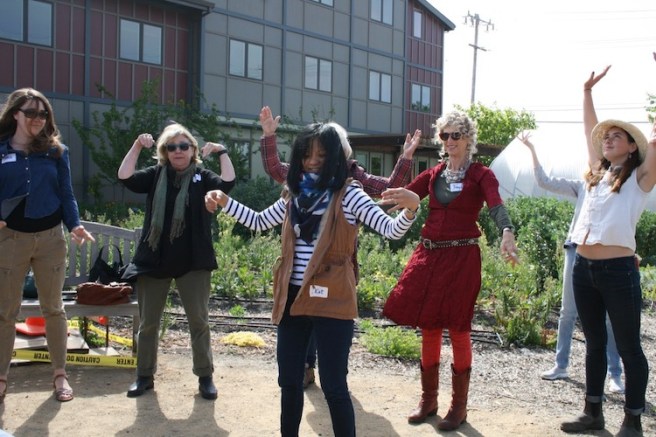
As we start our day together, Zumba teacher Kat leads us in noticing our surroundings and getting in touch with the wind and sky

Keeyla points out that almost every area of the farm has a central open area designed for small groups of people to meet and build relationships. This was a specific request made by Urban Adamah’s founder–places to gather as a community must be plentiful, welcoming and comfortable. The farm is open to the public most week days and is a lovely environment in which to enjoy the outdoors and observe nature at work–plus volunteer workers are welcome! We will explore most of the farm’s major areas, stopping to observe the plantings and ask questions as Keeyla and Emily share the design philosophy and challenges in developing this very young garden.

Adamah 25

We start at the Blueberry Meeting Circle where a ring of sturdy upright logs provide both seating for us and a podium for Keeyla.

Adamah 24

Without sharp eyes you might miss the ring of blueberries planted around the meeting circle, nestled amongst freely self sowing California poppies. Several native penstemons, blue-eyed grass and salvia also make their home here along with many Douglas iris.

Adamah 26

Gardeners are good multi-taskers. As Keeyla describe the soil building and design process for this area, one of our group pulls weeds as she listens. The farm is organic and weeding is a never ending task, especially in areas where self-sowers are allowed to have their way.

The Blueberry Meeting Circle is a charming front garden to the Aquaponic House where four levels of plants are stacked, producing lettuces, basil and other leafy greens.

Adamah 27

adamah-30.jpg

This buttery lettuce is planted with only a small amount of bark like material and its roots reaching down into the water below.

The bottom trays now hold a variety of plants being grown for their leaves textural experience, such as the gigantic Gunnera leaf and the surprising soft, almost furry, leaf of its neighbor.

Adamah 31

This tank is home to fish whose waste provides the natural fish emulsion nutrients to the plant via the circulation system of pipes.

We circle out of the Aquaponics House and return to the Blueberry Meeting Circle, a great vantage point to see the full length of the Urban Swale. the farm is adjacent to Codornices Creek which is in the midst of a civic restoration plan. The city of Berkeley required the installation of a swale on the farm’s property to prevent runoff of both rainwater and farm waste water into the creek.

Adamah 34

The Urban Swale, planted entirely in California natives runs from just beside the Blueberry Meeting Circle and along the farm’s front fence line almost to the entry gate.

Adamah 33
Hummingbird Sage

Hooker Creek boulders and Sonoma stone were brought in to form the bank stabilizing structure of the swale. Plantings were designed in repeating color bursts to keep your eye moving down the length of the swale. Keeyla calls this ‘weaving color’ throughout a space. Native plants requiring more moisture are planted lower on the bank while the more drought tolerate plants are higher up. The shape of the swale allows accumulated water to percolate slowly back into the ground. Keeyla’s choice of native plantings in part was to relate the swale to the creek and to honor the area’s indigenous peoples and their stewardship of the land.

Adamah 68
A little closer look at the beehive end. Notice the enormous Verbena ‘De La Mina’!
Adamah 35
Visitor to the ‘De La Mina’

Several varieties of California poppies were included in the original sowing of reseeding annuals. Subsequent seasons have produced some interesting color variations as the result of natural hybridization.

Adamah 37
Looking back as we wander the Urban Swale
Adamah 36
Fledgling bee colony
Adamah 11
Looking across the farm from the Urban Swale end

Adamah 10

As we walk to the far side of the farm to see the Pollinator Garden, Emily shares that this Administration Building was the first permanent structure built on the site; a great accomplishment after five years of a trailer office. The passionflower vines on the office trellises (and on the fences in the Urban Swale) were a concession to a former farm colleague who was instrumental in the early planning days. He loves passionflowers and would regularly harvest the fruit for use in tea and other edibles.

Adamah 12

Urban Adamah gives away 90% of the food it grows. The remainder is used on the farm for events and for use by residents of the farm. They host a weekly farmer’s market for anyone who needs food. Local grocery stores, including Whole Foods, contribute goods not yet produced on the farm. At any given times throughout the year they will produce all kinds of vegetables, herbs, stone and pomme fruits, potatoes, onions, eggs and milk.

Adamah 32

Adamah 8

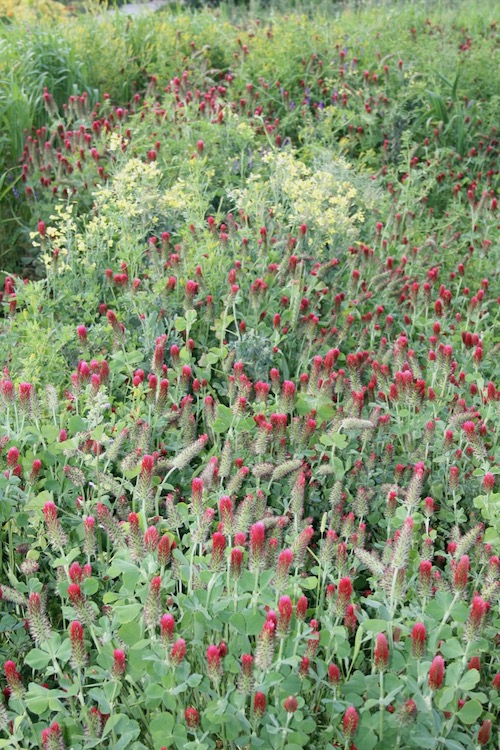
Crops are rotated regularly–vetch, Fava beans and crimson clover are planted as nitrogen fixing cover crops to be tilled back into the ground (after bean harvest, of course).

Adamah 38

Adamah 6

The Pollinator Garden is our next stop–a melange of seasonal veggies surrounded by plants chosen specifically for their attraction of certain pollinators. Emily worked closely with Keeyla on the implementation of the design and credits this garden as awakening her desire to not only plant, but also be a designer. As we visit not much is in prime bloom. Emily explains what different shapes and colors are attractive to specific kinds of pollinators–tubular for the hummers vs flat for the butterflies, etc.–and the importance of having something for everyone if you want to maximize pollination.

Adamah 39

The Children’s Garden entrance is home to arbor seating–I haven’t been counting seating areas but I’m sure there at least 10. A young vine is on its way up to give visitors some shade while they get to know each other.

Urban Adamah has a full schedule of family friendly activities, including summer camp. The goals for children are the same as for adults; to build community; to foster Jewish traditions; to learn and practice sustainable agriculture and living.

Adamah 42

The Children’s Garden is only a stone’s throw from the creek and has its own swale to serve the same purpose as the first built Urban Swale. Keeyla also designed this garden and the swale is similar in planting with the exception of possibly more native wildflowers–sowing seeds is a popular activity on this side of the farm. Here you can see the swale emerging from under the bridge to the Earthbench meeting place.

Adamah 44

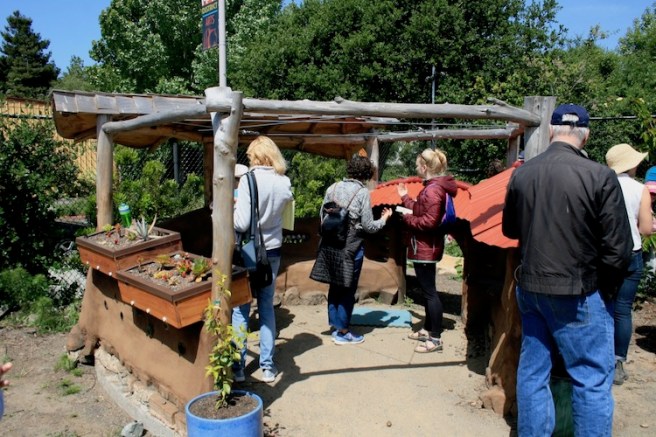
With the guidance of an educator from the Peace on Earthbench Movement (POEM) children built this garden gathering space using plastic bottles and other recycled materials over several camp sessions. Locally based POEM’s international mission is to encourage youth to turn plastic waste into artistic community gathering places. This is a project I would want to participate in–what fun!

Adamah 41

Looking down the Children’s Garden swale you see art created by children and displayed on the fence.

Adamah 43

Adamah 46
A surprisingly unafraid hummingbird

Leaving the Children’s Garden we pass a newly constructed grape arbor tucked up against the street side fence.

Adamah 48

Adamah 64

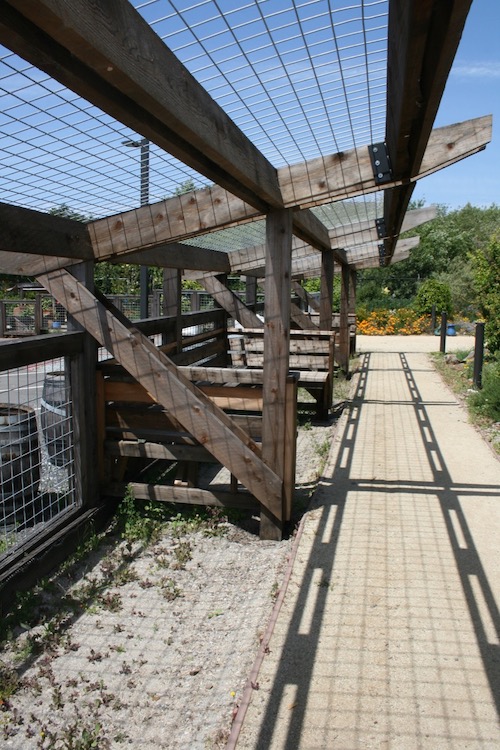
As yet unplanted, the arbor will be home to several grape varieties (you can see the barrels just outside the fence awaiting the vines) for a nascent partnership with the kosher winery directly across the street. The structure was built by local Eagle Scouts–notice every section has seating for several people.

We make a quick detour to the goat pen to meet Lev and Ivy and give them a snack pulled right from the field–and right in front of the Do Not Feed the Goats sign.

These two clearly recognize Emily and know she comes with goodies. They will not let her out of their sight!

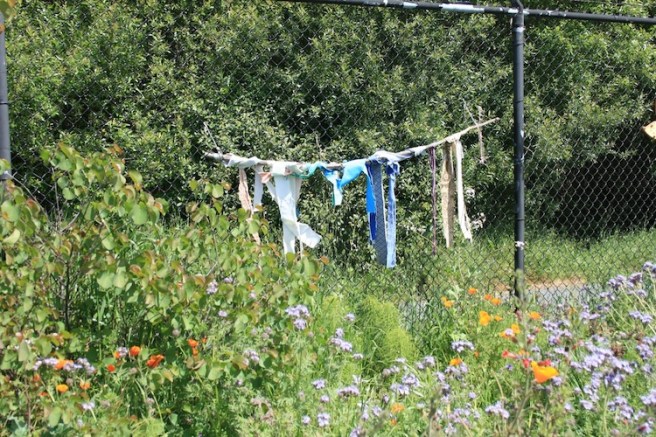
On our way to talk about the Seven Sacred Species Garden we stop for a brief art activity. Keeyla has provided us with paper, colored pencils and markers, and string and asks us each to make a wish or a prayer to hang on the farm’s olive tree, telling us our thoughts will be released into the wind. The olive tree is the farm’s focal point, visible as soon as you enter the gate. A universal symbol of peace and one of the Seven Sacred Species, this tree was 42 years old when it was selected for the farm 18 months ago and the variety is one preferred for its oil. It actually sits mounded high because the farm’s electrical and water utilities are underneath it. Rocks were added to stabilize the raised planting area. I’m not sure how much of an olive oil crop you can get from one tree but I’m giving the farm extra credit for covering all the bases.

Had to make a quick trip back to the goat pen to retrieve an errant paper prayer from Ivy!

Adamah 54

The Seven Sacred Species are plants which deeply link spiritual beliefs to the natural world and play prominent roles in the Bible. They are olive, fig, date, wheat, barley, grapes and pomegranate. It was important to the farm’s founder to include these species on the farm and at this writing they have 6 of the seven, lacking only barley.

Several are represented around the entry gate.

Adamah 57
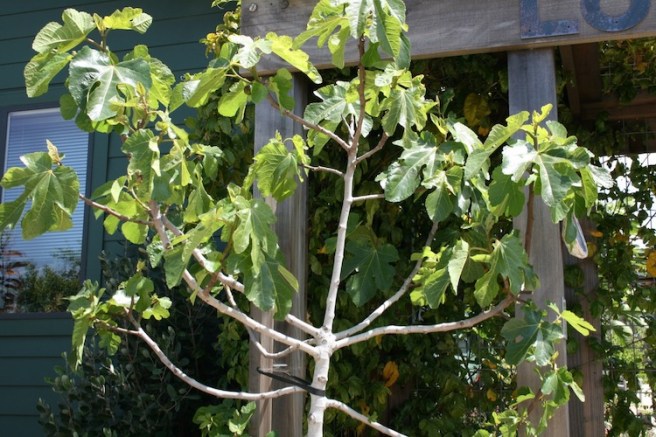
One of several young fig trees on the farm
Adamah 56
Pomegranate in the background–in the foreground is Etrog, a yellow citrus used during the Jewish holiday Sukkot
Adamah 58
Grapes will cover the entry trellis

There is a lone date palm near the Blueberry Meeting Circle and wheat planted in the crop beds. It is fitting that these species closely linked with the Bible would be at home in this place deeply rooted in Jewish traditions.

Our group had thinned a bit by now–many, including me, did not know the extent of the experience and had planned for less time. Those of us remaining took a break to gather fresh herbs, berries, greens and edible flowers to add to salad ingredients Keeyla had provided.

Adamah 60
A fresh dressing was made…
Adamah 62
Our table was set…

Adamah 61

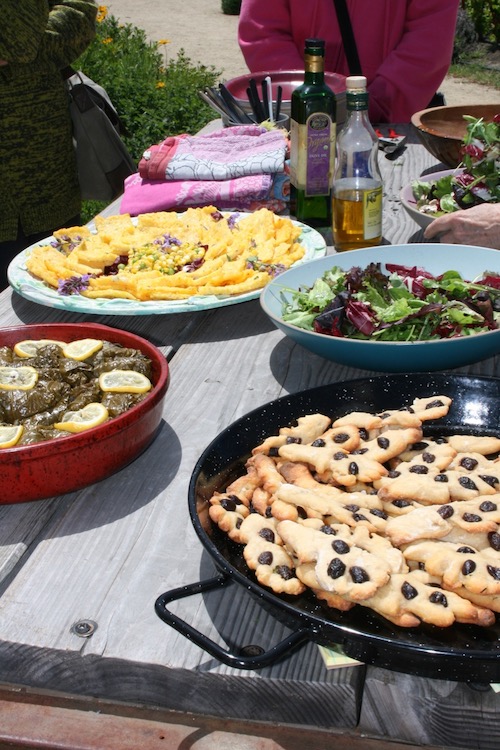
Keeyla had made grape leaf dolma stuffed with barley and currents, polenta, small white pastries with dates, and a blueberry tart. A wonderful challah was the highlight for me–delicious.

Adamah 63

We filled our plates and gathered at a circle of benches to break bread and get to know each other a little better–exactly what Urban Adamah founder Adam Berman would have wanted.

This day was a wonderful experience and I would encourage anyone in the vicinity of Urban Adamah to take a few minutes to see the farm. I will close with a few more photos and several websites for you to get more information if you desire.

Here we go–

For more information about Urban Adamah, its mission and programs go to http://www.urbanadamah.org

For more information about Keeyla Meadows, her art, books and gardens go to http://www.keeylameadows.net

For more information about Garden Conservancy Digging Deeper programs go to http://www.gardenconservancy.org then click on Open Days, then Digging Deeper

For more information about the Peace on Earthbench Movement go to http://www.earthbench.org

Adamah 2

Gamble Garden Spring Tour 2019…the last two gardens

EAST MEETS WEST

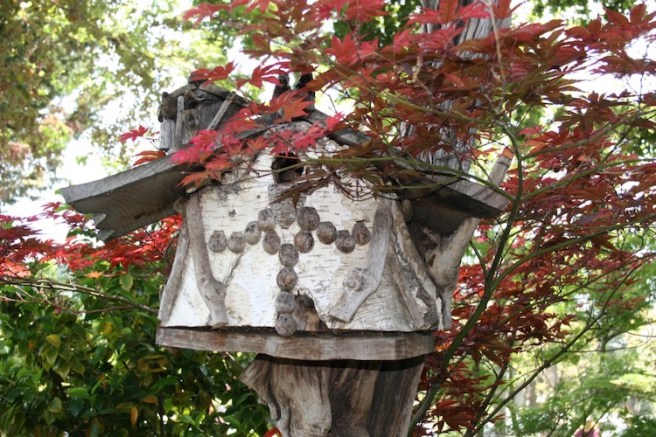
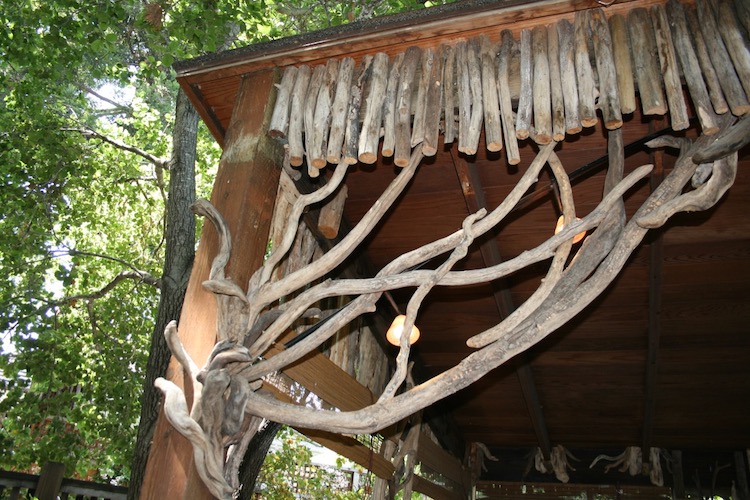
The owner of this historic Professorville cottage in Palo Alto wanted a garden to honor his father’s garden in the family’s native Vietnam. The result is an eclectic mix of tropical and traditional plants nestled amongst paths, gates and art pieces fashioned from driftwood and salvaged antique bricks.

Gamble drift 1

The fully enclosed front garden is a potpourri of shrubs and vines nestled underneath a canopy of mature oaks.

Gamble drift 4

The first of many unique driftwood creations crafted by the homeowner greets visitors near the front gate.

Gamble drift 2

Gamble drift 5

Mature rhododendrons grace the front walk–the only ones I saw on the tour this year.

Gamble drift 3

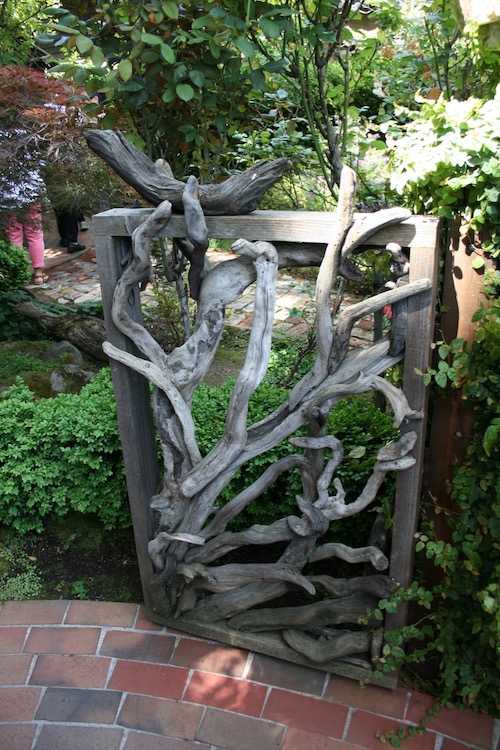
The piece of driftwood perched atop this gate’s frame is reminiscent of a bird stopped for a rest on its daily travels.

Gamble drift 7

Multi-colored antique bricks laid were laid in sand to make this rustic path.

Gamble drift 7

A vine covered arbor..

Gamble drift 8

…and another driftwood gate open onto a brick path to the back garden.

Gamble drift 9

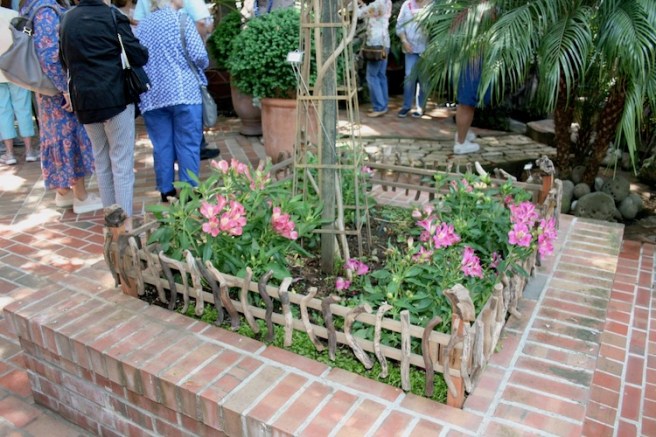
The back garden features a brick floor with accents of stone and driftwood. The single sunny spot in the garden is home to a raised planter with its own ‘found wood’ fence.

Gamble drift 10

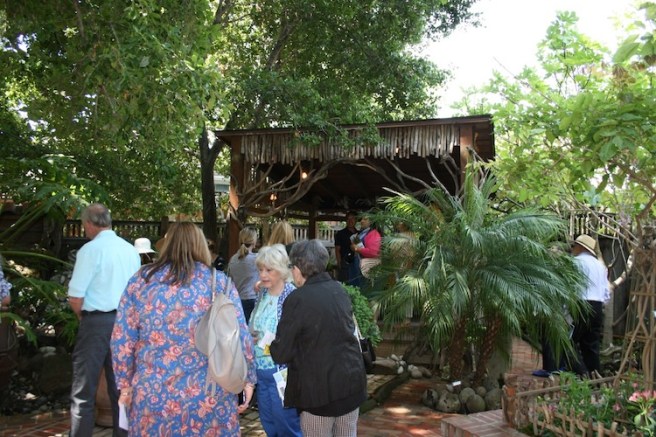
A raised gazebo is dressed in driftwood style and its comfy couch offers a great view of the garden.

Gazebo details

Gamble drift 15

A huge orchid in bloom,  Dendrobium  kingianum, is perched atop a waist high stump.

Gamble drift 14

Gamble drift 13

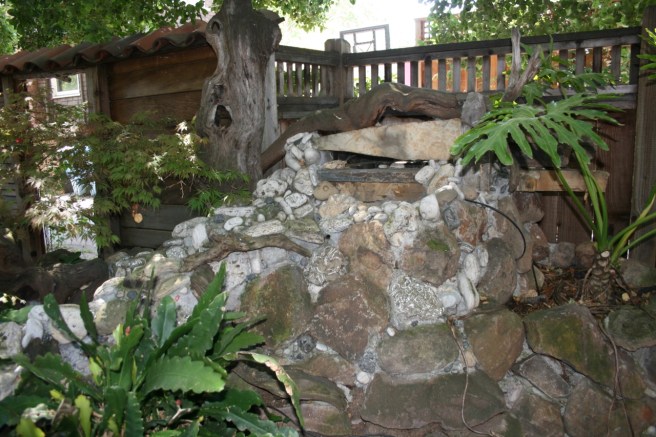
A rock waterfall, once part of a koi pond whose inhabitants sheltered under the raised platform of the gazebo, is home now to tropicals and ferns. The pond itself is now a brick floor, a bit of which you can see in the lower right corner.

Gamble drift 16

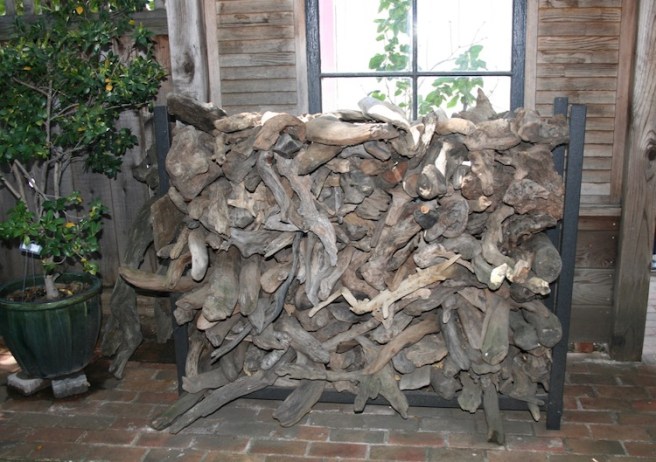
A neat stack of materials stands at the ready for future projects! The beauty of this garden for me was the homeowner’s obvious affinity for the space and enjoyment in creating his garden with his own hands.

A FEAST FOR THE SENSES

As much as I admire landscapes with sophisticated green and white palettes, perfectly poised pots, and every detail dedicated to the theme; I am at heart a gardening girl who loves a riot of color and texture, prefers her shrubs in naturalistic shapes and adds things to the garden just because I want to try them out rather than that they fit some prescribed color or category. This last garden of my day on the tour spoke to me in terms I not only understand but see as achievable and possible to maintain in my slightly messy, do what you will vibe.

Gamble senses 1

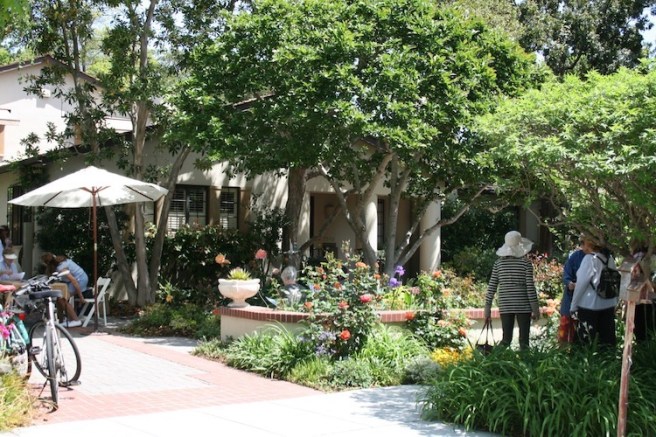
My dream home and garden would be an authentic Spanish bungalow tucked behind wonderful courtyard walls–a little bit of public garden street side and the rest of it  nestled privately inside where I could play to my heart’s content in raised beds reached by stone and ground cover paths. Although the garden of this third generation landscape professional is very visible from the street side, it checked almost all my design boxes.

Gamble senses 3

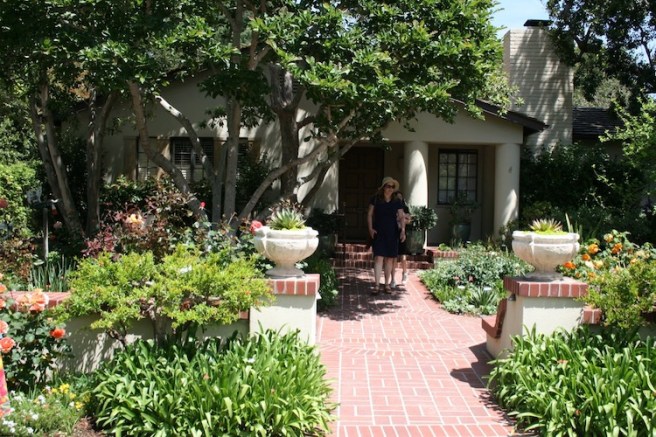
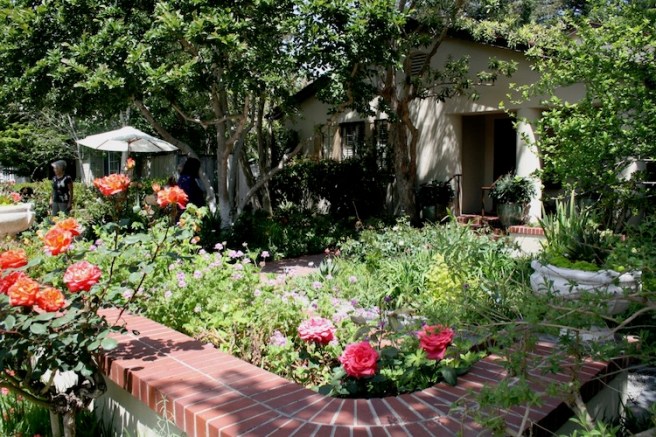
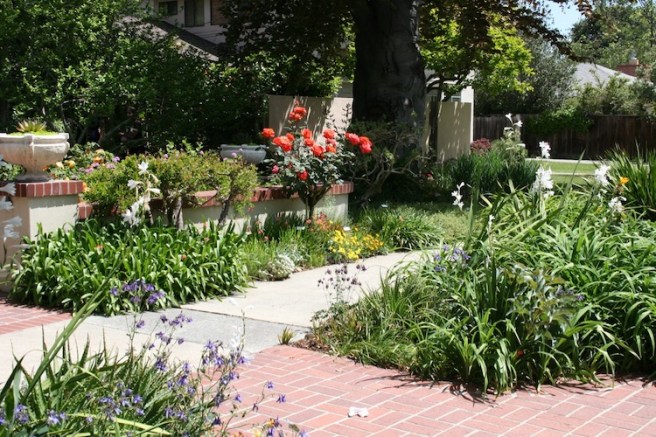
Red brick walks are the front garden’s floor and series of geometric beds harbor most pf the plants. The raised beds are capped with red brick and are perfect sitting walls. I love a good sitting wall!

Gamble senses 4

The beds have a definite East coast influence is throughout and are densely planted with a mixture of roses perennials coming in and out of bloom amongst a formal structure of evergreen shrubs.

Gamble senses 2

This neighborhood has sidewalks and wide parking strips (called something different everywhere-the area between the sidewalk and the curb)–masses of agapanthus and daylilies and other strap leafed perennials will make this the prettiest ‘hell strip’ in town when they are in full bloom.

Gamble senses 5

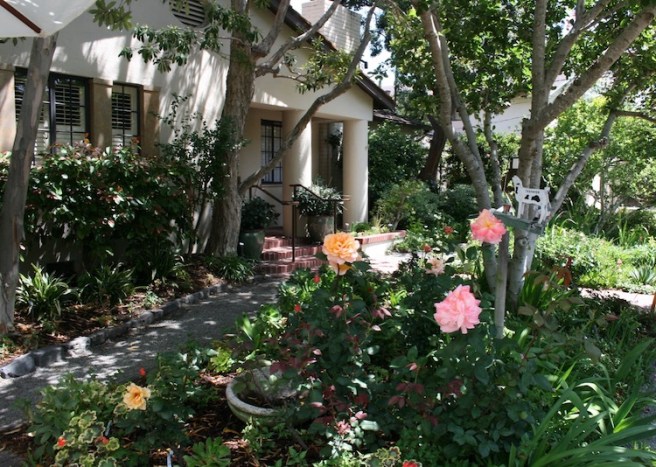
A mature tree canopy provides dappled shade to the front walk.

Gamble senses 7

The homeowner enjoys flower arranging and makes use of many blooms from her own garden. The front plantings were originally designed to serve as a demonstration garden for her clients.

Gamble senses 8

A narrow planting strip along the driveway offers vertical gardening opportunities, both softening the look of the property line fence and providing additional privacy.

Gamble senses 19

The driveway as seen from the garage which is placed far back on the lot. The combination of brickwork adds interest and just feels softer and cooler than concrete.

Gamble senses 9

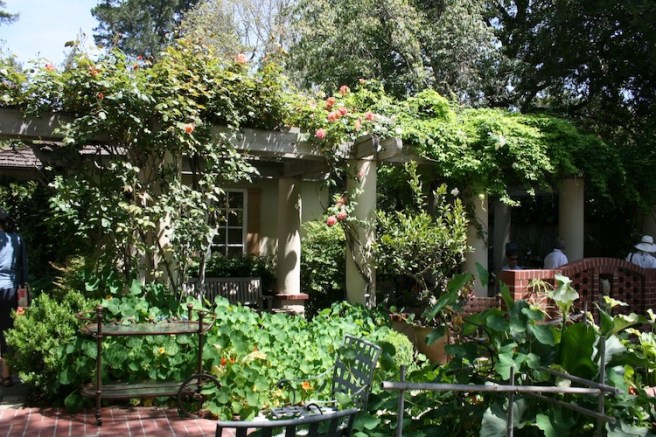
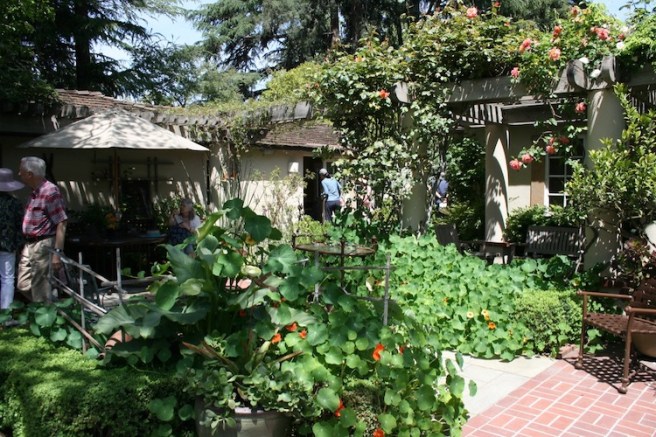
A small guest house with a pergola whose columns mimic those on the home’s front facade separates the back garden into rooms. I thought this little sitting area was one of the most charming I saw on the tour and I know I would be relaxing out there every day.

Gamble senses 12

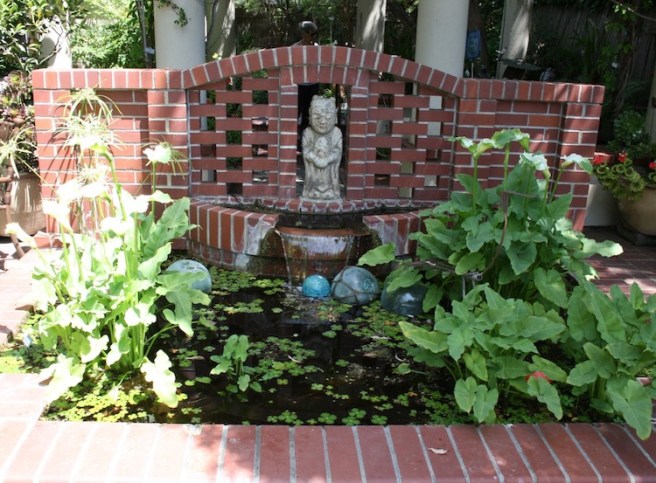
The red brick fountain tucked next to the sitting area is presided over by a Korean acolyte sculpture the homeowner has named Yoda. The glass balls are meant to deter raccoons from fishing in the pond!

Gamble senses 13

Green Goddess calla lilies share the spotlight with papyrus and other water plants in the pond.

Gamble senses 11

Raised beds and pots in the sitting area are massed with nasturtiums and other edible flowers.

Gamble senses 18

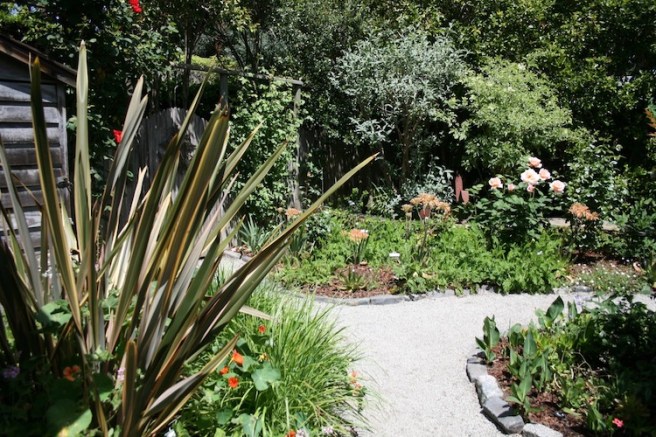
The sitting area and pergola provide a lovely view of the rectangular lawn with its wide compacted gravel walkway–the original brick walkway was replaced after the homeowner’s Parkinson’s disease diagnosis in preparation for a time when a wheelchair path might be needed. Railings were also added to any areas having even a step or two.

Gamble senses 10

The lawn leads to a raised patio from which to dine and enjoy the garden. Kiwi vines cover the the arbor and abundant roses are within reach of the house for easy cutting.

Gamble senses 14

A brick walkway between the guest house and the garage draws visitors back–anxious to see what other delights they will find.

Gamble senses 15

The lot is remarkably deep and easy to walk compacted gravel paths wind around beds filled with annuals, bulbs, perennials and herbs. A green screen along the back property line offers the sense of being all alone in the city.

Gamble senses 17

Ornamentals give way to edibles in raised beds. I could sooo…live in this garden. It feels cool and colorful without being fussy or overly regimented. This is a gardener’s garden.

Gamble senses 20

So ends this year’s Gamble Garden Spring Tour. The Elizabeth F. Gamble Garden deserves a post of its own and I’ll save that for the dog days of the summer when my spring travel is over and my own garden looks like scorched earth.

Still rambling in Palo Alto…

This year’s Gamble Garden Spring Tour is even more walkable than usual–it looks as though all but one of the gardens is an easy stroll from the Elizabeth F. Gamble Garden. Three are within a couple of blocks from each other. Taking the docent’s instruction I headed down the alley and around a corner to see my third garden of the day.

SIMPLICITY IS THE ULTIMATE SOPHISTICATION

Gamble asian 27

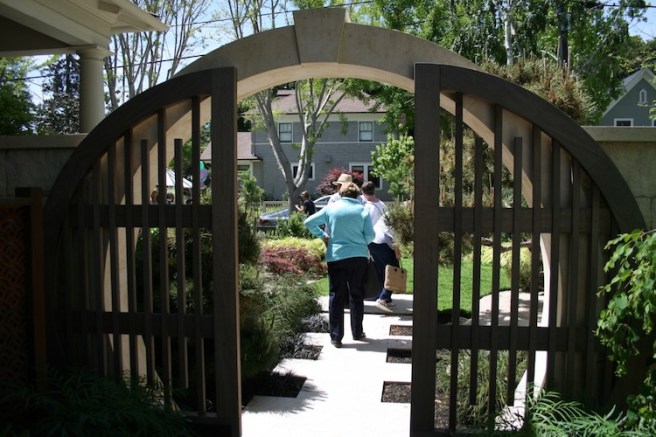
This 120 year old cedar shingled residence is home to a minimalist modern Japanese garden commissioned by a homeowner with an affinity for Japanese history, art and garden design. She also is a practitioner of ikebana and wished her garden to have materials to use in her flower arranging. Family friend and garden designer Jarrod Baumann gave her the garden of her dreams including her requested Moon Gate, an iconic Asian design throughout the world.

Gamble asian 26

The garden gate is flanked by a pair of weeping, corkscrew elms which were just leafing out. A zipper style path of Devonshire cream limestone and Ipe wood planks leads to the front door.

Gamble asian 3

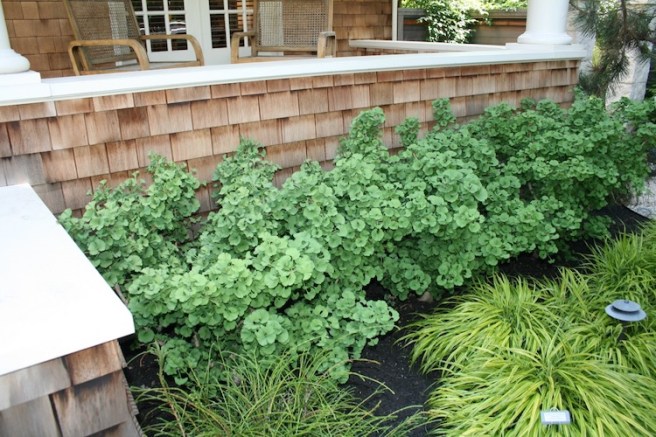
Miniature gingkoes, Gingko biloba ‘Mariken’ take the role of foundation shrubbery on both sides of the front steps and supply glowing yellow fall color fall. The plantings on either side of the front path are not symmetrical but compliment each other with similar materials in free flowing swathes.

Gamble asian 1

The planting scheme is restrained without being overly manicured. Areas which would traditionally be moss in Japanese gardens are clothed in a perennial lawn substitute which is labeled Kurapia–botanically it is Lippia nodiflora. A bit of post tour research revealed this not particularly new plant is being trialed and marketed as a drought tolerant lawn replacement. It is a dense ground cover no more than about an inch tall. If allowed to flower it is very attractive to bees. The flowers are sterile and thus does not seed itself. HOWEVER, what is not really covered in the informative Kurapia brochures online is that it is very invasive, spreading rapidly by rooting runners. I planted a single 4″ pot under a tree in a smallish bed and spent 3 years fighting to get rid of it. It will overwhelm any other plant material and run under and over hardscape borders intended to contain it. I reckon this homeowner has it edged regularly. In this garden it was absolutely beautiful but I would caution buyer to beware! The Kurapia is bordered with a black mondo grass and sparkling Hokone grass, Hakonechloa macro ‘Aureola’. The low fencing encasing the front garden echoes the style of the zipper paths.

Gamble asian 28

The shade of mature redwoods give this front garden which is on a busy corner, a welcome sense of enclosure and beds in dappled shade. Notice the large white concrete boulders which punctuate both sides of the front garden. Their smooth surfaces and pale color mimics the cream of the wall and path stones.

Gamble asian 4

A magnificent cut-leafed Japanese maple, Acer P. dissectum ‘Sekimori’ stands as a sentinel to the side garden entrance in its stone planter.

Gamble asian 7

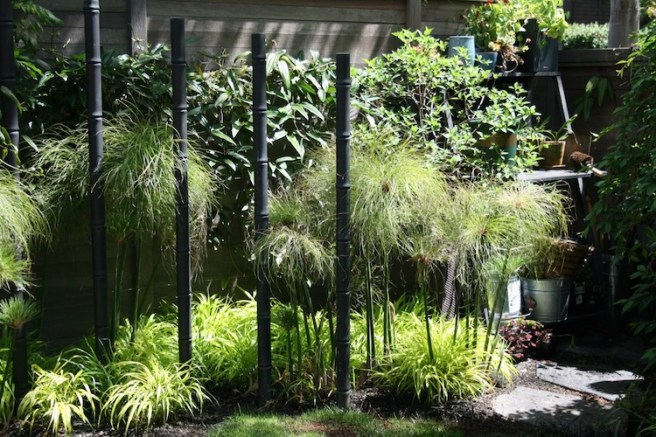
The side yard is anchored by a rectangle lawn surrounded by mostly green plantings. The vertical bronze sculptures of bamboo stalks on both ends of the lawn are meant to evoke Inari shrines.

Gamble asian 6

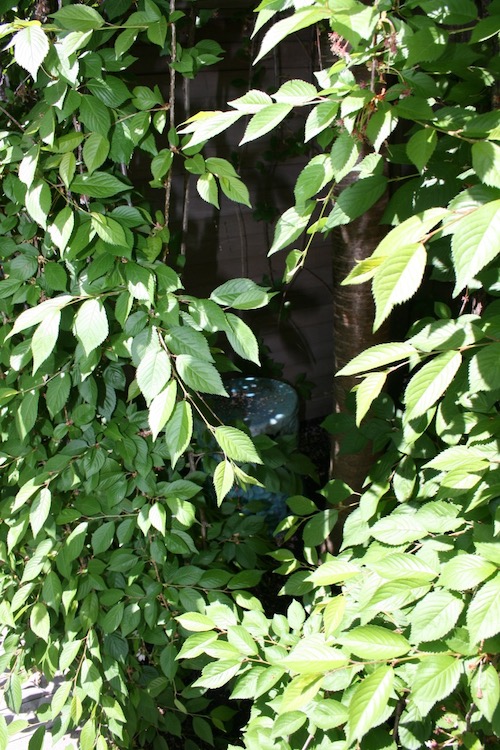
Just inside the gate and up against the house is this weeping cherry tree, one of a several used as a hedge, under which is tucked a small garden stool just in case you need a quiet spot to hide!

Gamble asian 9

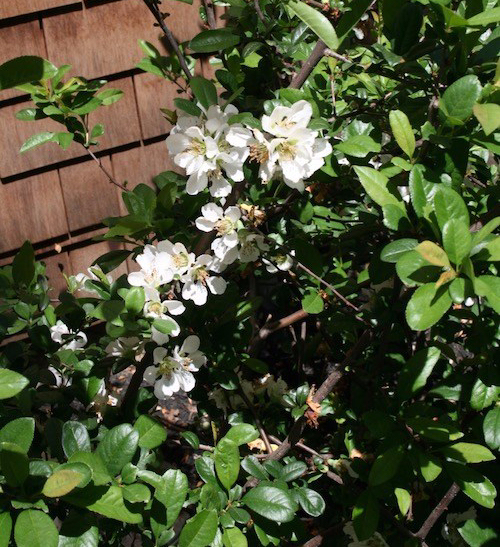
The white flowering quince also planted up against the house is prized material for late winter flower arrangements.

gamble-asian-10.jpg

I can’t resist showing you the world’s best looking power meter, almost disappearing into the cedar siding.

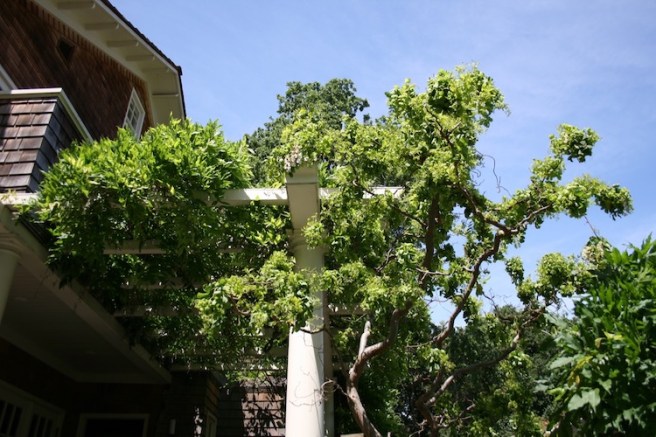
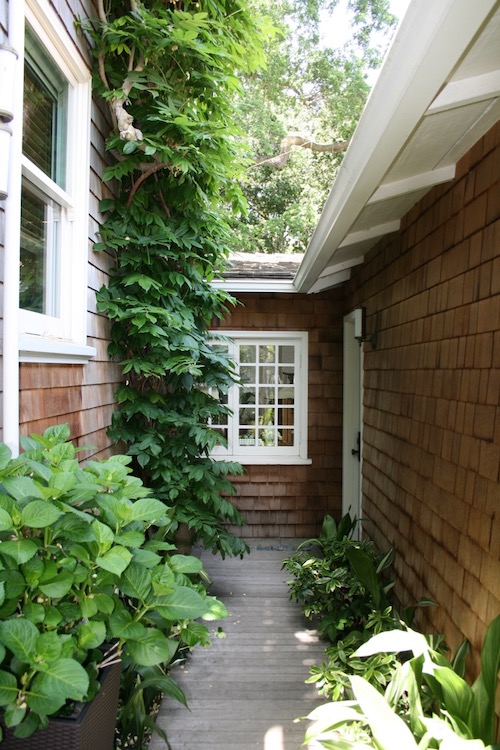
Porches on two levels at the back of the house are draped in wisteria–white above and purple below.

Gamble asian 15

Also planted on the front edge of the arbor is a Robinia pseudoacacia ‘Twisty Baby’, a deciduous, multistemed shrub in the black locust family. It’s contorted form and relatively small size make it an eye-catching patio specimen.

Gamble asian 12

As we’ve reached the back of the side garden the bronze bamboo and plantings are repeated. They mask a wee potting bench and utility area.

Gamble asian 16

A narrow Ipe planked path carries us to the opposite of the home. The small cottage ahead is used mostly for flower arranging.

Gamble asian 17

Gamble asian 18

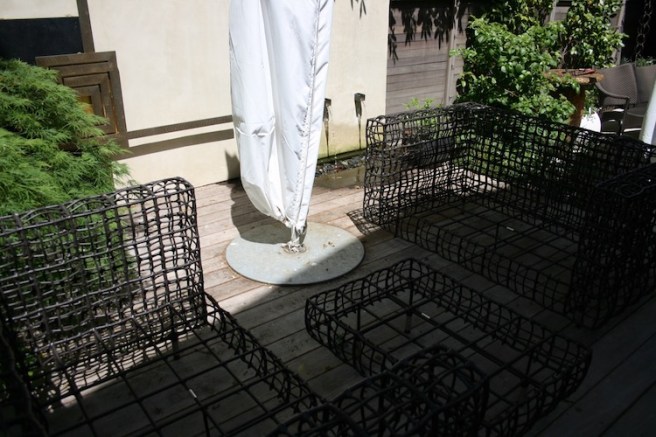
Adjacent outdoor seating areas, one on a stone surface and the other stepped up on a wooden deck offer plenty of places to visit with friends and a glass of wine. The woven iron sofa and coffee table are massive yet airy–I’m not sure if cushions would usually be in play here.

Pots throughout are kept simple and spare. This large amber colored crystal was an unexpected piece of nature’s own art.

Gamble asian 19

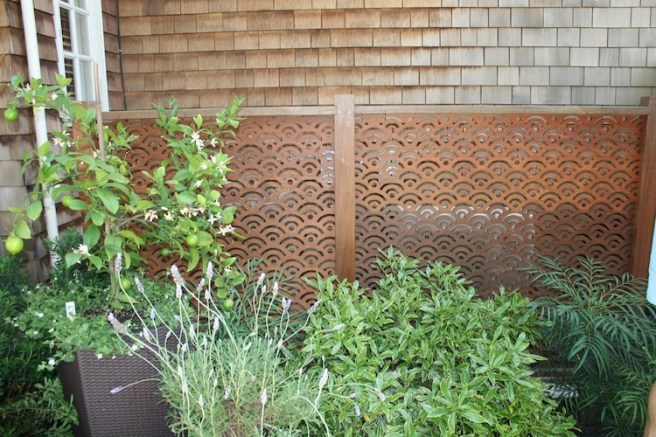
This designer left no detail undone–you saw the power meter, and now, necessary garden equipment (and possibly AC units?) is hidden behind a beautiful Ipe screen based on a traditional Japanese fan design.

Gamble asian 20

The Moon Gate leads visitors back into the front garden via another zipper limestone path.

Gamble asian 22

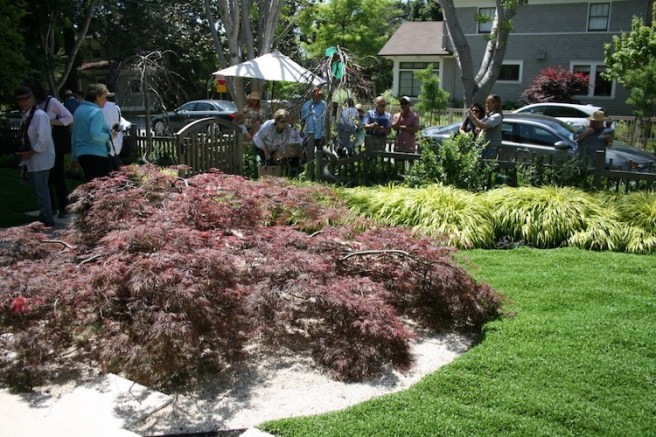
This sculptural Japanese pine, at least forty years old, anchors the front garden on this side of the house.

Gamble asian 23

A dwarf red cut-leafed Japanese maple hovers only inches above the ground and seems to float in a sea of crushed limestone. The Kurapia ‘lawn’ and Hakone grass elements tie the front garden’s two side together.

Gamble asian 25

Leaving the garden I can’t help but take one more glance at the Moon Gate, this time as it’s seen from the front.  This garden is simple and serene without feeling fussed over or complicated–Glee, this one’s for you!


UC Berkeley Botanical Garden Spring Plant Sale…

The second day of this Bay Area road trip is devoted to a visit to the University of California Botanical Garden at Berkeley to take in their spring plant sale. The sea mist was still hanging in the air as I made my way up into the Berkeley Hills overlooking the San Francisco Bay. All I can say is thank goodness for navigation–a mere four miles from my hotel must have had 2 dozen lefts and rights to get to the 2 lane road into the hillside campus.

Berk sale 13

The garden’s parking lots were full and signage led me uphill to the overflow parking some 3/4 of a mile away at Lawrence Hall. A free shuttle awaited to ferry us back down to the garden.

Berk sale 9

It didn’t take long for me to realize I could not take photos, peruse plants and pull my wagon all at the same time so pictures are few because in this case, plants rule. The garden’s collections are all closed for the sale so only the main walkway seen here is accessible with all secondary paths being roped off.

The Botanical Garden was formally established on the UC Berkeley campus in 1890 with its current 34 acre location in Strawberry Canyon since the property was purchased in 1909. Ten thousand plant types are organized in 9 geographic regions of naturalistic plantings from Italy to South Africa, along with a major collection of California native plants. With the little bits I could see from the sale site I know I want to schedule another visit to see all there is off this beaten path.

Berk sale 1

Here are a few vignettes visible from the walkway…

Berk sale 4

Berk sale 2

Berk sale 6

The fabulous royal blue Ceanothus below was the backdrop for a display of varieties for sale.

Berk sale 3

Berk sale 10

It was identified as Ceanothus thyrsiflorus var. griseus ‘Kurt Zadnik’ and it was no surprise to me that all of this particular one had sold in the few minutes since the sale opened. It is such a benefit to us to be able to see a plant we buy in a gallon can at its mature size and in excellent health. The common appellation Carmel creeper could lead you to believe it is a prostrate variety–not so!

Berk sale 12

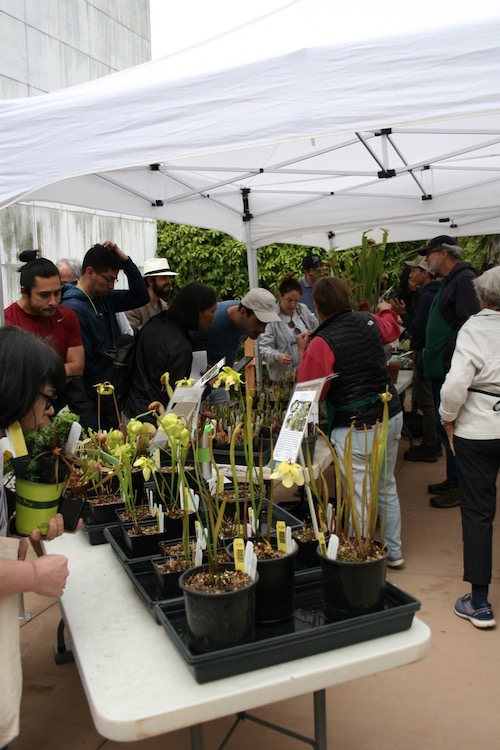
There were areas for trees and shrubs, California natives, succulents, shade lovers and sun cravers, houseplants and tropicals but the table with the biggest crowd was the collection of carnivorous plants. Amazing!

Berk sale 8

I gathered up and paid for my precious cargo. All but one of the plants I purchased was propagated onsite from the garden’s collection. My booty includes 4 salvias, two of which have been on my acquisition list for a few years, a coveted Campanula incurva to add to a dappled shade area and a pelargonium with interested red patterned foliage. A day with new plants is a very good day for me!

Another Gamble ramble…

Enter the Garden is the theme for the 34th Annual Gamble Garden Spring Tour. Five homeowners graciously opened their gardens to give garden lovers a peek into Palo Alto’s historic neighborhood surrounding the Gamble Garden and just a short drive from Stanford University. I am an unashamed garden tour junkie and this event is right at the top of my favorites list. The Elizabeth F. Gamble Garden is a precious community resource and is supported solely by memberships and donations, receiving no funding from the city, state, or any other government entity. This annual tour provides valuable funding needed to keep the garden open to the public every day of the year. Please look back at my posts Gather in the garden… and You can Gamble on this spring tour… to learn more about the historic Gamble property and see gardens from the 2017 and 2016 tours.

A SHEEP IN PALO ALTO

Gamble sheep 1

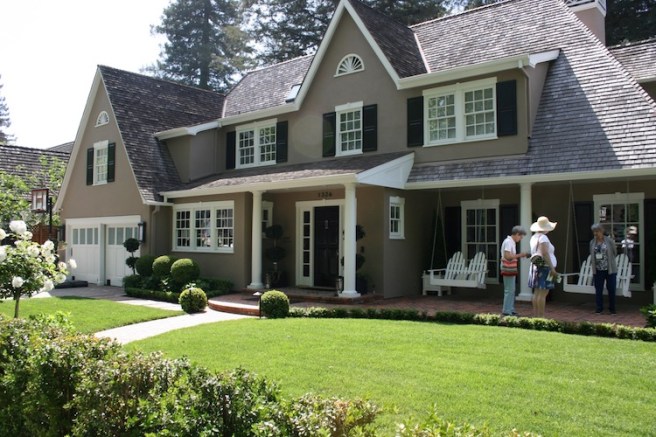
The clean and classic lines of this New England flavored family home are enhanced by the front garden’s simple elegance, featuring formally clipped boxwood hedges and white tree roses.

Gamble sheep 2

Glossy black shutters and sparkling white woodwork play off the warm toned brick porch set in a herringbone pattern. The pair of Adirondack styled swings invite visitors to stay awhile.

Gamble sheep 3

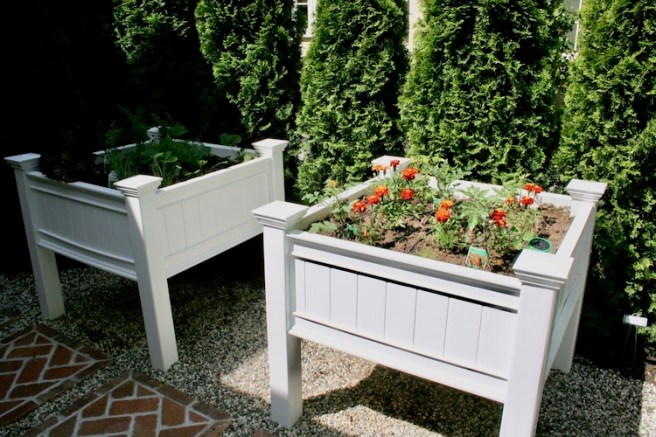
A sunny spot as you enter the side yard offers a place to grow a few veggies. Notice the herringbone brick ‘stepping stones’, carrying the porch floor theme into the back garden.

Gamble sheep 4

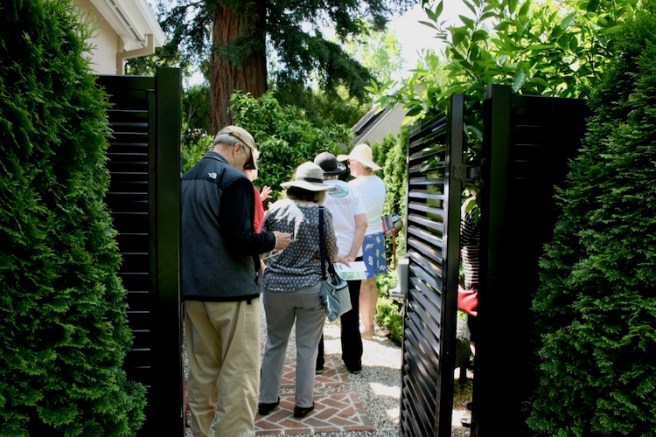
The simple black metal gate echoes the home’s shutters and provides privacy for the family’s personal spaces. The coniferous Thuja trees (seen behind the planters above and on either side of the gate) are used as bright green backdrops throughout the garden.

Gamble sheep 6

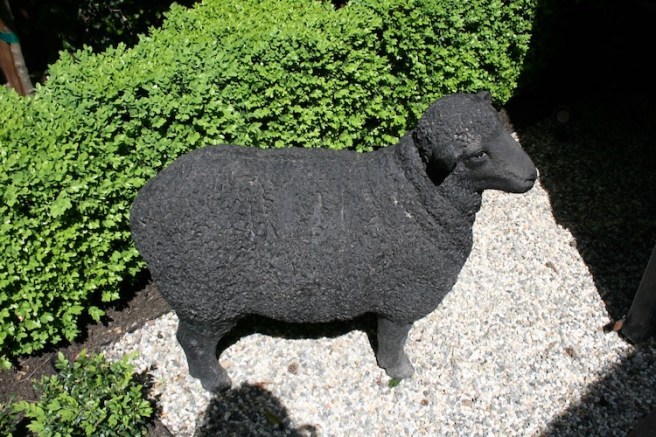
This black sheep welcomes you to the back garden and was an online find by the owner.

Gamble sheep 5

This side yard provides visitors with their first full height view of the back garden’s small grove of mature redwoods.

Gamble sheep 7

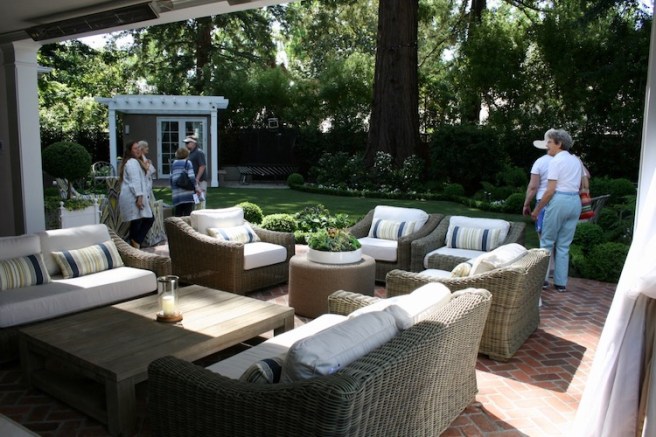
A beautifully appointed outdoor sitting room offers a spot from which to enjoy the garden–the use of herringbone patterned brick is repeated here.

Gamble sheep 12

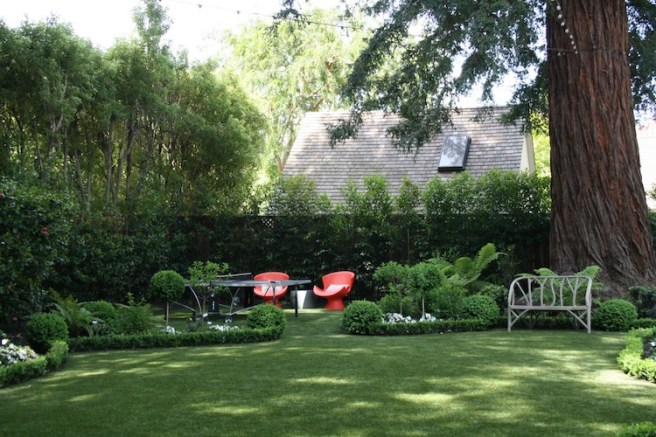
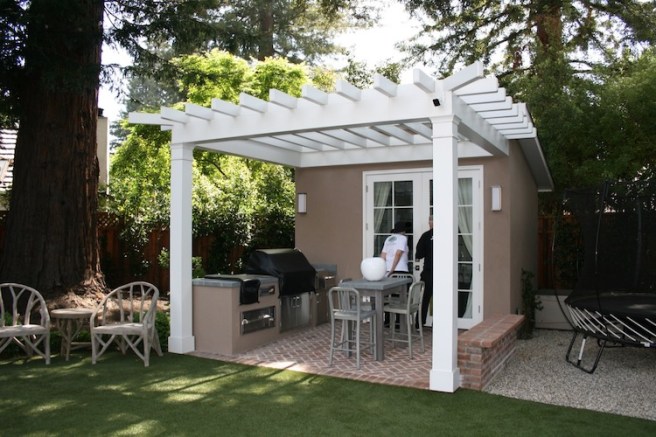
Artificial turf provides open play space for a busy family and the ability to host large gatherings. The garden’s green and white palette gets a pop of color from the orange mid-century modern chairs tucked in a spot perfect for viewing outdoor ping pong tournaments. Formal boxwood hedges and globes enclosing beds planted with white azaleas, ferns and New Guinea impatiens feel cool and chic with a Southern ambience.

Gamble sheep 9

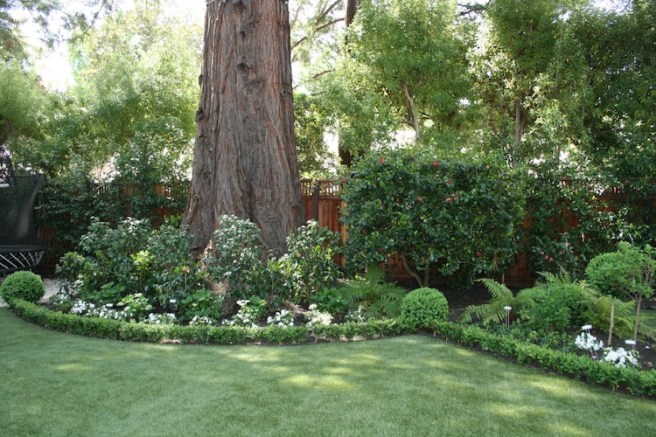
The redwoods’ trunks and roots dictate the bed elevations and the stair step plantings make the beds feel very full even though a good circle of air space protects each tree’s base. The redwoods have been limbed up to a height of 25 feet. This allows them to provide almost a forest like atmosphere without overwhelming the space. Lights have been woven among the trees and they need to be adjusted every few years to accommodate the trunk’s changing girth.

Gamble sheep 10

Looking back from the grass to the home offers a view of the gorgeous second story deck which spans the width of the home and is outfitted with lounges and greenery in bright white cans.

Gamble sheep 11

The outdoor dining room graces a small brick patio and is partially screened from the neighboring property by Thuja.

Gamble sheep 13

This small guest house was added in a recent remodel and its patio offers space for the outdoor kitchen plus a powder room for guests.

As you exit the back garden by the side yard an out of the way, but easily accessed, nook has been created for the family’s bikes. Even the family dog has a stylish pad, including his own sun screen.

Gamble sheep 16

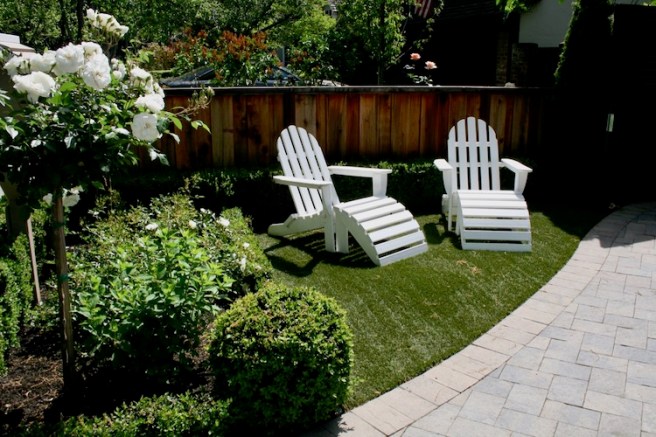
The small space between the driveway and the property line fence is outfitted in keeping with the home’s formal front garden–including its own Adirondack loungers…

gamble-sheep-17.jpg

…and a Little Free Library in case you need a good book while enjoying the garden!

PARADISE IN A MEADOW

I like to start a garden post with a street shot–sort of a curb appeal intro to what the garden is all about. The Palo Alto neighborhood surrounding the Gamble Garden has homes of all styles and sizes set on smallish to moderate sized lots by California semi-urban standards. Real estate here is purchased possibly by the square inch and even a tear down property is priced in the multi-millions. Homes may be very close to the street and shielded from view by walls or hedges. Mansions on huge lots with expansive gardens are rare but very large homes on small lots are not, especially if the current home is not the original one built on the parcel.

gamble-meadow-1.jpg

This historic Victorian home (photographed from the neighbor’s front walk) rises above its totally enclosed modern meadow garden inspired by New York City’s High Line, a naturalistic garden established on an unused spur of the city’s elevated train. Check out http://www.thehighline.org if you are not familiar with this unique garden offering trails and a killer NYC view.

Gamble meadow 2

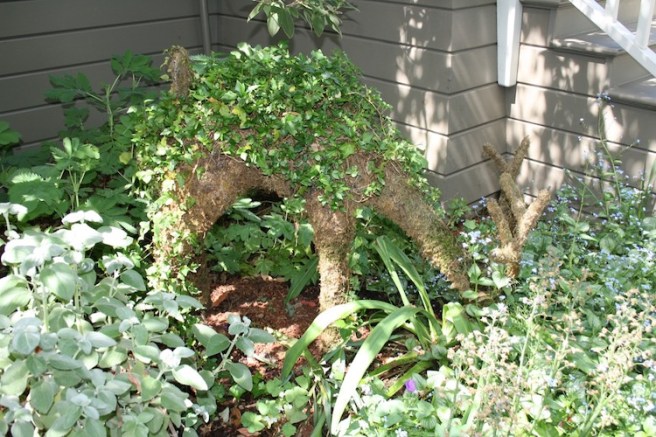
As you enter the shallow but heavily planted area you are greeted by a fawn sized moss topiary grazing on its planted partners. Access to the open meadow is narrow and with a steady line of tour goers it is not possible to even step aside to identify or photograph individual plants.

Mixed plantings of shrubs, perennials, grasses, bulbs and ferns fill this small space, including many plants selected for their popularity in Victorian gardens–such as the Bear’s Breeches in the upper left and the Queen’s palm in the upper right.

Gamble meadow 10

The meadow is reached through a tunnel arbor planted thickly with sweet peas and other flowering annuals. Artistic accents are welcome surprises around each curve.

Gamble meadow 9

Gamble meadow 5

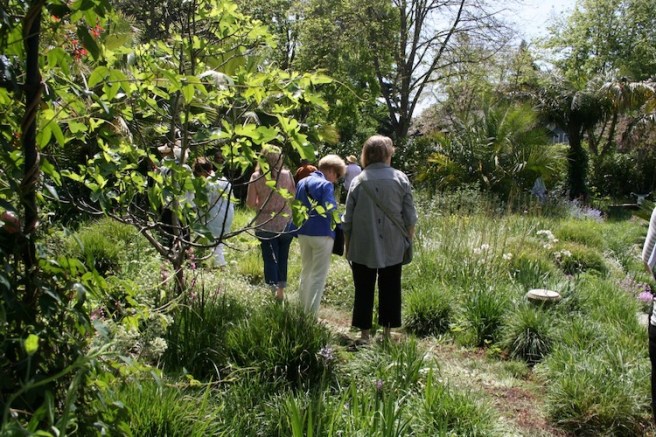
Entering the sunny meadow we walk along a single person wide path–a profusion of flowering trees and shrubs, bamboo, grasses, bulbs and perennials mingle in happy abandon.

Gamble meadow 8

The path follows the outside curve of the sunny center allowing us to walk in shade looking back over the meadow to the home’s porch.

Gamble meadow 11

The death of a massive oak last year offered the opportunity to plant two Chinese silk floss trees, one of which you see in front of the group of visitors. The tree’s trunk sports huge thorns and it will bear pink hibiscus like flowers in late summer through fall.

This eye-catching Albuca batteniana is tucked among the path’s green backdrop. This is a rarish South African perennial bulb related to Orthinogalum and will eventually have white starry flowers. The leaves were a yard long and the immature flower stalk rose over my head. I would think it a winner even if it never bloomed!

Gamble meadow 14

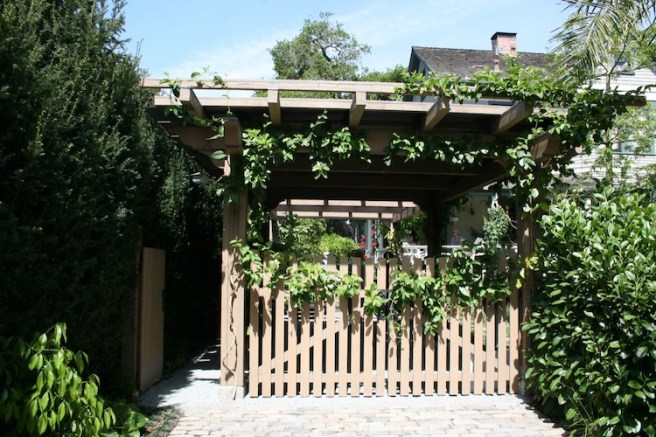
This beautiful vine draped arbor along the back of the garden was the space’s standout for me, offering a shady space to relax, dine and enjoy the garden.

Gamble meadow 15

The front half of the arbor has metal roofing in addition to the vines but the back half is open as you can see by the shade lines. Comfy outdoor furniture invites visitors to rest a bit while they admire one of several beautiful flower arrangement made from flowers, branches and foliage cut from the meadow.

Gamble meadow 3

Gamble meadow 17

View of the garden from the outdoor seating area under the arbor.

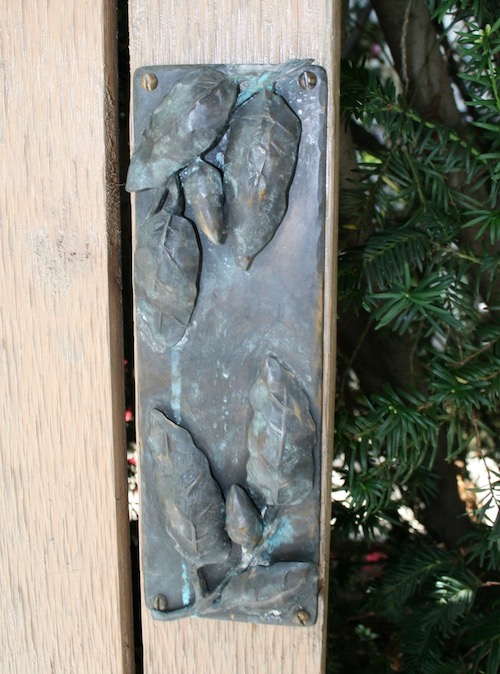
The more shaded end of the arbor is shielded from the street and the home’s parking by a double gate made from the same materials. These gorgeous custom iron handles and latches grace the double gate and adjacent pedestrian gate.

Gamble meadow 19

Looking back from the cobbled parking pad to the gates and arbor–who says functional can’t be also charming?

These first two gardens on the 2019 Gamble Garden Tour could not be more different from one another. The meadow garden, carefully planned and executed, results in a look of wild and natural abandon–anything goes! The classic, clean lines and limited palette of the first offer traditional garden beauty while not limiting the family’s use of the space for parties and play.

With such an inspiring start to this year’s tour I can’t wait to for you to see what’s next. This year I will spread the gardens over a few posts to give you as many photos and details as possible. Keep your eyes open for more gardens coming up soon–right now I am off to the UC Berkeley Botanical Garden’s spring plant sale!!


Tuteur-ial…

I went on a small Etsy buying splurge in early 2018–taking advantage of its access to lots of very fine woodworkers offering all sorts of garden related items. It was then I purchased the Little Free Library you’ve seen in my front garden photos, an additional one made in the style of our mountain cabin (still unpainted!) and two six foot cedar tuteurs.

Tuteur is the French word for “trainer”, as in a place on which to grow ornamental vines, roses or veggies. Traditionally a four sided pyramid and fashioned from wood or metal, the structure may also be referred to as an obelisk, teepee trellis or pyramid trellis. There may be subtle distinctions in these names (you know the whole pergola vs arbor thing) but for my purposes tuteur describes its function and the gardener is free to choose its design and style.

tutuer 1

I was a little overwhelmed when I originally opened one of the long boxes in the spring of last year and, with a full garden to do list already and lots of travel planned, I slid the opened box and its partner against the back wall of my quilt studio to tackle at a later date.

Fast forward to my 2019, my spring resolution to get a whole slew of unfinished projects done and having tripped over the long boxes innumerable times over the past year, I dragged the opened one out to the garage to get started. It didn’t look any less daunting…

My tuteur’s craftsman, Richard deJong of Woodbrute Designs in British Columbia, promised “easy assembly” but dang, there are a lot of pieces. When in doubt, read the instructions! I quickly determined that the twelve thin pieces were the optional decorative vertical rails, installed after the basic structure was built, and set them aside.

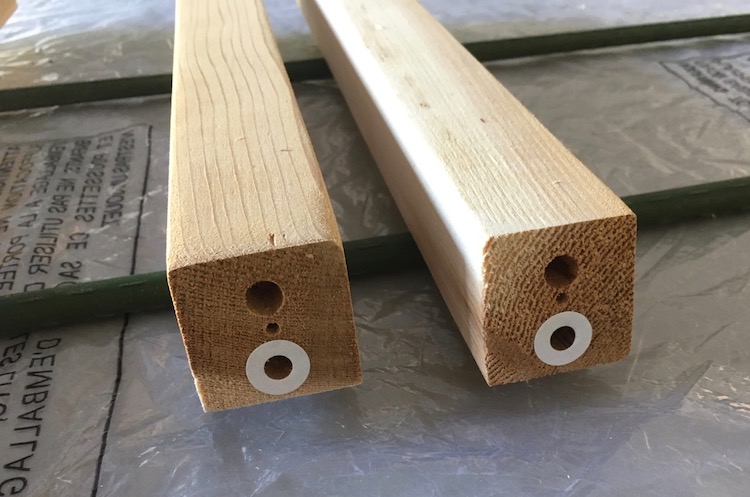
Mr. deJong has cleverly coded the pieces to aid people just like me in getting all these sticks going in the correct direction.

The white painted dowels on the horizontal posts fit into the holes with the white sticker. The unpainted dowels go into the holes without the sticker–thank you God and Mr. deJong.

As the tuteurs will be painted to match my existing trellis work and my front door, I lined all the parts up for a quick coast of primer. I decided to prime before assembly so that the cut ends of the wood would also have the primer’s weather protection.

tutuer 4

tuteur 5

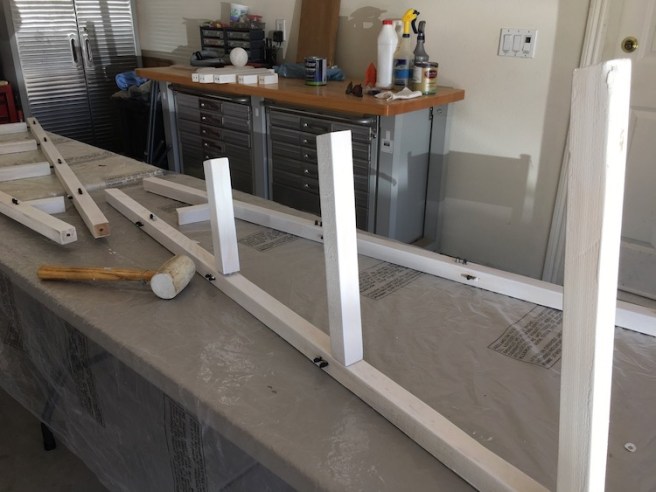
When the primer was dry I laid the first two sides out on my work surface, making sure to line up the cross pieces white hole to white dowel. The remaining cross pieces sitting on the tool bench will ultimately connect these two panels together.

tuteur 6

Using a rubber mallet as specified in the instructions, I tapped each cross piece in to the first vertical rail.

tuteur 7

I then tapped in the remaining vertical rail. Both the dowels and the holes are angled exactly so a good fit is easy to achieve.

A first coat of paint is added on what is the inside of each panel and on the insides of each remaining cross piece to make the final painting after assembly a little easier. This is Dunn Edwards Purple Trinket. It a great foil for green foliage and the pinks blues and lavenders I favor in the garden.

After a good bit of time painting, drying and flipping over each panel I am ready for the first assembly that will eventually connect the two panels, making the pyramid shape.

tuteur 10

The graduated lengths of cross pieces are added to both sides of the interior of one assembled panel, using only gentle taps of the rubber mallet. Standing up in this position, the cross pieces are a snap to paint out.

The day is getting late and I’ve almost lost all the natural light in the garage. A good bit of drying time is needed for the partial framework in this state. I am heading up the road a piece tomorrow, leaving at daylight for 3 days of garden events in Palo Alto and Berkeley.

It will be next week before I will have time to return to this purple project–watch for my post to see how the two turn out and where they find a home in my garden.


‘Blueberry Bliss’ & friends put on an Easter show…

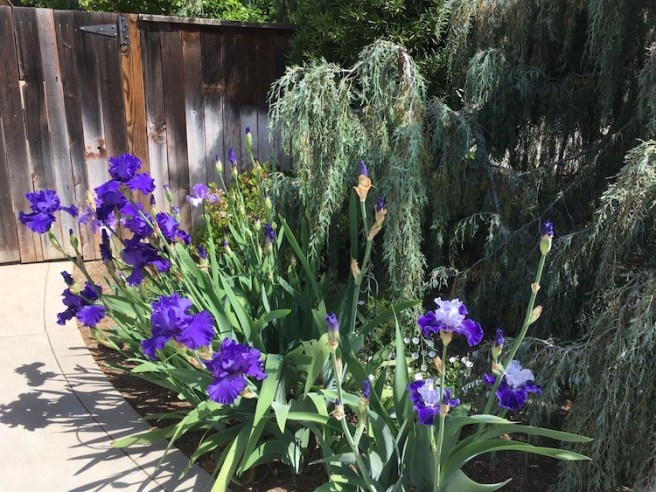
Always a spring standout in my garden, the bearded iris have never disappointed me. Some years, as with this one, they get a later start. Even though I have selections classified in all the expected bloom times–Early, Mid-season and Late, our short, warmer winters and early springs seem to compress all bloom times to March through mid-May. Mine are generally finished before the beardeds even get started in other parts of the country.

Since its addition to the front garden in late 2017 Iris ‘Blueberry Bliss’ has assumed the mantle of very first iris to flower, taking over from my long standing champion ‘Riverboat Blues’.

Project update 11
‘Blueberry Bliss’ in the foreground and ‘Sweet Geisha’ in the left background

Project update 10

This little swathe of bluey-purples blooms for just its second season–the original planting replaced a narrow arc of turf and was intended to be 3 rhizomes each of ‘Sweet Geisha’, ‘Blueberry Bliss’ and ‘Blue Hour’ (not yet in bloom). A label snafu resulted in an errant rhizome of ‘Visual Intrigue’ (seen in the foreground right) taking the spot meant for one of the ‘Blue Hour’–undiscovered until the ‘Blue Hour’ flowered in an unexpected place last year.

Project update 12
Iris ‘Visual Intrigue’
Project update 13
Iris ‘Sweet Geisha’

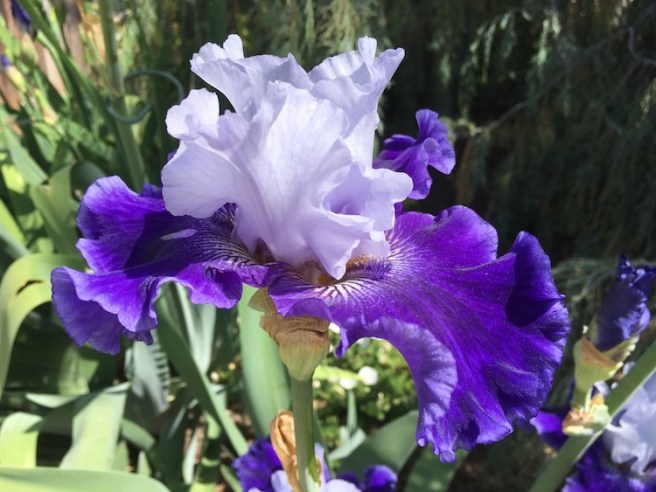
Below, ‘Absolute Treasure’ also planted for last season is looking great. Photographed  from its shady side, the characteristic pale sky blue self and standards are clearly visible. Photographed from the sunny side, it is almost white with only a blue undertone. An unfolding bloom on another stem shows the blue most clearly.

A few more iris on their Easter Parade…

Easter 5
Iris ‘Identity Lost in the Great 2016 Iris Division’
Easter 1
Iris ‘One More Night’
Easter 2
Iris ‘Shadow Dancing’

With the front garden now without turf I will be adding more iris this fall to fill in open areas. Their towering and majestic blooms will always be on my favorite flowers list!

Wishing all my gardening friends far and wide a Happy Easter and hooray for Spring’s new and unfolding life.

Ongoing project updates…April 2019

No garden is ever FINISHED, but it is nice to see projects which have seemingly dragged on for years finally reach active ends and retreat to being just another part of your landscape that is developed and refined from year to year. We are now declaring our front lawn removal and bed rehabilitation project started in 2016 as complete. The lawn removal and replanting of three major areas of my corner lot has been chronicled in numerous posts including: Xerihysteria!Update on lawn removal projects…Now THIS is a Labor Day…A little cleanup and a few new friends…Slapped upside the head by winter on the first day of spring…Falling into the new season…Moraea and the 3 M’s…A ghostly princess…The “new” Grevilleas…Salvia ‘Dara’s Choice’…Bigger than a See’s candy but smaller than a coffee table…at least so far, and probably several others I missed in scanning the list.

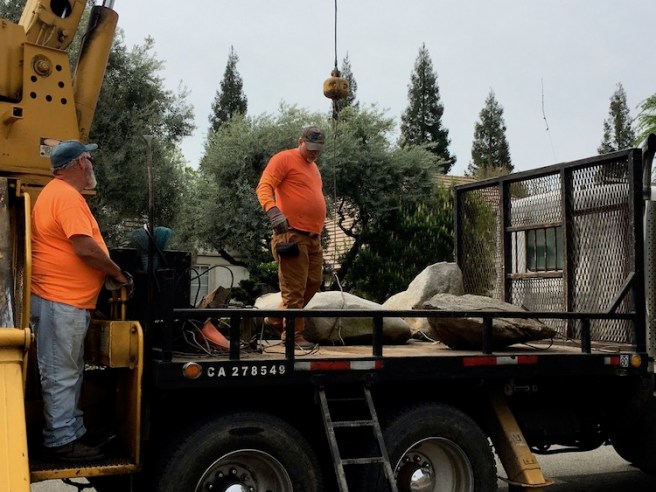
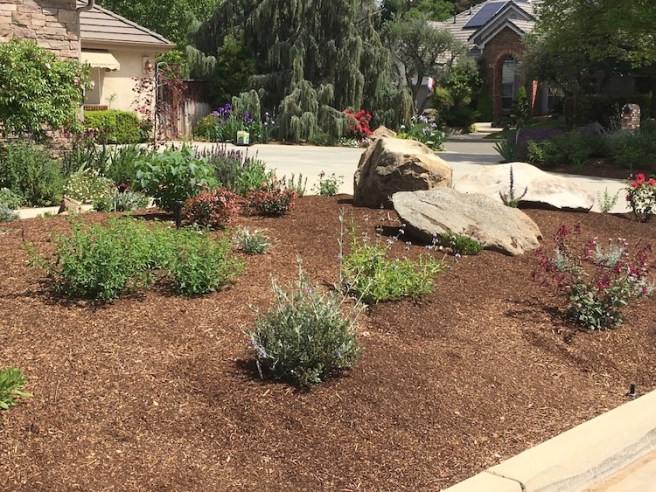
By mid March the last and largest section–the true ‘front’ part of our yard–had been cleared, tilled, double dug, amended and at least preliminarily planted in all but the squarish wide open section about 18′ X 20′ adjacent to the driveway. As the original landscape has numerous groupings of very large granite boulders we planned to add several to this wide open and fairly flat area to help tie it to the rest of the garden. Rain and snow in the mountains limits the harvest of these boulders from private property owners who sell them by the ton to landscapers and rock yards. When ROCK DAY finally arrived the installation drew a small crowd of walkers and neighborhood kids.

Project update 1
John and James from The Rock Yard arrive with the goods!
Project update 3
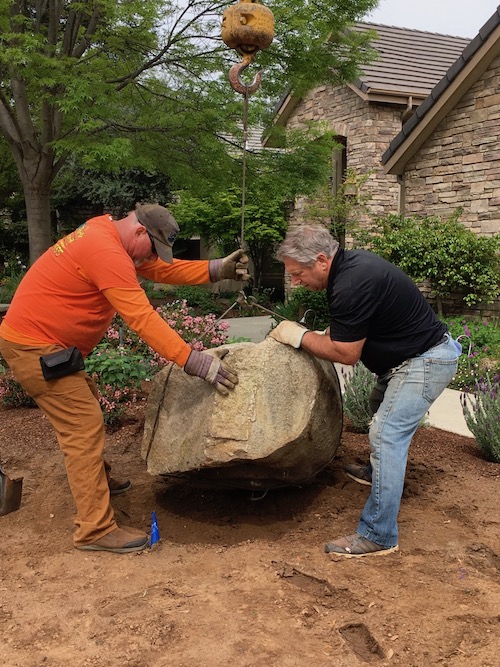
The crane swings the boulder into place and a rough perimeter is marked. The crane then lifts the rock to allow removal of whatever soil necessary to let it sit naturally.

I was more absorbed with the placement of the rocks than with my photographic record. John was a really good sport about picking it up over and over again until it was to my liking.

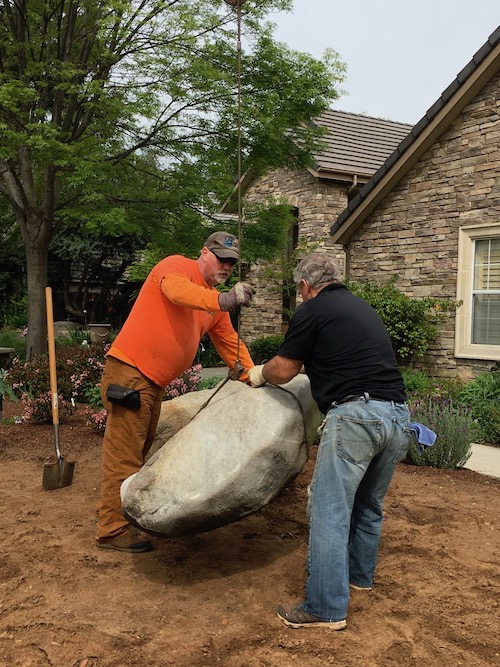
Project update 2
Dave did concede that this was easier than him dragging the rock around with a chain and the pick-up.

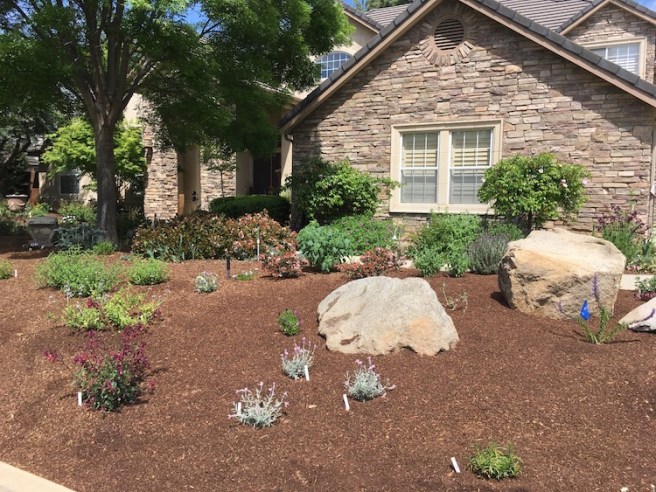
Our three boulders for this grouping plus one additional we added to the driveway circle bed weighed in at around 4 tons.

With the rocks anchoring the open area it is much easier to visualize how plant material can be built up around them. I planted the things in my holding area earmarked for the bed and transplanted a number of underperforming plants (needing more sun of which there is plenty in this spot) from other beds. Over the course of several days I mulched it down with 2 truck loads of lovely brown humus.

Project update 4
Two of the Knockout roses moved from a shady area needed to be cut back dramatically–the third never even had a droopy leaf!
Project update 5
As with the first pics of the previously redone areas there is not much to see–everything is very small.
Project update 6
From this angle you can see a number of plants in the adjacent area, installed in early winter and already having grown significantly.

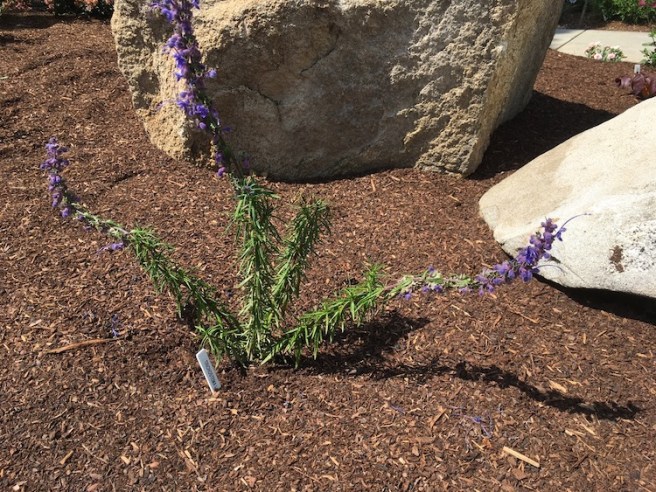
As the new plantings mature to the point they are recognizable I will post on a few individually–I am especially anxious to monitor the growth of the native Trichostema lanatum, or Wooly Blue Curls which should fill the space in the foreground of the center rock.

Project update 14

Project update 15

Needing full sun and no summer water once established this small evergreen shrub is not often successful in residential gardens due to overwatering. Keeping my fingers crossed that I have sited it for minimal irrigation and maximum sun! I purchased this gallon can sized plant in late fall and it has only been watered once in the can since then and came into bloom about a month ago when the weather warmed a bit.

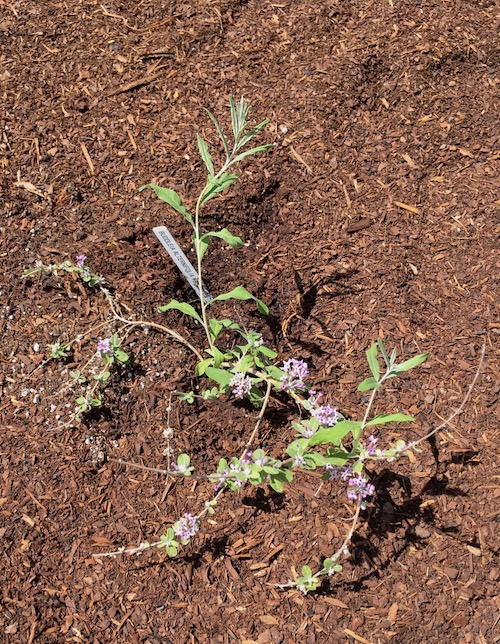
Also moving out of it’s temporary home in a pot to a spot between the first and second boulders on the left is Buddleia alternifolia var. argenta, a spring blooming butterfly bush with willow like branches that layer up to an ultimate height of 8-12 feet.

Project update 16

See my post A minor miracle… to learn more about this plant which is not very common in my gardening circles. Granted it doesn’t look like much now but keep in mind I purchased it by mail order in a wee 2 inch container from High Country Gardens (thank you David Salman and the Garden Bloggers Fling 2018) last summer.

Now that this huge undertaking has drawn to a close, save for adding more plants as I happen upon something interesting, what am I to do now??

An additional project inspired by my visit to Austin last year is also in its final stretch.

Project update 7

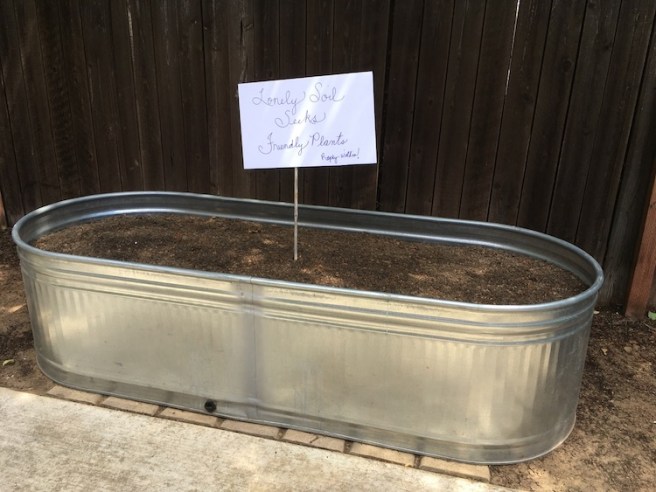
A Volvo station wagon full of organic container mix and several days of mixing it, bag by bag, 70%/30%, with some clean and weed free native garden soil has brought my stock tank project (see Dipping my toe into the stock tank gardening craze…) to plant ready status.

Project update 8

I’m counting on my road trip to the UC Berkeley Botanical Garden plant sale next week to yield both inspiration and plants for this oversized container!

So that you are not worried that I am laying around eating chocolates and watching soap operas here’s a before pic of my next project.

Project update 9

Washington state garden blogger Alison at Bonnie Lassie came up with the idea of a blog meme where you post the wretched parts of your garden rather than the fabulous ones–she calls it Tell the Truth Tuesday. Garden bloggers far and wide weigh in with their photos. We all have those spots that just cause us misery and this one is mine. Alternately under water and dry as a bone, this shady north facing wall is weed heaven–often times they are so high they obscure the sprinkler manifold on the right. In the last 10 years, more stuff has lived and died in this spot than I want to recall.  My goal is to transform this area–one of few that has a little afternoon shade in the back garden–with a 6 foot potting bench sited between the green tape lines and an accompanying raised seed starting/plant holding area. Being a big picture girl I haven’t quite pinned down the details yet. First up–dig the weeds again and devise a solution to current drainage issues! And we’re off…